The Unwinding: An Inner History of the New America, by George Packer

In the first sentence of The Unwinding, George Packer tells us what his title means:  “No one can say when the unwinding began – when the coil that held Americans together in its secure and sometimes stifling grip first gave way.”

Packer is a staff writer for The New Yorker, the author of an award winning book on American involvement in Iraq, two novels, and a play.  You could almost guess it would take someone with Packer’s chops to weave together the disparate threads of change that have irreversibly altered the country we thought we lived in.

It began in 1973, when the mid-east oil embargo coincided with models showing American had reached peak oil production.  And in 1977 when the steel mills in Youngstown, Ohio, that once stretched side-by-side for 25 miles, shut down.  When an idealistic young man named Jeff Connaughton, got an MBA and then decided to go to Wall Street, because by the early 80’s, getting a business degree and going to work for a company “that actually made things,” was viewed as failure.  When, according to Packer, concern over exported jobs prompted Wal-Mart to hang “Made in the U.S.A” signs over racks of clothing from Bangladesh.  When Connaughton became a Washington lobbyist and one of his colleagues told him, “Four-hundred thousand a year just doesn’t go as far as it used to.”

Poets see things before the rest of us, and Packer quotes Bruce Springsteen, who put it like this in 1984:  “Don’t you feel like you’re a rider on a downbound train?”

Now, almost 30 years later, when we all know we’re on a downbound train, Packer turns a light on some of the hydra-headed influences that led us collectively down this road.  He also shows us where positive change is likely to come from.  And where it is not.  It won’t come from the power elites, though it may come from disaffected refugees from those elites.

Jeff Connaughton, who made it into the outer circles of the inner circle, as a legal council for the Clinton White House, left Washington after being “radicalized by a stunning realization that our government has been taken over by a financial elite that runs the government for the plutocracy.”  Connaughton is now writing a book called The Payoff:  Why Wall Street Always Wins.

Packer also profiles Peter Thiel, a Silicon Valley entrepreneur who co-founded Paypal and helped bankroll Facebook as a startup.  Thiel put it like this:  “…the deep secret is there’s nobody at the steering wheel at all…People pretend to be in control, but the deep secret is there is no one.”  Thiel now looks for unusual entrepreneurial projects to fund.  Claiming that education is “the latest U.S. economic bubble,” he compares university administrators to sub-prime mortgage lenders.  In response, he began awarding Thiel Fellowships, two year grants of $100,000 each, to 20 people a year under the age of 20, willing to leave school to work on projects that “could make the world a better place.”

Packer doesn’t just profile movers and shakers in the post-unwinding world.  He details the story of Dean Price, son of generations of tobacco farmers, who overcomes multiple obstacles, including personal bankruptcy, to establish a working and profitable biodiesel refinery after learning about peak oil and taking the message to heart.

George Packer

author George Packer

In writing the book, Packer spent a lot of time with Tammy Thomas, an African-American woman who was 11 when the mills closed in Youngstown.  A few years later, she found herself an unwed mother of three, with a fierce determination, which she attributed to her grandmother, to get off welfare, even as jobs evaporated and gangs took over the neighborhoods.  She succeeded in doing so, and is now a community organizer and advocate, but her story makes clear that the odds were stacked against her.  She survived for 19 years in a car parts factory but is scornful of politicians who attach the label of “good jobs” to such work.  “Mitt Romney would be dead in week,” she said.

Packer interweaves the individual stories in a way that keeps you turning pages, like a novel with a large cast of characters that you care about.  Not all the stories have happy endings, and the suffering of individuals, cities, and regions is palpable.  By giving so many seemingly separate events the name, Unwinding, Packer helps clarify connections I had been sensing but unable to articulate.

“Alone on a landscape without solid structures, Americans have to improvise their own destinies, plot their own stories of success and salvation.”

A problem has to be named and described before we can begin to imagine solutions, and for this reason The Unwinding is a profoundly important book.

Notes on Trickster stories

Many of you will have heard the old Chinese curse, “May you live in interesting times.”  We do, beyond any question.  With a longstanding interest in folklore, I often find myself wondering which, if any, of the old tales can speak to us now and illumine our situation?  I always come back to the trickster stories.

Br’er Rabbit, an Americanized African trickster, from an 1881 book cover by Frederick S. Church. Public domain

Trickster tales are told around the world and may be among our earliest stories; in some traditions, tricksters create the world and bring fire to humans.  Sometimes benefactors and sometimes criminals, tricksters are contrarians, rule breakers, restless beings who disrupt and disturb, who keep creation moving, dealing out life and death in turn.

Groucho Marx, Loki, all of Shakespeare’s fools, and many animals, from Coyote, to Spider, to Br’er Rabbit are tricksters.  We named our first rescue dog Kit, short for Kitsune, which is Japanese for “Fox,” another famous trickster.  The reason should be obvious in this picture:

Kit

Kit

We have to lock the windows when driving with Kit because she knows how to hit the window button with her paw to roll it down so she can hang her head out, bark at other dogs, and catch the breeze. If Kit had thumbs, we’d be in serious trouble!

Establishments have little use for tricksters, and it’s easy to see why.  We may like them in the movies, but no one wants the Three Stooges to work on their plumbing. Schools are ruthless in their suppression of tricksters.  And yet, in times when the norms break down and the culture looses its rudder, trickster energy may be what we need.  Free of cultural norms and concern for what is polite or even legal, tricksters focus on what will work in the here and now.

After interviews with twin tower survivors, researchers discovered that people waited an average of ten minutes before deciding to exit the buildings.  “Do you think we should leave?”  “Will we have to use vacation time if we go?”  “What about the report I have to finish?”  Once they decided to exit, survivors spent several more precious minutes logging out of their systems and locking their desks and file cabinets.

Researchers concluded from this and other studies, that the human brain is often dangerously slow in reacting to radically different events or disasters.  These are the times when we need trickster energy.  Unbound by convention, the trickster jumps on a desk and yells, “The sky is falling – get the f**k out!”

Allan Chinen, M.D., a psychiatrist and professor of psychiatry, wrote about tricksters from the Jungian perspective.  In 2012, I discussed his Once Upon a Midlife, an analysis of folklore aimed at that stage of life.  In 1993, Chinen published Beyond the Hero:  Classic Stories of Men in Search of Soul.

beyond the hero

Chinen argues that despite popular concepts and movies like Man of Steel, The Hero is not the core masculine archetype – the Shaman/Trickster is an older, wiser, and more primal energy.

Like most Jungian’s I have read, Chinen regards tricksters as primarily masculine archetypes.  I’m not sure how opinion stands in currently folklore studies; much work has been done with women’s tales in the last 20 years.  It is Gretel, after all, who uses trickery to kill the witch and save her brother.  Only by wiles can Bluebeard be defeated or brothers saved from various enchantments.

I suspect the difference is that full-time tricksters like Coyote are usually male.  You see it in children at play too, and sadly, it is overwhelmingly boys who get dosed with ritalin when they’re not docile enough for the modern classroom.  As Jung and Hillman both observed, what a culture defines as pathology may say more about the culture than the people it labels as defective.

Guardians of the status quo are wary of tricksters and with good reason.  They are almost always subversive – the Stooges only throw pies in the homes of the 1%, and Charlie Chaplin was no friend of the captains of industry.

Charlie Chaplin in "Modern Times."  CC-by-SA-2.0

Charlie Chaplin in “Modern Times.” CC-by-SA-2.0

To personify self-preservation; to point out the shadow of a dominant culture; to keep the flame of hope and spirit alive; to demonstrate the power to wit to those who are disenfranchised.  Scholars now believe the Br’er Rabbit tales performed such functions for slaves as the Coyote stories did for Native Americans on the reservations.  In all likelihood, these are the gifts tricksters have given for untold millennia.

Next time I’ll look at a classic trickster story that Allan Chinen told, with an eye to it’s relevance for the 21st century.

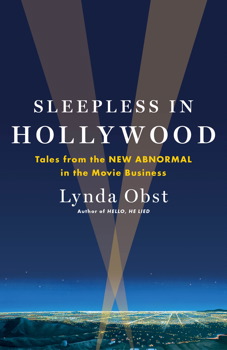
Sleepless in Hollywood by Lynda Obst

Have you been to the movies lately?  Like what you see?  Wonder if it’s a trend?

Today’s edition of Marketplace clued me in on the answer to question three via an interview with Hollywood insider Lynda Obst, producer of The Fisher King and Sleepless in Seattle.  Obst realized something had changed when her son said, “Mom, trying to get movies made because they’re good is so 2003.”  The interview concerned her new book, Sleepless in Hollywood:  Tales from the New Abnormal in the Movie Business.  

sleepless in hollywood

Obst says the “old abnormal” was when she could get movies made because they were good.  DVD sales financed half of studio profits and allowed production of the “smaller” movies she loves, like romantic comedies.  Then domestic DVD sales tanked at the same time as foreign viewership rose, particularly in China and Russia, where there’s an endless demand for our blockbusters and special effects.  You can make “small movies” anywhere in the world, she says, but so far, you can only make blockbusters here.

Which may explain why I’ve been to so few movies this year – when the trailers assault my senses with digitized special effects, I tend to give them a miss, with the exception of movies like Star Trek, because…well, it’s Star Trek.

Sleepless in Hollywood is now in my book queue, in part because Obst’s final chapter is called, “Does the future have a future?” and I want to know her answer to the question.

And a final note on 2013 movies to date – they’ve finally pushed us into the 21st century, with a subscription to Netflix, so there is at least one happy outcome.

Inferno by Dan Brown: a book review

Inferno

I am one of the millions who couldn’t put The Da Vinci Code down when it was published in 2003.  Dan Brown’s breakout thriller went on to become the second best selling book of all time, trailing only The Bible.  Yet after reading his next offering, The Lost Symbol (2009), I swore off the author for good.  Information overload and a two dimensional, comic strip villain made it a disappointing read.

Time weakened my resolution, and happily so.  With Inferno, published this month, the author has found his stride again.  Weaknesses remain, but Dan Brown can tell an enthralling story.

The code that Robert Langdon must decipher this time comes from Dante’s Divine Comedy, and especially the first book of that trilogy, The Inferno.  It’s safe to say that everyone in the western world, Christian or not, has been influenced by The Divine Comedy, which gave us our graphic geographies of hell, purgatory, and paradise.  Artists then painted Dante’s vision, shaping the devils and angels that still lurk in imagination.

One of those paintings, Botticelli’s “La Mappa dell’Inferno” or “Map of Hell,” is a key to the mystery Langdon must decipher in his race to stop the release of an engineered plague designed to “cull the human herd” and prevent over population from destroying us all.

La Mappa dell'Inferno by Botticelli

La Mappa dell’Inferno by Botticelli

There aren’t many thrillers with stakes higher than this, and all the elements of it are real.  The threat of ever more people struggling for fixed or diminishing resources can hardly be exaggerated.  The threat of bio-terrorism is here.  Will genetic engineering open the gates of heaven or hell?  Into this nail-biting mix, drawn from the headlines, Brown adds a pretty and brilliant sidekick for Langdon, an equally brilliant mad scientist, and black-uniformed spooks in pursuit.  We have all the elements of an engrossing thriller, but Dan Brown has ways of subverting himself.

His most obvious flaw is excessive information dumping.  Inferno has two primary speeds, fast-forward chase scenes and slow motion data uploads.  When the pacing is off, both can become tiresome.

In one scene, Langdon searches for a clue in the 25th canto of Dante’s Paradiso.  He borrows an iPhone from a tourist to google the relevant passage, but then, although all the police in Florence and a surveillance drone are on his tail, the action stops for a treatise on different translations of Dante.  Robert Langdon, aka Brown, should take a page from Sherlock Holmes and not crowd his head or ours with facts that do not bear on the case at hand.

I also had a problem with several late-in-the-story surprises.  In any good thriller, things and people are not what they seem.  Sometimes it takes a magician’s sleight-of-hand and clever misdirection to pull off major twists with characters whose thoughts we have shared all along.  Several of Inferno’s revelations were clunky in a “What the…?” kind of way.  

Even with these flaws, I can recommend the book.  It had been a long time since I’ve found myself carried away by a work of fiction; as I read, I put everything I could on hold to keep turning the pages.

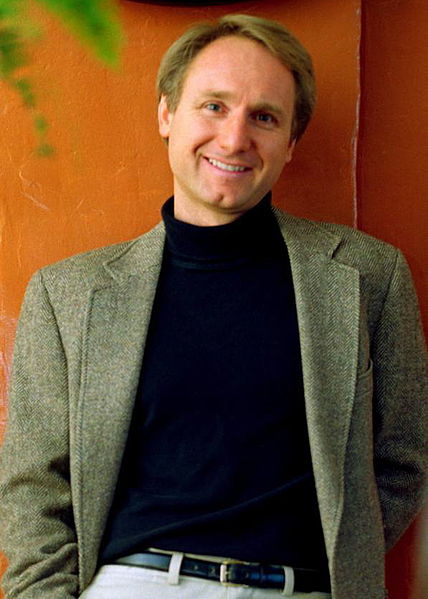
Dan Brown, 2007, by Phillip Scalia, CC-By-SA-3.0

Dan Brown, 2007, by Phillip Scalia, CC-By-SA-3.0

Reading Dan Brown convinces me yet again of the absolute primacy of story.  I had the same reaction after a pilgrimage to the home of Jack London, a writer I loved when I was young.  George Orwell, among others, described London’s writing and use of language as “poor,” yet more than 50 movies have been made from his novels and stories.  Not bad for a writer whose life was over at 40.

Fortunately for everyone who enjoys a gripping tale, Dan Brown, like London before him, has every reason to continue following his own star and forget the whining of critics like me.  If he does, he will likely continue to bring us supremely engrossing fiction.

Skinwalkers by Tony Hillerman: A book review

Skinwalkers

As I worked on a recent post, Favorite Fictional Detectives, I realized I didn’t remember the details of Skinwalkers, a key Tony Hillerman novel that I read soon after it was published in 1986.  I read it again and found it to be a thoroughly satisfying mystery.  I offer this brief review to encourage others who may not know Hillerman’s work to give it a look.

***

Officer Jim Chee, of the Navajo Tribal Police, tosses and turns one night in the airstream where he lives in the desert.  When his closest neighbor, a feral cat, shoots through the pet door, Chee gets up to peer out the window at what might have scared it so badly.  Probably a coyote, he thinks.  For a moment, thinks he sees a shape in the darkness.  Then the night explodes.  Three shotgun blasts tear holes in the trailer just above the bed where Chee was sleeping moments before.

In the morning, as he cleans up his trailer, Chee makes a frightening discovery.  Among the shotgun pellets that litter the floor is a small bone pellet.  Navajo witches, or skinwalkers, inject bone into the bodies of people they want to kill.  The bone produces the fatal “corpse sickness.”  This bone fragment links three apparently separate killings that Lt. Joe Leaphorn, a senior tribal detective, has been trying to solve without success.  When Leaphorn and Chee join forces, their first problem is persuading anyone to talk, when tradition holds that speaking a skinwalker’s name will attract his harmful attention.

Chee is learning to be a traditional Navajo healer.  With a background in college psychology classes, he understands his role to be restoring people to the core Navajo values of beauty and harmony.  Skinwalkers have fallen away and try to take others with them.

Leaphorn is not a believer, but he learned by hard experience that other people are.  Early in his career, when he ignored talk of witches, three murders and a suicide were the result.  As he and Chee grope through the dark, a very real menace is watching from a direction they do not expect.

This book represents fine storytelling, with characters and a setting that are outside our normal experience.  It’s one of the best mysteries I’ve read, and I suspect it will make you want to read more of Tony Hillerman’s work.

Favorite Fictional Detectives

Sherlock Holmes by Sidney Paget.  Public domain.

Sherlock Holmes by Sidney Paget. Public domain.

In literary gatherings, I usually introduce myself as part of the fantasy camp, but I’ve probably read and enjoyed just as many mysteries over the years.  In my previous post, I gave a lukewarm review to James Patterson’s latest Alex Cross thriller.  I think the real reason is that I’ve never bonded to Alex Cross the way I have to other favorite detectives.

Character is key to detective novels just as it is to other types of fiction, and this is separate from an issue that has surfaced over the last decade, the distinction between plot driven and character driven stories.

In character driven tales, some attribute of the protagonist begins and sustains the action, the way Katniss Everdeen’s sacrifice for her sister gets things moving in The Hunger Games.  Mysteries are almost always plot driven – the story begins when the first body is found.

These days, agents and editors say they’re looking for character driven tales.  Dan Brown wasn’t listening when he wrote The DaVinci Code, now one of the five best selling books of all time, a distinction shared with The Bible and Harry Potter.  Like much advice for writers, I think it misses the point.  Regardless of what moves the action, we love novels with characters we love, in worlds we’d love to visit.  Have you ever imagined yourself in Baker Street when Holmes jumps up and cries, “The game is afoot?”

If so, read on!  I’ve listed a few of my favorite detectives, not necessarily in order, for that, like everything else, is subject to change.

Sherlock Holmes:  This is obvious.  How many popular books of today will still be read and loved 100 years from now, spawning a lively stream of new presentations in all the popular media of the future?  I seldom reread mysteries – often there is no point when you know the criminal’s identity, but I still dive into Holmes for recreation.  Has there ever been a more dastardly villain than Dr. Grimesby Roylott in “The Adventure of the Speckled Band?”  And for chills up the spine, one sentence has never been beaten:  “Mr. Holmes, they were the footprints of a gigantic hound!” 

I enjoy all the presentations of Holmes in film, but my favorite movie Holmes is still Jeremy Brett for his perfect blend of genius and madness, without the slightest trace of modesty:

Cadfael:  The Brother Cadfael mysteries were the creation of Edith Pargeter, under the pseudonym, Ellis Peters.  In early 12th century England, during a period of contention for the crown known as The Anarchy, Cadfael, a middle aged and disillusioned veteran of the crusades, becomes a Benedictine monk.  With keen powers of observation, a scientific turn of mind, and an in depth knowledge of herbalism, he solves the many murders that just happen to happen whenever he is near.

I enjoy the film versions more than the books, thanks to renowned Shakespearean actor, Derek Jacobi, who plays Cadfael.

Hercule Poirot and Miss Marple:  Most writers are lucky if they can create a single unforgettable character.  Agatha Christie gave us two.  Sometime in the early 90’s, I went on an Agatha Christie binge, and over the next few years, read all the stories of both characters I could find, some 80 novels in all.  Poirot and Miss Marple turn up often in films and on TV.  I’ve enjoyed several versions of Murder on the Orient Express and Death on the Nile.

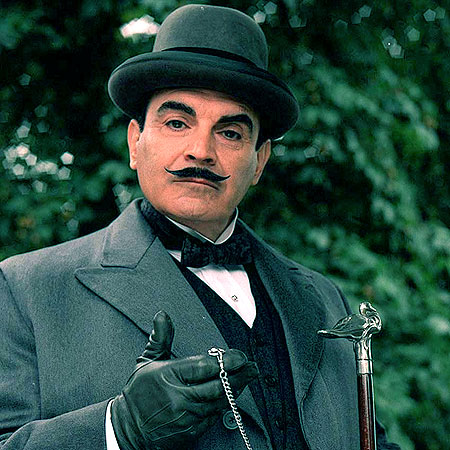
The bad news is that Miss Marple stories are usually classed as “cozy mysteries,” a sub-genre with a distinctly unmanly name.  The good news is that  I’m too old to care.  There is no definitive movie Miss Marple, but British actor, David Suchet takes the honors for his portrayals of Hercule Poirot:

David Suchet as Hercule Poirot

David Suchet as Hercule Poirot

Wallender: To re-establish my manly credentials, I add Kurt Wallender to the list.  Wallender is sort of a Swedish, existentialist, high plains drifter, and the most angst-ridden detective in the history of the world.  The creation of Swedish novelist, Henning Mankell, Wallendar was adapted for British TV, beginning in 2008.  Episodes are show up here on PBS.

The series stars Kenneth Branagh, another great Shakespearean actor.  Branagh says Wallender is “an existentialist who is questioning what life is about and why he does what he does every day, and for whom acts of violence never become normal. There is a level of empathy with the victims of crime that is almost impossible to contain, and one of the prices he pays for that sort of empathy is a personal life that is a kind of wasteland.”  

Don’t watch this guy when you’re feeling blue!

Kenneth Branagh as Wallender

Kenneth Branagh as Wallender

Jim Chee and Joe Leaphorn:  These officers in the Navajo Tribal Police star in 18 mysteries Tony Hillerman wrote between 1970 and 2006.  The grandeur of the American southwest and Navajo tribal beliefs are the background against which these unique detective stories unfold.  Chee, the younger officer, struggles to hold on to tribal traditions in 20th century America.  Leaphorn is more world weary and cynical, but he knows that where there is talk of witches and taboos, trouble erupts.

Hillerman, who died in 2008 loved the four corners and wrote about it so vividly that it’s really another character in the stories.  His books won many awards, but he always said what pleased him most was being named a Special Friend of the Navajo Nation in 1987.  Adam Beach and Wes Studi starred in three movie versions of Hillerman’s novels, including Skinwalkers, (the Navajo name for malevolent sorcerers), that is regarded as Hillerman’s breakout novel.

Amelia Peabody:  Elizabeth Peters’ 19 book series centers on the adventures and detective skills of independently wealthy and independently minded Egyptologist, Amelia Peabody and her family, which at first includes her husband Radcliff Emerson (who hates his first name and refuses to use it), and their son Ramses, who was born as stubborn as his parents.  Later Amelia and Emerson take in two wards, David, the son of a Muslim and a Christian whom they rescue from semi-slavery, and Nefret, a red headed former priestess of Isis who will eventually marry Ramses.

Set in the years between 1884 and 1923, there are rascals, rogues, adventurers, tomb robbers, mummy’s curses, and Sethos, aka, The Master Criminal.  Historical Egyptologists and archeological events are woven into the series which ends with the 1922 discovery of the tomb of King Tut.  The author has said that Amelia herself is based in part on Amelia Edwards, a Victorian novelist and Egyptologist, whose 1873 travel book, A Thousand Miles up the Nile was a best seller.

The middle east has changed since Peters began writing her novels, but they remain among my favorite beach reads of all time.  For anyone who enjoys a good mummy movie or has ever fantasized lost tombs, pith helmets, and midnight at the oasis, these are great adventure stories, ever complicated by the corpses that turn up wherever Amelia goes.

I’ve only listed detective series here because I cannot remember every good singular mystery novel I’ve read.  Please add any favorites of yours to the list.  There’s always room for more, since the game is always afoot somewhere!

Alex Cross, Run: an audiobook review

In the 15 years since Morgan Freeman starred in the first Alex Cross movie, Kiss the Girls, I’ve enjoyed quite a few James Patterson thrillers in films, books, and audiobooks.  He knows how to keep you on the edge of your seat, whatever the medium.  Alex Cross, Run, the 20th tale in the series, is no exception.

When I’m doing a lot of driving, I often choose Patterson audiobooks – they make the miles fly, but once I started this one, I kept the earbuds plugged in while fixing breakfast, walking the dogs, and even late at night.  It wasn’t exactly pleasure that kept me listening.  It often felt like drinking coffee when nervous.

There’s an amped up quality to Alex Cross, Run that couldn’t quite hide a formulaic quality, even though Patterson created much of the formula.  Throw in enough serial killers – Alex Cross Run had three – and an author like Patterson will create plenty of tension, but I often felt manipulated.  Every book tries to manipulate an audience; successful ones do it with subtlety.  Here, elements like bad guy motives and family interludes felt somewhat perfunctory, like I might do if I started with a list of plot points and checked them off one by one.

Alex Cross, Run is not a bad book by any means.  I’d give it three and a half stars out of five.  It’s a thriller by any measure, but it adds nothing new to the series or the genre.

Perhaps it simply felt rushed compared to books I’ve read in Patterson’s other signature series, the “Women’s Murder Club.”  I find Lindsay Boxer a more rounded character, with a richer circle of friends and environment than Alex Cross.

Any reader who likes thrillers and any writer who wants to learn about tension will be rewarded by reading James Patterson, but Alex Cross, Run is not where I would advise them to start.

One Nation Under Stress

The title of this post comes from a new book reviewed on NPR, One Nation Under Stress:  The Trouble With Stress as an Idea, by Dana Becker, PhD.

According to Dr. Becker, “stress” is a recent concept.  The first article on stress in the New York Times was published in 1976.  The first diagnoses of “nervous disorders” or “neurasthenia,” came from the work of Dr. George Beard ca 1869.  In the NPR interview, Becker says that physicians of the time considered “American nervousness” to come from outside factors, related to the increasing pace of life after the civil war.  “Stress,” as we understand it today, is the polar opposite.

Now we have internalized stress, focusing on the risks to our health and the ways we should cope with it, through diet, exercise, yoga, and so on.  Our experience of stress derives from our ideas of stress, Becker says.  The internal emphasis on health is necessary, but we let it divert us from questioning the external causes of stress.  She gives an example in the NPR interview: many articles are written to help working mothers cope with stress – far fewer are written about the need for affordable daycare.  We may eat kale and do yoga to survive the 24/7 world, but we seldom ask why this is the norm and what the alternatives are.

This argument echoes a major concern of James Hillman, who I frequently write about here.  Though he was once Director of Studies at the Jung Institute in Zurich, in 1992 he co-authored a book called We’ve Had a Hundred Years of Psychotherapy and the World is Getting Worse.  In it, he said:

“Every time we try to deal with our outrage over the freeway, our misery over the office and the lighting and the crappy furniture, and the crime in the streets, whatever – every time we try to deal with that by going to therapy with our rage and our fear, we deprive the political world of something.”

In her NPR interview, Dana Becker presented a balanced view of stress – it’s fine to treat the symptoms, which are personal, as long as we don’t gloss over the underlying causes, many of which are not.  The promise of new view of a modern ailment is enough to put One Nation Under Stress near the top of my “to read” list.