The Dream-Maker’s Magic

I have loved fantasy since I was little, growing up on a diet of Norse Mythology, British folklore, and Godzilla.

For years, I helped bankroll the fantasy genre; I patronized specialty bookstores, and even (introvert that I am) went to conferences and Renaissance Faires.  I probably ate up every Tolkien-spinoff quest series ever written.  Eventually, I burned out and wandered to other sorts of reading, but over the last decade, several wonderful books revived my love of fantasy.  One of those gems was Sharon Shinn’s, The Dream-Maker’s Magic.

Shinn’s first book, The Shape-Changer’s Wife, (1995)was critically acclaimed. With her Samaria series, she went on to make a name for herself as an author of adult fantasy. In 2004 she launched a trilogy of thematically connected young-adult fantasies, publishing one a year: The Safekeeper’s Secret in 2004, The Truth-Teller’s Tale, 2005, and The Dream-Maker’s Magic in 2006.

The stories are set in the same world, where magic is part of the fabric of life, and yet it plays a surprisingly minor role. These are not sword-and-sorcery tales. They are more akin to Shakespearean comedy. They are coming of age stories with romantic intrigue, complicated by plot twists and questions of identity, some even resulting from babies swapped at birth.

In The Dream-Maker’s Magic, Kellen Carmichael’s mother almost dies in childbirth. Two weeks later, when she is well enough to care for Kellen, she becomes hysterical, convinced beyond reason, that she gave birth to a boy – and Kellen is a girl.

Kellen says: I was that baby. I was that strangely altered child. From that day on, my mother watched me with a famished attention, greedy for clues. I had changed once; might I change again?  Into what else might I transform, what other character might I assume?  As for myself, I cultivated a demeanor of sturdy stoicism…It was as if I hoped my unvarying mildness would reassure my mother, convince her to trust me.  It was as if she was some animal lured from the wild lands and I was the seasoned trainer who habitually made no sudden moves.

But, Kellen concludes, She never did learn to trust me…or accept me for who I was. It was my first lesson in failure, and it stayed with me for the rest of my life.

If life is hard for her as a child – growing up in boy’s clothing, with sugar-bowl haircuts and a mother who refuses to acknowledge what she is – it becomes even worse in adolescence. Luckily, Kellen begins to meet allies, none more important than Gryffin, a boy who was born lame, whose legs are getting worse, and whose uncle periodically beats him.  Kellen initially scoffs at his unquenchable optimism, at his belief that with an education, he can be anything he desires.  Several days after they meet, however, these two broken people are inseparable friends.

Betsy Palmer, an innkeeper, and her daughter, Sarah, also befriend Kellen, and teach her such arcane mysteries as how to sew a dress that fits and how to do her hair, yet that alone does not end Kellen’s confusion:

…there was one person who was not fooled by my new looks or my modulated personality, and that was Gryffin…He did not seem to notice what I was wearing or how I had arranged my hair…I did not bewilder or surprise him.  He did not think I was trying to be something I was not, as my mother did; he did not think I was trying to break a chrysalis and become something I was meant to be, as Betsy and Sarah surely believed.  He just thought I was Kellen.

I found this the most comforting thing that had ever happened to me.  At times, when I lay awake at night, confused myself about what role I should take and what direction I should try to follow, all that kept me from slipping into tears was knowing I was not completely lost if Gryffin knew how to find me.

That was the point where I put the book down on my first reading, and have every time since, to marvel at the simple way Shinn breaks through all the limits of genre, to evoke something everyone probably longs for:  I was not completely lost if Gryffin knew how to find me.

The Dream-Maker’s Magic is about magic, but it cuts both ways when it appears, and separates Kellen and Gryffin.  The story is a lyrical romance, though you have to watch for the two kisses that Kellen and Gryffin exchange at the very end of the book.  It is a novel whose ending surprises Kellen and the reader; she is not the person she and we imagine her to be.

The ending satisfies in the way that Shakespearean comedies satisfy: what was lost is found, those who were separated are reunited, and poetic justice is meted out.  The story ends on Wintermoon, the holiday when people attach tokens of their hopes and dreams to a wreath, and burn it at midnight, to let the smoke carry their desires to heaven.  Kellen asks Gryfinn what he wishes.  “That every Wintermoon be better than the last,” he says.

Not a realistic wish, as anyone could have told him – but I would not be the one to say so.  Why limit your dreams, after all?  Why not hope for the grandest and the best?  I watched Chase throw the wreath into the bonfire, and I saw the flames scrawl secrets on the sky, and I closed my eyes and knew no end of dreaming.

Be sure to check out Sharon Shinn’s website.  There’s a permanent link in my Blogroll.

More on, “So Cold the River”

(Warning: spoilers ahead)

It is rare and delightful to find a book I hate to see end.  It is rarer to find a creepy book I hate to see end, and this is the first time ever I have hated to see a story end when the most compelling character is the villain.

Campbell Bradford, the villain of Michael Koryta’s,  So Cold the River, is no ordinary bad guy; he not just a bad man, he is evil. This important distinction is made by eighty-something, Edgar Hastings.  “He [Bradford] put a chill in your heart. My parents saw it; hell, everybody saw it. The man was evil.” The only fictional villain I can think of in his class – as evil and fascinating – is Hannibal Leckter in Silence of the Lambs

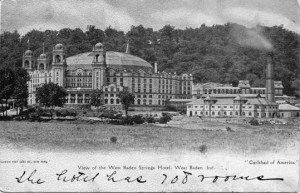
The evil Campbell Bradford is not the ninety-five year old Campbell Bradford who freaks out when hero, Eric Shaw, shows him a bottle of haunted “Pluto Water.”  This faux Bradford whispers, “So Cold the River,” and dies a short time later, sending Eric, a failed Hollywood filmmaker, to West Baden, Indiana, to learn the story of Bradford, Pluto water, and the newly restored West Baden hotel, (which actually exists), a once famous spa that was the domain of presidents, prize fighters, royalty, and gangsters.

The West Baden Hotel

The evil Campbell Bradford is a ghost, a very malevolent ghost, who possesses his great-great-grandson, Josiah, and later tries to possess Eric.  Bradford’s era is the roaring twenties, but his voice and tone suggest an earlier time.  Perhaps it is his fictional distance, the sepia toned feel of the old west that surrounds this villain, that works like the glass that allows us to watch a cobra in a zoo with an equal degree of fascination.  Imagine the Clint Eastwood of the sphagetti westerns as an angry psychopath, ready to sacrifice anything and anyone for his ambitions.  The ambitions of Campbell Bradford’s ghost drive the story.

“Look for the artifacts of their ambitions.”  That is Eric Shaw’s philosophy of documentary filmmaking, announced at the opening of the book.  The artifacts of Bradford’s ambitions are dead people. In the end, the mysterious Pluto Water, which carried Bradford’s spirit back to West Baden, allows Eric to survive his onslaught to tell the tale.

But Eric stops short of trying to unravel the whole story.  He will not seek the honey-flavored spring where Bradford lost his life.  Is the spirit really gone? Apparently. And yet, as Anne McKinney, who has devoted her life to watching the weather and waiting for the big storm cautions, “You can’t be sure what hides behind the wind.”

Sequeul anyone? I will definately read it if it comes.

Angelology

When I first read the March 15, Time Magazine review of Danielle Trussoni’s, Angelology,  ( http://www.time.com/time/magazine/article/0,9171,1969720,00.html )I was struck by the killer premise: the heroic battle of an art historian and a young nun against the Nephilim, nasty, arrogant human-angel hybrids who have dominated world affairs for thousands of years.

When the reviewer compared it favorably to The DaVinci Code, I put it in my Amazon cart. Now I wish I had listened to the 100+ Amazon reviewers who gave the book 3 1/2 out of 5 stars.  They were too generous.

The characters, Sister Evangeline and Verlaine are good enough as action adventure heroes go.  Not every protagonist can be or must be unforgettable.  We like them enough to want to see them prevail.

Where the story really breaks down is in the interminable backstory, that fills the entire middle section of the book.  It slows the action to a full stop, and doesn’t really succeed in creating a suspension of belief.

There are several ways to draw readers into a fictional world that has fantasy elements.  One is simply to spin things that exist in our world, as Brown does in The DaVinci Code. The Gospel of Mary Magdalene, and DaVinci’s “Last Supper,” are real, and we’re all too ready to believe in nefarious religious cults.

The other classic tactic is to simply drop us into an alternate universe, as Orson Welles did in the famous/infamous War of the Worlds broadcast – simply announce that aliens have landed in New Jersey.

Trussoni begins Angelology in this manner – with a flashback to the discovery of a Nephilim corpse during  the “second angelological expedition” of 1943.  We’re hooked, especially when Nephilim menace Verlaine and Sister Evangeline before we quite know why.  All the elements of an exciting chase and forbidden romance are in place…and then the author manages to snatch defeat from the jaws of victory.

The story just stops.  If only an editor had reviewed the manuscript and suggested the simple, time tested device for action-adventure tales – sprinkle the backstory into the main action, but keep things moving.  Do not bore your reader to distraction.

Did I say Trussoni failed?  Well that may be an exageration – she has a movie contract and I don’t.  But as a reader, I have to conclude that a writer has failed when I skim or skip huge sections of their book and in the end regret the time and money I have invested in their story.  The following Amazon review by “MWA” sums up my reaction:

This Author may have had an interesting idea but the publisher’s rush to print to catch the wave of Vampire/Mythological/Faux Religious related sales certainly squashed it. The fact that the book is so poorly written is the fault of the people who are supposed to EDIT things prior to publication. This is actually painful to read up until about page 88 and then it is as if the absent editor came back from lunch and skimmed the rest. The worst thing about it is how obviously it is a set-up for another to follow! And a movie deal etc. etc. Enough is enough already.

http://www.amazon.com/Angelology-Novel-Danielle-Trussoni/dp/0670021474/ref=sr_1_1?s=books&ie=UTF8&qid=1280940731&sr=1-1

So Cold the River

Just arrived from Amazon and in my book queue (the short one): So Cold the River by Michael Koryta, which I learned about from an NPR interview/review during a recent homeward commute.

http://www.npr.org/templates/story/story.php?storyId=127561248

Koryta is a crime novelist whose father took him, at age eight, to see the ruins of the West Baden Springs Hotel in Indiana, once called the eighth wonder of the world.  He tried and failed to work the hotel into a crime novel, but it wasn’t until he decided on a venture into the supernatural that his story took off.

West Baden Springs Hotel, West Baden Indiana

The story involves a filmmaker hired to uncover and document the history of a dying man, and one of the clues is a bottle of “Pluto Water,” apparently from the lost river, “an evil force” that flows around and under the hotel.

It sounds like a tale to read around the fireplace on a dark and stormy night, but I’m not going to wait that long.