
Ash Wednesday

“Remember you are dust and to dust you will return.”

As a kid, I was always glad I came from a Protestant household so I didn’t have to give up candy bars or something like that during Lent. I don’t believe I ever took Ash Wednesday seriously until February, 2021, when Mary and I attended a drive-through imposition of ashes at an Episcopal church just 10 days after we’d gotten our first covid shots at a drive through vaccination clinic. With 350,000 Americans dead over the previous 12 months, the line about dust from the liturgy took on new meaning. Still largely in the isolation mode, I “borrowed” the practice of using the next 40 days for reflection and have done so at this time of year ever since.

The Lenten liturgy includes this passage from Matthew 6:19-20, “Do not store up for yourselves treasures on earth, where moth and rust destroy, and where thieves break in and steal. But store up for yourselves treasures in heaven.” The word “treasure,” threw me for a long time. I didn’t think I had many treasures, except perhaps, my iPhone and a few related gadgets. But during Lent in 2021, in a moment of insight, I thought I saw a connection between the Gospel word “treasure” and the core Buddhist concept of “refuge.”

Buddha summed up the “dust to dust” problem in the concluding lines of the Diamond Sutra:

“Like a tiny drop of dew, or a bubble floating in a stream;
Like a flash of lightning in a summer cloud,
Or a flickering lamp, an illusion, a phantom, or a dream.”

“So is all conditioned existence to be seen.”

We take refuge in any number of things, people, and aspects of our ordinary lives: family, pets, friends, work, nature, hobbies, organizations, churches, creative endeavors. We take refuge in watching the Super Bowl in February, even though the 49ers sometimes lose. But no matter how we distract ourselves, we know that our houses, and family, and friends, and pets are fleeting, like a drop of dew on a leaf.

These are our “treasures on earth.” While they bring comfort and happiness, they don’t bring true security, because however much we avoid it, we know, there are no guarantees. A Tibetan meditation manual by Mipham Jampal Gyepa says: “What appears as happiness is deceptive and will change. All ordinary perceptions are the cause of distress.”

Buddhism explicitly posits ordinary and extraordinary perceptions. A conditioned and an unconditioned existence. A relative and an ultimate reality. There are also three “kayas,” or “bodies.” The physical body perishes at the end of each incarnation, but there is also a Body of Enjoyment (corresponding, I believe, to the Western idea of an “astral body”), and a Body of Ultimate Truth.

As I understand it, Christianity implicitly posits parallel concepts of relative and ultimate realities. A Kingdom of Earth where our treasures are not safe, and a Kingdom of Heaven where they are. A physical body that comes from dust and returns to dust, as a well as a Soul which doesn’t perish. James Hillman pointed out that in early Christianity, Paul speaks of a triune human nature: “May your whole spirit, soul, and body be preserved blameless at the coming of our Lord Jesus.” I Thessalonians 5:23.

The message of Ash Wednesday always reminds of the constant longing that I find poignantly expressed in this line from the title song of the last Grateful Dead studio album: “Show me something built to last.”

Both Christianity and Buddhism talk of a condition beyond concepts that is “built to last,” which exists as a “Kingdom” or a state of realization within us. This, I believe, is a source of our tales of heroic quests from around the world, as well as all of our contemplative traditions.

This is a perfect time of year to reflect upon and even explore them.
New Leaves

There’a a miasma of negativity in the air these days that can sometimes seem like a toxic fog or something choking, like the smoke from last year’s wildfires. It’s almost that tangible. This is one reason I haven’t posted anything recently. No need to add to the glut of opinions on where we are, how we got here, and where we’re going, when nobody really knows. Looking through some old posts, I see that I already weighed in on several occasions, most recently in the summer of 2019.

In a series of posts called, Cycles, Gyres, and Yugas, Part1, Part2, and Part3, I discussed some prophetic statements that Paramahansa Yogananda made in 1940, which were later published in a pamphlet called World Crisis. He spoke of the kind of upheavals we are now facing. The good news is, that in his view, things will end well. The bad news is, that ending won’t come anytime soon.

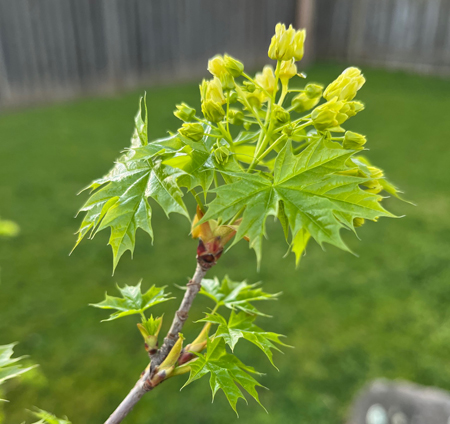
Yet even during times of chaos and fear, Spring comes. I was reminded of this recently by new leaves on the maple trees.

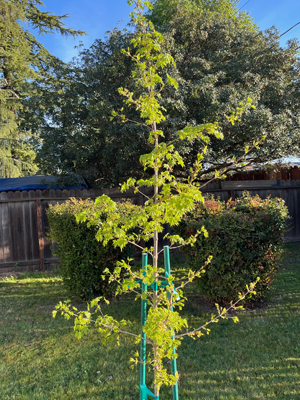
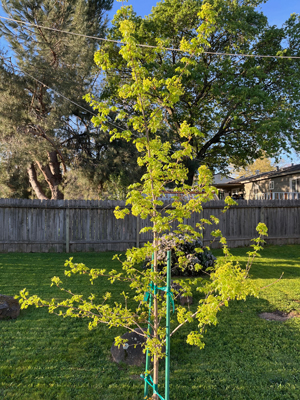
A year ago, a long-suffering linden tree in the back yard died. Due to our poor soil, a tree service recommended replacing it with maples. Two in the front yard, planted a decade ago, are thriving, so we picked out two saplings at a large local nursery and planted them in the back. Unfortunately, the man who sold us the trees also recommended what proved to be a large overdose of starter fertilizer. As a result, from May through late October, the leaves that appeared would soon burn. All through that first season, the trees looked like they were dying.

An expert at a another nursery told us the trees would survive. I was hopeful but not convinced until I saw the new buds begin to unfold this year.

My pleasure at watching these leaves appear brought to mind “a lowly and unlearned man by the name of Nicholas Herman of Lorraine,” who later became known as Brother Lawrence of the Resurrection, one of the most appealing but little known figures in the literature of world mysticism.

Born in 1619 to a peasant family, poverty forced him to join the army as a teen during the 30 years war. “At the age of 16, he saw a leafless tree in the middle of a battlefield. Realizing that the tree would be in full leaf and flower in a few months, he saw the tree as a symbol of God’s ability to transform the human heart.” (1)

Ten years later, after leaving the service wounded, and then working as a footman, he followed his vision and the example of an uncle and joined a Carmelite monastery in Paris as a lay brother. He lived there until his death in 1691. This unlearned man drew the attention of poor people, other monastics, and religious scholars because of the aura of peace that surrounded him. Abbé Joseph de Beaufort, a noted cleric, held numerous conversations and exchanged letters with Brother Lawrence, and published a selection of these after his death in a small volume, The Practice of the Presence of God, a spiritual classic of only about 60 pages.

There are not many accounts of such conversions or enlightenment moments, and most of those I have seen come from the east. In one story, a Tibetan seeker lay on his back on a hillside next to his spiritual teacher to gaze at the night sky. His moment of awakening was sparked by the sound of a barking dog. An Indian guru conveyed enlightenment to his disciple with a sudden blow to the head with his sandal, not out of anger, but to open his crown chakra when the moment was right.

All of us have seen bare trees bloom and heard dogs bark, and many of us have had too many blows to the head, but without experiencing any profound awakening. A common point in these stories is that these moments come when the mind is free of all habitual thoughts, emotions, assumptions and meanings, when awareness is clear so something new can arise. Both of the eastern seekers in these stories had spent years practicing spiritual disciplines with their teachers. Brother Lawrence’s vision came at a moment of stillness after a pitched battle. Saint Francis’s conversion also followed military service, after a serious illness during his year as a prisoner of war, and later, when a vision came after he set off on another campaign (1).

Events of the last two years have shocked millions of us out of our “habitual thoughts, emotions, assumptions, and meanings,” but with one major difference from the previous accounts. Brother Lawrence, Saint Francis, and the two eastern seekers lived at times when a coherent world view, Christian and Buddhist respectively, shaped people’s lives, their cultures, and the meanings they gave to powerful “breakthrough” experiences.

We no longer have anything of the sort. Yet we still have the changing skies and seasons, the bees and geese returning, and squirrels scampering along power lines. And we have leaves reappearing on bare trees. Paying attention to these “small” messages from the natural world seems like a good place to start looking for something deeper and more nourishing than the next headline or trending hashtag.