
Life: The Movie by Neal Gabler – A Book Review

In his final movie, Being There, 1979, Peter Sellers plays Chance, a gardener with a low IQ, who becomes an advisor to the president and business tycoons. In one iconic scene, Chance is accosted by a knife wielding youth in Washington, DC.  He pulls out his TV remote control and clicks it to change the channel.  He is puzzled when the assailant doesn’t vanish.

Peter Sellers as Chance in “Being There”

This might be the perfect illustration for Neal Gabler’s, Life, The Movie:  How Entertainment Conquered Reality, (2000).  Gabler quotes historian, Daniel Boorstin, who wrote in the early 60’s that, “We risk being the first people in history to have been able to make their illusions so vivid, so persuasive, so ‘realistic’ that they can live in them.”  Done deal, according to Gabler, who calls us, not just a “post-modern culture,” but a “post-reality culture.”

At times I had to keep my own assumptions in check:  subjects like reality and imagination open onto psychological and spiritual vistas beyond the scope of this or any other single book.  But when Gabler cited concrete examples, I found myself nodding my head on almost every page.

“You know how to brood because you have seen Rebel Without a Cause,” Gabler says, quoting cultural analyst, Louis Menand.  “What better model does the world offer?”

Gabler charts the ascendency of entertainment in America from the early 19th century, where the split between high and low culture was fueled by our democratic suspicion of all elites.  Calling someone “aristocratic” was a serious insult.  During the 1840 presidential campaign, when a man called Daniel Webster an aristocrat, he thundered back that he’d grown up in a log cabin, and anyone calling him an aristocrat was “a coward and a liar.”  ( Sound familiar? )

Nathaniel Hawthorn despaired of the fate of serious writers amid the flood of “trash” being published.  One publisher sold four million dime novels in five years, at a time when the US population was only 25 million.

In 1850, 1% of the population owned 50% of the nation’s wealth and held almost all public offices.  Upward mobility was a myth, since 98% of that wealth had been inherited.  While the one-percent held the power, then as now, culture wars raged, sometimes with a violence that we (thankfully) haven’t seen yet.  One night in New York, rival Shakespearean actors, one British and one American, were both scheduled to perform, the former in an uptown theater, the latter downtown.  Police ejected the rabble who had bought tickets solely to heckle the British actor.  A much larger crowd gathered across the street to throw rocks as the “aristocratic” crowd tried to leave.  The militia was called, a riot ensued, and before the night was over, 22 lay dead and more than a hundred wounded.

In the end, it was movies that won the day for popular culture.  The 1% stayed away from the early nickelodeons, which tended to be crowded and crass.  Later, with middle-class patronage, refined behavior became the norm, but the elite have never fared well in the movies, from the Marx Brothers  Night at the Opera, to the present, where a too-expensive suit is always the mark of a villain.
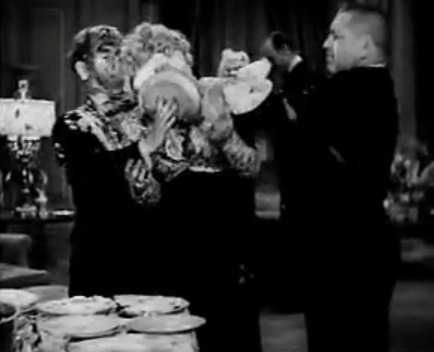
Three Stooges + high society + pies = disaster

As he charts the history of high vs. popular culture, Gabler makes a telling point.  It isn’t just about high brow and low brow – it’s about the ascendency of entertainment.  Being entertained is easy, and the corollary is that when the goal is entertainment, grabbing and holding audience attention is the supreme value, and “things that do not conform – for example, serious literature, serious political debate, serious ideas, serious anything – are more likely to be compromised or marginalized than ever before.”

Life: the Movie is a complex and disturbing book.  Gabler says in the introduction, it is diagnostic and not prescriptive.  To offer easy answers, he says, would be like the movie illusion where we meet the monster in act one and see it vanquished in act three.  Writing 12 years ago, Gabler said:

“One is almost compelled to admit that turning life into escapist entertainment is a perversely ingenious adaptation to the turbulence and tumult of modern existence.  Why worry about the seemingly intractable problems of society when you can simply declare ‘It’s morning in America,” as President Reagan did in his 1984 reelection campaign, and have yourself a long-running Frank Capra movie right down to the aw-shucks hero?”

I read this book after watching Neal Gabler speak on the fictions that lace the current election campaign on Moyers & Company, as I described in the preceding post. Because of it’s scope, I would recommend Life: the Movie only to those who want to delve into this issue in some depth.

But  I would recommend that everyone watch the ongoing conversation this year between Gabler and Moyers.  The confusions and illusions surrounding the political process are more convoluted than when the book was written, but Neal Gabler remains a reliable guide to pulling back the curtains and helping us draw closer to the truth.

Politicians as Would-Be Movie Stars

James Hillman died last fall at the age of 86.  Even though I only met him twice at lectures, I’ve read his books for decades, and he is one of only a few people who deeply shaped and changed the way I see the world.  Hillman was an influential post-Jungian thinker.  As I said in my “About” page, from Hillman I learned to search for the fantasy in our “realities,” and the reality in our “fantasies.”

James Hillman

Hillman considered literalism one of the great diseases of our time, but one area where I have trouble “seeing through” the illusion of “fact” is election year politics.

On Sunday I got a clue about why so much of the rhetoric sounds like bad dialog in a B grade movie – to a great extent, it is!  A guest on Sunday’s edition of Moyers and Company was Neal Gabler, a film historian, cultural critic, and author of Life the Movie: How Entertainment Conquered Reality (2000). Gabler says our politicians are trying to play movie heroes.  We-the-people demand it, but it makes us cynical because we know it’s a sham:  “we’re…in a campaign season where what we’re really watching is not so much political debate, though it’s called that, as we are watching a movie in which candidates are contending to be our protagonist-in-chief.”

Neal Gabler

Gabler continues:

“There’s a kind of American schizophrenia about our politics. On the one hand we love to sit back and see these people be compelled to seduce us because elections are basically about seduction…But that also gives way to an incredible cynicism about the process…And one of the reasons we’re cynical is because we get it. We get how it works.”

Gabler says now that we have an Occupy Wall Street movement, we need an Occupy Media movement.  We need people fed up enough to say, “I want a real debate on issues.”  Otherwise, “if we don’t start asking those questions we can’t move this forward at all. All we’re going to get is punditry and analysis of who’s winning and who’s losing and a movie. We’ll get nothing but the movie. But the problem is movies don’t answer the pressing questions of America. Policy answers the pressing questions of America and we have to demand to know what these guys are going to do and what choices they’re going to make.”

I personally don’t have much hope that it’s going to happen in this election cycle.  Meanwhile, Gabler’s image of the candidates-as-would-be-actors, trying to be Clint Eastwood or John Wayne, makes their actions intelligible.  There is Hillman’s “fantasy in the reality.”

If this sounds as interesting to you as it is to me, you can watch the 20 minute interview or read the transcript here:  http://billmoyers.com/segment/neil-gabler-on-how-pop-culture-influences-political-culture/

The good news is, Moyers promised to have him back on the show as the election year continues.

Little Free Libraries

Todd Bol and Rick Brooks, with their Little Library

Todd Bol’s mother, a book lover, died a decade ago. Two years ago, to honor her memory, Bol built a miniature library, filled it with books, and set it in his front yard in Huron, Wis.  He and his friend, Rick Brooks, an outreach program manager at the University of Wisconsin, thought the idea could grow.  It has.  Bol and Brooks estimate there are 300 to 400 little libraries in 24 states and 8 countries.  Their website, http://www.littlefreelibrary.org/, has plans for people who want to build their own, places to purchase the small structures, and a map to track their locations.

“Take a book, leave a book,” is the operating principle.  Right now, a group of Wisconsin prison inmates is building libraries for new communities.  In New Orleans, Bol plans to make libraries out of debris left by Hurricane Katrina.  In El Paso, Texas, an elementary school where illiteracy was a problem now has two Little Libraries.  Lisa Lopez, the school librarian, says books are circulating “like crazy.”

“People tell us over and over, there’s something about the physical feel about the book in your hands,” Bol says. “It has meaning. There’s a spirit that can’t be found electronically.”

from an article in USA Today: http://www.usatoday.com/news/nation/story/2012-02-21/little-libraries-lawn-boxes-books/53260328/1

A Great Community Bookstore

Last week I wrote about Ann Patchett, a bestselling author who opened a bookstore after experiencing life in a city without one (http://wp.me/pYql4-1Kn).  A few days later, on a drive into the gold country, Mary and I were reminded of what a treasure a community bookstore can be.

The Book Seller has been a fixture in Grass Valley, CA since 1977.  For whatever reason, we hadn’t stopped by since the days when every small town had a bookshop.  In the days before anyone said, “brick and mortar,” because there was nothing else.

Kit Cole Hattem, The Book Seller owner

We didn’t set out with this or any other destination in mind, but stopped to look in the window and then walked in.  Several customers chatting with the salesclerk and carefully arranged displays in the front suggested the store was thriving.  With Ann Patchett’s words in my mind and Joni Mitchell’s too – “You don’t know what you’ve got till it’s gone” – I looked around to see what made this bookstore work.

Unique books for one thing, stacked from floor to ceiling.  I leafed through a few biographies I hadn’t seen before.  The selections had clearly been made by readers, not corporate marketing groups.

Lots of books of regional interest – fiction, history, natural history, and travel guides for the gold country and the Sierra foothills were well represented.

And ebook fans were not left out.  Notes on every shelf invited readers to order Google format books from the Book Seller’s website.  You can read these ebooks on pcs, macs, smartphones, tablets including the kindle fire, and all dedicated readers except the kindle.

Kit Hattem, owner of the Book Seller since 1985, said the store functions as a hub of a vibrant local writing community.  As if to emphasize her words, Steve Sanfield, a nationally known poet, author, and storyteller strolled in to chat with the sales clerk and browse for a few minutes.  Sanfield founded a popular summer event, the Sierra Storytelling Festival, 26 years ago.

To top off the great vibe in the store, conversation stopped when someone came in with a dog, for The Book Seller is pet friendly.  You can’t do that at Barnes&Noble…

I think you’ll enjoy The Book Seller’s website,  http://www.thebookseller.biz/.  If you read ebooks, think about ordering your next one from them.  And look around your own area.  What gems like this are waiting to be discovered and win your support?

Ann Patchett Interviewed on the Colbert Report

By a happy coincidence, I was channel surfing Monday night at just the right moment to catch author and indie bookstore owner, Ann Patchett, on the Colbert Report.  In an earlier post, I discussed Ms Patchett’s bookstore venture. http://wp.me/pYql4-1qW.

Author and owner of Parnassus Books, Ann Patchett

Colbert played devil’s advocate, arguing that brick and mortar bookstores are obsolete, and besides, Amazon’s Jeff Bezos is no one to mess around with – didn’t he bludgeon the owner of Borders to death with a tire iron?

Patchett said, fine, stay indoors, never talk to anyone, live your life online, “But you’ll wake up one day and find you’ve become the unibomber.”

“A strong argument,” Colbert conceded.

From the sound of it, Patchett’s Parnassus Books has become a community gathering place – not just a bookstore, but a literary salon, a poets corner, a venue for local musicians, and a place where the staff is composed of avid readers who can make suggestions for every taste.  If I were an independent bookstore owner, I’d be tempted to travel to Nashville to look at this model of success.

The full episode is available online: http://www.colbertnation.com/full-episodes/mon-february-20-2012-ann-patchett.  The Patchett interview is about 2/3 of the way through the show, though with a cup of coffee and a slightly twisted sends of humor, you may enjoy listening to it all.

An Excellent Article on the Occupy Movement

“It is no longer sufficient to appeal to government to put things right; a corrupted system will not reform itself. We must create new systems, new modes of decision-making and interaction, and new forms of economic behavior to replace the old.”  

These words of Carne Ross, a former British diplomat come from an article in the Feb. 27, 2012 edition of The Nation, “Occupy Wall Street and a New Politics for a Disorderly World.” http://www.thenation.com/article/166122/occupy-wall-street-and-new-politics-disorderly-world

Thanks to blogger, Henry David Thorough for the link: http://deliberateobserver.wordpress.com/

A Great Site With Free Books, Courses, Movies, and More

http://www.openculture.com/

How about a website with four hundred free online classes from well known universities like:

  • “Introduction to Visual Thinking,” from Berkeley
  • “Virgil’s Aeneid,” taught by a Stanford professor
  • “Game Theory,” from Yale
  • “Science, Magic, and Religion,” from a class at UCLA

What if the same website had classical audio books:

  • Poets like Eliot and Ginsberg reading their own work.
  • MP3’s of numerous authors:  Jane Austen, Charles Dickens, Fitzgerald.  Mary Shelley, Frank L. Baum.  Wanna hear Beowolf, The Iliad, or Moby Dick on the morning commute?
  • Or perhaps as you sit there in traffic you’d like to while away the time with Gibbon’s complete Decline and Fall of the Roman Empire.

On open culture you will also find free ebooks by a similar set of authors.

And 450 free movies, much like you see on TCM, but with some hard to find gems, like Luis Bunel’s 1930’s surrealist classic, L’age d’Or, or the 1902 French science fiction clip, A Voyage to the Moon.

On Openculture, you can also find free language lessons, free textbooks and other goodies.

But wait, there’s more!

I found the Openculture link on a wonderful WordPress Dailypost by Sylvia V., who lists a total of six sites where she goes for inspiration.  Now, thanks to her info, we can do the same.  http://dailypost.wordpress.com/2012/02/07/inspiration-that-clicks/

Stephen Colbert’s Super PAC is Worth a Million Dollars

Americans for a Better Tomorrow, Tomorrow, the Super PAC started by Comedy Central’s Stephen Colbert, filed papers with the Federal Election Commission yesterday stating that it has raised $1,023,121. “How you like me now, F.E.C? I’m rolling seven digits deep!” Colbert wrote in an addendum. http://money.cnn.com/2012/01/31/news/economy/colbert_super_PAC_filing/index.htm

Colbert, who has been using his show to explore the murky world of campaign finance added, “It’s the way our founding fathers would have wanted it, if they had founded corporations instead of just a country.”

Documents filed by Colbert showed that most contributions were less than $250, but listed some interesting exceptions.  Gavin Newsom, the Lieutenant Governor of California, gave $500.  Newsom said, “I applaud Stephen Colbert exposing the absurdity of our current political financing system. I’m proud to support Colbert’s message with a donation. And I like his haircut.”

It can hardly be an accident that Colbert filed his report on the same day that Mitt Romney completed his purchase of the 50 Florida delegates using Super PAC funds.

I spotted an interesting article in the morning paper, drawn from the Washington Post:  “GOP super PACs may give Obama a run for his money.”  Unusual so early in an election year – no high-sounding phrases about the will of the people or selecting the best candidate.  Just a bare statement of fact that the winner will be the one who buy the most airtime on TV.

On the January 20, Bill Moyers interviewed David Stockman, former budget director for Ronald Reagan, who shared his disillusionment:

“we also have to recognize the pessimism that the public reflects in the surveys and polls is warranted…The Congress is owned lock, stock and barrel by one after another, after another special interest…So how do we turn that around? I think it’s going to take, unfortunately a real crisis before maybe the decks can be cleared.” http://billmoyers.com/

On the same program, Moyers interviewed Gretchen Morgenson, a Pulitzer Prize winning journalist for The New York Times and author of the 2011 book, Reckless Endangerment: How Outsized Ambition, Greed, and Corruption Led to Economic Armageddon.

Morgenson agrees that another crisis, worse than 2008 is inevitable, because nothing has changed, and expects it to happen within the next 10 years.  After listening to her sadness and anger, Moyers asked Morgenson if there was anything that gave her hope, and she said yes:

“What makes me optimistic is that people are understanding this now, that Main Street gets it, you know, the thing that I found compelling about the Occupy Wall Street movement was that it seemed to be tapping into this anger. Previous to that there was just this kind of silence, you know, people were maybe too flabbergasted by what had gone on.
…………………………………..
But we still don’t know it all and until we do we can’t really protect ourselves going forward. But I do get a sense that there is anger, that there is rage and that maybe, maybe, just maybe somebody in Washington might pay attention to that.”