Washington’s Crossing by David Hackett Fischer: A Book Review

Every now and then the fit comes upon me, and I find myself avidly burrowing into American history.  My interest most often centers on the Civil War era, but not exclusively.  David Hackett Fischer presents our struggle for freedom with an in-depth study of the second half of 1776, when the leadership of George Washington transformed the American army from a beaten rabble into a force to be reckoned with in their own eyes, those of the British, and the other European powers.

In his letters, Washington articulated his central problem – how to mold a collection of very different sorts of men, with radically different ideas of freedom, into a force that could stand against the most powerful army in the world.  Shortly after Washington assumed command in New England, a Maine regiment made up of fishermen, with freed slaves among them, got into a brawl with a Virginia regiment that included slave owners.  Others rushed into the fray and soon 1000 troops were fighting each other – more than the total number of soldiers who fought at Lexington and Concord.

Washington – who really was “larger than life” – mounted his horse and galloped into the center of the fight.  He grabbed two combatants by the neck, and alternately shook them and swore.  Everyone else ran away.

In an era when history too often debunks heroes, George Washington emerges as a leader chosen by destiny, as most of his men believed him to be.  A Virginia aristocrat, who could have lived a life of leisure, he trained himself in physical endurance and chose a military career as his means of public service.  As an aid to General Braddock, during the latter’s defeat in the French and Indian War, Washington had two horses shot from under him, and four musket balls tore through his coat, but he was unscathed.  Through the revolution, he inspired his men with courage under fire, and he inspired them in other ways:  putting aside his aristocratic background, he created the first army in the world where private soldiers were addressed as, “Gentlemen,” and their grievances were seriously considered.

The British army was was undefeated in battles on five continents.  In the summer of 1776, King George committed half his total forces to putting down “the rebellion.”  A few thousand American defenders awoke one morning in July to see 500 British transports and warships in New York Harbor.  A simple feint drew the Americans to Brooklyn while the British landed 23,000 royal troops and 8,000 Hessians.  This was just the first wave.  When they moved on Manhattan, with naval cover from the rivers, the only surprise was that most of the American army escaped.

British General Howe swept through New Jersey, pushed Washington’s army across the Delaware, and threatened Philadelphia.  Thomas Payne caught the mood of the times in a pamphlet called, The American Crisis, which begins with the famous line, “These are the times that try men’s souls.”

British forces assumed the collapse of the American “peasants” was immanent – the problem was, they did not behave like defeated soldiers.  In early December, Washington sent his forces to collect and hide every boat they could find on the Delaware.  Little by little, the story unfolds of all the telling mistakes the British made:

  • General Howe spread his forces along every ford of the river, with inland garrisons to support them.  In the end, he held numerous strongpoints, but with reduced numbers in each each.
  • Howe attempted to reconcile with the population, but his troops in New Jersey undercut those efforts by plundering farms and private homes, and in some towns, with the mass rape of women and girls.  These actions swelled the ranks of American insurgents.  When British commanders threatened this “third column” with instant execution if they were caught, even more civilians joined.  Soon there were groups of as many as 600 insurgents threatening any British troops who ventured out of their garrisons.
  • Hessian Colonel Rall, who had only 1500 men at Trenton, repeatedly asked for reinforcements, but his requests were denied by a British general who refused to believe the Americans posed a credible threat.
  • Rall’s superior, Carl Von Donop, was stationed six miles away to reinforce Rall in case of trouble, but shortly before Washington’s crossing, Von Donop marched to Mt. Holly to put down a militia attack.  While he was there, Von Donop met an attractive “physician’s widow” and sequestered himself on Dec, 24, 25, and 26.  The man ordered to reinforce Trenton was “occupied” when the Americans crossed the Delaware.  The identity of this colonial Mata Hari, if that is what she was, has never been discovered – no local physicians had died in Mt. Holly.  Some speculate that it could have been Betsy Ross:  her husband had recently died in Philadelphia, she had family in Mt. Holly, and her brother-in-law was a doctor.  There is no historical proof, but after the war, more than one British officer wrote that the colonies were lost because Von Donop could not “keep his passions in check.”
  • The Hessians in Trenton were not drunk when Washinton attacked, as the popular story goes, but they were exhausted after a week of constant alarms from militia attacks that kept them on sentry duty at night in the freezing weather, and under orders to sleep in battle garb when they did get a chance to rest.
***
These are the details and human stories that make history come alive, and David Hackett Fisher’s book is filled with such accounts.  Washington and many others believed Providence would favor the side with the greatest virtue, and Washinton’s Crossing is enough to make you a believer too, both in Providence and the genius of Washington, who repeatedly understood and used “coincidences” that happened outside his plans and even against his orders.  In a fateful period of less than two weeks, his army rose from its “crisis” with stunning victories that convinced both friends and foes that the revolution could be won.  This is a fun book to read if you are in the mood to see that history can sometimes be as fantastic as fiction.

R.I.P Steve Jobs

Logging into my mac just now, I was very saddened to see, on the Apple home page, that today we lost a true American original.

“Your time is limited, so don’t waste it living someone else’s life.  Don’t let the noise of others’ opinions drown out your own inner voice.” – Steve Jobs

Please take a look at Jobs’s 2005 commencement address, delivered at Stanford University, a source of ongoing inspiration for me:  http://www.forbes.com/sites/davidewalt/2011/10/05/steve-jobs-2005-stanford-commencement-address/

Remembering that I’ll be dead soon is the most important tool I’ve ever encountered to help me make the big choices in life. Because almost everything — all external expectations, all pride, all fear of embarrassment or failure – these things just fall away in the face of death, leaving only what is truly important. Remembering that you are going to die is the best way I know to avoid the trap of thinking you have something to lose. You are already naked. There is no reason not to follow your heart – Steve Jobs

Contagion: A Movie Review

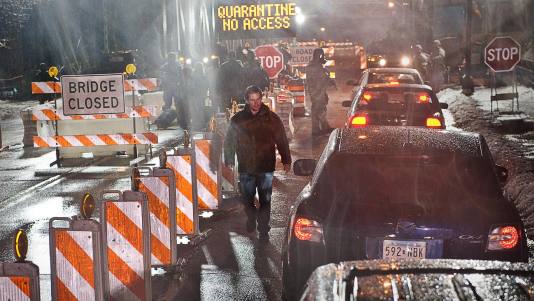
We’ve all seen pandemic movies before.  Andromeda Strain, The Stand, Outbreak, and 12 Monkeys come to mind, but all of these add something extra to the disease:  aliens, demons, time travel, or a government ready to nuke a California town.  Contagion adds something too, but unfortunately, it is all too plausible – visions of cracks in the thin veneer of order that covers our 21st century civilization.

First, let’s establish that such a disease is plausible.  Dr. Fatimah Dawood, an epidemiologist with the CDC confirms that animal viruses could combine to produce a deadly virus against which humans have no prior immunity.  Contagion is a vision of what people most feared during the H1N1 outbreak two years ago.

Can you imagine looting and outbreaks of violence if there was not enough food to go around?  What about people willing to profit from the distress or death of large numbers of their fellow human beings?  Can you imagine local governments delaying the closure of shopping malls at the start of an epidemic because of the Thanksgiving shopping weekend?  If not, please send me the location of a portal to the universe where you live.

Director, Steven Soderbergh, set out to make a scary and realistic disaster movie set in our post 9/11 and post Katrina world.  He builds and maintains suspense with restraint and subtlety.  Contagion opens with a dark screen and the sound of a woman coughing.  Then we see Gwyneth Paltrow reach into a bowl of nuts at a crowded airport bar.  Twenty seconds into the movie and I was gripping my seat.  The tension remained compelling throughout this two hour film.  As with many books and movies of the action/adventure genre, I didn’t deeply connect with the characters.  There were two many stories going on at once, and perhaps I instinctively held something back, not knowing who would live and who would die.  Most critics have given Contagion three stars out of four and I would agree.  Because of my emotional distance from the protagonists, I wouldn’t call it a great movie, but it is very very good.

We learn at the end of the film exactly how the virus mutation occurred.  Strangely enough, I thought of the novels of Thomas Hardy, where seemingly minor coincidence leads to disaster.  Hardy’s vision of the unfathomable relations between events actually mirrors certain concepts of modern science.  I remember hearing a pithy quote about the beating of a butterfly’s wings affecting weather on the other side of the globe.  One early 20th century physicist – I do not remember his name – said, “Bend down to pluck a flower and you affect the most distant star.”  What do the world views of Thomas Hardy, modern science, eastern religion, and Contagion, have in common?  A sense that events are connected and impact each other in ways beyond what the rational mind can ever grasp.

What is conspicuous by its absence, in the movie as in our culture, is a parallel understanding of ways that our fellow humans are interconnected for good or ill.  Some of the medical workers demonstrate selflessness and compassion, just like certain religious orders during the plague years in Europe, who ministered to the sick until they fell ill.  One thing the CDC people have in the movie which no one else does, is information.  We know from Katrina that orders, and curfews, and martial law, combined missing information, can drive people to the breaking point.

We identify with Mitch Emhoff (Matt Damon) and his daughter and hope we could do as well as they struggle to stay alive and keep their humanity while the social order crumbles.  Lawlessness is muted in Contagion, but it is there, and I found myself wondering what I would do, after standing in line for hours at a military food distribution point, only to have the rations run out and a soldier say, “You’ll have to come back tomorrow.”  What would I do?  Walk away like Emhoff or charge the empty truck like some of the others in a futile display of fear and frustration?

Contagion is a movie I will be thinking about for some time.  As an extra dividend, my hand washing habits instantly improved.  I’m sure yours will too if you see this movie.

Your Brain on Google

According to Alva Noe, Professor of Philosophy at UC Berkeley, Google is not making us stupid.  Good news, even though I wasn’t worried until I saw his article. http://www.npr.org/blogs/13.7/2011/09/20/140625802/google-is-not-making-you-stupid.

Noe is the author of, Out of Our Heads: Why You Are Not Your Brain and Other Lessons from the Biology of Consciousness.

He refers to results of a Columbia University study that found we are more likely to remember things we cannot find online than things we can.  The study caused some concern, but Noe says this is unwarranted and links to a blog with this quote from Einstein:  “Never memorize something that you can look up.”

Researchers are not picking on Google in particular but cite it because the phrase, “Google effect” has come to stand for the way many new technologies influence us.  Noe suggests that they are not qualitatively different from other tools we use to navigate the world and make sense of it:  “We use landmarks and street signs to find our way around; arithmetical notation makes it possible for us to calculate with big numbers; we wear wrist watches so that we can know the time without needing to know the time; and we build libraries so that we have access to what we need to know, when we need to know it.”

My predisposition to agree with Noe is based on Sherlock Holmes.  Conan Doyle’s famous detective told Watson he could not afford to fill his mind with information not relevant to his profession.  As a result, he could identify 37 varieties of cigarette ash but knew almost nothing about the solar system.

Beyond my lifelong fascination with Holmes, several things leap to mind.  I really don’t use the internet to remember things – I use it to find things.  Also, memory and intelligence are not the same.  If they were, I’m sure post-it-notes would have shaved several points off my IQ.

Though I don’t worry about Google and memory, Noe adds a link for further reading that raises more serious concerns.  In August, 2008, Nicholas Carr published an article in The Atlantic, called, “Is Google Making Us Stupid:  What the Internet is Doing to our Brains.”  http://www.theatlantic.com/magazine/archive/2008/07/is-google-making-us-stupid/6868/).

Carr is the author of, The Big Switch: Rewiring the World, From Edison to Google.

If nothing else, the internet is changing our brains, says Carr:  “I’m not thinking the way I used to think. I can feel it most strongly when I’m reading. Immersing myself in a book or a lengthy article used to be easy. My mind would get caught up in the narrative or the turns of the argument, and I’d spend hours strolling through long stretches of prose. That’s rarely the case anymore. Now my concentration often starts to drift after two or three pages.

Carr cites the work of Marshall McLuhan, who in the ’60’s observed that media not only supply the content of thought, but shape the process of thought.  Carr says, “what the Net seems to be doing is chipping away my capacity for concentration and contemplation. My mind now expects to take in information the way the Net distributes it: in a swiftly moving stream of particles.”

Before anyone panics, we should note that Carr is primarily talking about the fight “to stay focused on long pieces of writing.”  An acquaintance of his says he can’t read War and Peace anymore.  I couldn’t get through it even once.  Carr emphasizes intelligence as a series of very cerebral pursuits.  I suspect he and I have different ideas of “meditation and contemplation:”  I don’t think he’s talking of sitting meditation, something I’ve always used to counterbalance intellectual activity, and one I do not find impacted by time spent online.  Watching a violent movie may impact my ability to meditate, but so far, Google does not.  Maybe I’m in denial, but these concerns are fairly low on my hierarchy of worries.

Carr cites another concern that comes from the mouths of the founders of Google:  Sergey Brin and Larry Page, the gifted young men who founded Google while pursuing doctoral degrees in computer science at Stanford, speak frequently of their desire to turn their search engine into an artificial intelligence, a HAL-like machine that might be connected directly to our brains.  More than once, I’ve chatted with friends about how “they” will jack into our brains when the day comes:  USB?  Firewire?  The Matrix ruined my ability to take such a fantasies literally.

***

Serious research is underway, studying what is good and bad about our reliance on the internet.  Parallel hopes and concerns met Gutenberg’s invention of the printing press.  From the distance of centuries, we can see how it affected our brains.  No one in a literate culture has the memory of the tribal Griot in Alex Haley’s, Roots, or the ancient Homeric poets, but we have to ask, along with Einstein, how much should we care?  Is that kind of memory central to intelligence?  Does it’s loss have a negative human destiny?

The internet seems every bit as profound a change as the invention of printing, and it’s likely to take a long time for the dust to settle so that objective evaluations can occur.  Hopefully, as with printing, the good will outweigh the bad.

***

Everyone who has made it through this post should feel good about their ability to concentrate.  Having come to the end, I’m going to go for a walk – one of those those vitamin C for the brain type strategies that can hopefully inoculate me even against the dangers of Google!.

Celebrate Banned Books Week

Banned Books Week, Sept. 24 – Oct. 1 is our only national celebration of the freedom to read.  The event was founded by the American Library Association in 1982, in the face of a surge in “challenges” to books in libraries, bookstores, and schools.  The ALA reports more than 11,000 challenges since then, and estimates that 70% are never reported.  At least 348 books were challenged in 2010.  http://www.bannedbooksweek.org/.  In whatever ways we find suitable, this is a wonderful occasion to celebrate books that somebody, somewhere, did not want us to read.

Huckleberry Finn was banned by the Concord Public Library in 1885 as “trash suitable only for the slums.”

In addition to “sexually offensive” passages in Anne Frank’s diary, some readers complained that the book was “a real downer.”

The Arabian Nights, was banned both by Arab governments and the US, under the Comstock law of 1873.  (Hint – get hold of an unexpurgated edition of Burton’s translation).

Brave New World by Aldous Huxley.  It “centers on negative activity.”

When I found Catcher in the Rye at sixteen, I was no longer alone.  More than one generation had this experience.  The most widely banned American book between 1966 and 1975, people complained it had “an excess of vulgar language, sexual scenes, and things concerning moral issues.”

Fahrenheit 451 by Ray Bradbury.

The Grapes of Wrath by John Steinbeck.

Gulliver’s Travels by Jonathan Swift.

I Know Why the Caged Bird Sings by Maya Angelou. Parents in Kansas objected to “vulgar language, sexual explicitness, and violent imagery,” in this autobiography.  The author mentions being raped as a girl.

A Light in the Attic supposedly,”glorified Satan, suicide and cannibalism, and also encouraged children to be disobedient.”

Of Mice and Men A second winner for Steinbeck.

The Scarlett Letter by Nathaniel Hawthorne.

Song of Solomon by Toni Morrison, a Nobel Laureate.

Uncle Tom’s Cabin by Harriet Beecher Stowe.

A Wrinkle in Time by Madeline L’Engle. This award winning favorite was on the ALA most challenged list from 1990-2000 for, “offensive language and religiously objectionable content (for references to crystal balls, demons and witches).”

Lord of the Flies by William Golding.

The Sun Also Rises by Ernest Hemingway.

Catch-22 by Joseph Heller.

As I Lay Dying by William Faulkner.

Lady Chatterly’s Lover by D.H. Lawrence.

Madame Bovary by Gustave Flaubert.

Ulysses by James Joyce. The US Post office burned 500 copies in 1922.

This book has frequently been banned for the abuse James suffers. “Others have claimed that the book promotes alcohol and drug use, that it contains inappropriate language, and that it encourages disobedience to parents.”

***

I find it easy to roll my eyes and assume that the bad old days of suppressing Mark Twain are behind us.

Unlike the good people in the American Library Association, I’m not on the front lines, seeing the constant attempts to limit what we can read and think.  Banned Books Week is a perfect time to reflect on our freedoms and pass the word of this celebration to others.  And read or reread a book that someone, somewhere, tried to keep out of our hands!

An Interlude with Mutant Chickens

The other day, I took a break from literary activities to meet a friend in Fair Oaks Village for coffee.  Once upon a time, Fair Oaks was a farming community, separated by miles of fields and orchards from Sacramento.  Those days are gone, but there’s still something inviting about the town.  It’s slower than the boulevards and mini-malls that surround it, but not yet gentrified.  That may have something to do with the chickens, but I will get to that.

Fair Oaks Coffee Shop and Deli

So my friend were I are sitting at a table outside, having coffee and waxing eloquent on matters of great import, when I spotted a mutant chicken pecking at the pretzel I’d dropped on the sidewalk.  If you really pay attention, even normal chickens are sort of scary; you can understand the theory that they descend from dinosaurs.  Watch them run around, and you think of mini-velociraptors.  Yet chickens are the official Fair Oaks bird.  Herds of them run loose in town, and they are even featured on the town sign.

Once, when our dog, Holly, was younger, she jerked her leash out of my hand and took off after a chicken. By the time I caught her, thinking I was about to burst a lung, an irate citizen informed me that chickens are protected.  I believe I said something along the lines of, “Come on, Holly, we’ll hunt for dinner elsewhere.”

Fair Oaks is famous for chickens, and I have it on good authority that people throughout the region come here to dump their excess fowl.  What you have is a group of birds that interbreed, and every now and then you see a really demented one, who could play in a monster movie.  Such was the one who pecked at my feet the other day.  It had some kind of growth, like the extra head on the alien in Men In Black II.  I was so busy thinking of tetanus shots and keeping my feet out of its way, that I forgot the camera phone in my pocket and didn’t document the monster.   Today I went back with a real camera, and naturally all the chickens looked normal – or as normal as chickens can look.

Here’s the Fair Oaks chicken ideal:

Mural on the Fair Oaks, open air theater

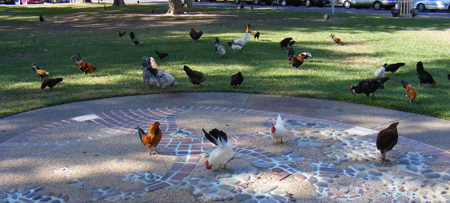
And here’s the reality – chickens invading the public men’s room:

Employees must wash their hands before returning to work

The ideal – an idyllic shot in the town square

Don’t be fooled! Think of Alfred Hitchcock.

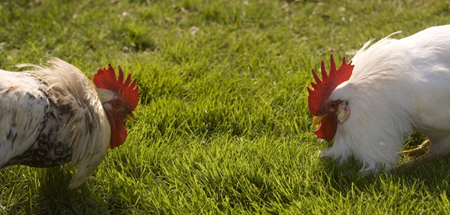
The real – high noon in roosterville.

Go ahead – make my day.

And finally, here is the biggest Ideal Chicken of all – at the 2010, Fair Oaks Chicken Festival:

Has everyone had a chance to go, “Awwww?”  If you can make it, this year’s Chicken Festival will be held on September 17.  Feel free to bring the munchkins, but be ready to change the subject if they ask, “What’s for lunch?”  Last year, the featured item was barbecued chicken.  (I’m serious).

Have fun if you go.  I would never dream of saying anything on my blog about eating Big Bird, but I will be home that day eating tofu.  Probably with the shades drawn too, in case the mutant chicken knows where I live.

An Important Book You Can Only Buy on Amazon

News on ebooks seems to come in clusters, and it happened again today.  While having lunch at Fresh Choice, one of those build-your-own-salad type places, I was reading and enjoying a Donovan Creed novel by John Locke who I wrote about yesterday.

I’ve said many times that I think the burgeoning option of ebook publishing is important for readers and writers.  But there is important and there’s important.   Here’s something weightier than simply a good read.

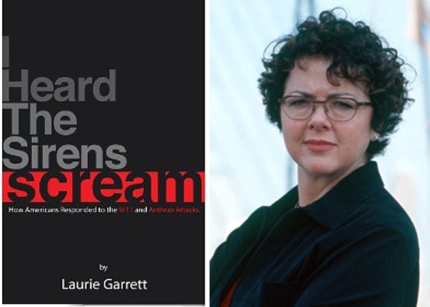
After my lunch, I got in the car and turned on NPR to listen to, “Science Friday.”  Laurie Garrett was being interviewed about her book on 9/11 entitled, I heard the Sirens Scream.

Ms Garrett is senior fellow for global health at the Council on Foreign Relations.  She’s the only journalist to win “the big three” prizes in her field, the Peabody, the Polk, and the Pulitzer, but you cannot get her book in a bookstore – it is only available on Amazon.

With all the impending chest thumping and flag waving on the occasion of the 10th anniversary of 9/11, I would suggest everyone listen to or read the transcript of this interview:  http://www.npr.org/2011/08/26/139972661/a-look-back-at-9-11-in-i-heard-the-sirens-scream

Garrett is furious that New York:  “became the reason to beat the drumbeats of war, that the attacks on our city were used by people who don’t live here to decide that we needed to invade Iraq, that the attacks on our city have been used by any number of politicians, misused, abused, with rewritten narrative, you know, the great lies told to justify all sorts of political things, everything from decreasing our civil liberties to building up a massive bioterrorism apparatus in this country, distorting our whole public health mission.

And I think the other thing is that as we approach the 10th anniversary, I should warn your listeners you’re going to be deluged with pathos.”

She contrasts this with the attempts of by Congress to deny funding to surviving Twin Towers rescue workers.  Garrett herself, who spent time near ground zero, was coughing up blood on her pillow at night, and talks of the way reports were massaged to remove the word, “asbestos.”

She summarizes worldwide response to 9/11 as unity or “singularity,” in outrage at the horror of the attacks, but goes on to say:  “You go out 120 days, that singularity has turned into the exact opposite: a moment of complete fracturing, of compete degeneration of the unity that was on one day…I think many of the ways that we responded, whether we’re talking about the public health response, the political response, the law enforcement, whatever aspect you look at, many of ways we responded set the seeds for this terrible, almost civil-war-type atmosphere that we live in in this country with such partisan dispute that the word compromise is considered evil, and the word governance is on nobody’s lips.”

You can see more of Laurie Garrett’s work on this and other topics at her blog: http://www.lauriegarrett.com