An Interlude with Mutant Chickens

The other day, I took a break from literary activities to meet a friend in Fair Oaks Village for coffee.  Once upon a time, Fair Oaks was a farming community, separated by miles of fields and orchards from Sacramento.  Those days are gone, but there’s still something inviting about the town.  It’s slower than the boulevards and mini-malls that surround it, but not yet gentrified.  That may have something to do with the chickens, but I will get to that.

Fair Oaks Coffee Shop and Deli

So my friend were I are sitting at a table outside, having coffee and waxing eloquent on matters of great import, when I spotted a mutant chicken pecking at the pretzel I’d dropped on the sidewalk.  If you really pay attention, even normal chickens are sort of scary; you can understand the theory that they descend from dinosaurs.  Watch them run around, and you think of mini-velociraptors.  Yet chickens are the official Fair Oaks bird.  Herds of them run loose in town, and they are even featured on the town sign.

Once, when our dog, Holly, was younger, she jerked her leash out of my hand and took off after a chicken. By the time I caught her, thinking I was about to burst a lung, an irate citizen informed me that chickens are protected.  I believe I said something along the lines of, “Come on, Holly, we’ll hunt for dinner elsewhere.”

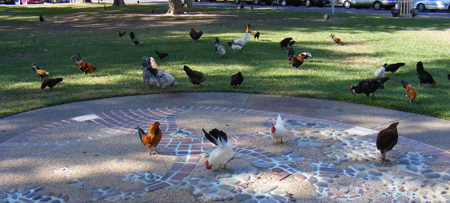
Fair Oaks is famous for chickens, and I have it on good authority that people throughout the region come here to dump their excess fowl.  What you have is a group of birds that interbreed, and every now and then you see a really demented one, who could play in a monster movie.  Such was the one who pecked at my feet the other day.  It had some kind of growth, like the extra head on the alien in Men In Black II.  I was so busy thinking of tetanus shots and keeping my feet out of its way, that I forgot the camera phone in my pocket and didn’t document the monster.   Today I went back with a real camera, and naturally all the chickens looked normal – or as normal as chickens can look.

Here’s the Fair Oaks chicken ideal:

Mural on the Fair Oaks, open air theater

And here’s the reality – chickens invading the public men’s room:

Employees must wash their hands before returning to work

The ideal – an idyllic shot in the town square

Don’t be fooled! Think of Alfred Hitchcock.

The real – high noon in roosterville.

Go ahead – make my day.

And finally, here is the biggest Ideal Chicken of all – at the 2010, Fair Oaks Chicken Festival:

Has everyone had a chance to go, “Awwww?”  If you can make it, this year’s Chicken Festival will be held on September 17.  Feel free to bring the munchkins, but be ready to change the subject if they ask, “What’s for lunch?”  Last year, the featured item was barbecued chicken.  (I’m serious).

Have fun if you go.  I would never dream of saying anything on my blog about eating Big Bird, but I will be home that day eating tofu.  Probably with the shades drawn too, in case the mutant chicken knows where I live.

The Ghost Star

Twenty-one million years ago, in the Pinwheel Galaxy – a close neighbor in cosmic terms – a white dwarf star exploded.  This week, as the moon sets early, we will have the rare chance to see this one-time sun’s final blaze of glory from our own back yards, with just a small telescope or a pair of binoculars.  Scientists are calling this a once in a generation event; type 1a supernovas like this are usually much farther away.

How do you find it?  Locate the last two stars on the Big Dipper’s tail, and imagine an equilateral triangle pointing north:

According to a Washington Post article, because type 1a supernovas are equal in intensity, astronomers use them to refine calculations of distance.  In the 1990’s, Robert Kirshner of Harvard:  “led a team that leveraged this property to make one of the biggest discoveries of the past century: The universe is flying apart, rapidly accelerating.

To explain this, cosmologists were forced into an uncomfortable conclusion. Either gravity does not work the way it is supposed to, or a mysterious force is pushing galaxies apart at a quickening pace. They called this unknown force “dark energy” and still have little idea what it is, even though they are able to calculate that it constitutes an astounding 73 percent of all mass and energy in the universe.”  http://www.washingtonpost.com/national/health-science/brightest-supernova-in-decades-serves-up-cosmic-clues-for-astronomers/2011/08/31/gIQA88CqwJ_story.html

Telescopes large and small, both on earth and in space (the Hubell) will be trained on this event, in the hopes that it may even clarify the nature of dark energy.  Though I don’t have a telescope, my father’s old film camera has a telephoto lens, and I’m hoping that on a tripod, we may be able to see the pinwheel galaxy.

I find this of interest from more than a scientific (or aging Trekkie) perspective.  The world’s religions tell us that things are not what they seem.  Most of the time we can only approach such truths through inference, faith, or meditation.  For the next few days we will have the chance to turn our physical eyes on something dramatic that has not existed physically for millions of years.

Something to think about…

An Important Book You Can Only Buy on Amazon

News on ebooks seems to come in clusters, and it happened again today.  While having lunch at Fresh Choice, one of those build-your-own-salad type places, I was reading and enjoying a Donovan Creed novel by John Locke who I wrote about yesterday.

I’ve said many times that I think the burgeoning option of ebook publishing is important for readers and writers.  But there is important and there’s important.   Here’s something weightier than simply a good read.

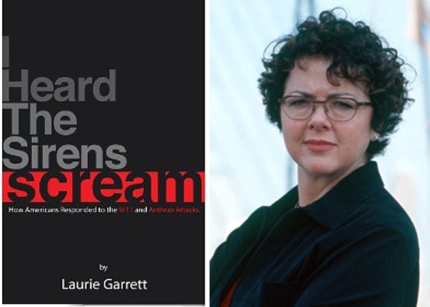
After my lunch, I got in the car and turned on NPR to listen to, “Science Friday.”  Laurie Garrett was being interviewed about her book on 9/11 entitled, I heard the Sirens Scream.

Ms Garrett is senior fellow for global health at the Council on Foreign Relations.  She’s the only journalist to win “the big three” prizes in her field, the Peabody, the Polk, and the Pulitzer, but you cannot get her book in a bookstore – it is only available on Amazon.

With all the impending chest thumping and flag waving on the occasion of the 10th anniversary of 9/11, I would suggest everyone listen to or read the transcript of this interview:  http://www.npr.org/2011/08/26/139972661/a-look-back-at-9-11-in-i-heard-the-sirens-scream

Garrett is furious that New York:  “became the reason to beat the drumbeats of war, that the attacks on our city were used by people who don’t live here to decide that we needed to invade Iraq, that the attacks on our city have been used by any number of politicians, misused, abused, with rewritten narrative, you know, the great lies told to justify all sorts of political things, everything from decreasing our civil liberties to building up a massive bioterrorism apparatus in this country, distorting our whole public health mission.

And I think the other thing is that as we approach the 10th anniversary, I should warn your listeners you’re going to be deluged with pathos.”

She contrasts this with the attempts of by Congress to deny funding to surviving Twin Towers rescue workers.  Garrett herself, who spent time near ground zero, was coughing up blood on her pillow at night, and talks of the way reports were massaged to remove the word, “asbestos.”

She summarizes worldwide response to 9/11 as unity or “singularity,” in outrage at the horror of the attacks, but goes on to say:  “You go out 120 days, that singularity has turned into the exact opposite: a moment of complete fracturing, of compete degeneration of the unity that was on one day…I think many of the ways that we responded, whether we’re talking about the public health response, the political response, the law enforcement, whatever aspect you look at, many of ways we responded set the seeds for this terrible, almost civil-war-type atmosphere that we live in in this country with such partisan dispute that the word compromise is considered evil, and the word governance is on nobody’s lips.”

You can see more of Laurie Garrett’s work on this and other topics at her blog: http://www.lauriegarrett.com

A View From Outside Our Borders

I had not planned to comment further on politics or the economy, but recently, in my geek mode, I was cruising for iPhone apps and downloaded the one for The Economist. I was so impressed with the first editorial I read that I decided to pass it along, as a pertinent view from an expert outside our fray.

If you favor the view that austerity is the way to prosperity in the short term, you’re likely to be disappointed because this editorial echoes others I have read suggesting that we have recently been asking the wrong questions.

The article is from the August 6, issue, “America’s Economy:  Time for a Double Dip?”   http://www.economist.com/node/21525405.  You may have to register to see it:

If America does manage to avoid recession and slowly begins to pull out of this mire, it will be testimony to its underlying strengths. It still has huge advantages over other rich countries: a younger, less-taxed population, a more innovative economy and, for now at least, the dollar as the global reserve currency. If only it had the political leaders to match, its chance of avoiding recession would be far better than one in two.

***

And now I return to my usual tricks, in particular, reading a gripping adult fantasy that I plan to review later this week.

Stories of the Fall

I started this blog to write about stories, imagination, and spirituality.  Initially, when I spoke of stories, I meant fiction.  I now use the word in the wider sense suggested by James Hillman when he defined psychology as, “the study of the stories of the soul.”  I also use “stories” as Professor of Religion, David Loy, did in his book The World is Made of Stories, a meditation on the worldwide intuition that what we normally see is not “reality” but our stories about reality.

Right now, stories of money and its lack weigh on everyone’s mind. I have my own stories of recent events that I hesitated to share until yesterday, when I saw that Rush Limbaugh accused the president of, “engineering the decline of the American Republic.”  http://awareamerican.wordpress.com/2011/08/09/limbaugh-on-market-collapse-obama-engineering-the-decline-of-america/.  I decided that since it’s Amateur Hour, I might as well weigh in.  Here’s my story of why the United States and Europe find themselves in such a colossal mess:

***

We are still in the early stages of globalization, but no one seems to remember that.  Limbaugh should blame Al Gore for inventing the internet, the steam engine of our current post-industrial revolution.  The changes are going to take as long, be at least as sweeping, and at least as traumatic as those of the first Industrial Revolution.  Here are a few key events:

1)  NAFTA:  The North American Free Trade Agreement, which went into effect on Jan. 1, 1994, marked the beginning of the end of blue collar work as a viable means of livelihood for large numbers of people in this country.

NAFTA protest

2) Offshoring White Collar Jobs:  This picked up in earnest in the late 90’s, as the internet made it feasible to hire large numbers of skilled foreign professionals for a fraction of the cost of their US counterparts.  I remember lots of phone conferences at the end of the day with engineers in Asia who would sometimes have solutions in our inbox in the morning.

The Y2K scare delayed the effects of sending thousands of tech jobs overseas, but once it was clear that the world was not going to end, the “dot com bust” ended the party for good.  Springsteen’s blue collar lyrics came true for professionals as well:  “Foreman says these jobs are going boys, and they ain’t coming back.”

3)  The Economy on Speed:  Thanks to Alan Greenspan, who held interest rates artificially low, and George Bush, who started two wars, the bust was delayed, but delayed only.  Quite a few people saw it coming:

  •  In 2004, a poster on a Motley Fool bulletin board said, “Soon our biggest industry will be selling each other beanie babies on eBay.”
  • Ca 2004, Warren Buffett called derivatives, “financial weapons of mass destruction.”
  • By 2006, people on all the financial websites were warning that a housing bust was no longer a matter of “if” but only of “when.”  The only thing no one fully realized then was how bad it would be.

Our problem now is not just that housing prices crashed in 2008, but that since the turn of the millennium, housing and consumer spending have been our major industries.

So what comes next?  Here are a few random suggestions and observations, not necessarily in order of importance.

1)  The President should demand to see Rush Limbaugh’s birth certificate.  Evidence suggests he is an alien – and I don’t mean the kind that comes from another part of planet earth:

2) On the Sunday before the debt ceiling resolution, I saw an interview with General Motors CEO, Dan Akerson, that made me hopeful.  Not only has GM paid back the government bailout, but they’ve done so with the introduction of fuel efficient cars.  Akerson articulated our need for independence from foreign oil that politicians since Jimmy Carter have talked about without effect.  Other American auto makers have echoed Akerson’s sentiment.  Now that greener energy is becoming profitable, there there is hope for eventual movement, growth and jobs in that sector.

3)  I’d like to see every Democrat in Washington read this article Julian Zelizer posted on CNN.com, “Where are the Democrat’s Ideas?”  http://www.cnn.com/2011/OPINION/08/08/zelizer.democrats.ideas/index.html?hpt=hp_t1

4)  We all need to look at the situation in Britain as an example of what could happen here if politicians try to balance the budget with only draconian cuts.  It’s time for people who care about the country to name the Flat Earth Party for what it is – an assortment of morons who don’t understand that they live in the 21st century and not in 1776.

5) Vote against any candidate who claims to have “a plan to create jobs” – they are either deluded or lying.  In discussions I’ve heard, usually referencing Japan, the only government action that seems to work is stimulus money applied for the long term, they way you have to use a lot of matches to start a fire with wet wood.   Unfortunately, we’ve exhausted the means and will to do that.

***

If you’ve actually read to the end of my rant, thank you.  It’s no more outlandish than claiming a single man could bring down our Republic all by himself.  To paraphrase Hillary Clinton’s book, it would take a village to do that – a large village, like Washington, DC.

How Much is Too Much?

I have to thank Ceinwenn for this topic.  He or she (I can’t be sure, since the link takes me to a password protected forum) commented on my previous post, Three Requirements of a Book Review (?).  Ceinwenn felt I had given away too much plot info in my review of  David Baldacci’s First Family.  It’s entirely possible.  Several comments mentioned avoiding spoilers, something I have not considered as much as I will now.

In my own defense, I would cite the similarities of a synopsis, which you use as a design and advertising tool with your own fiction, and the plot exposition section of a book review.  In a synopsis, you must reveal what happens; you can’t leave an agent or editor guessing.  In a book review you must not.  Got it.  Thanks.

But that wasn’t what I really wanted to talk about here.  Ceinwenn’s comment spun me off thinking of several recent things I’ve said about blogging, and specifically my discovery that the public act of blogging is far more stimulating than the private act of writing in a journal.  The public nature of blogging makes it challenging in terms of deciding how much self-revelation is right.

My wife has commented on my tendency to get too academic and boring, which is an easy path for me to take.  On the other hand, I remember a psych teacher who was Mr. Sensitive-Self-Revelation, and it wasn’t a pretty sight!  A remember a very calm and poised young woman walking out of the class, shaking her head and making barfing noises.

You get what I’m saying.  As a blogger I want to be real and I enjoy the same quality in others, but I’ve used the delete key on posts that went to far.  I might write about an embarrassing moment, especially if there is humor involved, but I’m probably not going to post my most mortifying-ever experience.  You know the one – you’re driving along and it comes to mind and you slink down in your seat in case the nearby drivers can read your mind.

Some topics rouse caution immediately, notably politics and religion.  Mary and I have a couple of long-term friends that are long-term because we learned early on to stay off these topics.  Here on this blog I circle both politics and religion, but I keep more of a distance than I would personally like to.  Still, because I really dislike door to door religion or candidate salespeople, I don’t want to risk using this space to invade anyone’s right to decide for themselves.  Fortunately, tonight I get to quote someone brilliant on a political topic.

I’m traveling.  As a matter of fact, I’m attending a two day intensive teaching session let by a Tibetan Buddhist teacher of international renown (forbidden topic #1).  I got back to my room and flipped on the news just in time to see the President’s message that a compromise is in the works. (forbidden topic #2).  Whew!  No one with their head screwed on right could wish to see our country in default, and yet, the whole situation is icky!  Have you ever gone for a swim in a lake or river that was too full of alge?  You come out feeling slimy.

It’s far to easy to blame someone else, but none of us are innocent in this mess.  We elected these clowns, most of whom are doing what they think we want them to do in order to get re-elected.  It cuts a lot deeper than that, and once I get home, I may quote from an article I found that has a lot to say about this dance of the public and the politicians.

Meanwhile, here is the brilliant comment I promised, from Walt Kelly, creator of the wonderful comic strip, “Pogo.”  This particular panel was printed in 1971, on the occasion of the first Earth Day, but its message took on a life of its own that goes beyond any single issue.  If we could learn one thing from this latest crisis, this would be my vote.  We, as a nation, will not be destroyed from without, goes the common wisdom, often repeated over the last decade – but clearly we can do it to ourselves.

Remember Real Money?

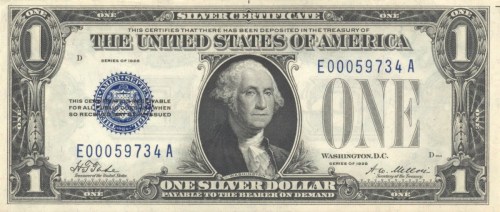
US Silver Certificate

In 1965, my father, who worked for IBM, was assigned to the south of France for two years, so the family packed up for Europe.  Back then, except for a few parodies in Pink Panther and James Bond movies, Americans in Europe got some respect.  Our money got a whole lot of respect – everyone wanted dollars.

My mother, who was an artist and appreciated fine drawing and engraving, drew the line at most European currencies.  “It looks like play money,” she said.  No wonder!  It was colorful and had big heads!  Real money, like good old yankee greenbacks, was sober and serious – it was monochrome and the heads were decently small.  I laughed the other day at a fast food restaurant.  I handed the clerk a twenty and he held it up to the light.  No one trusts a big-head!

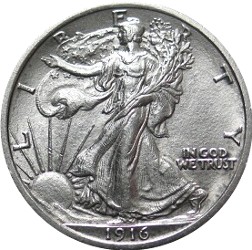
Our coins contained silver through 1965

My father was involved in the early development of magnetic card readers.  I remember his mood of euphoria the day engineers succeeded in programming a “1” and a “0” on a magnetic strip.  He announced that someday none of us would carry money at all.

“That sucks,” I said – my usual answer to my father when I was a teenager.  I thought of him today as I used my iPhone to buy a frappacino and then glanced at the budget headlines as I carried it out the door.

Money has always been abstract:  the great Lakota medicine man, Black Elk, called gold, “the yellow metal that drives men crazy.”  To his people, gold was just a pretty stone in the river – nothing to get excited about.

Now money is virtual as well – I used a pattern of pixels to buy my drink.  That doesn’t mean it doesn’t have as much power as it ever did – you can’t see or touch the wind, but this year especially, we have seen what it can do.  Still, in some ways, the increasingly non-material nature of money makes it seem all the more open to abuse.  As I understand it, the Fed doesn’t even have to print big-heads to increase the money supply – a few keystrokes will do it.

Standing liberty quarter

In truth, I love the convenience of electronic money.  A decade ago, when I was managing our affairs and my fathers, I had to write out 30-40 checks a month, a task that took a lot of time and was always subject to error, for my mind wanders when it is bored.  One Friday evening I wrote a payee the entire amount of my paycheck.  Luckily, that honest woman called me a few days later and said, “Uh, sir, I think you made a mistake.”

Abstract or not, we use our money for concrete things – a meal, a car, a house, a movie ticket, a new pair of shoes.  One immediately thinks of bartering, but these days, that seem rather strange.  In the last elections, a conservative senate candidate from Nevada suggested people might think of barter if their medical costs were too high.  Her opponents jumped on that statement, and their slogan, “Chickens for checkups” was a factor in her loss.

There is one aspect of money we do not think of often – in some of its forms, it is beautiful.  When I was a kid, I collected coins – just pennies for the most part.  I tended to spend anything bigger on baseball cards.  Now I have come to appreciate the sheer beauty of the two types of coins pictured here:  walking liberty halves, and standing liberty quarters.  These pictures show the amazing quality of the engraving.  Coins in this condition are premium, but fortunately, more heavily circulated specimens can be purchased for just a few dollars.  It’s quite an exercise in imagination to hold a coin that is 80 or 100 years old and wonder about its story.

It’s a lot more fun to think in these terms – of the beauty of money – than it is to think of our headlines or watch politicians on TV.  One thing “those European countries” did when we lived abroad, was periodically throw their governments out.  Even now, some nations hold votes of no confidence, which amount to a mass recall.  I remember feeling superior to that  – our system worked after all.  Now as I look at the big-heads in my wallet  – my mother’s old criterion for funny money – I doubt that I am alone in the fantasy of charging our leaders with high crimes of cluelessness and voting the rascals out.

Disruptive Technologies and the End of Borders.

In the electronics industry, one of our truisms was that change is the only constant.  We also talked and thought a lot about “disruptive technologies.”  The term was coined by Clayton Christensen in a 1995 article and elaborated in his 1997 book, The Innovator’s Dilemma.  Even well managed firms (and Borders does not seem to have been one of these), can be blindsided by failing to recognize “the next big thing.”  This is because its first manifestations tend to be clunky and crude.

The makers of fine coaches were probably not too worried when the first loud, dirty, and expensive horseless carriages appeared.  The empty factories and smokestacks in Rochester, NY are mute witnesses to Kodak’s failure to recognize the threat that digital photography posed to their chemical business.  Tower Books, which I loved, failed to develop an online presence, and Borders, among other things, was late to the eReader party.

There is no good news in this for anyone, least of all the 11,000 employees who are out of a job.  Or everyone who found wonderful things while browsing the stacks.  Even the idea that disappearing big-box bookstores will give indies a second chance seems unlikely.  One writer interviewed on NPR, whose books are carried by Borders, suggested that future bookstores may resemble what you find in airports:  “cookbooks, vampire novels, and celebrity tell-alls.”  http://www.npr.org/2011/07/19/138499967/mich-book-chain-borders-closing-after-40-years

I remember a college town where a wonderful independent bookstore closed soon after a Borders opened. Now it has come full circle and both are gone.  All I can think of are these words of the late George Harrison: All things must pass.