Lunch with Ebook Advocate, Mark Coker

According to Time Magazine, in 1812, the year Charles Dickens was born, 66 novels were published in Britain.  Many were written by “Anonymous,” since novels were not very reputable.  No one dreamed of making a living writing them.  Dickens, the first literary celebrity, whose bicentennial we celebrate this year, was instrumental in changing that, but he never could have imagined today’s literary landscape, which his work helped to create.

Mark Coker, guest speaker for January’s California Writer’s Club lunch, described an experience that is emblematic of the challenges faced by new writers today.  Coker and his wife co-wrote a novel.  They went through the revision process, and eventually became clients of a prestigious New York agency.  Two years later, their book remained unsold.  Coker’s solution was Smashwords, an ebook publishing service he started in 2008 that is at the forefront of changes rippling through the industry.
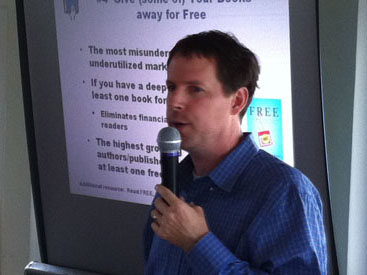
Mark Coker

Coker says that large publishers “look in the rearview mirror” for what has worked in the past.  There is little financial incentive for them to risk new concepts and new authors.  Even an author who wins the publishing game and gets a book on the shelves has no guarantee that a title with slow sales will not be remaindered within a matter of weeks.  That may not be enough time to establish the buzz that drives success.

Publishing on Smashwords is free and fast.  Correctly formatted books are distributed to all the major ebook publishers, and authors receive 85% of the sales.  Books do not go out of print, so there’s time for word of mouth to evolve.  Smashwords usage is growing exponentially.  Authors uploaded 140 books in 2008.  In 2011, the total was 92,000.

Smashwords historical usage, from a chart on their blog

Coker’s talk was animated with a sense of mission.  He said what gets him up in the morning is, “enabling writers to express themselves.”  He never suggested it’s easy, however, and most of the rest of his presentation detailed what is required.

First in importance, of course, is a really good book.  Coker suggested as many revisions and beta readers as necessary, and possibly professional editing.  At stake is the trust of readers, hard to build and easy to lose.

Next in importance are a well designed cover and compelling blurb.  Coker says polls reveal that “discovery” accounts for 50% of ebook sales – in other words, we still buy books by their cover.  This is good news for indie authors.  Only 18% of readers polled reported sticking with authors they know.  This means that for independent authors without design skills, hiring an artist is almost essential to come up with a cover that will capture attention as readers scroll through pages of thumbnails.  An email to list@smashwords.com will generate an auto reply listing 3d party artists and people who handle format.

Coker presented more information than I can cover in one article.  He has free guides to ebook formats and marketing at https://www.smashwords.com/.  Other topics are covered on the Smashwords blog, (referenced on the blogroll here) and at http://www.huffingtonpost.com/mark-coker.

With ebook sales continuing to climb; with Apple’s move into electronic textbooks; with Smashword’s impending foray into library distribution, it becomes increasingly clear that ebooks are where the future of publishing lies.  Mark Coker used the phrase, “democratization,” which again brought to mind the Time article on Dickens I referenced to begin post.

“The flood of books in the 19th century elicited two powerful institutional responses:  the rise of prize culture and the rise of literature as a field of study.  The message (sometimes subliminal, sometimes not) was that the masses needed help figuring out what to read, and the cultural elite…was going to provide it.”  (“Charles in Charge” by Radhika Jones in Time, Jan. 30, 2012)

Noting that such elitism broke down well before the advent of ebooks, (for example, with the rise of Oprah as our great taste-maker), Radhika Jones ends her article with a question that would likely delight Mark Coker and maybe Charles Dickens as well:  “Will the readers of the future find their 21st century Dickens on the Pulitzer roster or the best-seller list or FanFiction.net?”

“The future is in your hands,” said Coker at the end of his talk.  “The power of publishing is shifting to the authors.  Go and serve your readers.”

Ebooks at the New Year

A funny thing happened to ebooks last year – they became legit.

Last January, right after I got my kindle, I started noticing stories about Amanda Hocking and a few other ebook superstars in places like the New York Times and the Wall Street Journal.   The articles had a semi-surprised, “look at this,” tone.  No longer.  Now an ebook author doing well raises no more eyebrows than John Grisham writing another best seller.

Even though I was paying attention, I don’t quite know when the shift in attitude happened.  It was a done-deal by October.  That’s when a local member of the California Writer’s Club asked advice from the group:  his manuscript was ready.  Should he submit it through traditional channels or go the ebook route?  Everyone in the room, with no exceptions, recommended the ebook option.

As recently as twelve months ago, people still talked of ebooks as “self-publishing,” a phrase that carries a touch of “vanity press” stigma.  That has changed.  Now we speak of “traditionally published” in contrast to “independently published” authors.  Listen to the words:  traditional vs. independent.   Which one has more panache?

Not long ago, approval by traditional agents and editors signified quality.  I think the rapid loss of brick and mortar stores was a factor in changing that.  When Borders folded, half the gates that gatekeepers kept disappeared.  As the industry scrambles to find new ways to stay afloat, literary quality may not be so big a factor in the mix.  Mark Coker, the founder of Smashwords put it like this:  “The cachet of traditional publishing is fading fast. Authors with finished manuscripts will grow impatient and resentful as they wait to be discovered by big publishers otherwise preoccupied with publishing celebrity drivel from Snooki, Justin Bieber and the Kardashians. 

When you consider more serious fiction, odds seem to favor established names more than ever these days, in stores both large and small.  I stopped at an independent bookstore last fall in a small town.  It has been around for a while and continues to thrive.  There were lots of attractive craft and gift items – pens, handmade notebooks, and things like that.  The books were shelved by genre, and carefully chosen to reflect popular titles and series.  It was easy to find something good to read, but almost all the choices were books by established authors.  I’d do the same if I was the owner and wanted to stay in business, but that’s bad news for authors just starting out.

This is where time enters the equation for everyone, especially for older writers.  The man who asked the ebook question at CWC was about my age and put it like this:  “I don’t have forever.”  Mid-list titles, which authors used to be able to sell while learning their craft are an endangered species.  “Their demise has been predicted for years,” said agent Donald Maass.  “This time it’s true.”  As all these trends converge, the attraction of the ebook publishing has exploded.

One thing I notice consistently in the ebooks I have enjoyed is a certain playfulness or quirkiness,  a willingness to step off the path of genre convention.  I’m reminded of fantasy fiction in the ’80’s, when getting published wasn’t such a nail biting affair.  The stories were full of surprises.  Writers took more chances than those I see today at Barnes&Noble.

Recently, a well-meaning writer friend warned me that, “Editors don’t like colons.”  That’s the second time someone has said that, and I’ve heard exclamation points are out of favor too!  The only kind of writer who’s going to remember tidbits like that is one who is contentious, dedicated to learning her craft, and interested in giving her peers a leg up.  And yet…isn’t that kind of “wisdom” going to backfire?  Where is my imagination when I’m trying to remember which punctuation marks are okay to use?  I’m not going to be fully engaged in telling the best story I can, especially if runs afoul of news of “what editors are looking for now.”

Everyone has to come to their own conclusions about what to read, what to write, and what to do with their writing.  I find myself ever more grateful for ebooks and independently published authors.  I plan to champion more of them this year.

A Vote For Ebooks

Last weekend, I attended the monthly meeting of the local branch of the California Writer’s Club. The meetings feature introductions, socializing over a buffet lunch, and a speaker. This month we tried something new. Members were invited to throw out a question or concern. The rest of the group had five minutes to offer suggestions.

A man at my table had finished writing a fantasy novel and was wrestling with whether to try to get it traditionally published or go the self-publishing route in ebook format. Quite a few members weighed in, including unpublished, traditionally published, and self-published writers. Several others present provide marketing and design services for writers. What struck me was that everyone who spoke, without exception, urged the questioner to go the ebook route.

Several people pointed out that nowadays, successful ebook sales are an alternate route to acceptance by traditional publishers, a message we heard at an agent’s workshop last winter, and one that is underscored by the deal Amanda Hocking made with St. Martin’s Press. Others mentioned the amount of time it takes to see one’s work in print even after winning acceptance by one of the big six publishers. This underscored the author’s comment that, “At my age, I don’t have unlimited time.” One of those who provide marketing services for writers emphasized the need for a plan to publicize one’s work regardless of how your book gets published.

Even ten years ago, “self-publishing” was synonymous with “vanity press.” No longer. Not one person in the room raised the issue of “legitimacy,” one of the draws of traditional publishing before the recent spate of ebook success stories. Now, to paraphrase The Godfather, everyone who spoke felt the decision was, “just business.”

Petroplague by Amy Rogers: A Book Review

Dr. Amy Rogers

Dr. Amy Rogers

Neil, a disaffected eco-activist, meets an explosives expert at 2:00am.  They drive to a deserted gas station in south-central LA.

Christina Gonzales, a PHD student at UCLA, volunteers at the La Brea tar pits.  After monstrous gas bubbles burst over the tar, Christina and her co-worker smell vinegar, which doesn’t make any sense.

An elderly woman spots a huge puddle of “drain cleaner” in the alley behind her house.  She blames the neighbors and calls the police because this could injure her cats.  A moment later, explosions rock the entire block.

Christina learns that an apparent methane explosion at a deserted gas station has ruined her PHD project, an attempt to use genetically altered bacteria to break down heavy crude oil into easy-to-harvest natural gas.

If you think these events are coincidence, you have probably never watched a disaster film.  Like the best movies in the genre, or the novels of Stephen King, Amy Rogers takes a mixed group of people, with their individual hopes, plans, secrets, and strengths, and puts them in an impossible situation.  By the time I had read this far, I was hooked.  From here, Petroplague just gets better and better – meaning the tribulations of Rogers’s characters get worse and worse.

Imagine Los Angeles, or the largest car-dependant megalopolis you know.  Imagine a mutant bacteria in the underground oil supply and the local refineries that breaks down hydrocarbons, reducing petroleum  into acetic acid and highly flammable hydrogen, among other things.  Cars stall on the freeway.  Airplanes fall from the sky.  The acid corrodes gas tanks and lines, releasing hydrogen that the smallest spark can ignite.  Nothing that runs on gasoline moves:  no firetrucks or ambulances or police cruisers.  No food deliveries or garbage pickups.  The looting begins.  Instability under the Santa Monica fault leads to bigger and bigger earthquakes.  The La Brea Tar Pits “erupt.”   When Christina and her PHD supervisor discover an antidote for the plague, both an eco-terrorist network and ruthless corporate interests are willing to go to any lengths to suppress it.

Are you scared yet?  If not, as Yoda told Luke, You will be!  Because this is just the beginning.  Now that we care about Christina, the real chills and thrills begin.  Eco-terrorists smuggle the petroplague out of the LA quarantine area and plot to release it worldwide in a matter of days.  Christina and her allies face virtually every danger you can think of as LA spins into chaos – and some you can’t.  Think of all the seat gripping you do watching James Cameron movies like,  The Terminator and Titanic.  This is what Amy Rogers does; she throws the good guys into a tight situation and keeps cranking up the pressure.

I read lots of thriller/action adventure stories.  When you become familiar with a genre, you begin to recognize conventions and trends.  As anyone who has glanced at this week’s movie listings can attest, epidemics are a standard disaster scenario, but as far as I know, Rogers’s story question is unique – what would happen in our oil-dependant world if a petroleum-destroying plague got loose?

A lot of books in this genre suffer from forgettable heroes and two-dimensional villains.  Psychopaths are a dime a dozen these days, but not in Petroplague.  Several of the bad guys are idealists-gone-wrong, sometimes-conflicted fanatics of conscience, who you cannot hate even as you cringe at their actions.  One of the evil-doers is a corporate higher-up, willing to screw anyone or everyone in the name of profit.  Even if that is a stereotype, it is not hard to imagine in our post-economic meltdown world.

We bond with the heroes of the story because they are very human, even as events evoke courage they didn’t know they had.  When Christina first learns of the plague, all she can think of is her ruined dissertation, but her circle of concern and her actions rapidly grow beyond self-interest.  Her cousin, River, and River’s boyfriend, Mickey, are ready to run when things get tough – but they don’t.  A politician who survived a helicopter crash in Iraq, finds the courage to pilot another chopper filled with fuel that might have been compromised by the plague.

It’s always a pleasure to post here about a book I really enjoyed.  I couldn’t put this one down.  I urge you to stop by Amy Rogers’s web site to learn more about the author and the various formats in which you can read Petroplague.  http://www.amyrogers.com/

A Science Thriller by Amy Rogers

I met Dr. Amy Rogers at the Sacramento branch of the California Writer’s Club where she is Web Site Coordinator, and an author of science thrillers. What is a science thriller? Think of Frankenstein, Jurassic Park, and Contagion, coming soon to a theater near you. You can learn a lot more about the genre and read a number of reviews at Roger’s blog, http://www.sciencethrillers.com.

Dr. Amy Rogers

Dr. Rogers just published her debut thriller, Petroplague, in ebook format, with a paperback release due in November. She sent this synopsis:

UCLA graduate student, Christina Gonzalez, wanted to use biotechnology to free America from its dependence on Middle Eastern oil. Instead, an act of eco-terrorism unleashes her genetically-modified bacteria into the fuel supply of Los Angeles, turning gasoline into vinegar.

With the city paralyzed and slipping toward anarchy, Christina must find a way to rein in the microscopic monster she created. But not everyone wants to cure the petroplague – and some will do whatever it takes to spread it.

From the La Brea Tar Pits to university laboratories to the wilds of the Angeles National Forest, Christina and her cousin, River, struggle against enemies seen and unseen to stop the infection before it’s too late.

A former professor of microbiology, with a PHD from Washington University, Dr. Rogers has the background to make such a story plausible. In addition, Petroplague is one of two of her novels picked up by New York agents who were then unable to sell them. At this point, Rogers mentioned self-publishing, and her agent directed her to Diversion Books, which she says, “lies somewhere between self-publishing and a traditional Big Six contract. Diversion Books is loosely associated with a traditional literary agency – the first such publisher, though others have sprung up since.”

I plan to review Petroplague here, but you don’t have to wait for me. Click on the book cover photo above to go to the authors website, http://www.amyrogers.com, to view a trailer and read the first two chapters for free.

In addition, Amy has said she’ll be happy to write a guest post or answer interview questions here. So stop back soon, and visit Amy Rogers’ website and blog, for information on publishing, on scary microbes, and to check out what promises to be an exciting read!

An Important Book You Can Only Buy on Amazon

News on ebooks seems to come in clusters, and it happened again today.  While having lunch at Fresh Choice, one of those build-your-own-salad type places, I was reading and enjoying a Donovan Creed novel by John Locke who I wrote about yesterday.

I’ve said many times that I think the burgeoning option of ebook publishing is important for readers and writers.  But there is important and there’s important.   Here’s something weightier than simply a good read.

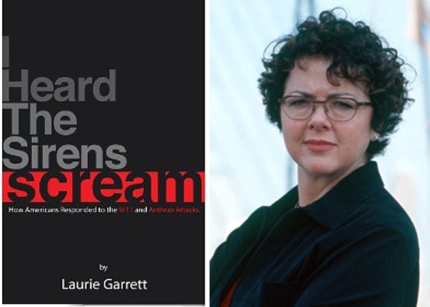
After my lunch, I got in the car and turned on NPR to listen to, “Science Friday.”  Laurie Garrett was being interviewed about her book on 9/11 entitled, I heard the Sirens Scream.

Ms Garrett is senior fellow for global health at the Council on Foreign Relations.  She’s the only journalist to win “the big three” prizes in her field, the Peabody, the Polk, and the Pulitzer, but you cannot get her book in a bookstore – it is only available on Amazon.

With all the impending chest thumping and flag waving on the occasion of the 10th anniversary of 9/11, I would suggest everyone listen to or read the transcript of this interview:  http://www.npr.org/2011/08/26/139972661/a-look-back-at-9-11-in-i-heard-the-sirens-scream

Garrett is furious that New York:  “became the reason to beat the drumbeats of war, that the attacks on our city were used by people who don’t live here to decide that we needed to invade Iraq, that the attacks on our city have been used by any number of politicians, misused, abused, with rewritten narrative, you know, the great lies told to justify all sorts of political things, everything from decreasing our civil liberties to building up a massive bioterrorism apparatus in this country, distorting our whole public health mission.

And I think the other thing is that as we approach the 10th anniversary, I should warn your listeners you’re going to be deluged with pathos.”

She contrasts this with the attempts of by Congress to deny funding to surviving Twin Towers rescue workers.  Garrett herself, who spent time near ground zero, was coughing up blood on her pillow at night, and talks of the way reports were massaged to remove the word, “asbestos.”

She summarizes worldwide response to 9/11 as unity or “singularity,” in outrage at the horror of the attacks, but goes on to say:  “You go out 120 days, that singularity has turned into the exact opposite: a moment of complete fracturing, of compete degeneration of the unity that was on one day…I think many of the ways that we responded, whether we’re talking about the public health response, the political response, the law enforcement, whatever aspect you look at, many of ways we responded set the seeds for this terrible, almost civil-war-type atmosphere that we live in in this country with such partisan dispute that the word compromise is considered evil, and the word governance is on nobody’s lips.”

You can see more of Laurie Garrett’s work on this and other topics at her blog: http://www.lauriegarrett.com

The Other eBook Superstar

Everyone remotely interested in ebook publishing knows Amanda Hocking’s story, but fewer, I am sure, have heard of John Locke.  No, not the 17th century philosopher.  I mean John Locke, the Louisville businessman who was the first self-published writer to sell a million ebooks on Amazon.  I first heard of him this week when a critique group friend handed me a clipping from the Aug. 23, print edition of The Wall Street Journal.

John Locke

Since 2009, Locke has written eight thrillers featuring former CIA assassin, Donovan Creed.  He has also written westerns and a self-help book for other writers who plan to publish digital books.  http://donovancreed.com/2011/06/lower-your-expectations-really/

The Journal article, “E-Book Author Tries New Format: Real Paperbacks,” described a contract Locke has signed with Simon & Schuster, to handle sales, distribution, and returns of eight paperback versions of existing digital books.  Locke will do the printing under his “Locke Books” imprint.  Simon & Schuster approached Locke’s New York agent to form the partnership.

Such distribution-only contracts are becoming more frequent as traditional publishers look for ways to compete with self-published books in the face of the loss of Borders as a major point of sale for printed books.  I heard a literary agent this spring confirm that successful ebook publishing is another possible avenue to traditional success, as measured by getting a New York agent and a contract with a “real” publisher.  On the other hand, only eight authors have sold a million books for Kindle – pretty long odds.

“For every John Locke, there are probably 5,000 authors trying and falling short,” says Arthur Klebanoff, CEO of RosettaBooks LLC, a digital publishing house.  But Klebanoff also says that, “The e-book world has created an opportunity in self-publishing that simply didn’t exist 18 months ago.”

The odds may be long on striking it rich and becoming a topic of cocktail party conversation, but the friend who gave me the article is going down the ebook road, as I may do someday.  I am a great believer in opportunities, and that is what Locke’s story represents.

Guest Post by Indie Author, Jayden Scott – Part 2

Yesterday, our guest blogger, Jayde Scott, spoke of what led her to publish her novels on Smashwords.  Today she describes all the work behind her growing success, (in addition to writing novels).  She cautions that:   Independent publishing isn’t an easy route to go and it’s certainly not a ‘get rich quickly’ scheme. Be prepared to invest more time than in a nine to five job.

She includes a link to her blog, Fiction and More, and I’ve added it to my blogroll, since her stated intent is to help writers promote and market their work.  

Also, If you have not already done so, please visit her Smashwords homepage to look at the full range of her books: http://www.smashwords.com/profile/view/JScott

My sincere thanks to Ms. Scott for sharing all she has done to champion her own work.  This is vital information to anyone thinking of following her path into print.

_______________________________________________________

So how did I do it? With lots and lots of marketing such as contacting blog hosts for reviews, giveaways, interviews and book spotlights. I don’t just copy and paste the information about my book into my emails to possible reviewers; I take the time to get to know their blogs and preferences and try to send them all information as requested in their review policies. Since they invest so much of their time and effort into reading my books, it’s only respectful that I at least try to make it easier for them to decide whether my book is something they might enjoy or not.

Independent publishing isn’t an easy route to go and it’s certainly not a ‘get rich quickly’ scheme. Be prepared to invest more time than in a nine to five job. Establishing a presence with all the fierce competition is tough work. Several times I changed the covers of my books, which involved days of searching sites like istockphoto.com and fotolia.com for the right digital art; once I changed the title, after which sales picked up. I also spend days on designing my print books and book trailers, and promoting those on various sites. As a very active Goodreads member, I devote a great amount of time to answering messages and updating my blog, http://jayde-scott.blogspot.com/, in case readers stop by to find out more about me and my books. And finally, I try to keep in touch with many author friends because, like in every job, connections matter. One of the most important tasks for any indie author, however, is writing and publishing a constant flow of well-edited quality work to keep up with fast moving trends. Even though I can’t afford paying a professional editor, I have two editor friends who proofread my work. My critique group helps with brainstorming and provides feedback on character development, story elements and pace. Even though my books are cheap, I try my best to give readers good quality for their money.

Writing has gifted me with a purpose in life, and nothing gives me more pleasure than hearing how much readers enjoyed my books. I’m a full time writer now who’s still sending out application forms to get a job, but the job market in the UK is shaky and doesn’t seem to want to recover any time soon. Independent publishing has at least helped ease my financial struggles and I know it’s helped many of my fellow authors, too.