More about Dummlings and Fools

Fool Tarot of Marseilles

In an earlier post, Tales of the Dummling, (January, 2013) I discussed a theme from folklore, and specifically from The Brothers Grimm, which has long intrigued me.  In this story type, the youngest of three brothers, whom everyone else considers a fool, triumphs because of virtues like honesty, compassion, and attention to the present moment.

I mentioned Forrest Gump, 1994, as a recent movie version of the theme, and several readers were quick to point out that Being There, 1979, with Peter Sellers also fits the type.  I’m currently reading an excellent book on screenplays, Save the Cat Goes to the Movies, by Blake Snyder (1957-2009) that widens the scope of this kind of movie by calling the genre, “The Fool Triumphant.”  This shift allows us to see the connections between many other types of tales where innocence and virtue are rewarded.

Save the cat2

I reviewed Snyder’s first book on screenwriting, Save The Cat, in January, 2012.  I expect to write a review of this book after I finish, but first I want to focus on Snyder’s words about films with “fools” as heroes.

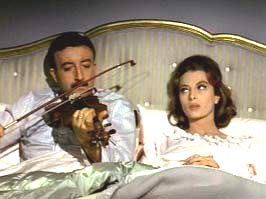
Inspector Clouseau in The Pink Panther, 1963

Inspector Clouseau in The Pink Panther, 1963

He lists three key elements:

  1. The “fool” is someone with skills or powers that are overlooked or unnoticed by everyone except (sometimes) an antagonist who resents the fool’s success.  Example:  Inspector Dreyfus in the Pink Panther movies.
  2. The fool is foolish to an establishment that opposes him or her.  In Snyder’s words, “while he does not set out to do anything but live his life, it’s usually the establishment that’s exposed as the real fool in the equation.  Have no fear, our unlikely hero won’t become a part of the system – or want to!”
  3. Finally, Snyder says, a “transmutation” occurs for the fool.   Sometimes this involves a change of name, as when Chance the gardener becomes Chauncey Gardner in Being There.  It may be a change of life circumstance, like Goldie Hawn in Private Benjamin.  It may involve gender swapping as in Tootsie and Mrs. Doubtfire.  The fool’s mission may change as it does in Legally Blonde, where Reese Witherspoon first enrolls in Harvard law to win back her fiancé, but then discovers that law is her true calling.
Reese Witherspoon for the defense in "Legally Blonde"

Reese Witherspoon for the defense in “Legally Blonde”

Blake Snyder identifies sub-genres in stories about the wisdom of foolishness.  “Political Fool” movies include Being There, Mr. Smith Goes to Washington, and The Princess Diaries.  Films like Tootsie, Miss Congeniality, and Some Like it Hot are grouped together as “Undercover Fool” stories.  Forest Gump and Zelig are “Society Fool” movies.

the-three-stooges

In addition to Legally Blonde, “Fool Out of Water” movies include Stripes, Beverly Hills Cop, and Crocodile Dundee.

Snyder is aware of the deep roots of these stories.  The fool “has a bead on the truth,” he says, whether it’s Shakespeare’s Puck, saying, “Lord what fools these mortals be,” or Forrest Gump, who “can find a whole universe sitting on a bench waiting for a bus.” In discussing Gump, Snyder suggests that ultimately, the fool opens our minds and our hearts to spiritual wisdom.

I thought of an 11th century Buddhist master, Tilopa, who lived as an itinerant sesame seed grinder.  A thousand years later, people still study his teachings, which are very complex in one sense, but can also be boiled down to these “six words of advice:”

  1. Let go of what has passed.
  2. Let go of what may come.
  3. Let go of what is happening now.
  4. Don’t try to figure anything out.
  5. Don’t try to make anything happen.
  6. Relax, right now, and rest.

Clearly such wisdom lies beyond the reach of anyone but a fool!

Fans of movies and fairytales will love this 1922 Cinderella (Aschenputtel), a 12 minute animated silhouette feature by Lotte Reiniger (1899-1981). Reiniger went on to create the first animated feature film in 1926. Those who appreciate the art of fantasy will want to know about Lily Wight’s blog, where so many finds like this appear.

Lily Wight's avatarLily Wight

     German animator Lotte Reiniger created the first surviving full-length animated feature, The Adventures Of Prince Achmed, back in 1926.

     An enchanting collection of Reiniger’s paper silhouette Fairy Tale adaptations is now available on DVD.

     You can watch Cinderella (1922) right here…

     Recommended…

     The Wonderful World Of Froud

     From Aliens To Vampires And Angels To Zombies

     Fantastic Fashion Fairy Tales

     Little Red Riding Hood With Christina Ricci

View original post

Authenticity and folklore

In his comment on my review of Once Upon a Time, Calmgrove zeroed in on one of author Max Luthi’s key concepts, that fairytales show us “man’s deliverance from an inauthentic existence and his commencement of a true one.” Luthi gives us story examples: “a penniless wretch becomes wealthy, a maid becomes queen…or a toad, bear, ape, or dog is transformed into a beautiful maiden or handsome youth.”

What can we make of such a statement in terms of our own lives? Is there anything we can learn from stories of toads and bears transformed?

Rumpelstiltskin by Henry Justice Ford, 1889. Public domain.

In trying to answer the question, our first hurdle is trying to figure out what an “authentic existence” might look like, a philosophical exercise right up there with defining “the true,” “the good,” or “the beautiful.” When I try to imagine “authentic” in our world, one of the first things that comes to mind is Crazy People, 1990, a movie in which Dudley Moore, as an advertising executive, is checked into an insane asylum after he suffers a nervous breakdown and begins writing truthful adds.

Truth in advertising wins Dudley Moore a straight-jacket in “Crazy People,” 1990

Fairytales mirror philosophy and religion in their concern with lives well lived, but they are much less precise in prescribing what to aim for and how to proceed. When someone achieves their happy destiny, we see outer events representing that highest good, like a royal wedding or the discovery of buried treasure, but what works for one hero or heroine may not work for others.

This observation offers a segue into the first of several attribute that fairytale heroes and heroines seem to share – they chart their own course. In Luthi’s terms, they are “wanderers” who “set forth into the unknown in search of the highest, the most beautiful, or the most valuable thing.” Most often, but not always, it is male characters who cover the greatest outer distance, but in Faerie, the unknown waits outside your door. Cinderella’s journey begins with a solitary trip every day to weep at her mother’s grave. The smallest step into the forest is fraught with danger for one who goes their own way, whether the goal is the end of the world or the prince’s ballroom.

Arthur Rackham illustration from “The White Snake”

A second attribute of successful folklore characters is kindness, at least for those creatures who turn up with guidance for the quest. It is not the kind of universal compassion espoused by religion, but is more practical and down to earth. Cinderella is kind to birds, and they always assist her, but she makes no objection when they later peck out the stepsisters’ eyes. The hero of “The White Snake,” who learns the speech of animals, goes out of his way to help ants, fish, and ravens, who will later save his life, but he doesn’t hesitate to sacrifice his horse when events demand it.

According to Max Luthi, the fairy tale character’s estrangement from conventional social relations allows him or her to connect with help from unexpected quarters, with toads or foxes, crones or dwarves. Luthi often distances himself from Jungian interpretation, but not in the case of fairytale helpers. They can be viewed,not only as outer creatures, but “as forces within the soul of the individual which are at first in need of assistance but finally unfold and develop.”

A third attribute of folktale heroes and heroines is patience. Things take a long time to unfold. In the Grimm brothers version, Cinderella has no fairy godmother. Instead she plants a hazel twig on her mother’s grave and waters it with her tears every day until it is grown. Only then do the tree and the dove that lives in its branches grant her wishes. In “The Devil’s Sooty Brother,” a former soldier works in the devil’s kitchen for seven years, forbidden to bathe, cut his hair, his beard, or his fingernails, or wipe the tears from his eyes.

“Kitchen work,” as Robert Bly calls it, applies to both men and women in fairytales. In Iron John, he wrote, “The way down and out doesn’t require poverty, homelessness, physical deprivation, dishwasher work, necessarily, but it does seem to require a fall from status, from a human being to a spider, from a middle-class person to a derelict. The emphasis is on the consciousness of the fall.”

Fairy tale time, as both Luthi and Bly point out, is not literal time. Seven years in the kitchen might equate to several decades for the writer who has to make a living by some other means. Yet in all the stories, this tempering process is essential. Shortcuts don’t work. After seven years, even the devil is forced to keep his bargain.

Arthur Rackham, “The Goose Girl”

When I was young, I assumed the signs of an “authentic life” were visible – at a minimum, bohemian trappings were required. Now I know that such plumage is far too easy.

The courage to go one’s own way, to keep one’s own council. To be kind to the odd and despised parts of oneself and to give them a hearing. The poise and patience to allow events to unfold at their own pace rather than try to push the river. Fairy tale heroes and heroines champion themselves and their deepest desires. Their stories lead us to wonder what would happen if we follow their example. What do their footsteps look like in the 21st century?

Once Upon a Time: On the Nature of Fairy Tales by Max Luthi

Why do fairytales continue to fascinate?  Why do we  think of Red Riding Hood when we find ourselves alone in the woods or even a city park?  Why does Hollywood still reap profit from retelling the old stories?  Why do they move us so deeply?

On the Nature of Fairy Tales by Max Luthi (1909-1991) is a wonderful place to begin to look under the surface of these deceptively simple tales.  The eleven essays gathered in this book explore different features of fairytales such as structure, symbolism, and meaning.  Luthi views the tales as a unique literary genre.  He knew and referred to the major schools of folklore research – the sociological, the psychological, and the comparative historical approaches – but he always returned to the stories themselves.  The meanings he found there were more than enough.

Fairytales have “a crispness and precision” in part, according to Luthi, because they eliminate most descriptions.  We hear of a dark forest, a cottage, a witch, but any and all details come from our own imagination.  In a similar way, there is no real character development.  “The fairy tale is not concerned with individual destinies,” but this lends the tales a universal meaning.  The prince or princess stands for all of us, “as an image of the human spirit.”

At its core, the fairytale is about our “deliverance from an unauthentic existence and [the] commencement of a true one.”    Prince or princess, goose girl or goatherd, all have lost their way.  Their radiance, which is our radiance, is hidden.  The kitchen lad wears a hat to hide his golden hair.

Sometimes the hero or heroine sets off into the forest alone.  Sometimes they sit and weep.  “Crying, the sign of helplessness, summons assistance – again a feature recurring in innumerable fairy tales.  Precisely as an outcast can man hope to find help.”  The caveat is that one must be kind and compassionate to all living creatures in order to find the right kind of help at the right time.  Even ants will repay a kindness that can save the hero’s life.

Luthi quotes Mircea Eliade who said that fairytale listeners experience an “initiation in the sphere of imagination.”  In Luthi’s view, fairytales echo the truths of the great spiritual traditions – both we and the world are far more than what we seem.

Thank you!

Thanks to everyone who stopped by this week to read and comment on “Tales of the Dummling” after it was freshly pressed.  I’ve been getting over a cold – fortunately not the nasty flu that’s going around, but bad enough that I was too tired to thank everyone who liked the post or signed up to follow thefirstgates.  Thank you now if I missed you then!

I’m grateful to the good folks at WordPress who singled out this particular post.  I was freshly pressed before, in 2011, which was exciting and encouraging, but this time the post truly mattered to me.  I won’t say I was, “Following my bliss,” because that phrase has been so over-used.  How about, “Following my feather?”  I didn’t think this kind of work would have that wide an appeal, but I’m happy to see that it does.

Your comments this week gave me many things to mull over.  Just like the very best stories, you raised questions I cannot easily answer.  Questions about the various goals that folktale characters pursue.  Questions about which attributes lead to success.  How and even whether to try to interpret fairytales – this is a topic I plan to address very soon.

Meanwhile, here is part of a post I started in December on what the stories tell us we need to do on a quest.  (Aren’t we are always on some kind of a quest?).

I called it, “What fairytales have to say about living in difficult times,” and though I don’t plan to finish it in its present form, I offer this portion of it as kind of an online journal entry, that’s bound to resurface later in some other form:

***

Dec. 12, 2012
In my previous post, I outlined a US intelligence report, Global Trends 2030, that listed factors likely to speed up the rate of change in our already fast moving world.  I ended with a question:  can fairytales tell us anything about living in difficult times?

I believe the answer is yes.  As James Hillman put it, “If we had more fairy tales when we were young, we’d need less therapy as adults.”  Fairytales always deal with crisis times.  Your father will die if you don’t find the water of life.  Your stepmother wants to kill you.  The king will cut off your head if you fail to capture  the firebird.

Lives are on the line in fairytales, and sometimes the characters don’t survive.  When they do, we find they share  certain characteristics which can be stated as guidelines for people on a quest, in the otherworld or in this one.

1. Never travel alone – successful quests demand allies.  Sometimes the hero or heroine assembles a group of companions with strange skills that prove to be essential.  At other times, a single helper is enough.  In longer tales the guide may change; a shaggy horse will become a spirit brother.  One of my psych professors claimed that the best chance of success in folklore belongs to those who win the help of an animal guide.  For Jung, such totem animals symbolize the “Self,” the center of our being, as well as our instincts, which get submerged in modern life.  On this point, all the world’s stories agree – our ordinary habits, ideas, and ways of doing things are never up to the most important tasks in life.

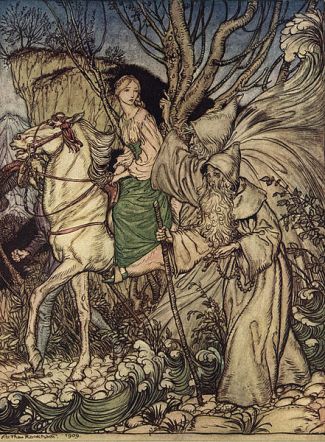
Undine by Arthur Rackham, 1909.  Public domain

Undine by Arthur Rackham, 1909. Public domain

Help often comes from people and places that “wise” people avoid.  The hideous hag or the strange man by the side of the road may hold the key to happiness and survival itself.  They reveal their secrets only to those who see and hear with the heart and their deepest wisdom.

2.  Be kind, but keep your wits about you:  In one story, a girl is kind to an ugly old hag and is rewarded.  Her step sisters mouth off, and forever after, toads fall from their mouths when they try to speak.  Kindness, respect, and compassion matter, yet some creatures are evil and we have to know the difference.  In the original version, Snow White falls for the witches tricks repeatedly (despite the dwarves warnings) before she finally takes a bite of the poison apple.  “Fool me twice, shame on me,” as the saying goes.  If strange little men give you shelter when you’re lost in the woods, you might want to heed their advice!

From an 1852 Icelandic translation of Snow White. Public Domain

3.  Be Flexible:  

4.   Trust Yourself and your instincts:

I cannot now remember what I was going to say about 3 and 4 – I’ll let you know when I figure it out, so please stay tuned!

Tales of the Dummling

Many of Grimm’s fairytales begin with three sisters or three brothers who have a critical task to perform.  Invariably, the youngest succeeds.    In her introduction to a story called “The Golden Bird,” Maria Tatar, editor of the recently published bicentennial collection says: “If the female protagonists of fairy tales are often as good as they are beautiful, their male counterparts often appear to be as young and naive as they are stupid.”

“The Golden Bird” illustrates the point.  The youngest son is so hopeless that even his animal guide, a fox, grows frustrated, yet in the end, the boy wins “complete happiness.”

Not all youngest sons are so dense, and sometimes the stories have great depth, like “The Water of Life,” which I discussed here last March (http://wp.me/pYql4-1OC and http://wp.me/pYql4-1Pm).

According to Marie-Louise von Franz, Carl Jung’s closest colleague and author of five books on fairytales, the Brothers Grimm published  50-60 stories of dumb youngest sons.  Von Franz thought these stories were so important, individually and culturally, that she started her first book on folklore, The Interpretation of Fairytales 1970, with a detailed study of one Dummling tale, “The Three Feathers.”  The story is one of the better known Grimm stories, present in the new annotated edition as well.  What follows is a brief synopsis.  The tale isn’t long and those who wish can read it on Project Gutenberg: http://www.reelreality.com/fairy_tales/grimms_fairy_stories/index.html#dummling

“The Three Feathers” from the Project Gutenberg ebook edition of Grimm’s fairytales.

*** Synopsis of The Three Feathers ***

Once an aging king had three sons. Two were clever, but the third didn’t say much and was considered dim-witted.  People called him Dummling [or “Dummy” depending on the translation].  The king decided to test the boys to determine who should rule his kingdom when he was gone.   He told them whoever returned with the most beautiful carpet would inherit the kingdom.  Then he took them outside, blew three feathers into the air and told his sons the feathers would determine which way they should go.

One son’s feather flew east and another’s west, but Dummling’s feather flew straight ahead a few paces and fell to the ground.  The other brothers laughed and set out, but Dummling just sat down by the feather and waited.  Eventually he noticed a trapdoor nearby.  It opened onto a staircase descending into the earth.  The boy followed the stairs down to another door on which he knocked.  From inside a voice called:

“Maiden, fairest, come to me,
Make haste to ope the door,
A mortal surely you will see,
From the world above is he,
We’ll help him from our store.”

Inside was a fat toad, surrounded by many smaller toads.  The boy said he needed the world’s most beautiful carpet.  The toad called out to the younger ones to “bring the box for the boy at the door.”  Inside was a beautiful carpet.  Dummling carried it home, his father was astonished, and declared that he should be the next king.

“The Three Feathers” from the Project Gutenberg ebook edition of Grimm’s fairytales.

The two other brothers, who had simply bought pieces of linen from the first peasant women they met on the road, protested so loudly that the king decreed another test.  He sent his sons out to find the most beautiful ring.  Again one feather blew east, another west, and Dummling’s by the trapdoor.  The fat frog called for a box in which the boy found a beautiful gold ring.  The brothers brought rings they had made from  nails they had taken from cart wheels.

Again the king declared Dummling the winner, and again the older brothers protested.  The king’s third test was to bring home the most beautiful wife.  Dummling won a toad bride who became a beautiful human woman after he took her home.  The brothers, who had married the first peasant women they met, complained again so the king ordered a fourth test.  The brides were ordered to jump through a hoop suspended in air.  Naturally, Dummling’s wife, who had been a toad, easily won.  Dummling received the crown and he ruled “with great wisdom” for many years.

Jumping through the hoop by Arthur Rackham

Jumping through the hoop by Arthur Rackham

***

In The Interpretation of Fairytales, Marie-Louise von Franz devoted three chapters to an in depth analysis of this tale.  She believed Dummling stories reflect the situation of individuals, cultures, and institutions that get stuck when certain rigid patterns and ideas cut them off from sources of renewal.

The first thing she notes is that all the Dummling tales begin with a father and three sons but no wife or sisters.  The feminine element is missing and regardless of what he sets out to do, the most important achievement of the younger son will be to bring home a bride.  In abstract terms, that is bringing Eros into a situation overweighted with Logos.  Von Franz cites cultural examples like the importance of the cult of the Virgin Mary in the medieval Catholic church.  She also says that third-son stories:

“compensate the conscious attitude of a society in which patriarchal schemes and oughts and shoulds dominate.  It is ruled by rigid principles because of which the irrational, spontaneous adaptation to events is lost.  It is typical that Dummling stories are statistically more frequent in the white man’s society than in others, and it is obvious why that is so.”

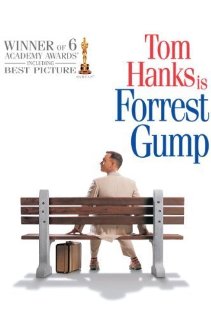
Once you start thinking along these lines, many characters spring to mind from history as well as the arts.  Saint Francis, who called himself “God’s Fool,” brought flexibility and Eros to the medieval church.  A classic movie example from recent times is  Forest Gump 1994.  Tom Hanks’ Dummling character succeeded where the smart people failed.  Gump, who lived in the moment and was close to his emotions, reacted to things as they happened rather than to his own fixed ideas.  Remember the movie’s opening shot of a feather?  If nothing else, that convinces me that Forest Gump’s creators knew the Dummling stories in detail.

Tom Hanks as a modern Dummling

Tom Hanks as a modern Dummling

Von Franz amplifies the detail of the feather, saying it was a common medieval practice in many countries.  “If someone did not know where to go, if they were lost at a crossroads or had no special plan, he would take a feather, blow on it and walk in which ever direction the wind took it.  That was a very common kind of oracle by which you could be guided.”

It isn’t as apparent in this Dummling tale as it is many others that the older brothers are modern A-types.  They don’t have time to fuss with insignificant creatures like frogs, or dwarves, or old ladies, or any of those helpful beings who guide the youngest brothers on their way.  Youngest brothers have time to listen because their calendars are clear.  They sit by their feathers or walk through the forest, paying attention and waiting for new ideas to arrive.

Von Franz used the feather analogy in discussing her method of therapy.  She said when her patients were stuck, she would listen to their dreams to see which way the winds of the psyche were blowing.  When I studied psychology, one of my teachers spoke in the same vein, of the importance of listening to the little impulse, the small thoughts that are easy to ignore, like “Oh, that looks interesting,” or “Wouldn’t it be nice to take a few hours off for a walk beside the river?”  Smart older brothers, working on their MBA’s, don’t have time for things like that, which is how they get into therapy in the first place.

I’ve heard that when he was president, Harry Truman once said, “We’re going to try X, and if that doesn’t work, we’ll try something else.”  Our government might not be so stuck if politicians dared to admit that sometimes they don’t know the answers and need to see which way their feathers blow.

Sometimes being “smart” is a greater hindrance than being “dumb,” for the key thing is to be teachable.

I came upon the Dummling stories years ago, and they often come to mind when things are stuck in my own life or in what I observe around me.  “When you don’t know what to do, do nothing,” is a common and useful bit of advice.  I sometimes restate it and say, “When you don’t know what to do, sit by your feather and pay attention.”

Something is happening here…

Readers of a certain age will recognize the title of this post as part of the chorus of one of Bob Dylan’s iconic songs of the ’60’s, “Ballad of a Thin Man.”

And something is happening here
But you don’t know what it is
Do you, Mister Jones ?

What brought the song to mind was another simple phrase which seemed to sum up our own time in a similar pithy way.  Strangely enough, it came from a piece on CNN.com called “Why the best thing you can do is fail,” by Eddie Obeng, founder of a virtual business school  http://www.cnn.com/2012/12/30/opinion/obeng-business-disruption-ted/index.html.  Here is the passage that caught my attention:

“What’s happened in business is that the rules of the real 21st century aren’t clear to us, so instead we spend our time responding rationally to a world which we understand and recognize, but which no longer exists.”

We can substitute many other words for “business” and find the phrase rings equally true.  Try it.  “What’s happened in [publishing, school safety, government, warfare, economics, international relations] is that the rules of the real 21st century aren’t clear to us, so instead we spend our time responding to a world which we understand and recognize, but which no longer exists.”

Both the Dylan lyrics and Obeng’s observation put into simple words what we’ve known for some time but could not express so clearly.

One of my favorite words, liminal, stands for times like these, times of uncertainty and change in the life of an individual or a culture.  Webster’s Dictionary defines liminal as: “1 of or at the limen or threshold 2 at a boundary or transitional point between two conditions, stages in a process, ways of life, etc.”

I started a post in December concerning what fairytales have to say about living in liminal times.  Fairytales always happen in times of transition or crisis times.  Your father will die if you don’t find the water of life.  Your stepmother wants to kill you, or you find your new husband is a serial killer.  The king will cut off your head if you fail to capture  the firebird.

Can this be relevant to the 21st century?  I’m convinced that it can.

Right now I’m reveling in one of my Christmas presents, The Annotated Brothers Grimm, a fine new collection published to celebrate the bicentennial of Grimm’s fairytales.

Reading so many stories at the same time raises a number of questions.  What does it take for a character to survive their otherworld challenges?  Sometimes you have to obey a witch, and at other times you need to push her into the oven.  Sometimes not knowing is an asset and sometimes a fatal flaw.  You should listen to animals by the side of the road unless they are wolves and you’re wearing red.

I don’t expect to come up with definite answers, but I do expect to turn up some interesting questions.  This is my immediate plan; after that, I’ll do as I’ve always done on this blog, make things up as I go along.

I very much hope you’ll stay tuned.  And now, I’ll leave you with my wish for a joyous and prosperous 2013, and with a very old clip of Bob Dylan doing “Ballad of a Thin Man” in 1966 in Copenhagen…

http://www.youtube.com/watch?v=EpatC8sR-KU

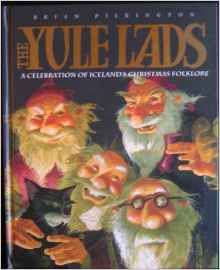
The Yule Lads: Icelandic Christmas folklore.

The Yule Lads

In most Christian countries, Christmas was slower to catch on than other major church holidays.  The clergy may have been wary of pagan solstice celebrations which happened at the same time of year and included serious revelry.  Some early Christmas festivities mimicked the custom.  They were banned in 17th century England, and American Puritans outlawed them too.

According to Brian Pilkington, author of The Yule Lads, Iceland was ahead of the curve. A 16th century law stated that “All disorderly and scandalous entertainment at Christmas and other times and Shrovetide revels are strongly forbidden on pain of serious punishment.”

Icelandic winters are long and dark, with fewer than five hours of daylight at this time of the year.  Imagination tends to fill the darkness with what we fear, and Pilkington’s book describes “the lads” that kept Icelandic children awake at night.  The gentlemen pictured on the cover are not our shopping mall Santas!

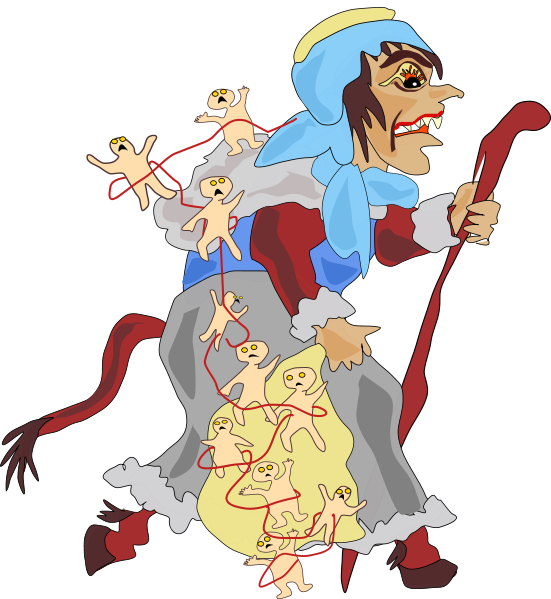
The matriarch of the clan was the ogress, Gryla, who loved to eat stewed children.  It couldn’t be just any kid though.  It had to be one who was “naughty, lazy, or rude.”  In one 13th century account, Gryla had 15 tails, and tied to each was a sack full of naughty children.  It was not “the most wonderful time of the year” if you were young!  The Icelandic word for icicle is “grylukerti” which means “Gryla’s candle.”

Gryla. CC-by-SA-2.5

Gryla had three husbands and 80 children, though legend now boils it down to 13 sons who visit the homes of children on successive nights from Dec. 12 – 25.  Time and the law have taken the edge off the Yule Lads, for a 1746 decree said “The foolish custom, which has been practiced here and there about the country, of scaring children with Yuletide lads or ghosts, shall be abolished.”  By the 19th century, the Lads had morphed from cannibals into rascals and petty thieves, who even began to leave gifts for good children who left their shoes on a window ledge.

The first to arrive was Stekkjarstaur, the “Sheep Worrier.”  He would visit the the sheep cot and try to suck milk from the ewes.  That doesn’t work in December and led author, Brian Pilkington to suggest that Sheep Worrier’s IQ is “somewhat less than three digits.”  These days  he heads for the fridge to get his milk.  If a child has been good, Stekkjarstaur leaves a sugary sweet.  Bad children get a potato.

Next comes Giljagaur, aka, “Gully Gawk” who travels through gullies and ravines, also in search of milk, but he looks for cow barns and inattentive milkmaids.  “Stubby” arrives the third night, as short as his name suggests.  He likes to raid the kitchen, as do the brothers that follow, “Spoon Licker,” “Pot Licker,” and “Bowl Licker.”  In their present forms all they do is mischief, but food thieves were no joke in earlier times.  For northern farming families, the time between Christmas and the spring thaw in April or May could be times of famine if food or fodder for livestock ran short.

The next lad to show up is Hurdaskellir, or “Door Slammer,” one of only two of Gryla’s sons who isn’t out to fill his belly.  Imagine loud bangs in the dead of night and you know how he gets his jollies.

And as if the sons of Gryla were not bad enough, children also had to contend with Jólakötturinn, the Yule Cat, a huge feral creature who hunts children on Christmas Eve instead of mice. Like the lads, the cat discriminates in choosing his victims, eating only those who have not received a new item of clothing for Christmas. Pilkington says that “Until fairly recently in Iceland, all clothing came directly from sheep. The wool had to be washed, combed, and spun before it was painstakingly crafted into a garment. It was a long, arduous process.”  Fear of the Cat induced lazy children to do their part!

This is a fun book and a fine counterbalance to the usual TV holiday movies.  You can picture families gathered around the fire as the wind howls outside, thinking as we do when hearing a good ghost story, “This can’t be true…can it?”  Something within the listeners then and within us now loves to be scared, to confront monsters and vanquish them in imagination.  On that score, Gryla & Sons and the Yule Cat satisfy!

A click on the book cover at the top of this post will take you a site where you can order The Yule Lads.