RIP Maurice Sendak

If you haven’t heard, Maurice died today of a stroke, at age 83.  Here is a nice five minute interview he gave in 2002 that ran on the PBS Newshour tonight.  It’s illuminating to hear him say, “I don’t know how to write for children.  I don’t think anyone knows how to write for children, and those that say they do are frauds.”

He goes on to say, “I write for me,” and adds that it isn’t always easy to be driven by something internally that is “riotous and strange.” What a great gift he gave to riotous strangers!

http://www.pbs.org/newshour/bb/entertainment/jan-june12/wildthings_05-08.html

Swan Maidens and Fairy Lovers, Part 2

It’s good to know that glasses can help us drink.  The problem is, we don’t know the purpose of thirst. – Antonio Machado

I hope I didn’t create the impression that I have any solid answers to the questions The Bride of Llyn y Fan Fach raises. Just “hints followed by guesses,” to quote T.S. Eliot.

In stories of this type, from all over the world, beautiful Otherworld women enter the lives of mortal men and then leave.  It’s not too great a stretch to imagine they represent the beauty, the love and fulfillment, the joy and intensity we long for in the world, but usually find to be fleeting.  The occasion for the lake woman’s departure is a tap on the shoulder that counts as a “blow.”  In a literal sense, this is absurd.  I take it to mean that the radiance of the Otherworld is like a spectacular sunset:  it illuminates our world but does not endure.  If it hadn’t been a tap, it would have been something else.  Perhaps as T.S. Eliot said, “Human kind cannot bear very much reality.”

Renunciation is not giving up the things of this world, it’s giving up the idea that they last – a Zen master.

Traditional fairytales are not linked to specific dates and places, but this one is.  This indicates a modern sensibility shaping the story pattern, and it seems especially clear in the lake woman’s belief that the world is a veil of tears.  The usual fairytale heroine does not cry at weddings, where people are “entering trouble,” nor does she laugh at funerals where people are “leaving their troubles.”  Her legacy is the gift of healing to help alleviate suffering.

In the lake woman’s view, this world is not our home, but while we are here, compassion is the highest virtue.  This sentiment could have come from Celtic Christianity.  It is also very eastern and reminds me of the theory that the Celts are linked, by diffusion, with the Aryan warriors of India.  Either way, this is a very different world from the Cinderella tales or stories like The Water of Life which suggest you can find your prince or princess and live a happy life together.

And you know the sun’s setting fast, And just like they say, nothing good ever lasts. – Iris DeMent

At the opening of this story, we learn that the young man’s father “died in the wars.”  The dates vary in different texts. One says the end of the 12th century, and others, the 13th century.  The latter date would coincide with the conquest of Wales by Edward Longshanks, the villain in Braveheart.  Edward invited all the bards in Wales to a council and had them killed, understanding that a nation without stories ceases to be a nation.  What Longshanks didn’t understand was that Celtic stories survive wherever there is a pub, a hearth fire, or a quiet country lane, yet I think the sadness of a conquered people infuses the story.

We know there is another world.  The question is, how far is it from midtown and how late is it open? – Woody Allen

Twenty years ago, Mary and I travelled with a small group of storytellers on a tour called, “The Quest for Arthur’s Britain.”  Our guides were a remarkable couple, Robert Bella Wilhelm and his wife, Kelly, who have devoted their lives to storytelling and the sacred.  I’m happy to say they are still at it.  You can check out their website for details on storytelling trips to the Orkney Islands in May, to Iceland in September, and to Hawaii in Jan., 2013:  http://www.storyfestjourneys.com/

On Glastonbury Tor, Sept., 1991

We spent the last days of this journey at an Elizabethan manor house in the Black Mountain foothills, not too far from Llyn y Fan Fach.  It was one of a very few times in my life that I heard no traffic sound at night and saw no lights of a city.  When the moon was down, it was pitch black.  You could see the shapes of trees against the stars, but little else.

One night I strolled to the end of the yew walk.  The lights from the manor were hidden.  No light, no wind, no sound.  That alone was uncanny, but there was something more.  My Jungian training, which had taught me to understand spirits and fairies as archetypes of the psyche, vanished in a visceral rush of ice down the spine.  Part of me wanted to know what lay beyond, out in the open fields, but I couldn’t bring myself to take another step.  The hair on my neck stood up until I got back to the manor.

Do I believe in other worlds?  I did that night, and I think I do still.  I’m glad I knew the old stories and their lesson:  as human beings, this world is our home, for good or ill.  The peril is very great – too great – for those who venture too close to any other.

Swan Maidens and Fairy Lovers, Part I

When I was an active storyteller, I loved to tell one of the best known legends of Wales.  It’s found in many collections under various names, most often, “The Bride of Llyn y Fan Fach.”  Variations of this story are found all over the world.  A mortal man marries an Otherworld woman who breaks his heart, but sometimes brings marvelous children into the world.

Llyn y Fan Fach and the Bannau Sir Gaer by Rudi Winter. CC by-SA 2.0

I’ve started to write about this legend on other occasions, discarding drafts that rapidly grew beyond the scope of a blog post or two or three.  What prompted me to begin again was a visit to Barnes & Noble.

Barnes & Noble knows what sells.  An entire row is now filled with “Paranormal Romance.”  The covers feature illustrations of winsome teenage girls.  The genre isn’t new; Charles de Lint, a Canadian author, has written stories like this for thirty years.  The popularity is new, and almost all of today’s novels invert the usual folklore setup, in which a mortal man meets a fairy woman.  Not only that, but the odds of a happy ending in these tales are worse than the chance of hitting a single number at roulette.

The Swan Maiden

The Swan Maiden is the most widespread “mixed marriage” type of folktale.  It is also considered the most primitive, since the Otherworld woman’s native form isn’t human.  Usually it’s a bird.  Swan maiden stories are found all over Europe, as well as the middle east, Russia, India, China, and Japan.  There’s a parallel water buffalo woman story in Africa.  According to one researcher, the motif is 30,000 – 40,000 years old, as shown by a bison-woman cave painting.

In swan maiden tales, a man sees a flock of swans glide to earth at night.  Removing their swan robes, they change into beautiful women who bathe or dance together.  Enamored of one in particular, the man takes her robe so she won’t fly away, and eventually persuades her to marry him. Later they have children.  One day the swan-wife hears her children sing of where her husband has hidden the robe, or they tell their mother when they see her in tears.  The swan maiden puts on her robe and flies away forever, leaving the children with their father.

The Welsh Stories

I have a passion for Celtic stories, and those from Wales in particular, but Celtic fairies seldom give a mortal a break.  They put out a Scottish woman’s eye simply because she could see them.  When Thomas the Rhymer succeeded in pleasing the fairy queen for seven years, what did she give him as a reward?  A tongue that could only speak the truth!  Think about how that would serve you at work.  No mystery about why Thomas never married – “Does this make me look fat?”

In Welsh mixed-marriage tales, a mortal man wins the hand of a fairy wife who agrees to stay with him under certain conditions.  They have children, the husband accidentally breaks a condition, usually by touching his wife with iron, and she leaves.  He never sees her again, though she sometimes slips back to visit her children, whose descendants are beautiful and wise.  Here is the best of these stories:

The Bride of Llyn y Fan Fach

At the end of the 12th century, a young man lived with his mother, a war widow, in Carmarthensire in Wales.  Every day he drove their small flock of cattle to the lonely tarn known as Llyn y Fan Fach.  The cows preferred the grass there to any other pasture.

Llyn y Fan Fach, copyright Stuart Wilding, licensed for reuse CC by-SA

One morning, the man (who isn’t named in the tale) beheld a beautiful woman sitting on the water combing her hair.  All he had to offer was a bit of bread, but he walked to the shore and held it out.  She glided over the water and said, “Hard baked is thy bread.  Hard am I to hold.”  Then she dove under the waves.

Unable to think of anything else but her, he brought unbaked dough the next day.  She appeared at noon, glided to the shore, and said, “Unbaked is thy bread.  I will not have thee.”

The lady combs her hair on the water

The third time, the bread was just right.  The lady gave her assent and her father offered a sizable dowry of cattle, goats, and horses, after the young man agreed to one condition – his wife would leave him if he struck her three blows without cause.

Things went well at first, and they had three sons.  Then one day the couple was to attend a christening.  The lady delayed getting ready.  She sent her husband back to the house for her gloves, saying she would saddle the horse.  When she didn’t do so, the young man playfully tapped her on the shoulder with the gloves.  “Not ready yet?”

“Be more careful,” she said.  “For you have just struck the first blow without cause.”  [This incident echoes other stories where the husband touches his fairy wife with an iron bit while bridling a horse, but that detail is missing here.]

A few years later, at a wedding, the wife burst into tears.  The husband tapped her shoulder and asked why she wept.  “I weep for this couple who are now entering trouble,” she said.  “Be careful, my love, for your trouble draws closer.  That was the second blow without cause.”

The man stayed vigilant, and things went well for several more years.  Then one day his wife burst into laughter at a funeral.  He tapped her on the shoulder again and asked why she laughed.  “I laugh because this man has left a world full of trouble,” she said.  “But now your trouble is here.  Farewell, my husband.  You have just struck the third blow without cause.”

Ignoring his protests, she marched to the lake, and all her father’s animals followed.  A pair of oxen dragged a plow six miles to the lake, and the furrows can be seen to this day.  Of the unfortunate husband, we know nothing more.  Longing for their mother, the three sons went to the lake at night and she appeared.  “You are to be of help to the world,” she said.  “I shall instruct you in the arts of medicine.  You and your descendants will be great and skillful physicians.  Whenever you need my advice, I will appear.”

In time, they became the personal physicians of the Prince of South Wales.  The legend of the Bride of Llyn y Fan Fach comes from a book called The Physicians of Myddvai, 1861, by a Welsh printer named Rees.  The Welsh Historical Society has herbal recipes attributed to the lake woman’s descendants, and the last of the line, Dr. C. Rice Williams lived into the 1890’s.

***

What do we make of a story like this?  First, we can recall Marie-Louise Von Franz’s comparison of myth and folklore. The great myths and legends tend to be more polished.  Their plots are coherent enough to satisfy modern demands.  In contrast, folktales are more primal and more opaque.

One unique feature of this tale is the specificity of location and the lake lady’s descendants.  Greek families traced their ancestry to the heroes of Troy, and my mother had a coat of arms dating back to the Normal Conquest.  A similar dynamic is one explanation for the unique segue of this fairy tale into history.

The real mystery for me has always been, why is the husband is doomed from the start?  Who would count a shoulder tap as a “blow?”  Why do mortals never win when they give themselves to Otherworld lovers?

I’ve asked myself why since the day I found a book of local fairytales in a used bookstore in Wales on a visit 20 years ago.  Though I don’t have certain answers, I have some thoughts which I will offer next time.  Meanwhile, does anyone else have any ideas?  Why would the girl’s father set an impossible condition, and why would she actually leave over such a minor slight when the text says she really loves her husband?  I welcome any suggestions you may have.

The Muppets Get Their Star

On March 20, the first day of spring, The Muppets received the 2466th star on Hollywood’s Walk of Fame.  The cast, which has charmed TV and movie viewers for 50 years, now joins a select group of “fictional” stars, which includes Mickey Mouse, Godzilla, Shrek, and The Simpsons.  Miss Piggy pointed out during the news conference, however, that all movie stars are fictional.

Photo by Frazer Harrison / Getty Images

Lisa Henson, CEO of Jim Henson Enterprises remarked that The Muppet’s star, in front of the El Capitan Theater, is very close to her father’s.  Henson created Muppet prototypes in 1955, for a show called Sam and Friends, which ran for six years on WRC-TV in Washington, DC.

Jim and Jane Henson with the cast of "Sam and Friends"

Henson died in 1990, at the age of 53, of complications from a severe strep throat infection.  Associates and family say he was so busy working, he didn’t seek medical help until it was too late.

During the last year of his life, Henson negotiated to sell the Muppets to Disney. The sale was finalized in 2004. The latest Muppet movie was released to DVD yesterday too, a seemingly successful effort to revitalize the cast and introduce Walter, a new character, who was present at the dedication ceremony.

Kermit received his own Walk of Fame star in 2002, but Henson’s little frog would be the first to say The Muppets are a group effort. The group finally has the recognition it deserves.

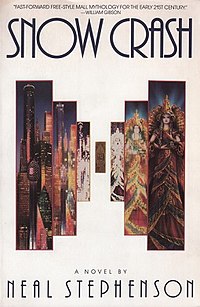
Snowcrash by Neal Stephenson – An Appreciation

Twenty years ago, Mary and I got our first real home computer (the Commodore 64 didn’t quite count).  With an Intel 486 processor, 500k of ram, an 8k external modem, and AOL memberships, we were wired!  Full-fleged members of the information age, at least by the standards of the day.

The same year, 1992, Neal Stephenson published a visionary novel called, Snowcrash. In retrospect, it merits the word, “prophetic,” for its sketch of life in the metaverse – a word Stephenson coined – and in the inconvenient world we call “reality.”

Consider:

In Snowcrash, Stepenson posits a world where nation states have transferred most of their power to corporations. Most people are corporate citizens and live in corporate enclaves, or less prestigious burbclaves.  The hero of Snowcrash, Hiro Protagonist, is a citizen of “Mr. Lee’s Greater Hong Kong.”  Military power belongs to private contractors, as do the roadways, which vie for driver/customers.  The post office is gone; private couriers deliver snail-mail.  The United States occupies a smallish territory centered in the Mohave Desert, and keeps it’s employees busy with make-work projects.  The former United States economy hinges on two industries – computer microcode and high speed pizza delivery, which has been revolutionized since the Mafia took control.

Though Hiro is a citizen of Hong Kong, as a pizza driver, he can’t afford to live in their enclaveclave.  Home is a self-storage unit under the flight path at LAX.  Like most of his hip and cyber-savvy generation, he spends most of his time online in the guise of his avatar, navigating virtual worlds.  But something is happening in the online world.  A strange new computer virus, when opened, generates a graphic pattern that scrambles the brains of the user.  They are dazed and speak in tongues.  With a young woman named YT, for Yours Truly, Hiro sets out to unravel the mystery.

The villain turns out to be a charismatic preacher.  In his attempt to secure both temporal and spiritual power, he has tapped into the ancient Sumerian glyphs that first scrambled human speech patterns in the event known as the Tower of Babel.

It’s been 20 years since I’ve read Snow Crash, so I’m writing this from memory.  I’m not necessarily recommending the whole novel.  The first jaw-dropping 100 pages, where Stephenson built his world, flew by and still leave me in awe.  I remember the rest of the book dragging in parts, but I still think of the story all the time.  Most futuristic fantasies prove as silly as the 1930’s movie shorts that show humans zipping along in their air cars between high rise buildings, happy and without any accidents.  This book is different.

In 1992 there were no virtual worlds.  Now there are, and you have to create an avatar to negotiate them.  These days, it isn’t so hard now to imagine a bright young man living in a self-storage shed.  But above all, Snow Crash comes to mind because in the wake of “citizens united,” it’s so easy to see corporate power growing while government power wanes.  With Super Pac money rolling the election year dice, does the government control corporations or do corporations control government?  Neal Stephenson saw this and other aspects of our world coming 20 years ago.

Snow Crash, is a visionary novel that all lovers of fantasy should know.

The Shape-Changer’s Wife by Sharon Shinn: A Book Review

I’ve enjoyed several young adult fantasies by Sharon Shinn and reviewed one of them here http://wp.me/pYql4-iQ.  Before she published her first YA book, Summers at Castle Auburn, in 2001, Shinn had a solid reputation as an adult fantasy writer.  I recently finished her first novel, The Shape-Changer’s Wife, which won the Locus award for Best First Fantasy Novel in 1995. Shinn was nominated for the John W. Campbell Award for Best New Writer that year.  On top of these honors – all well deserved – long time readers of this blog will know I am fascinated by stories of shape shifters (check out three posts I wrote on the theme in Feb., 2011).

At the start of The Shape-Changer’s Wife we meet Aubrey, a young man with a sunny disposition who is already on his way to becoming a skilled magician. His master sends him to study with Glyrenden, highly skilled in the art of shape-changing:

“Learn everything he teaches you so well you can cast his own spells back at him,” the old wizard had said. “Glyrenden respects only those stronger than he is, and those he hates. If you cannot beat him, he will destroy you.”

With the optimism of youth, Aubrey brushes the warning aside and sets out. Even when local villagers react to Aubrey’s request for directions with narrowed eyes and cold responses, his hunger to learn drives him on.

Shinn is masterful in building a sense of menace, which begins the moment Aubrey steps into the 3″ of dust that cake the entry way of the shape-changer’s house.  It builds when he meet the uncanny servants – Orion, covered with hair except for his eyes and nose, and Arachne, a woman who fights a loosing battle against the dust, while muttering curses and shooting everyone hostile glances.  Above all, Aubrey is fascinated by Lilith, the shape-changer’s wife, whose emerald eyes seem to see right through him, who is silent and self-contained, and doesn’t react to anything like any other woman he’s ever met.

Shinn’s presents magic as matter-of-fact.  Shape-changing sounds dramatic to Aubrey, so he is dismayed when Glyrenden hands him piles of books on anatomy and science and makes him practice hours of concentration exercises.  “How can you change into something you don’t understand in all of it’s details,” the shape-changer asks.  In Shinn’s books, magic is seldom dramatic.  More often, it forms an atmosphere like the felt danger offstage in a Hitchcock movie.

By the middle of the tale, Aubrey is hopelessly in love with Lilith, even as he perceives that “She seemed to be fashioned from the idea of a woman, and not to be a woman at all.”  This and other related perceptions lead him to pierce the secret of Glyrenden’s house – why the townspeople fear him, and why no bird or animal will come anywhere near the wizard’s dwelling.  Aubrey learns that the only way to undo Glyrenden’s “barbaric spells” is to kill him or become a better wizard, and even if he succeeds, the spells may prove too strong to break.

“I came to magic with joy.” Aubrey says.  “I thought it was a splendid thing to take the well of power that I found within me and shape it to marvelous uses…But magic, I have discovered…is not inherently good in itself.  And some of it – yes, some of it is inherently evil.  There are wicked spells, savage spells, enchantments that are so black that even to know them withers the heart just a little, taints the soul.  And yet to be a great magician, to be a sorcerer of any ability or renown, those spells must be learned as well.  For if a magician does not know them, they can be used against him.”

With measured pace, Shinn has brings us through her imagined world to one of our oldest stories, that of tasting the fruit of the Tree of Knowledge.  The Shape-Changer’s Wife is also a love story, but told with a kind of restraint that is rare in the fantasy genre.

You seldom see titles by Sharon Shinn on the shelves of Barnes&Noble, and never her YA titles.  At first glance, her books are not the stuff of blockbuster series and lucrative movie deals, though I can see them as moody, gothic dramas.

Shinn is a wizard in her own right.  Beyond the pleasure I’ve gained from six of her novels, I return to them often to study the masterful way she can weave character and atmosphere into stories I cannot forget.

Sharon Shinn

King of Morning, Queen of Day by Ian McDonald: An Appreciation

My recent discussion of unlikely mentors and guardians http://wp.me/pYql4-1J8 reminded me of Tireseas and Gonzaga, two “mystical vagabonds” (book jacket description) in one of the best fantasy novels I’ve ever read.

Ian McDonald, a visionary author who lives in Belfast, published  King of Morning, Queen of Day in 1991.  I still pick it up to read certain passages or a random chapter, to study and enjoy the ideas, the writing, and characters.

The narrative follows three women of three generations who are alternately attracted and attacked by creatures of the Mygmus, a technical name for the infinitely overlapping worlds of Faerie.

“The Mygmus may be viewed not so much as a place, a spatio-temporal relationship, a quasi-Euclidean geometrical domain, but as a state.  The concept is a familiar one in modern quantum physics, in which time is not considered a dynamic process, but a succession of recurring states eternally coexistent.  Such thinking liberates us from our essentially linear concepts of time, with past, present, and future.”  So reads a manuscript given to one of the women by a strange group of deformed, “Midnight Children.”

The first of the women, romantic, Edwardian Emily, dreams of a faerie lover and seeks him out.  First her rapes her, and then she disappears.

Gonzaga and Tireseas help Emily’s daughter, Jessica, battle free of the otherworld threat, which is personified by her mother, who has become a demonic force.

Jessica’s daughter, Enye, modern young woman in Dublin, battles Otherworld manifestations at night with martial arts swords.  Gonzaga and Tireseas charge her blades with high tech wizardry as well as ancient charms that allows her to win her way into Faerie, redeem her grandmother, Emily, and return to modern day Dublin.  The author gives the ending a contemporary twist that I won’t reveal here.

McDonald’s characters are among the most vivid in any novel I can remember, painted with a sure touch both in broad stroke and detail.  Every December, for instance, I reread “Enye’s soliloquy” – my name for it, with a nod to Molly Bloom.  It’s her internal monologue, in response to the question, “Wouldn’t it be nice if we could have Christmas all year long?”  It’s a long single sentence paragraph – not quite as long as the one that ends Joyce’s Ulysses, but then Joyce doesn’t make me laugh out loud.  I’ll quote the whole thing next December.

With his first book, Desolation Road, 1988, Ian McDonald won critical acclaim, and an Arthur C. Clarke award nomination.  Like other cyberpunk authors at the time, his vision of the impact of  technology at the birth of the internet age continues to amaze.  As a quick aside in King of Morning, Queen of Day, McDonald throws out a challenge to fantasy writers that has largely remained unanswered in the 21 years since it was written.  In the same manuscript that defined the Mygmus, Enye reads:

“I have this dread that…somehow we have lost the power to generate new mythologies for a technological age.  We are withdrawing into another age’s mythotypes, an age when the issues were so much simpler…and could be solved with one stroke of a sword called something like Durththane.  We have created a comfortable, sanitized pseudo feudal world of trolls and orcs and mages and swords and sorcery, big-breasted women in scanty armor and dungeon masters; a world where evil is a host of angry goblins threatening to take over Hobbitland and not starvation in the Horn of Africa, child slavery in Filipino sweatshops, Colombian drug squirarchs, unbridled free market forces, secret police, the destruction of the ozone layer, child pornography, snuff videos, the death of whales, and the desecration of the rain forests.

Where is the mythic archetype who will save us from ecological catastrophe, or credit card debt…where are the Translators who can shape our dreams and dreads, our hopes and fears, into the heroes and villains of the Oil Age?”

Ian McDonald

I haven’t kept up with the work of Ian McDonald in the two decades since I first read King of Morning but returning to the book via the characters of Tireseas and Gonzaga reminded me to do so. McDonald published Planesrunner, his first YA fantasy, in December, 2011. Here’s the blurb:

“When Everett Singh’s scientist father is kidnapped from the streets of London, he leaves young Everett a mysterious app on his computer. Suddenly, this teenager has become the owner of the most valuable object in the multiverse—the Infundibulum—the map of all the parallel earths, and there are dark forces in the Ten Known Worlds who will stop at nothing to get it.”

I don’t know about anyone else, but this is my very next read.

Angels Incognito

The local California Writer’s Club branch hosts an annual short-short story contest every year.  I hadn’t intended to enter until this morning when one of those end-of-the-night inspirations slipped into awareness.  A story idea:  A reprobate is convinced that “they” are stealing our memories, and he is probably right.

I wrote the opening with relative ease.  We’ll see how it goes; openings are easy, but I also have a great fondness for this kind of character – the guardian or the wise one whose appearance is humble or even repulsive.  You meet him – he is most often male – in various guises in movies and fiction:

Mel Gibson in "Conspiracy Theory," 1997

He is found  in myth and scripture.  John the Baptist is a classic example, who must have dismayed a lot of the city people who came out to hear him.

John the Baptist

Tilopa, (989 – 1069) one of Tibetan Buddhism’s greatest teachers, was expelled from a monastery and made his living as a sesame pounder, a pretty low rung on the social ladder.

Tilopa

Once in a while, you meet someone like this in real life.  I read an account by a man who wanted to go to India in search of a guru, but then found his teacher, a Zen master, earning his living by fixing washing machines in a laundromat 12 miles away.

When my wife was a social worker at Loaves and Fishes, a local center that helps the homeless, she was startled one day as a small hispanic man climbed out of a dumpster in a parking lot. Significantly, his name was Jesus. Mary’s eye’s still light up when she tells what a joyful man he was.  The meeting was so unexpected, but left such a vivid memory, that she thinks of him whenever the subject of angels comes up.

These reflections led me to think of one of my all time favorite fantasy novels, King of Morning, Queen of Day, by Ian McDonald, 1991.  The story features a pair of otherworldly guardians who look a lot like bums as they craft powerful magical charms from bottle caps and debris.  McDonald came to mind when he published his latest novel in December.  I haven’t yet read the new one, but I’ll discuss King of Morning next time.

Meanwhile, has anyone else encountered an angel, a wise man or woman, a mentor or a guardian who showed up disguised as an “ordinary” person but then turned out to be anything but?