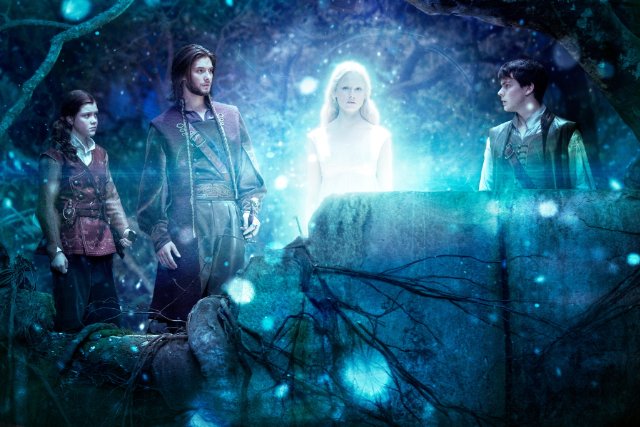
Young Adult vs. Middle Grade Fantasy

I know a sure-fire way to depress myself – visit the young adult section of the local Barnes & Noble.  I should explain.  None of my favorite authors or books like the ones I want to write are out on the shelves; everything is far too market researched, too hip, slick, and cool for the likes of moi.

I made my semi-annual visit recently, and went through my usual chain of thoughts.  Should I take a pseudonym and try my hand at vampire romance?  Should I do like Marcel Duchamp and spend the rest of my life playing chess?

Sooner or later – in this case, the same day – I come to a solution that works.  I stopped by the local library and went to the “middle-grade” stacks.  For readers in this range, roughly older grade school through middle school, fantasy never goes out of style.  Reading these books is like dipping into the fiction that really made me love fiction.

The YA/middle grade distinction is anything but exact.  Harry Potter is usually found in the middle grade section, and in thinking about that, a few differences became clear.  There is less introspection and more action, of course, but there is also a different quality to the characters’ introspection.

A middle grade hero like Harry worries that he is not adequate to take on Voldemort.  A young adult hero worries that he is not adequate.  They are just on different spots of the whole arc of coming of age, which I don’t think anyone ever fully outgrows.  I’m sure that is one reason why people of all ages love Harry.

Here is a brief synopsis of three middle grade fantasies I have thoroughly enjoyed, and which you may as well.

The Sisters Grimm: The Fairy-Tale Detectives by Michael Buckley

Two years ago I drove to a nearby Borders to hear Michael Buckley discuss his popular middle grade fantasy series, The Sisters Grimm. Buckley was snowed in on the east coast and forced to cancel, but interestingly, there were five adults and two seventh grade girls waiting when the news came.  The girls told us how disappointed they were, and gave a synopsis of the series.  Both said they liked these books better than Harry Potter.  When articulate young readers tell me they like something better than Harry Potter, I pay attention; I brought home the first three books of what has grown to an eight book series.

In book one, after their parents mysteriously disappear, Sabrina and Daphne Grimm are sent to live with their Granny Relda in the Hudson River town of Ferryport Landing.  Suspicious Sabrina has no patience with the tall tale this “grandmother” spins – that the sisters are descendants of the famous Brothers Grimm, whose fairytales were actually case files of the activities of “The Everafters.”  These strange and sometimes dangerous creatures of story actually exist in Ferryport Landing, where they were brought and contained by Wilhelm Grimm to ensure their survival.  When Sabrina sees Granny Relda taken by a giant who almost catches her and Daphne, she can no longer doubt.  The sisters must team up with Puck and Jack the Giant Killer to dodge the town police (the three little pigs), rescue Granny Relda, and get to the bottom of a shady real estate deal engineered by the foppish Prince Charming, the mayor of Ferryport landing.


Inkheart by Cornelia Funke

When she is twelve, Meggie Folchart discovers that her father, Mo, is a “Silver Tongue,” a person with a dangerous gift.  When he reads a tale aloud, characters from the book are drawn into our world, while people from our world disappear into the the story.  Meggie learns that her mother, Resa, vanished when Mo read from a rare book, Inkheart, while the evil Capricorn came here from the story.  He has since found his own Silver Tongue to read his henchman into this world, even as he seeks to destroy all other editions of the book, so that Mo cannot send them back.

Mo, desperate to rescue Resa, seeks out the author of Inkheart who still has one copy of the manuscript.  Mo, Maggie, and the author, are captured by Capricorn, whose personal Silver Tongue is of the poorest quality.  When Meggie proves to have the gift, Capricorn threatens to kill her mother unless she reads “The Shadow,” the ultimate evil, into this world.

Inkheart was made into a fun movie in 2009, starring Brendan Frazer, Helen Mirren, and Eliza Bennet as Meggie.  There are two additional titles in this series.  I have not read them, but a friend says each book is better than its predecessor.

The Spiderwick Chronicles by Tony DiTerlizzi and Holly Black
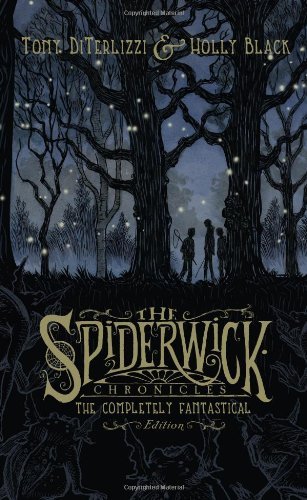
After his parents split up, Jared Grace, his mother, his twin brother Simon, and his older sister Mallory, find themselves in the broken down Spiderwick Estate.  It’s a dump, and even worse, right on the edge of Faerie.  When the Grace siblings find a mysterious Field-Guide to the nice and not so nice denizens of this other world, some very unsavory creatures are determined to get it back.  At first, poor Jared, with a history of anger issues after the divorce, is blamed for the mischief.  Later  the whole family joins together in a fight for survival.

The Spiderwick Chronicles consist of five thin books.  The edition pictured above contains all of them, because you won’t be able to read just one.  I started the books after seeing an enjoyable movie version in 2008.

What I am reading Next:

I love libraries, where I am free to choose a book by its cover, or in this case, by its title.  Next in my middle-grade book queue is The Faceless Fiend:  Being the Tale of a Criminal Mastermind, His Masked Minions, and a Princess with a Butter Knife, Involving Explosives and a Certain Amount of Pushing and Shoving, by Howard Whitehouse.  I’ll let you know how I like it.
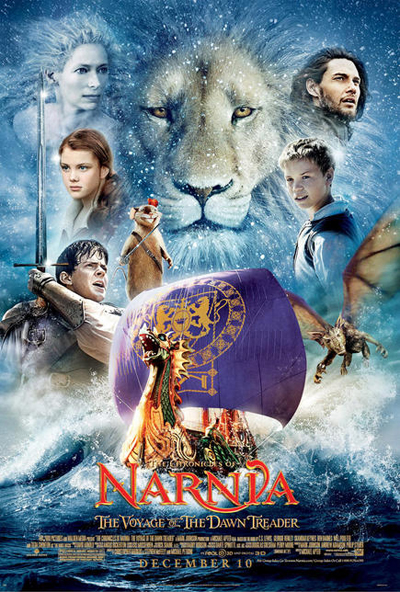
The Chronicles of Narnia: The Voyage of the Dawn Treader

Okay, once again I waited until nearly the end of a theatrical run to see a popular movie. I don’t know if there is a name for my condition: an almost pathological fear of seeing new releases in crowded theaters that harks back to the trauma we suffered when first attempting to see Star Wars. The theater sold overbooked tickets, just like an airline, and we had to leave just as Darth Vader appeared.

Voyage of the Dawn Treader is the third book of C.S. Lewis’s Chronicles of Narnia, and this movie is the first produced by Fox after Disney let go of the franchise when Prince Caspian, the second film, posted disappointing returns.

I can understand that to a degree. I’ve read the first Narnian chronicle, The Lion, The Witch, and the Wardrobe, many times; not so the others. The first book has things guaranteed to enchant the dreamer in all of us: a magical world in a clothes closet, filled with talking animals, where children become kings and queens, and defeat a great evil with the help of a lion who is a thinly disguised Christ figure.

I do not propose to outline the series for those who are not familiar with it, but pose a question the movie raised. What do we make of a film that is more compelling than the book because of the director and screenwriter have added elements the author did not?

Blasphemous as this may sound, I found Peter Jackson’s film treatment of Tolkien’s Lord of the Rings more compelling than the book, but those movies remained scrupulously faithful to the text.

In Dawn Treader, the two youngest Pevensie children, Lucy and Edmond, and their obnoxious cousin Eustace, are transported to Narnia to help King Caspian on his voyage to the east to find seven missing lords of Narnia.  I remember the book as a series of episodes that were not connected thematically except through the characters’ battles with temptation:  Lucy’s desire for Beauty, Edmond’s desire for Power, and Eustace’s Greed which causes his temporary transformation into a dragon.

Let’s just say that when the first of this series of movies came out in 2006, I set out to reread the seven books, and gave up in the middle of this one.

In Dawn Treader, the final test that is overcome is a dark island where dreams come true.  Lewis alludes to, but doesn’t dwell on the possibilities of a world where truth and illusion are indistinguishable; with Aslan’s help, the crew rescues the final lord and makes their escape.

Director Michael Apted makes this dark island central to the story:  the crew and all of Narnia are threatened by a great evil that can take any shape – it mirrors each individual’s hopes and fears.  This is a very personal darkness, a tailor-made evil, a Satanic force that Christian theology imagines, but which Lewis did not in the third book of his series.

This force is also Mara, the demon lord of Buddhist theology who evoked the most piercing desires and fears in an effort to overcome Prince Siddartha on the night of his enlightenment.

“Value added,” is a business term I first heard in the 90’s applied to Intel, which takes silicon, one of the most common elements on earth, and transforms it into microprocessors.

“Value added” is also what Michael Apted did in fleshing out the unrealized potential of C.S. Lewis’s book, to portray each individual’s unique path of heroism.  In the words of the magician, Coriakin, “You cannot hope to overcome the darkness without until you subdue the darkness within.”

The Dream-Maker’s Magic

I have loved fantasy since I was little, growing up on a diet of Norse Mythology, British folklore, and Godzilla.

For years, I helped bankroll the fantasy genre; I patronized specialty bookstores, and even (introvert that I am) went to conferences and Renaissance Faires.  I probably ate up every Tolkien-spinoff quest series ever written.  Eventually, I burned out and wandered to other sorts of reading, but over the last decade, several wonderful books revived my love of fantasy.  One of those gems was Sharon Shinn’s, The Dream-Maker’s Magic.

Shinn’s first book, The Shape-Changer’s Wife, (1995)was critically acclaimed. With her Samaria series, she went on to make a name for herself as an author of adult fantasy. In 2004 she launched a trilogy of thematically connected young-adult fantasies, publishing one a year: The Safekeeper’s Secret in 2004, The Truth-Teller’s Tale, 2005, and The Dream-Maker’s Magic in 2006.

The stories are set in the same world, where magic is part of the fabric of life, and yet it plays a surprisingly minor role. These are not sword-and-sorcery tales. They are more akin to Shakespearean comedy. They are coming of age stories with romantic intrigue, complicated by plot twists and questions of identity, some even resulting from babies swapped at birth.

In The Dream-Maker’s Magic, Kellen Carmichael’s mother almost dies in childbirth. Two weeks later, when she is well enough to care for Kellen, she becomes hysterical, convinced beyond reason, that she gave birth to a boy – and Kellen is a girl.

Kellen says: I was that baby. I was that strangely altered child. From that day on, my mother watched me with a famished attention, greedy for clues. I had changed once; might I change again?  Into what else might I transform, what other character might I assume?  As for myself, I cultivated a demeanor of sturdy stoicism…It was as if I hoped my unvarying mildness would reassure my mother, convince her to trust me.  It was as if she was some animal lured from the wild lands and I was the seasoned trainer who habitually made no sudden moves.

But, Kellen concludes, She never did learn to trust me…or accept me for who I was. It was my first lesson in failure, and it stayed with me for the rest of my life.

If life is hard for her as a child – growing up in boy’s clothing, with sugar-bowl haircuts and a mother who refuses to acknowledge what she is – it becomes even worse in adolescence. Luckily, Kellen begins to meet allies, none more important than Gryffin, a boy who was born lame, whose legs are getting worse, and whose uncle periodically beats him.  Kellen initially scoffs at his unquenchable optimism, at his belief that with an education, he can be anything he desires.  Several days after they meet, however, these two broken people are inseparable friends.

Betsy Palmer, an innkeeper, and her daughter, Sarah, also befriend Kellen, and teach her such arcane mysteries as how to sew a dress that fits and how to do her hair, yet that alone does not end Kellen’s confusion:

…there was one person who was not fooled by my new looks or my modulated personality, and that was Gryffin…He did not seem to notice what I was wearing or how I had arranged my hair…I did not bewilder or surprise him.  He did not think I was trying to be something I was not, as my mother did; he did not think I was trying to break a chrysalis and become something I was meant to be, as Betsy and Sarah surely believed.  He just thought I was Kellen.

I found this the most comforting thing that had ever happened to me.  At times, when I lay awake at night, confused myself about what role I should take and what direction I should try to follow, all that kept me from slipping into tears was knowing I was not completely lost if Gryffin knew how to find me.

That was the point where I put the book down on my first reading, and have every time since, to marvel at the simple way Shinn breaks through all the limits of genre, to evoke something everyone probably longs for:  I was not completely lost if Gryffin knew how to find me.

The Dream-Maker’s Magic is about magic, but it cuts both ways when it appears, and separates Kellen and Gryffin.  The story is a lyrical romance, though you have to watch for the two kisses that Kellen and Gryffin exchange at the very end of the book.  It is a novel whose ending surprises Kellen and the reader; she is not the person she and we imagine her to be.

The ending satisfies in the way that Shakespearean comedies satisfy: what was lost is found, those who were separated are reunited, and poetic justice is meted out.  The story ends on Wintermoon, the holiday when people attach tokens of their hopes and dreams to a wreath, and burn it at midnight, to let the smoke carry their desires to heaven.  Kellen asks Gryfinn what he wishes.  “That every Wintermoon be better than the last,” he says.

Not a realistic wish, as anyone could have told him – but I would not be the one to say so.  Why limit your dreams, after all?  Why not hope for the grandest and the best?  I watched Chase throw the wreath into the bonfire, and I saw the flames scrawl secrets on the sky, and I closed my eyes and knew no end of dreaming.

Be sure to check out Sharon Shinn’s website.  There’s a permanent link in my Blogroll.