
How to Write a Great Novel

“Put your left hand on the table. Put your right hand in the air. If you stay that way long enough, you’ll get a plot,” Margaret Atwood says when asked where her ideas come from. When questioned about whether she’s ever used that approach, she adds, “No, I don’t have to.”

“How to Write a Great Novel,” is not a title one expects to see in an article in the online Wall Street Journal, but here it is. A friend sent this piece, dated Nov. 2009, which recounts some of the strategies eleven different authors use to deal with, “the daily work of writing, clocking thousands of solitary hours staring at blank pages and computer screens.

http://online.wsj.com/article/NA_WSJ_PUB:SB10001424052748703740004574513463106012106.html

Nicholson Baker rises at 4:00am and writes in the dark, on a black screen with gray type, then goes back to sleep and when he rises again, edits what he produced in the “dreamlike state.” For a recent novel about a “rambling professor,” he grew a beard, put on a floppy hat, and spent a lot of time creating the character’s voice which was “something I had to work on a lot in order to get the feeling of being sloppy.”

Hilary Mantel also likes to work in the morning, even before she has coffee  [yow!!!!!].  Mantel spent five years writing Wolf Hall, a Tudor historical drama, and kept a 7′ bulletin board in her kitchen to capture ideas jotted in the notebooks she carries everywhere.

Richard Powers lounges in bed all day and “speaks his novels aloud to a laptop computer with voice recognition.”

Junot Diaz, a Pulitzer-prize winning author, shuts himself in the bathroom and perches on the edge of his tub with a notebook when working on difficult passages.

Kate Christensen was “two years and 150 pages into her first novel,” when she discovered what the book was “really about.  She threw out her earlier work and started again.  The process repeated itself with her second, third, and fourth novels. Christensen, who won the PEN/Faulkner award in 2008, starts her mornings with housework, emails and phone calls “to avoid facing her work.”   In the past, she’s played 30 games of solitaire before typing a first sentence.

Michael Ondaatje writes in 81/2 x 11 notebooks, then cuts and pastes his sentences with scissors and scotch tape.  His prose will sometimes run four pages deep.

Kazuo Ishiguro, author of six books including “Remains of the Day,” which won the Booker Award, spends two years researching and one year writing his novels, but says sometimes they still don’t come together.  He showed his wife a draft of a story set in medieval Britain and she said, “This is awful. You have to figure out how they speak to each other. They’re speaking in a moron language.”

 These are interesting vignettes to read, because the authors vary so widely in their working habits:  some use computers, some write longhand.  Some make elaborate plotting diagrams, others get up early to sidestep the rational mind.  Some have trouble turning off the flow of words, and some approach the writing desk with trepedation. 

What they have in common is a very uncommon tenacity, and a willingness to arrange their lives and and working methods in very personal ways in order to coax imagination onto page.
A Novel Planning Method

There seem to be two general approaches to plotting a novel. When I was younger, my efforts consistently ran aground because I tried to fit myself into the outlining and pre-planning camp.

When I first learned to trust imagination and revel in the lets-see-what-happens-next process, I finished a 90,000 word draft in seven months of evenings and weekends. The good news is, I’d found my natural way of working – the bad news is it took me seven months to see the gaping plot flaws an outliner could have flushed out in a couple of weeks.

I undertook a study of plot and learned about the three act structure, the key plotpoints, and various other fundamental concepts.  What I still didn’t have was a method of planning that didn’t inhibit imagination, the way an armature supports a ceramic sculpture but doesn’t inhibit expression.

I found something very useful online, Randy Ingermanson’s “Snowflake Method,” a literary brainstorming practice  that takes its name from the simple to complex process of designing a snowflake fractal:

http://www.advancedfictionwriting.com/art/snowflake.php

Ingermanson begins by suggesting a one-sentence synopsis of the entire story – something that may seem impossible at first, but which I now believe is absolutely necessary.  The process clicked into place for me when I saw, on another web site, the following example offered for  The DaVinci Code: A late night murder in the Louvre leads to the discovery of a secret the Vatican has tried to suppress for 2000 years. Very high-level like that.

Ingermanson then suggests growing this story summary to a paragraph and then a page, in the spirit of discovering what the story is really about.  If the villain isn’t bad enough or is too easily defeated, it’s worth knowing upfront rather than thousands of words later.

Once I have gone as far as I wish with the Snowflake Method, I’ve got a decent high level map of plot and perhaps my protagonist and villain, but for me, something is still missing – how do I find out what’s going to happen next?  How do I dream up new complications, discover and weigh alternative endings, without writing those thousands of practice words?

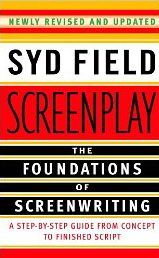
I’ve recently begun to explore something I saw a decade ago, the “storyboards” Peter Jackson and his team developed to map the scenes of The Lord of the Rings. This was part of the “making of” section of the DVD’s. I dug them out and watched again after recently reading Syd Fields’ excellent, Screenplay: The Foundations of Screenwriting, which recommends using 3×5 cards to work out plot.

Screenplay

I find that either a quick sketch or a few words can sum up a scene in a graphic manner that appeals to imagination. I can carry a few cards in a shirt pocket and glance at them over a cup of coffee or mull them over while driving home.

Two Towers Storyboard

They do not need to be nearly this detailed, because we are not planning camera angles.  This could be summed up as:

After witnessing Frodo confront the Nazgul, Faramir releases Frodo, Sam, and Gollum to pursue their mission to Mordor, or simply, After Nazgul, Faramir lets them go.

I find that if I let the images play around in the background of my mind long enough, the next step will come, and often surprise me.  I fully expect this process to evolve and change, but for now, this is a huge step forward.

Biff, Pow, Bam; how not to begin a story.

The books I most enjoy reading have one or two things in common:  characters I enjoy so much I’d rather hang out with them than do anything else and/or such a compelling plot that I resent anything – like fatigue at 2:00am – that forces me to put the book down.

At writer’s conferences, critique groups, and blogs or newsletters devoted to the craft of writing, a common piece of advice emphasizes the effort to construct a thrilling plot: “Throw out the first three chapters of your story and begin in the middle of the action or conflict.”

Here’s a refreshing take that advances the primacy of character, the factor that seems central to the few special books I read again and again.

It’s probably the most over-repeated and cliche advice—so much so that writers have come to hate hearing it: Start with action.

I’ve critiqued hundreds, maybe thousands, of first pages, and this advice is most to blame for story beginnings that leave the reader in a quivering mass of Why-the-Hell-Do-I-Care-About-This?

http://blog.writersdigest.com/norules/2010/03/11/TheBiggestBadAdviceAboutStoryOpenings.aspx

Angelology

When I first read the March 15, Time Magazine review of Danielle Trussoni’s, Angelology,  ( http://www.time.com/time/magazine/article/0,9171,1969720,00.html )I was struck by the killer premise: the heroic battle of an art historian and a young nun against the Nephilim, nasty, arrogant human-angel hybrids who have dominated world affairs for thousands of years.

When the reviewer compared it favorably to The DaVinci Code, I put it in my Amazon cart. Now I wish I had listened to the 100+ Amazon reviewers who gave the book 3 1/2 out of 5 stars.  They were too generous.

The characters, Sister Evangeline and Verlaine are good enough as action adventure heroes go.  Not every protagonist can be or must be unforgettable.  We like them enough to want to see them prevail.

Where the story really breaks down is in the interminable backstory, that fills the entire middle section of the book.  It slows the action to a full stop, and doesn’t really succeed in creating a suspension of belief.

There are several ways to draw readers into a fictional world that has fantasy elements.  One is simply to spin things that exist in our world, as Brown does in The DaVinci Code. The Gospel of Mary Magdalene, and DaVinci’s “Last Supper,” are real, and we’re all too ready to believe in nefarious religious cults.

The other classic tactic is to simply drop us into an alternate universe, as Orson Welles did in the famous/infamous War of the Worlds broadcast – simply announce that aliens have landed in New Jersey.

Trussoni begins Angelology in this manner – with a flashback to the discovery of a Nephilim corpse during  the “second angelological expedition” of 1943.  We’re hooked, especially when Nephilim menace Verlaine and Sister Evangeline before we quite know why.  All the elements of an exciting chase and forbidden romance are in place…and then the author manages to snatch defeat from the jaws of victory.

The story just stops.  If only an editor had reviewed the manuscript and suggested the simple, time tested device for action-adventure tales – sprinkle the backstory into the main action, but keep things moving.  Do not bore your reader to distraction.

Did I say Trussoni failed?  Well that may be an exageration – she has a movie contract and I don’t.  But as a reader, I have to conclude that a writer has failed when I skim or skip huge sections of their book and in the end regret the time and money I have invested in their story.  The following Amazon review by “MWA” sums up my reaction:

This Author may have had an interesting idea but the publisher’s rush to print to catch the wave of Vampire/Mythological/Faux Religious related sales certainly squashed it. The fact that the book is so poorly written is the fault of the people who are supposed to EDIT things prior to publication. This is actually painful to read up until about page 88 and then it is as if the absent editor came back from lunch and skimmed the rest. The worst thing about it is how obviously it is a set-up for another to follow! And a movie deal etc. etc. Enough is enough already.

http://www.amazon.com/Angelology-Novel-Danielle-Trussoni/dp/0670021474/ref=sr_1_1?s=books&ie=UTF8&qid=1280940731&sr=1-1

The Brave New World of ePublishing

Three years ago I spent a long weekend at one of the better known writer’s conferences, and one of the dominant themes was the impending revolution in publishing due to print-on-demand and eBooks.  One editor, discussing trends in the fantasy genre, explained that it just wasn’t cost effective for publishers to risk printing books by new or unknown authors, when their existing stable of stars brought in the bucks.  At the same time, other presenters painted a picture of a more egalitarian landscape where anyone could upload their gem to Kindle format, bypassing the kind of short-sighted  gatekeepers who rejected Harry Potter 23 times.

I once heard author, John Barth, describe a poetry reading given in the ’60’s by Allen Ginsberg.  Protesters disrupted the event, saying Ginsberg had no business sitting up on a stage, pretending to be special, because we are all poets.  Barth said, “Fine, we’re all poets, but given a limited amount of time, there are some poets I would rather listen to than others.”

Laura Miller, a literary critic, posted a recent blog article on the impending publishing revolution, saying, “be careful what you wish for.”  There will be gatekeepers.  It’s a dirty job, and if technology achieves an end-run around traditional sources of books, the gatekeeper function will fall to us – and we won’t even get paid!

http://www.salon.com/books/laura_miller/2010/06/22/slush/index.html

And then what happened?

What, if anything, do our favorite stories and novels  have in common?  Are there any traits shared by, Lord of the Rings, The DaVinci Code, The Wind in the Willows, Along Came A Spider, A Christmas Carol, Little Women, and Harry Potter?

Some have memorable characters, people we’d rather spend our time with than do most anything else.  We’d follow them anywhere;  Frodo and Gandalf, Ratty and Mole, Harry and Hermione.  Sometimes the plot carries us away, and we put the book down grudgingly at 2:30 am on a work night, only because the alternative is falling asleep in the chair.

In his introduction to the just-published collection of stories, called Stories, co-editor Neil Gaiman gives another answer to the question of what makes a story memorable.  When someone asked him what quote he’d inscribe, if he could, in a public library chidren’s area, he thought about it and said:

I’m not sure I’d put a quote up, if…I had a library wall to deface.  I think I’d just remind people of the power of stories, of why they exist in the first place.  I’d put up the four words that anyone telling a story wants to hear.  The ones that show that it’s working, and that pages will be turned:

“…and then what happened?”


And then what happened? I think of all my favorite stories share this characteristic.  How does an author or storyteller bring it about?  By discipline and magic, no doubt – words that give no hint on how to evoke this special quality.  But as I thought about Gaiman’s four words, I remembered a simple exercise from basic art classes that I think is very relevant.

Draw four dots on a sheet of paper in the shape of a rectangle.   Now draw three  on another sheet of paper.

*          *                                                 *          *

*          *                                                 *

Which is the more interesting figure, the more dynamic?   Why?