D-Day – Normandy Landing Beaches : American Cemetery – Colleville – 50 photos.

Wonderful pictures of the site of a world changing event that unfolded 70 years ago, June 6, 1944

Ici & La Nature - Pictures of hiking tours in France and Europe's avatarICI & LA NATURE PICTURES

D-Day anniversary 1944 - 2014Normandy american cemetery colleville

D-Day 70th Anniversary 1944-2014

  Located near Colleville-sur-Mer ( Calvados ) in Normandy, the 172.5-acre site contains the graves of 9,387 U.S. military dead and the names of 1,557 of the missing.

NORMANDY AMERICAN CEMETERY

The Normandy Campaign

The massive Allied assault on the Normandy coastline on June 6, 1944, aimed to liberate France and drive into Nazi Germany.

Before dawn on June 6, three airborne divisions landed by para chute and glider behin targeted beaches. Allied naval forces, including the U.S. Coast Guard, conveyed assault forces across the English Channel . Beginning at 06.30 hours, six divisions U.S.,Canadian and British landed on Utah , Omaha, Gold, Juno and Sword Beaches in history’s greatest amphibious assault.

The U.S. Infantry Divisions battled German resistance over beaches bristling with obstacles. To reach the village of Colleville, troops fought across an open area of up 200 yards, and attacked up steep bluffs . By days’ end, the Americans…

View original post 135 more words

A great story I neglected to post

I found this during a year-end cleaning of my “Drafts” folder – an unfinished post inspired by a newspaper article in July which details the life’s work of unsung folk artist, Arthur Harold Beal, garbage collector for the town of Cambria, CA.

Just down the road from the Hearst Castle, that world-famous monument to excess, lies Nitt Witt Ridge, the house on the hill that Beal lovingly crafted of driftwood, river stones, beer bottles, abalone shells, toilet seats, and other assorted junk.  Beal started work in the 30’s was still going in 1992, when he died at the age of 96.

Nitt Witt Ridge by megpi, CC BY-NC-SA-2.0

Nitt Witt Ridge by megpi, CC BY-NC-SA-2.0

Michael O’Malley, a plumber in town, bought the Ridge for $42,000 in 1999.  Unfortunately, the sale price did not include water rights, so he and his wife cannot live there, and because it is zoned residential, they can’t open the house for public tours.  Several times a week in the summer, O’Malley gives private tours, in return for donations, to people who contact him directly.  He is something of an expert on stories surrounding the Ridge’s creator.

Beal used to say he salvaged his wood from the ocean, but O’Malley points out the quality of the material, and suggests that Beal might have “salvaged” it from local construction sites late at night.  Beal seems to have been a curmudgeon.  Some people asked to visit the house while he was still living.  If he liked their looks, he’d let them in, if not, he would shake his fist and yell, “Move along, small change.”  O’Malley found a video of Beal on a 1981 TV episode of “Real People.”  At age 81, with a long beard and a walking staff, “he looked like a mix of John Muir and Dennis Hopper.”

Here’s a brief but informative clip of O’Malley giving a tour of the house:

Last summer, when I started this post, I added descriptions of other architectural oddities, like the Watt Towers and the Bottle House of Rhyolite, NV.  The story grew too long and languished until now.

The end of the year is a good time to contemplate things like Nitt Witt Ridge.  While others compile their lists of “The Best of 2013,” here is my contribution to a list of things wacky and weird.

Yule ~ The Beginner’s Guide To The Wheel Of The Year

Just in time for the solstice, here is another of Lily Wight’s wonderful “Wheel of the Year” posts, with beautiful illustrations and commentary on the Celtic and Nordic stories surrounding this ancient holiday. Enjoy her post and enjoy the return of light!

Lily Wight's avatarLily Wight

Updated 18/12/2014

     There are four Solar Quarter Days (two equinoxes and two solstices) on The Wheel of The Year calendar.  Yule or The Winter Solstice is celebrated during a twelve day period from December into January.

     Yule commemorates the demise and rebirth of the sun’s powers because The Wheel continues to turn and daylight hours begin to lengthen again beyond The Shortest Day.

     The name “Yule” is thought to derive from the Old Norse ” jólnar”  – a collective term for the gods or “Yule Ones”.   Jólfaðr (Yule Father – interchangeable with All-Father) is one of many names attributed to Odin.  In Old Norse poetry names and terms for Odin are frequently synonymous with celebration and feasting.  Odin The Gift-Giver is undoubtedly the origin of our Santa Claus.

     The Midwinter period between the last harvest (Samhain)…

View original post 390 more words

Trust and belated reflections on November 22

I was going to pass on adding my $0.02 to the discussions of the Kennedy assassination.  I have nothing to add concerning the event itself.  I am writing this post because of a comment I cannot get out of my mind:

“Like a tornado, the Kennedy conspiracy theories have spun off whirlwinds of doubt about other national traumas and controversies…The legacy of that shocking instant is a troubling habit of the modern American mind: suspicion is a reflex now, trust a figment.” – David Von Drehle in Time Magazine, Nov. 25, 2013

You can’t argue with Drehle’s conclusion, that suspicion of government is a reflex,  but when and how did it come about? I truly don’t remember it starting in Dallas.  People at the time expressed shock and grief, and everyone shook their head and said the killing of Lee Harvey Oswald was “pretty suspicious,” but no one I knew, and not a single history teacher I ever had, obsessed about the conspiracy like we do now.

I wonder if that’s a key – like we do now.  I wonder if the weight given this month to assassination conspiracy theories isn’t history revised in light of our current mistrust of government, a mistrust that came about from a long string of incidents rather than a single one.

There was the Gulf of Tonkin the following year, used to justify escalating the war in Vietnam, which Robert McNamara, then Secretary of Defense, later admitted never happened.  There was the 1970 National Guard shooting of 13 students in Kent, Ohio, when fear and loathing of government rose to heights I’ve never seen before or since.  There was Watergate, the non-existent Iraq WMD’s, and now let’s all say hi to the NSA, both I who am writing and you who are reading this post.

Trust is the foundation of any honest relationship, slow to evolve and quickly broken by deceit.  In interpersonal relationships, once it’s gone it is pretty much gone for good – “fool me once…” as they say.

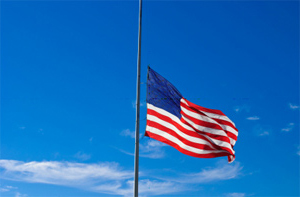
The flags flying at half-staff yesterday brought to mind a childhood grief, but we have moved on from the loss of one man.  What lingers and haunts is the memory of how that man could invite a public trust – “Ask not what your country can do for you…” – and seem worthy of it.  That level of hope and public trust is gone, and I don’t see it coming back.

More than a man, that is what I found myself mourning yesterday.

HalfStaffFlagNotification

101 Things that Made America

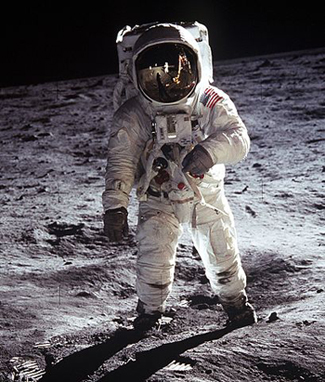
Apollo suit.  NASA photo, Public Domain

Apollo suit. NASA photo, Public Domain

The Novermber, 2013 issue of The Smithsonian Magazine is devoted to 101 things that made America.  The magazine lists 33 contributors who chose these items from among the 137 million artifacts housed in 19 Smithsonian museums and research centers.

Animals, vegetables, and minerals are represented, and the objects chosen evoke the range of both light and dark aspects of our history.  The opening photograph of a stuffed buffalo is as sad as it is iconic, and the inclusion of the Enola Gay, the plane that dropped the first atom bomb, reminds us that weapons of mass destruction are part of what made us what we are.

The chosen artifacts include:

– The Lewis and Clark Compass (1804). At a cost of $5, it wasn’t cheap, but it survived the 7,000 mile trip.

– A California Gold Nugget (1848)

– Polio Vaccine (1952)

– Abraham Lincoln’s Stovepipe Hat (1865)

– Barbie Doll (1959)

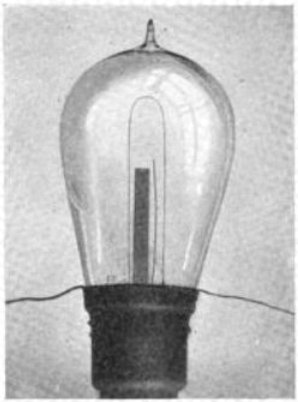
Edison Light Bulb.  Public Domain.

Edison Light Bulb. Public Domain.

– Louis Armstrong’s Trumpet (1946)

– Glass Shards from the Birmingham Church Bombing (1963). Barely a month after Dr. King’s “I Have a Dream,” speech, a bomb blast killed four African-American girls at their sunday school. Outrage over the murder of children at church lent a powerful impetus to the civil rights movement.

– Birth Control Pills (1965)

– The original, tattered Star Spangled Banner that flew over Fort McHenry during the War of 1812 and inspired Francis Scott Keys to compose the national anthem.

– Table and Chairs from Appomattox Court House, where General Lee surrendered to General Grant to end the Civil War (1865)

– The Model T Ford (1913)

– Section of a California Costal Redwood tree.

– Passenger Pigeons: Once there were billions of these birds, but 19th century communities slaughtered them to bake in pigeon pies. The last surviving bird died in 1914 and is stuffed in the Smithsonian.

– The Eniac Computer (1945). I would have chosen an Apple IIE, or even a TRS-80, since it was personal computers, not this behemoth, that changed the world.

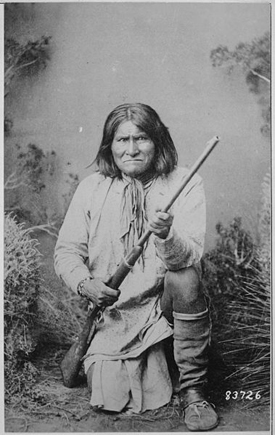
Geronimo, 1887.  Public Domain

Geronimo, 1887. Public Domain

This photograph of Geronimo, taken in 1887. The previous year, Geronimo surrendered his small band and was transported from his beloved Arizona to Florida. He spent the rest of his life in federal prison, though in 1905 he was brought out to ride in the inaugural parade of Theodore Roosevelt. His request to the president to return to his home was denied. On his deathbed in 1909, he reportedly said, “I should have fought until I was the last man alive.”

– Levi’s Jeans (1873)

– Singer Sewing Machine (1851)

– The Colt Revolver (1839)

– Alexander Graham Bell’s Telephone (1876)

– Wright Brothers’ Airplane (1903)

– The Huey Helicopter (1966).  Think of the “Ride of the Valkyries” scene in Apocalypse Now

– Section of the Aids Quilt (1987)

– The first Kodak camera (1888)

– Stage Coach (1851).  I would have included a covered wagon.

– The Teddy Bear (1903).  During a hunting trip in Mississippi, President Theodore Roosevelt refused to shoot a bear that guides had tied to a tree.  This inspired a political cartoon which featured a wide-eyed cub, and led to the toy that is still found in millions of nurseries.

Vintage Teddy Bear by David Crane, 2003, CC BY-SA-2.0

Vintage Teddy Bear by David Crane, 2003, CC BY-SA-2.0

– Ruby Slippers – the ones that Judy Garland wore to take us home in the 1938 Wizard of Oz.

– R2D2 (1983). Here’s the fun story from the Smithsonian Magazine: when filmmaker, George Lucas was finishing production of American Graffiti, the sound designer called for “R2-D2,” which meant, “Reel 2, Dialogue 2.” Lucas, who was already working on Star Wars, said, “What a great name!”

***

This is just a partial list.  You can see all the choices on the website.  No two people are likely to agree on all the artifacts.  What do you think is missing?  Which items should be dropped?  And for those who live in other countries, what are some of your key artifacts and their stories?

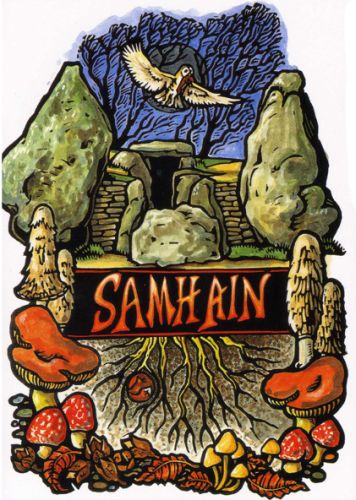
Samhain ~ The Beginner’s Guide To The Wheel Of The Year

Here is another of Lily Wight’s fine articles on the Celtic Wheel of the Year. This one discusses Samhain, a time of ending and beginning, when the veil between the worlds was especially thin. This is key information for those who love Celtic mythology as well as providing fun background for those who love Halloween.

Lily Wight's avatarLily Wight

     Updated 23/10/2014

     Samhain – pronounced “sow – inn” and known presently as Halloween – is celebrated from sunset to sunset on 31st October to 1st November.  It is the most important Fire Festival or Sabbat on the ancient Wheel of The Year calendar.

     “Samhain” has been variously translated as “first frost” or “Summer’s end”:  opposing suggestions with the same meaning.  It is the name for November in ancient and modern Gaelic.

     Samhain lies between The Autumn Equinox and The Winter Solstice.  It marks the death of the year and the end of the annual agricultural cycle.  Many ancient cultures throughout The Western Hemisphere regarded Samhain as their New Year’s Eve.

     Samhain is the third and final harvest on The Wheel of The Year calendar.  After Lughnasadh (grain and cereals) and Modron (fruit and vegetables) herding…

View original post 428 more words

Ship of Fools

Ship of Fools.  German woodcut, 1549

Ship of Fools. German woodcut, 1549

I’m sure it won’t surprise anyone to learn that this is my second post of this title in two years.

“The ship of fools is an allegory that has long been a fixture in Western literature and art. The allegory depicts a vessel populated by human inhabitants who are deranged, frivolous, or oblivious passengers aboard a ship without a pilot, and seemingly ignorant of their own direction.“Wikipedia

The Wikipedia entry documents the origin of this image in a method that Renaissance people developed to rid themselves of their mentally challenged fellows.  As Michel Foucault put it in Madness and Civilization, “they were put on a ship and entrusted to mariners because folly, water, and sea, as everyone then ‘knew’, had an affinity for each other.”

OK, I gotta say it – don’t you wish we could send all members of the Federal government off on a Carnival cruise and hope the engine stalls at sea?

“Ship of Fools” has been a recurrent image in literature, art, and music for 500 years.  Somehow it’s comforting to to know that folly and madness are nothing new, even – or perhaps especially – at the helm of the Ship of State.