Njal’s Saga, part 2

Map of Iceland, 1761. Public domain.

A man named Hrut had a stepbrother named Hoskuld.  One day Hoskuld held a feast and Hrut was there.  Hoskuld called to his daughter, Hallgerd, who was playing on the floor with other girls.  Hallgerd “was tall and beautiful, with hair as fine as silk and so abundant that it came down to her waist.”

Hoskuld asked Hrut what he thought of his daughter.  Hrut didn’t answer at first so Hoskuld asked again.  Hrut finally said,  “The girl is quite beautiful, and many will pay for that, but what I don’t know is how the eyes of a thief have come into our family.”

For a long time after that, the brothers did not speak to each other.  Hoskuld sent his daughter to a man named Thjostolf to foster her.  “It was said that he did nothing to improve Hallgerd’s character.”

***

As we meet Hallgerd at the opening of the saga, and several important themes begin to unfold.

  • Character is fixed and largely immutable.  Our culture is built on the notion of repentance and change – “I once was lost but now I’m found,” but this is absent from the nordic pagan worldview.  Hallgerd will start a bloody feud with another woman’s family in the first part of the story.  Even when her intentions are good, chaos follows in her wake.  She will have three husbands; each will think he can handle her, and each will die a violent death.
  • Another important theme is the equality of women.  In no other medieval tradition have I seen women with foster fathers.

***

Hallgerd’s uncle Hrut became engaged to a woman named Unn, but before the wedding, like many young Icelandic men, he travelled to Norway to seek fame and fortune.  He won an honored place in the king’s court and captured a fair amount of booty after defeating a group of vikings in a sea battle.  Most importantly for the story, the king’s mother, Gunnhild invited him to her bed.  This was an offer he couldn’t refuse (though he didn’t seem to want to), for not only did Gunnhild have the ear of the king, but she was skilled in magic.

When it was time for Hrut to leave, Gunnhild asked if he had a girl back home.  Hrut said he did not.  Gunnhild put her arms around him, kissed him, and said, “I cast this spell:  you will not have sexual pleasure with the woman you plan to marry in Iceland, though you’ll be able to have your will with other women.  Neither of us comes out of this well, because you did not tell me the truth.”

Hrut married Unn, but because of the curse, he could not please her sexually.  After conferring with her father, Unn divorced Hrut, but he kept her dowry,  creating a seed of conflict that reverberates through the story.

***   

More important themes appear:

  • Consistently in this saga, characters act in ways contrary to common sense and their own best interest.  Hrut knows Gunnhild is a prophetic sorceress.  Why would he deny having a girl back home, when there’s no indication that she even cares before he lies?  Perhaps the author appreciates how confused we can get at critical moments.  Perhaps everyone who has ever had a “What was I thinking” moment can identify with Hrut.
  • Related to this is the place of magic in the saga – it exists, but on the periphery, and when it appears, it’s a two-edged sword at best and harmful most of the time.
  • Once again we see the equality of women.  Both men and women can divorce their spouse by simply declaring themselves divorced in front of witnesses.
  • Romance and sexuality are not central to the saga, except as inciting incidents, but when they occur, they are dealt with in a frank and earthy manner.  When Unn’s father sees his daughter moping after her marriage, he persuades her to speak.  Unn says, “When he comes close to me, his penis is so large that he can’t have any satisfaction from me, and yet we’ve both tried every possible way to enjoy each other, but nothing works.”  The audience would not have been shocked, though it’s easy to imagine snickers and winks as the mead was drunk in the hall.

***

About the time Hrut returned from Norway, Hoskuld arranged a marriage for his daughter, Hallgerd.  In those days, women were charged with running the household and ensuring there was food for the family and retainers through the long winters.  Hallgerd was “bountiful and high-spirited,” and when her husband, Thorvald, berated her for running short of food, Hallgerd insulted him.  He struck her and stalked out of the house.  When Hallgerd’s foster-father, Thjostolf, saw her bleeding, he set off after Thorvald, and killed him.

Hallgerd was married a second time, to a man named Glum.  Though she loved him, a day came when “they had a strong exchange of words” and Glum struck her.  Once more, though she begged him not to, her foster-father killed her husband.

At this point, we meet the first of two principle characters in the story.  Gunnar of Hlidarendi fit the ideal of the nordic warrior.  He was “big and strong and an excellent fighter.  He could swing a sword and throw a spear with either hand…and he was so swift with a sword that there seemed to be three in the air at once.  He shot with a bow better than anyone else, and…he could jump higher than his own height, in full fighting gear…He swam like a seal and there was no sport in which there was any point in competing with him.”

After describing his martial skills, the narrator adds that he was a hunk and “very well off for property.”  As we get to know Gunnar, we find that his character matches his resume.  He’s a generous, open hearted man, honorable to a fault, and a warrior who doesn’t like to fight.  He’s related to Unn, however, and when he recovers her dowry by force, he begins to make enemies, including Unn’s second husband, another of the “bad seed” characters that populate the saga and guarantee that Gunnar will have to fight.

Gunnar at the Ranga River, where he and his two brothers defeat 30 men. 1898 illustration. Public domain.

Gunnar’s close friend, Njal supplies the wisdom Gunnar sometimes lacks. Njal (pronounced knee-AHL) was “well off for property and handsome to look at…so well versed in the law that he had no equal, and he was wise and prophetic, sound of advice and well-intentioned, and whatever course he counselled turned out well. He was modest and noble-spirited, able to see far into the future and remember far into the past, and he solved the problems of whoever turned to him.”

The strange thing about Njal was his inability to grow a beard.  Though he fathered three sons and three daughters, his enemies used this anomaly to suggest there was something lacking in his manhood.  It seems to me that legendary seers, from Tiresias to Merlin to Black Elk are always lacking in some of the cultural norms of manhood.  In particular, Njal never fights though he counsels those who do.  He and Gunnar make up for what the other lacks.  Both prospered, in large part, because Gunnar followed Njal’s advice – up until the day he met Hallgerd.

Gunnar and Hallgerd at the Althing, (the National Assembly). 1898 illustration. Public domain.

The day they met, Gunnar and Hallgerd “talked for a long time.”  Then Gunnar sought out her father to ask for her hand in marriage.  Njal told Gunnar,”Every kind of evil will come from her when she moves east.”  This time Gunnar didn’t listen to his prophetic friend.

To Be Continued
Photographs from Iceland

We are back from a week in southern Iceland, which we spent studying one of the great sagas with a small group of storytellers.  We also visited places where this thousand year old drama unfolded. I’ll speak of Njal’s Saga in future posts, but here are a few pictures of the striking Icelandic autumn.

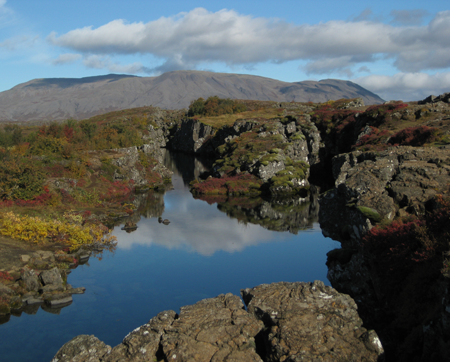
Pool at Thingvellir

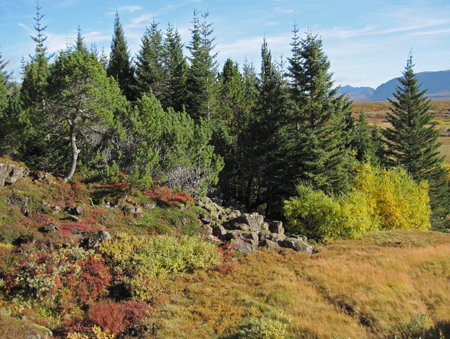
A thousand years of volcanic eruption and cutting trees for heat stripped most of the native birch and willow forests.  A joke we heard several times is, “If you get lost in a forest in Iceland, stand up.”  Reforestation efforts are underway, but meanwhile shrubs and even some of the lichen that covers the boulders provide dramatic fall colors.

Thingvellir Park. Photo by Mary

Pines are not native to Iceland, but this stand, planted by the government at Thingvellir Park, made a welcome spot for a picnic.

Thingvellir from the cliffs above.

The Law Circle, where the National Assembly met every summer, stands behind the church (a later addition).  Beginning in 930, the Icelanders’ efforts to govern by rule of law was key to the life of the nation and to Njal’s Saga as well.

Njal’s Saga, like The Illiad, is based on historical incidents and people.  This historical marker, along the Ranga River, marks the spot where a key character, the consummate warrior hero, Gunnar Hamundarson, was attacked by 30 men while riding home with his two brothers. The Hamundarson’s killed 14 attackers, but Gunnar’s youngest brother, Hjort died in the battle. In a nearby burial mound, archeologists found a ring engraved with a stag; the name Hjort means “stag.”

Hlidarendi with Eyjafjallajökull in the background

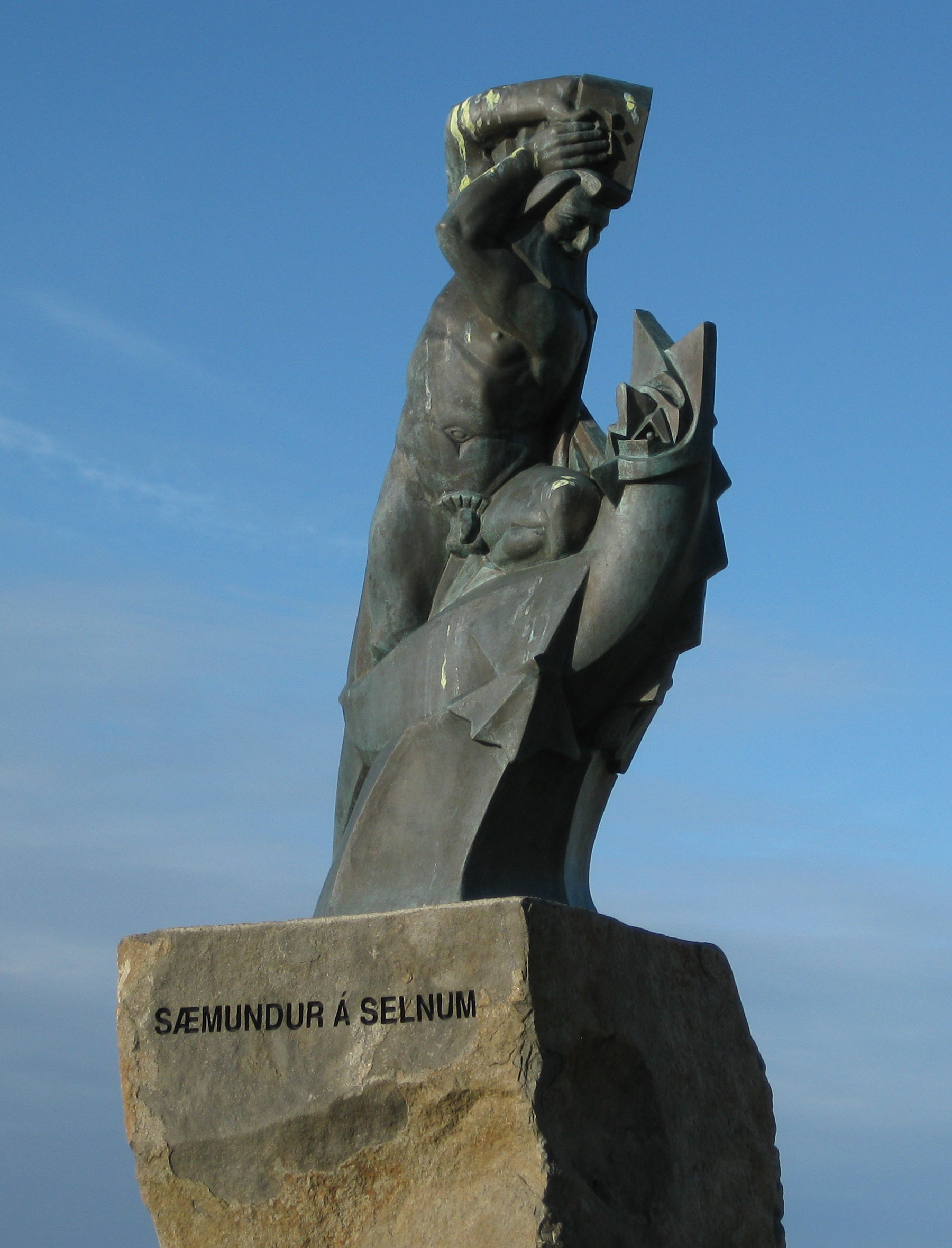
Gunnar lived and died at a farmstead in Hlidarendi, a name that means “Hill’s end.” This is where the highlands slope down to the coastal plain. The green area with a pine border in the middle ground is Nina’s Grove, a park and sculpture garden in honor of Nina Saemundsson (1892-1965), a world-renowned Icelandic sculptor who was born in Hlidrendi, but also spent 30 years in the US. Her statue, The Spirit of Achievement was placed over the entrance of the Waldorf Astoria hotel in New York.

In the distance is Eyjafjallajökull (Icelandic for “Island, mountain, glacier), which erupted in 2010. An explosion of lava blasting through a 700 meter thick glacier created tons of ash that blew toward the continent and stopped European air travel.

View from Nina’s grove over the coastal plains, to islands (on the right horizon) in the Atlantic

This view over the coastal plains shows a view of Nina Saemundsson’s sculpture of a mother holding two children.

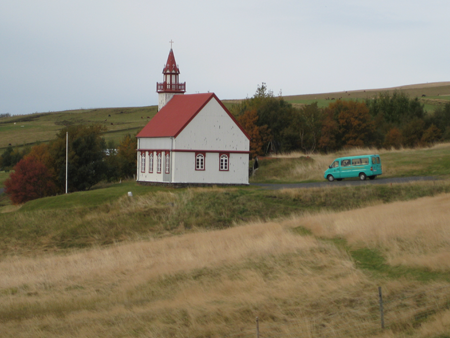
The church at Hlidarendi and a view of the little green van we toured in. Much of the information here came from our driver, who spoke excellent English. He tried to teach us how to pronounce “Eyjafjallajökull,” with little success.

To be continued.

Saemundur the Learned

Saemundur Sigfusson (1056–1133) was an Icelandic scholar, priest, and according to legend, sorcerer, who founded an important center of learning at the southern costal town of Oddi. He was known to have studied abroad, and many said he’d been at “The Black School,” though no one quite knew where it was. People said the headmaster was the Devil.

Seamunder and his fellow students received a fine education in witchcraft and sorcery, but graduation was iffy. The Devil would grab the last student out the door, and that soul was lost for eternity. Seamunder told his classmates not to worry. He told them to file out first, and then he donned a large overcoat. When the Devil reached out, he caught the coat.  Seamunder slipped free and ran out the door, though as it closed, it injured his heel.

The Devil had it in for Seamunder after that, always trying to trick him. Once Seamunder told the Devil he’d give him his soul in return for a voyage to Iceland in which he never got wet. The Devil took the form of a large seal and told Seamunder to climb on his back. The Devil was careful – not a drip of water touched his passenger. Seamunder spent his time on the Devil-seal reading his psalter, and as they neared the shore, he began to beat the seal with his prayer book. Startled, the seal dove under water, Seamunder got dunked, and made his way to the shore near Oddi, a free man.

Seamunder beats the seal with his psalter – statue in the churchyard at Oddi

Legend has Seamunder playing numerous other tricks on the Devil, who is always portrayed as honest and not quite the sharpest tool in the shed.

This information comes from a pamphlet designed by the Oddi Society. Founded in 1990, the Society’s goal is to make Oddi a center of learning again, this time with an emphasis on the environment as well as Icelandic heritage and culture.

A visit to Iceland continued

Gullfoss (Goldwater) falls, southern Iceland

It’s hard to pack for cold weather when it’s 90 degrees, as it was at home before we left. We did pretty well, but today was a challenge. Snow ringed some of the nearby hills as we left for the Gullfoss falls – not the largest in Iceland, but the largest that is easily accessible. The temperatures were below freezing as we climbed down the stairs from the overlook to the level where I took this picture. Rain, wind, and frozen spray from the falls drove us into the heated gift shop, where “California Girls” by the Beach Boys played on the radio.

We stopped down the road at Geysir, home of the geyser named Geysir that gave geysers their name. Is that clear? Geysir itself has grown quiet, erupting only infrequently, but there are many other geysers there, including Strokkur, which erupts at five minute intervals. In the cafe at Geysir, the Stones and the Doors were playing.

Strokkur quiescent

Strokkur erupting

According to Wikipedia, Iceland has about 23 days of rain in September, which fits our experience. Our one sunny day came during our trip to Thingvellir, which not only gave us a chance to admire spectacular autumn colors, but also to explore a spot that is key to Icelandic sagas and to the history of the nation.

Iceland was settled in 870. Sixty years later, the settlers, mostly vikings, formed a national assembly at Thingvellir, on land that was confiscated from a man who was outlawed for murder.

In the best known Icelandic saga, Njal (pronounced NEE-ahl, from Neal, an Irish name) says, “With law our land shall rise but without law, it will perish.” The assembly moved to Reykjavik in 1798, but a quarter of the population met at Thingvellir in 1944 to declare independence from Denmark.

As we left the cafe at Geysir, “Aquarius” came on the radio. “No way!” one of us said, but there it was…

Skalholt, Iceland

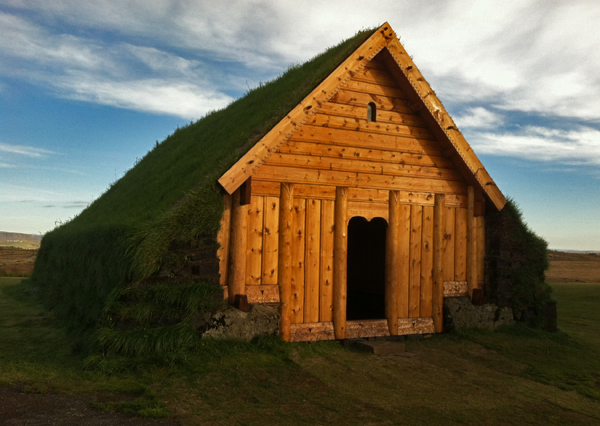
The view out my window is Skalholt Cathedal and this reconstructed chapel which is part of an archeological dig at one of Iceland’s key historical sites.  On the horizon behind the chapel likes Hekla, one of Iceland’s most active volcanoes.  In the middle ages, Europeans called it the Gateway to Hell.  Hekla last erupted in February, 2000, but with luck, it will continue to sleep through the rest of the week.

Mary and I are here for a different type of archeology – a dig into an ancient tradition of story.  We are here with three other storytellers to explore Njal’s Saga, the account of a feud with tragic consequences, not unlike the American tale of the Hatfields and the McCoys.  In both cases, events are based in history; we’re visiting some of the key locations mentioned in the saga.  Njal was shaped by an anonymous author into the masterpiece of a unique tradition that influenced Tolkien, among others.

Meeting of the continents: the North American tectonic plate (left) meets the Euro-Asian plate at Thingvellir, Iceland.

This week of the equinox, the temperature drops to freezing at night, but the guesthouse where we are staying is warmed by geothermal energy, by water bubbling up from hot springs that is shipped through pipes to cities and settlements throughout the island. Iceland is 99% energy independent.

I’ll have more to reflect on in future posts, but meanwhile it is seven hours later than west coast time – tomorrow is almost here, so it’s time to log out.  Please enjoy your week and stay tuned for future posts.

This day in history: the battle of Antietam

Near Dunker’s Church, Antietam. Photo by Alexander Gardner. Public domain.

One hundred and fifty years ago today, Union and Confederate forces clashed at Antietm Creek, near Sharpsburg, MD, in what remains the bloodiest day in American history.  By sunset, 23,000 men lay dead or wounded.  They fell in a cornfield, along a sunken road, and beside a stone bridge – places where George B. McClellan’s Army of the Potomac confronted Robert E. Lee’s Army of Northern Virginia in the latter’s first incursion into Union territory.  Based on opposition to the war in the north, Lee assumed – perhaps correctly – that a southern victory in Union territory might push the Federal government to peace negotiations.

In one of those moments in history that seem providential in retrospect, on the morning of Sept 13, Corporal Barton W. Mitchell of the 27th Indiana Volunteers found a packet of three cigars wrapped in what proved to be a copy of Lee’s battle plan.  Understanding the importance of his find, Corporal Barton sent the papers up through the ranks.  Upon reading them, McClellan was gleeful and said, “Here is a paper with which, if I cannot whip Bobby Lee, I will be willing to go home.”  He moved his army to intercept Lee near Sharpsburg.

Lee’s army of 55,000 was outnumbered 2-1, but the ever-cautious McClellan committed only 3/4 of his forces, allowing Lee to match him by shifting his own troops across the field as the advantage swung back and forth.  There was no clear winner.  After skirmishes throughout the following day, Lee withdrew from Maryland.

Lincoln fired McClellan for failing to pursue Lee, yet driving the southern troops from northern soil was victory enough for the president to release the Emancipation Proclamation.  Lincoln had been waiting for a northern victory to free the slaves, so the move would not be interpreted as a sign of desperation.  He had a long wait, for the south was largely unbeaten early in the war.  Though abolitionists criticized Lincoln for delaying emancipation, Antietam marked the moment when the war became about something greater than simply preventing secession.

One other consequence of the battle was the publication of battlefield photographs by Alexander Gardner.  Within a month of Antietam, civilians saw the price the soldiers were paying.

Confederate dead in the sunken road. Photo by Alexander Gardner. Public domain.

It’s always moving and worthwhile to remember the sacrifices earlier generations made in the name of ideals that underpin our way of life.  Especially in our current election year, characterized in the media as full of divisiveness, when we remember Antietam, we can reflect how the nation has experienced and overcome divisions far deeper than any we see today.

If Gardner’s photos preserve the tragedy of the civil war, the following clip immortalizes resilience, strength, and hope.  Taken in 1938, on the 75th anniversary of the Battle of Gettysburg, it shows veterans of the north and south meeting again at the wall on Cemetery Ridge – in a very different spirit than their first encounter.

A brief history of Labor Day

Labor Day Parade, New York, 1882. (Public Domain)

Labor Day was first proposed as a national holiday in 1882, by one of two members of early labor unions (historians are not sure which one).  Some say the idea came from Matthew Maguire, a New York machinist and secretary of the Central Labor Union.  Others credit Peter J. McGuire, of the American Federation of Labor, who had seen a Canadian labor festival in Toronto.

Oregon was first to make it a state holiday in 1887.  In the next few years, 29 more states did the same, but Labor Day did not become a national holiday until after the bloody Pullman strike of 1894.

The trouble began in May, 1894, when 4000 employees of the Pullman Palace Car Company protested a reduction in the wages, sixteen-hour workdays, and high rents in the company town of Pullman, IL.  Company owner, George Pullman refused to talk to the workers.  The workers struck, and in June, members of the American Railway Union, led by Eugene Debs, announced a boycott, refusing to switch Pullman cars onto trains.  Within a few days, 125,000 workers on 29 railroads had walked off the job rather than handle Pullman cars.

After a peaceful rally led by Debs in Blue Island, IL, some groups of workers set fire to buildings and derailed a locomotive.  Across the country, workers in sympathy with the strikers blocked the transportation of goods, and attacked strikebreakers.  President Grover Cleveland sent U.S. Marshalls and 12,000 army troops to break up the strike.  They fired on crowds, and before the disturbance was over, 13 workers were dead and 57 wounded.

Troops fire on Pullman strikers, 1894 – Public Domain image

Fearing further trouble, legislation to create a national Labor Day holiday was rushed through congress and signed into law by Cleveland just six days after the strike ended.

Because trains carried the mail, Eugene Debs was accused of conspiracy against the US Postal Service and tried for this and other criminal and civil charges.  After a brilliant defense by Clarence Darrow, he was acquitted of everything except violating an injunction, which carried a six month sentence.  While serving his time, Debs read the works of Karl Marx and became a socialist.  He ran for president on the socialist ticket in 1900.

Eugene Debs, 1912 (Public domain photograph)

During the strike, Illinois governor, John P. Altgeld had offered the President the use of the Illinois National Guard to maintain order.  He was incensed that Grover Cleveland ignored his  plan and put federal troops at the service of company management.  Altgeld used his influence at the 1896 Democratic convention to deny Cleveland a second nomination for president.

President Grover Cleveland (Public domain photograph)

A federal commission found the Pullman company’s town to be “unAmerican,” and in 1898, the Illinois Supreme Court forced it to divest.  The township was annexed by the city of Chicago.

When George Pullman died in 1897 he was buried at night in steel-reinforced crypt, surrounded by tons of concrete, in fear that veterans of the strike might try to desecrate his grave.

***

A friend who is active in a hospital union  insists we have to remember that people died to win us an eight hour day, vacations, health care, pensions, and other benefits workers could only dream of 100 years ago.  Employers didn’t give us these things from the goodness of their hearts.

It’s safe to say that western nations would not have a middle class without the efforts of organized labor.  And it’s no coincidence that both institutions are now on the ropes.

Something to think about this Labor Day.  Those who forget the past…

Man on the moon

Neil Armstrong on the Moon. (NASA photo, public domain)

There are moments we always remember.  Sadly, most of them are bad, like Pearl Harbor for my parents’ generation and September 11 for us.  Sometimes, however, the news is good, even fantastic.  Those of us who remember July 20, 1969 will never forget the thrill, the surge of optimism when Neil Armstrong stepped onto the moon.

I was driving home from the bay area yesterday afternoon when the radio said he had died at the age of 82.  In an instant, memory carried me back  back to a restaurant in Yosemite 43 years ago.  I was  up there for the summer, working to earn money to buy my first car.  It was slow at 4:30 that afternoon – the dinner crowd wouldn’t arrive for another hour.  The whole crew gathered in the kitchen where someone had placed a portable black and white TV with rabbit ears.

Later that evening, a friend and I lay on the ground near the river, gazing up at the summer moon, which was full that night, trying to wrap our imaginations around it.  The night was warm.  We lay there, not saying very much, until it was late.

Neil Armstrong. Photo by NASA, Public Domain

Several people who knew Neil Armstrong spoke on the radio.  A friend of his noted of the irony of a man who stood in the world spotlight but was one of the shyest and most retiring people she ever knew.  Everyone mentioned his patriotism and courage, as a combat pilot, a test pilot, and finally as a man who went where no one had gone before.

There are times in adolescence when we think we can do anything, like get a job in the mountains and earn enough money to buy a car.  There are times when nations believe they can do anything, like put a man on the moon.  The webs of cause and effect are far too complex to sort out, but both individual and collective achievements begin with strong intentions.  Even when we set out to find X and discover Z instead, some determination got us moving.

Neil Armstong seems to have been a decent and courageous man.  Now he is even more than that.  His smile from space will always remind us of how barriers can fall and new frontiers can be gained when we are motivated by deep and unswerving intention.