Ancient Mayan Newsflash: The World is Not Going to End in December

We can all breathe easier on this score, according to a recent find at Xultan, in northeast Guatemala.  Archeologists discovered a wall in a small room that seems to have functioned as a blackboard for Mayan astronomers.  The 1200 year old calculations represent the oldest known Mayan astronomical tables, suggesting a future at least 6,000 years long.

Courtesty, National Geographic.

“Why would they go into those numbers if the world is going to come to an end this year?” asked Anthony Aveni of Colgate University, an expert on Mayan astronomy.  Aveni and others published their findings Friday, in the journal, Science.

Independent researchers call the find very significant.  The results of Mayan calculations of moon phases and the position of the Sun, Mars, and Venus were known from public monuments, but up until now, the means of calculation were unknown.  Aveni suggests the scribes may have been  “geeks … who just got carried away with doing these kinds of computations and calculations…”

Rain forest location of the find – Courtesy National Geographic.

At the end of the year, when we no longer have the the elections to worry about, and all your friends are starting to think of apocalypse, you can tell them about the Mayan geeks, and suggest they chill.

You can read more about the find here: http://tinyurl.com/cw4aqzx

Identifying a Civil War Soldier

For those interested in Civil War history, there’s a marvelous story on NPR.org today.  A collector and his family donated 1,000 photographs of enlisted soldiers from North and South to the Library of Congress, and reporter, Ramona Martinez tells of her quest to learn the identity of one of these men who intrigued her with his flamboyant uniform and dashing pose.  You can read the story and see the photograph here:  http://www.npr.org/2012/04/11/150288978/unknown-no-more-identifying-a-civil-war-soldier.

The collector, Tom Liljenquist, gave Martinez her first clue, pointing out that the young soldier had carved his initials, T.A., into the stock of his rifle.  At the West Point Museum, Martinez learned that the Zouave-like uniform belonged to just one regiment, the 14th Brooklyn, sometimes called the “Red Legged Devils, for the bright red pants they wore.  The 14th Brooklyn served in some of the fiercest fights of the war, including Antietam and Gettysburg

Martinez plugged this information into the National Park Service’s Civil War Database http://www.itd.nps.gov/cwss/soldiers.cfm, and found just four men with initials, T.A., in the regiment.  A National Archives researcher helped her narrow it down to two possibilities.  Armed with vital statistics, including the height of the men, Martinez found an antiques dealer in Gettysburg who owned a musket like the one shown in the photograph.  Using the gun as a yardstick, they identified the soldier as Thomas Ardies, who stood 5′ 4 1/2″ tall.

Ardies was wounded at Chancellorsville, but survived the war.  He emigrated to Canada, where pension record notes, “He was always considered a bachelor by all who knew him in the community where he was widely known and most respected.”  Ardies married at age 75, five years before his death, and is buried in Ontario.

Those who have followed this blog for a while know I am fascinated by Civil War history.  Ramona Martinez search for the details of one private soldier’s life highlight an area that’s not as well known as the stories of generals and major campaigns.

I wonder a lot about the lives of private soldiers, during and after the war.  The battles were as horrendous as those of the First World War fifty years later, but history does not record a “lost generation” after the earlier conflict.  Bitterness, economic hardship, and instances of violence,yes, but not the world-weariness that characterized veterans of later wars.  More Viet Nam veterans died of suicide after the war than were lost on the battlefields – nothing like that happened after the Civil War.

We always see history through the filter of our own sensibility.  It’s easy for us to believe the casual brutality we find in the pages of Cold Mountain. It’s harder to imagine the idealism we see in pictures of men like Thomas Ardies.  Maybe that’s why the old photographs are so haunting.

A Great Site With Free Books, Courses, Movies, and More

http://www.openculture.com/

How about a website with four hundred free online classes from well known universities like:

  • “Introduction to Visual Thinking,” from Berkeley
  • “Virgil’s Aeneid,” taught by a Stanford professor
  • “Game Theory,” from Yale
  • “Science, Magic, and Religion,” from a class at UCLA

What if the same website had classical audio books:

  • Poets like Eliot and Ginsberg reading their own work.
  • MP3’s of numerous authors:  Jane Austen, Charles Dickens, Fitzgerald.  Mary Shelley, Frank L. Baum.  Wanna hear Beowolf, The Iliad, or Moby Dick on the morning commute?
  • Or perhaps as you sit there in traffic you’d like to while away the time with Gibbon’s complete Decline and Fall of the Roman Empire.

On open culture you will also find free ebooks by a similar set of authors.

And 450 free movies, much like you see on TCM, but with some hard to find gems, like Luis Bunel’s 1930’s surrealist classic, L’age d’Or, or the 1902 French science fiction clip, A Voyage to the Moon.

On Openculture, you can also find free language lessons, free textbooks and other goodies.

But wait, there’s more!

I found the Openculture link on a wonderful WordPress Dailypost by Sylvia V., who lists a total of six sites where she goes for inspiration.  Now, thanks to her info, we can do the same.  http://dailypost.wordpress.com/2012/02/07/inspiration-that-clicks/

Sabre Rattling Over Oil: Better Get Used to It

The juxtaposition of headlines this morning was strange but telling.  On page one of the Sacramento Bee, under the heading of “Tourism,” was the story of Virgin Galactic, a travel company that expects to offer 2.5 hour rides into space, starting as soon as next Christmas, for a mere $200,000.

You might want try to lock in your price now, before it goes up.  Buried back on page seven was this headline:  “Risk of showdown with Iran escalates as oil prices climb.”  According to Andrew Bacevich, in a 2008 interview with Bill Moyers, we can expect a constant string of oil crises; the choices we make as a nation make them inevitable.  There’s a price to pay for cheap space travel, among other things.

Andrew Bacevich

Bill Moyers 2008 interview with Bacevich is published in, Bill Moyers Journal: The Conversation Continues, (2011).  In the preface, Moyers says, “Our finest warriors are often our most reluctant warmongers.”  Bacevich is a West Point graduate and Vietnam veteran who retired as a colonel after 23 years in the military, to teach history and international relations at Boston University.  Bacevich’s son, Andrew, died in Iraq in 2007.  Bacevich is the author of several books, including the best selling, The Limits of Power:  The End of American Exceptionalism (2008).

In his interview with Moyers, Andrew Bacevich doesn’t pull any punches.  He says our foreign policy, including our wars:

“reflect the perceptions of our political elite about what we the people want.  And what we want, by and large, is to sustain the flow of very cheap consumer goods.  We want to be able to pump gas into our cars regardless of how big they happen to be…and we want to be able to do these things without having to think about whether or not the books balance at the end of the month…”

To our list of wants we can now add, “affordable” space travel, with its guaranteed 5.5 minutes of weightlessness.   As an ex-miltary officer, Bacevich points to the dark side of this, something you never hear in presidential debates, and don’t often see anymore on the front page of the paper.

One of the ways we avoid confronting our refusal to balance the books is to rely increasingly on the projection of American military power around the world to maintain this dysfunctional system.”

The biggest elephant in the living room is our dependance on foreign oil.  Without oil, Bacevich notes, the middle east has “zero strategic significance.”  Every president since Richard Nixon has promised to address our dependance on foreign energy, and Jimmy Carter staked his political career on finding a solution.  Bacevich paraphrases Carter’s speech in 1979:

“If we don’t act now, we’re headed down a path along which not only will we become increasingly dependent upon foreign oil, but we will have opted for a false model of freedom.  A freedom of materialism, a freedom of self-indulgence, a freedom of collective recklessness.  The president was urging us to think about what we mean by freedom…Carter had a profound understanding of the dilemma facing the country in the post-Vietnam period.  And of course, he was completely derided and disregarded.” 

When Moyers asked him about the realities of al-Qaeda and radical Islam, Bacevich replied that yes, they are violent and dangerous, but are “akin to a criminal conspiracy…Rooting out and destroying the conspiracy is primarily the responsibility of organizations like the FBI, and of our intelligence community, backed up at times by Special Operations Forces.  That doesn’t require invading and occupying countries.”

At the end of the interview, Bacevich, who defines himself as a conservative, says he hopes we will come to understand the war in Iraq as a great mistake.  And rather repeat the mistake in Iran or anywhere else, hopes we will “look at ourselves in the mirror.  And…see what we have become.  And perhaps undertake an effort to make those changes that will enable us to preserve for future generations that which we value most about the American way of life.”

You can read the full text of the interview with Andrew Bacevich in Bill Moyers Journal, along with many other provocative talks with thinkers and artists across the spectrum of contemporary life.

Of Greensleeves and Christmas Carol Karma

Regular readers will recall that at the start of the  season, I posted a wee diatribe on how much I hate what passes for Christmas music in most of the stores. http://wp.me/pYql4-1tv

Here’s where karma part comes in:  Mary is organizing a Christmas dinner for a large number of people at a local church.  I already volunteered to help with food prep, but the other day she gave me a further assignment.   “I need you to make a three hour playlist of Christmas music, and it has to be respectful.”

That actually is not a problem.  I love Christmas music – if I didn’t, the stuff in the stores wouldn’t bother me.  As I started to rummage through what I have on iTunes, I got caught up in listening to various versions of “Greensleeves,” and wondering – even though I love the song – what it has to do with Christmas.  Tracking its origins was not unlike researching a folktale.  I also found that everyone from Homer Simpson to John Coltrane has covered it, so I invite you to have a listen as I share a bit of what I learned about this haunting song.  Let’s begin with Homer (relax – his clip is only 14 seconds long).

Greensleeves is a traditional English folksong, of the sort known as a “romanesca.”  A broadside ballad of this name was registered at the London Stationer’s Company in Sept., 1580, as “A New Northern Dittye of the Lady Greene Sleeves”.  A broadside was a ballad or poem, printed on one side of a cheap sheet of paper and common between the 15th and 19th centuries.  Here is a traditional version, sung by Méav Ní Mhaolchatha’s on the Celtic Woman tour:

There’s a persistant rumor that Henry VIII wrote the song while courting Anne Boleyn, since at first she apparently “cast [him] off discourteously,” but music experts dismiss the legend.  Greensleeves is an Elizabethan song, composed in an Italianate style that did not reach England until after Henry’s death.

Another common interpretation is that the song refers to a promiscuous woman or a prostitute.  At the time, the color green had sexual connotations.  One translator of Chaucer notes that in the Canterbury Tales, green “was the colour of lightness in love.”  I tend to agree with this interpretation based on what I know of pre-Christian nature religion in the British isles, and the Pan-like “Green Man,” whose face still peeks out at worshipers in many British churches and cathedrals:

Green Man at Dore Abbey, Herefordshire

A reference to Greensleeves in The Merry Wives of Windsor, 1602, suggests both the popularity of the song, and coming from Falstaff, a bawdy interpretation.  The popularity of the song has continued unbroken to the present day.  Here my favorite modern interpretation, by Jethro Tull:

In 1865, William Chatterton Dix wrote “What Child is This,” to the tune of Greensleeves, which made both songs popular during the Christmas season.  Here is the version I’m going to use for the Christmas dinner project.  Josh Groban knows how to stir the soul, and that is something we really need this year.  Elizabethan renditions of Greensleeves have historical interest but tend to be slow and even lugubrious.  Much as I love ballads of trials and woe, this year we need all the hope we can get and the kind of music that can awaken it.

***

I wish each and every one of you a joyous holiday in whatever way you celebrate it.  I’m going to take a blogging break for a week or so, to walk, to read, to meditate, to catch some of the great year end movies, and in general, to simply kick back for R&R.  I will be back right around the new year.

Peace to all of you!

Forgotten Hero Honored – 67 Years Later

At 5:30am on the morning of Dec. 16, 1944, a massive German artillery barrage along an 80 mile front in the Ardenne Forest opened the Battle of the Bulge, the bloodiest conflict of WWII.  The battle, which raged until late January, cost 89,000 American casualties, including 19,000 killed.

Some of the fiercest fighting took place in the Belgian town of Bastogne, at a crossroads the Germans needed to capture in order to split the Allied armies in half.  Bastogne was the town where American general, Anthony McAuliffe, famously answered, “Nuts!” when ordered to surrender.  The town sustained a massive barrage, but never fell, and many stories of heroism later emerged.  This week a forgotten hero was honored – Augusta Chiwy, a Congolese nurse, now 93 years old, who saved hundreds of lives.

Augusta Chiwy. Photo by Clark Boyd

Chiwy’s story came to light, in great part, because of Martin King, a Scottish military historian. King has lived in Belgium for 30 years, interviewed countless veterans of the Bulge, and co-authored a book on the battle. He explained how Chiwy, just 4’8″ tall, repeatedly braved artillery and machine gun fire, in freezing weather, to drag wounded soldiers to safety.  “What I did was very normal,” Chiwy said. “I would have done it for anyone. We are all children of God.”

On Christmas Eve, 1944, an Allied aid station where Chiwy was sipping champagne with the only doctor in town was hit by a German shell.  She was blown through a wall, but afterwards, got up and began helping the doctor, who also survived, tend to the wounded.  Several history books said Chiwy died in the blast, but King did not believe it.  He finally found her living in a retirement home in Brussels.  It took some time before she would speak of her experiences.  King noted that nowadays she would likely be diagnosed with PTSD.

The more he listened to her, the more convinced King became that Augusta Chiwy should be honored for her service.  He began to write the King of Belgium and the US Military.  At last it paid off.  Chiwy was knighted by the Belgian king in June.  General David Petraeus, who once commanded the 101st Airborne, which defended Bastogne, wrote her a letter of appreciation, and earlier this week, she was awarded the US Army’s Civilian Award for Humanitarian Service.

Col. JP McGee, who commands the “Bastogne Brigade” of the 101st Airborne Division, gave her the award and said:

“M’aam, you embody what is best and most kind in all of us…It is an honor to share the stage with you and to be able to say on behalf of US veterans everywhere — thank you. The number of lives that you touched is incalculable. There are men and women in America who would never have a father or grandfather if you hadn’t been there to provide them basic medical care.”

After the ceremony, Chiwy said, “I’ve had a good life. I’ve got my children, and my grandchildren.  And,” she added, pointing to her head with a smile, “I’ve still got my marbles.”

You can listen to the story, here:  http://www.theworld.org/2011/12/nurse-honored-augusta-chiwy/

Sacred Stones in Northern California

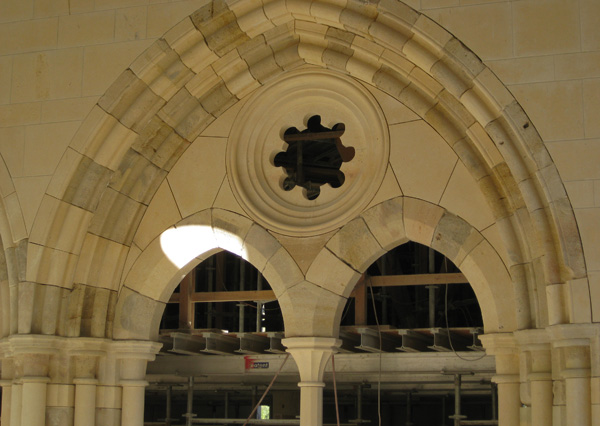
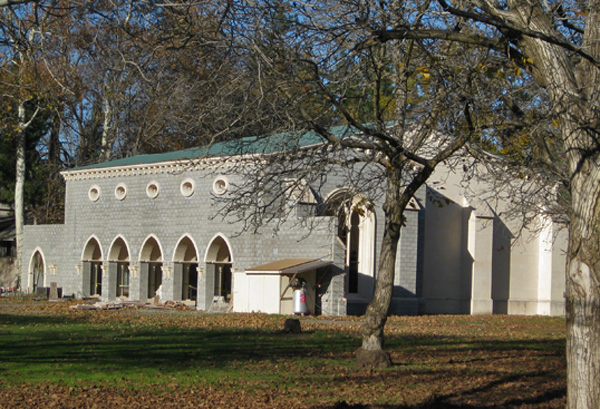
There are only two medieval structures in North America. Now a third is nearing the end of restoration in the small agricultural town of Vina, California, 100 miles north of Sacramento. It’s the 12th century Chapter House of Santa Maria de Oliva, a Spanish monastery that stood near Madrid. This building’s round the world journey makes an interesting tale.

The monks began their day in the Chapter House, where a chapter of the Rule of St. Benedict, an ancient guide to monastic living, was read and interpreted. This went on through the centuries until 1835, when the Spanish government closed all small monasteries and seized their lands. Santa Maria de Oliva was sold to a wealthy family that used the Chapter House to store farm equipment.

In 1931, William Randolpf Hearst bought the Chapter House for $285,000, intending to use the stones in the interior of a house he planned near Mt. Shasta. All the stones were marked for reassembly, and sent to California on 11 separate ships. The depression and WWII delayed Hearst’s plan, and in the end he donated the stones to the City of San Francisco to erect a Medieval museum in Golden Gate Park. This never happened and the stones lay outdoors in the park. Many were damaged, lost, or used for other projects

Meanwhile, the Cistercian Abbey of New Clarvaux was founded in Vina in 1955, and the first abbot began to make inquiries. In 1994, the Fine Arts Museums of San Francisco gave the stones to New Clarvaux with the stipulation that reconstruction begin in 10 years and the completed Chapter House be open to the public.

I first went to New Clarivaux in 1998 to stay for a few days at their retreat facilities. It’s an amazing place to unwind, and I have been there a number of times, so I saw the foundation of the Chapter House laid in 2001.

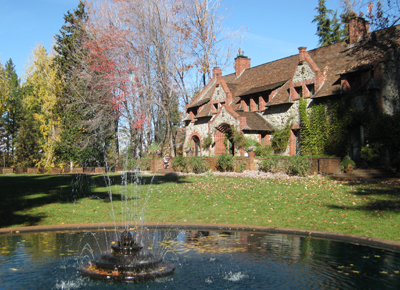
Section of New Clairvaux guest rooms

I had not been there recently, however, so when I drove up this past weekend, I found the structure was almost done – almost meaning another 18 months in a 10 year effort. Only 40% of the original stones were usable. The rest had to be repaired or replaced by stonemasons the abbey employed (they’ve raised $6.3 million to date, largely through small donations from across the country).

Master stonemason, Frank Helmholz, left Vina in November, bound for Luxor, Egypt, where he will spend the winter restoring a 3,400 year old temple. He plans to return to Vina next May. In an interview for the abbey newsletter, Helmholz said:

“In this modern age when everything is done fast and often doesn’t last long and serves no higher purpose, carving stones is a bit of a refuge. To create something that takes patience, dedication, and is lasting is very rewarding. And serving the monks in their spiritual lives gives a greater sense of meaning that is rare nowadays…to be part of something that has a higher purpose than one’s own comfort is inspiring in whatever form it takes.”

The abbey newsletter points out another significant point in the life of the Chapter House. It was built by Cistercians in Spain. Now it stands in another Cistercian abbey in the land that once was called New Spain. The stones have finally come home.

I have only alluded to the retreat facilities at New Clairvaux. In addition to nut crops and a vineyard, it’s one of the ways the monks earn their living, and it’s a marvelous place to spend some time apart. I will post about it later, but meanwhile, you can follow the link below for a summary.

www.sacredstones.org

www.newclairvaux.org

The Empire Mine

The visit of a friend over the holiday weekend was an excuse to drive out of the valley fog and into a stunning late fall day as we made our way to the Empire Mine State Park, a mile east of Grass Valley.  This is the site of California’s richest gold mine, in operation from the 1850’s through 1956.  We lucked out:  on Saturday they were holding a special open house.  Park personnel in historical costume were greeting visitors and explaining things in both the “cottage,” where the mine owner lived with his family, and at the diggings themselves.

The Empire Cottage

Gold was discovered in 1848, and by 1850, the rivers were panned out.  There was plenty of gold, but larger operations were needed to extract it.  The Empire Mine got off to a shaky start as it bought out numerous small claims, but faced serious difficulties in getting at veins of gold that laced the strata of quartz at deeper levels.  Starting in 1879, William Bourn Jr., who gained a controlling interest, and his cousin, George Starr, the mine superintendent, created a very successful enterprise, largely because of the technical know how and labor of a large number of miners from Cornwall, England, a region where hardrock mining for tin and copper was a thousand years old.  By 1890, Grass Valley was estimated to be 85% Cornish.

Cottage from the ornamental garden

Bourn ran the mine from 1879 until 1929 when poor health forced him to sell it to Newmont Mining. In today’s terminology, these miners, photographed in 1905, are the 99%. According to one of the living history guides, the least prestigious job was that of a “mucker.” After a blast, they would load the ore carts and push them up the tracks to one of the main shafts where the rock would be hauled to the surface. The muckers could fill six or seven carts an hour, and each held a ton of ore.  Muckers made $3 for a 10 hour shift.

Miners descending the main shaft (postcard)

In 1905, that wage beat the median income of twenty-two cents an hour.  In addition, the mine prospered during the 1930’s – The Great Depression didn’t happen in Grass Valley.  The safety record appears to be pretty clean too.  Not only are hard rock mines the safest, but after the San Francisco earthquake in 1905, when miles of steel rails were twisted beyond use by railroads, Bourn bought them up to reinforce the shafts.  In movies you see mines shored up with timber.  At Empire, the shafts were braced with steel.

Inside one of the shafts (state park photo)

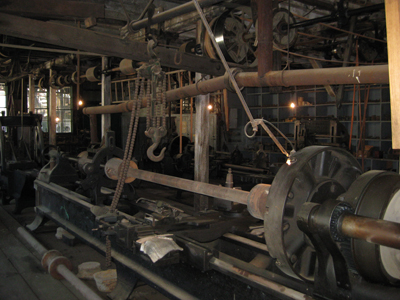
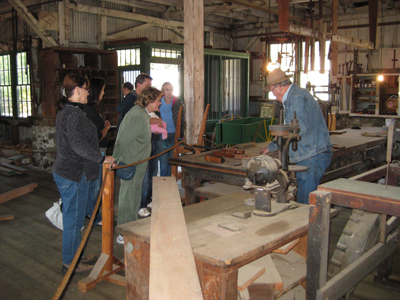
Still, with more than a bit of claustrophobia, I would have sought work in one of the craft shops above ground.  Carpenters and metalworkers on site made and repaired almost everything used in the mining operations, including the ore carts and their wheels.
Empire Mine Carpentry Shop

The metal shop

The blacksmith shop (state park photo)

The mine was closed as a non-essential industry but the War Production Board at the start of WWII. It reopened in 1945 but the price of gold was fixed at its 1934 level of $35 an ounce. By 1956, each ounce cost $45 to produce, and the mine closed in January, 1957.

During its years of operation, the Empire mine produced 5.6 million ounces of gold – roughly five billion dollars at current prices. The state owns the surface structures and grounds, but Newmont mining retains mineral rights, and there’s still gold underground. If the price of rises high enough, mining operations could resume. The real value these days, however, is the historical interest and beauty of the place.
Swimming pool below the cottage

Rose gardens behind the cottage

The heritage roses behind the cottage had all been cut back, but small plaques identified the roses and their dates. Most came from the 19th and early 20th century, but a few were earlier than that. When they are in bloom, you can buy cuttings.
View from the formal gardens toward the mine

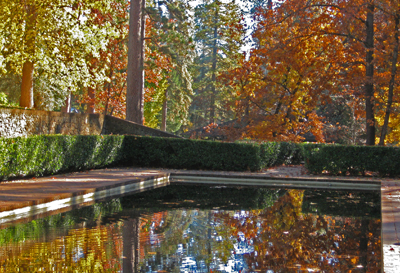
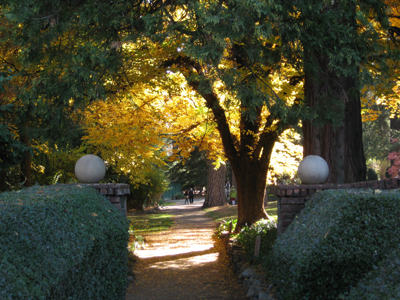
I had been to the Empire Mine once before, in the 80’s one January day when the trees were bare, the pool was dry, and no one was no one around. I’d been wanting to return for most of this year, but something always came up until this past Saturday. I had no idea how much I would enjoy the site, and I highly recommend it if you are ever in California’s central valley, with a yen to explore the foothills and the gold country.  http://www.empiremine.org/