R.I.P Steve Jobs

Logging into my mac just now, I was very saddened to see, on the Apple home page, that today we lost a true American original.

“Your time is limited, so don’t waste it living someone else’s life.  Don’t let the noise of others’ opinions drown out your own inner voice.” – Steve Jobs

Please take a look at Jobs’s 2005 commencement address, delivered at Stanford University, a source of ongoing inspiration for me:  http://www.forbes.com/sites/davidewalt/2011/10/05/steve-jobs-2005-stanford-commencement-address/

Remembering that I’ll be dead soon is the most important tool I’ve ever encountered to help me make the big choices in life. Because almost everything — all external expectations, all pride, all fear of embarrassment or failure – these things just fall away in the face of death, leaving only what is truly important. Remembering that you are going to die is the best way I know to avoid the trap of thinking you have something to lose. You are already naked. There is no reason not to follow your heart – Steve Jobs

Seven Year Cycles

If you google on almost any topic related to “cycles,” you wind up with a flood of information.  Scientists define life cycles for everything from insects to stars.

Cycles abound in spiritual and esoteric traditions, ranging from newspaper horoscopes to “Days and Nights of Creation” lasting millions of years.

I was searching for something simpler than that.  Biologists say our bodily cells renew themselves every seven years.  Parallel to that, I’ve noticed my world of ideas, interests, and ambitions changing, sometimes radically, over a similar time frame.  I’m not the only one.  Google on, “seven year life cycle,” and you get 5,400,000 hits.  Although Rudolph Steiner wrote on the subject, most of the entries I found were generic, analogous to newspaper horoscopes.  Here is Aquarius.  Here are your life tasks between the ages of 21 and 28.

No doubt Gemini’s, and seven-year-olds, and seventy-year-olds each have things in common, but I was looking for individual accounts of people who find their ideas, concepts, and aspirations changing every seven years or so

What brought this to mind was thinking of 2005, a year in which I experienced many beginnings.  One night I woke up at 12:30am, grabbed a pen and a notebook, and wrote the opening pages of my first novel.  The momentum grew, and I finished the first draft five months later (in retrospect, it was pretty bad, though I doubt that I’ll ever have so much fun writing again).

Aided by a sabbatical from work, and energized by visits with family and friends I hadn’t seen in years, I was bursting with fresh energy, new ideas, and new ambitions.  Many threads in my life seemed to become clear.  I jotted some down in a notebook.  I underlined things I was very sure of.  A bit of skepticism remained, so I made  note in the margin:  “check back in five years.”

Six years later, in most respects, I am not the same person.  I don’t really read or aspire to write the books I cared about then.  My spiritual ideas have shifted.  What I value and want to accomplish are not the same.  My overall outlook is different.  I’ve noted these seven year changes before; this was just more pronounced.

Once again I have to conclude that most of the contents of consciousness are in flux and do not capture the “core” of who I am or who anyone else is.  The metaphor I use is the mirror.  A mirror is not defined by what it reflects from moment to moment.  “I” am not what passes through awareness, “I” am the indefinable awareness itself.

This is wisdom that’s thousands of years old but I believe it more and more as time goes on.  This is the koan:  what is a mirror beyond what it reflects?  What is the heart/mind beyond what it conceives?

The Story of Charlotte’s Web by Michael Sims

In a recent interview on NPR, author Michael Sims discussed a project “that got really out of hand.”  He set out to do a natural history of children’s talking animal stories but became so fascinated by Charlotte’s Web that he never got beyond it.

Sim’s study, The Story of Charlotte’s Web: E.B. White’s Eccentric Life in Nature and the Birth of an American Classic, was published in June.  It’s interesting see what eccentricities and other facts Sims discovered about E.B. White.

White was quite a naturalist; on a farm in Maine, he studied spiders and raised pigs.  There really was a “Wilbur,” a pig that White was raising to slaughter in the fall, but it grew sick and died, despite all attempts to save it.  In his essay, “Death of a Pig,”  White recognized the irony of his sadness at the loss of an animal he had planned to kill, and his “sense of loss when the pig died, not as if he’d just lost some future bacon but as if he had lost…a fellow creature who was suffering in a suffering world.” 

Another time, while feeding the replacement Wilbur, White noticed a spider web with an egg sac.  The spider that wove the web disappeared, and White cut the egg sac down and carried it with him back to his apartment in New York.  He dropped it in a bureau drawer and forgot about it until the little spiders began to hatch.  According to Sims, White was delighted to watch them start to weave their webs in his room – that is, until the maid refused to work “in a spider refugee camp” and they had to go.

Sims explains that “eccentric” is a Greek word that originally meant, “off center.”  He goes on to say:

if ever there was a human being born off-center, it was E.B. White. He simply could not…follow in an established path if his life depended on it. And so he had his own quirky way. He was very fierce and funny hypochondriac. He liked to spend a lot of time alone. He loved working with animals, as much as possible. Even in New York City, even in writing for The New Yorker to begin with, he was off, you know, exploring what rats were doing in some alley.

Fans of E.B. White should enjoy listening to the interview or reading the transcript:  http://www.npr.org/2011/08/19/139790016/weaving-charlottes-web.  Of interest too, will be Michael Sims’s current project.  In keeping with his theme of “writing about how our imagination responds to nature in one way or another,” he is researching between the lines of Thoreau’s sojourn at Walden Pond to see how that great naturalist and philosopher filled up his days in ways we don’t yet know about.

After Potter

Of course it is happening in your head, Harry, but why on earth should that mean it isn’t real?  –   Albus Dumbledore

The fact that everyone is weighing in on Harry Potter stands as a tribute to the impact the saga has had on us all.  There’s no doubt the release of the final movie is most poignant for those who grew up with the series; a span of 13 years for the books or 10 for the movies is huge when you are young.  Some of those who picked up The Sorcerer’s Stone in grade school have finished college.

Annie Ropeik, an intern at NPR suggests three adult fantasies for the “Hogwarts Grad.”  She calls one of them, The Magicians by Lev Grossman, a cathartic examination of the nature of magic and our relationship to the stories we wanted to live in as kids — required reading for anyone trying to recover from a lifelong love affair with a fictional world.  http://www.npr.org/2011/07/14/137802346/3-grown-up-books-for-the-hogwarts-grad

Note the language Ropeik uses, especially the word, “recover,” which suggests that a love affair with a fictional world is something we should fight the way someone “in recovery” uses the 12 steps to fight for freedom from an addiction.

I’ve been sensitive to this kind of nuance ever since one of my psychology professors, a colleague of James Hillman and Joseph Campbell, recommended The Neverending Story by Michael Ende with the comment that, “It’s about our culture’s war on imagination.”  Can we graduate from the fictional worlds we have loved and lived in?  Should we even want to?  According to Hillman, our greatest danger is literalism, the mind that is closed to fantasy, or rather, refuses to see the fantasy in all our realities and the reality of our fantasies.

Today may be a day to mourn the end of an era, but it is also a day to celebrate the gifts we have received from Rowling, the young actors, and everyone who worked on the movies.  They have given us an unforgettable world of imagination and dreams where courage and friendship matter, even when the odds are bad, in the struggle of good against evil.

Kalachakra For World Peace: In Washington, DC and in Sacramento

Did you know that the Dalai Lama is currently engaged in an 11 day ceremony in Washington DC, called  “The Kalachakra for World Peace?” Did you know that a Sacramento organization, the Lion’s Roar Dharma Center is giving a parallel ceremony from July 23, to July 30?  Please read on for the details.

Kalachakra Sand Mandala

Kalachakra, meaning Wheel of Time, is philosophy and set of practices that “revolve around the concept of cycles and time from the cycles of the planets, to the cycles of human breathing.  It teaches the practice of working with the most subtle energies within one’s body on the path to enlightenment.”  Kalachakra also refers to a Tibetan Yidam or meditational deity, who represents a Buddha.  http://en.wikipedia.org/wiki/Kalachakra

Yidam practice is complex and widely misunderstood, but here is a quick analogy: a kid who pretends to be Luke or Leah or Yoda is doing something similar – invoking a figure who represents and inspires bravery and wisdom.  Perhaps the child experiences an inflow of those qualities – except it is not really an inflow because it is already there, in seed form, inside all of us.  Imagination can awaken these latent potentials in a child and in a practitioner of Tibetan Buddhism.

I used to pretend to be Davy Crockett for the same reason.  There was never any real confusion, although my mother looked at me strangely the day I asked her to pick up some bear meat the next time she went shopping – but I digress.

Kalachakra is one of the most advanced Tibetan practices, but because of his perception of the urgent need for non-violence in the world, the Dalai Lama opened this series of teachings to anyone who was interested.  A Tibetan Sangha in Sacramento, the Lion’s Roar Dharma Center, is offering a similar series of classes, beginning with an introductory lecture, July 23, from 7:00-9:00pm, followed by classes and empowerments from July 24-July 30. http://events.r20.constantcontact.com/register/event?llr=rnxs8gcab&oeidk=a07e3puot1u6e5e5f26

Finally, here is a description of the ceremony by , a Tibetan nun who has been working in Washington since May, 2010 to prepare for the Dalai Lama’s performance of this ritual, which is now in progress.

http://www.npr.org/2011/07/14/137848121/in-washington-a-ritual-for-world-peace?ft=1&f=1003

Harry Potter Fan Fiction

Harry, Ron, and Hermione in The Sorcerer's Stone, 2001

Fan fiction did not begin with Harry Potter or the internet.  According to Lev Grossman’s article, “The Boy Who Lived Forever,” in the July 18, issue of Time, xeroxed fanzines appeared after the premier of “The Man from U.N.C.L.E.” in 1964, and really took off with “Star Trek.”

In the broader sense, telling original stories with borrowed settings and characters is nothing new at all.  Homer did not create the Trojan War, Achilles, or Odysseus.  Shakespeare did not make up either King Lear or Henry V.  But with the internet and Harry Potter, fan fiction has exploded.  There are more than 2 million pieces on fanfiction.net and more than a quarter of these are based on Potter – everything from short stories to full length novels.

The final movie will not be the end of original Potter creations

Grossman explodes most of the stereotypes of those who write and read these tales.  One 38 year old writer and actress says it’s like character improvisation.  A best selling fantasy writer whose novels have been optioned by Peter Jackson says, “Fanfic writing isn’t work, it’s joyful play.”  This raises the key question of why writer’s of fiction write.  Joyful play, a platform, and an appreciative audience are there – and it’s not like many creators of “original” stories get to leave their day-jobs.

Well known authors fall on both sides of the unanswered copyright issue.  J.K. Rowling and Stephanie Meyer encourage new fiction based on their characters and worlds.  Orson Scott Card, Anne Rice, and George R.R. Marin, author of A Game of Thrones do not, and threaten lawsuits.  It may or may not be coincidence that the authors Lev Grossman names as supporting fanfic are more recent and write for a younger audience than those who are in opposition and write for adults.  So far, all cease and desist requests have been honored, so there are no legal precedents in the world of fiction, though court cases involving music have been liberal in their interpretation of what constitutes “fair use.”

This begs the interesting question of who a character or world belongs to.  Groosman says that until recently:

Writers weren’t the originators of the stories they told; they were just the temporary curators of them.  Real creation was something the gods did…Today the way we think of creativity is dominated by Romantic notions of individual genius and originality and late-capitalist concepts of intellectual property, under which artists are businesspeople whose creations are commodities they have for sale.

Personally, I have always loved the poet’s invocation at the start of The Odyssey:  Sing in me, muse, and through me tell the story… 

In my experience, the “I” does not invent worlds or characters.  Whether you call it the muse, the gods, or the collective unconscious, fictional worlds and imaginal people come from somewhere else.  With a bit of luck and humility, the “I” may get to witness what happens, and may even get adept at finding new rabbit holes.  To me, the idea of “owning” a “product” of imagination smacks of hubris.

There is no real data on whether fanfic hurts an author economically.  Intuitively, I can only imagine it benefits Rowling and Meyer.  I hope so.  Creativity is creativity, regardless of what spark ignites it.  I’m thinking of dropping by some of the sites to see what these authors are up to.  For those who write for the joy of it, I wish them a lot more.

The Emerald Atlas by John Stephens: A Book Review

I have said before, I often read middle grade fantasy for the sheer fun of it, and I recently picked up The Emerald Atlas, published in April by John Stephens.   Stephens comes from the world of television production where he wrote for “The Gilmore Girls” and “The O.C..”  He also produced and sometimes directed and wrote for, “Gossip Girls.”  Most interestingly, he says what he really wanted to do all along was write novels, but when he finished grad school, “I was pretty bad at it.  I really kinda stunk.”  Stephens learned his craft in Hollywood:

“Writing for Hollywood turns out to be a great training ground. You learn how to work on a schedule, tell a satisfying story, build character, construct scenes, you develop a feel for dramatic momentum…and you get to tool around the Warner Bros lot on a golf cart, which is kind of awesome.” 

He says working for television was so much fun he forgot about writing until he read Phillip Pullman’s, The Golden Compass and realized that “all” he wanted to do was write fantasy novels for children.  (thought he still misses the golf carts).

The Emerald Atlas is the story of three very special children whose parents mysteriously vanish when they are young.  One night when she is four, Kate’s mother slips into her room and insists that she promise to care for her younger siblings, Michael, two, and Emma, one. The three children are hustled to a waiting car driven by an elderly man who barely eludes magical pursuers in a chase reminiscent of Harry Potter.  After ten year of ever more awful orphanages where they never seem to fit in, the children are sent to an apparent “last stop,” facility in Cambridge Falls, New York, run by the mysterious Dr. Pym.

Dr. Pym, it turns out, is the wizard who had taken the children for safekeeping ten years earlier, to keep them from the grasp of the beautiful but evil witch who calls herself, the Countess.  The forces of both good and evil are interested in Kate, Michael, and Emma for they each have a magical bond with one of the three Books of Beginning, where the great wizards of old in Alexandria encoded their lore when the worlds of magic and humans began to seperate.

Kate’s affinity lies with the first book, The Emerald Atlas, which enables one to travel in time and space.  When they stumble upon the volume in Dr. Pym’s basement, Kate, Michael, and Emma are whisked into the past before they understand the powers they have awakened.  They become separated and fall under the power of the Countess and her minions.

There’s a lot to like in The Emerald Atlas.  The characters are nicely fleshed out.  Fourteen-year-old Emma, clever, brave, with intuitive understanding of magic, suffers under the burden of keeping her brother and sister safe, as well as the other children of Cambridge Falls.  Twelve-year-old Michael, who sometimes drives his sisters nuts with his camera, notebook, and bent for scientific experiment, has the thrill of his life when he meets real dwarves, the people he admires more than any other.  Eleven-year-old Emma is the feisty one – part of the reason they’ve been shuffled from orphanage t0 orphanage is Emma’s habit of mouthing off to prospective adoptive parents.  The three are desperate to locate their real parents and and learn who they really are.  The value of loyalty and family runs like a constant thread through the book, even through Michael’s betrayal and forgiveness, which is reminiscent of Edmund in The Lion, the Witch and the Wardrobe.

Something else I liked in the story was the complexity of the time-travel plot.  Traveling into the past creates alternative pasts and futures and things can get very complicated, but there is no simplification or condescension for young readers.  Humor that will appeal to all ages pervades the story as well:  “How was [Emma] supposed to know how to defuse a mine?  No one had ever taught her that in school.  Her classes had always been about useless things, like math or geography.”

This is the sort of book, like the Narnia tales or Harry Potter, that will appeal to readers of all ages.  With the cinematic sense of its author, I won’t be the least bit surprised to see it made into a movie.  Stephens said, in his Amazon interview, that none of the studios have contacted him yet, but I suspect it is only a matter of time.  I will certainly buy a ticket, just as I expect to read and enjoy the next two books of the trilogy.

Joseph Cornell’s Dreamtime

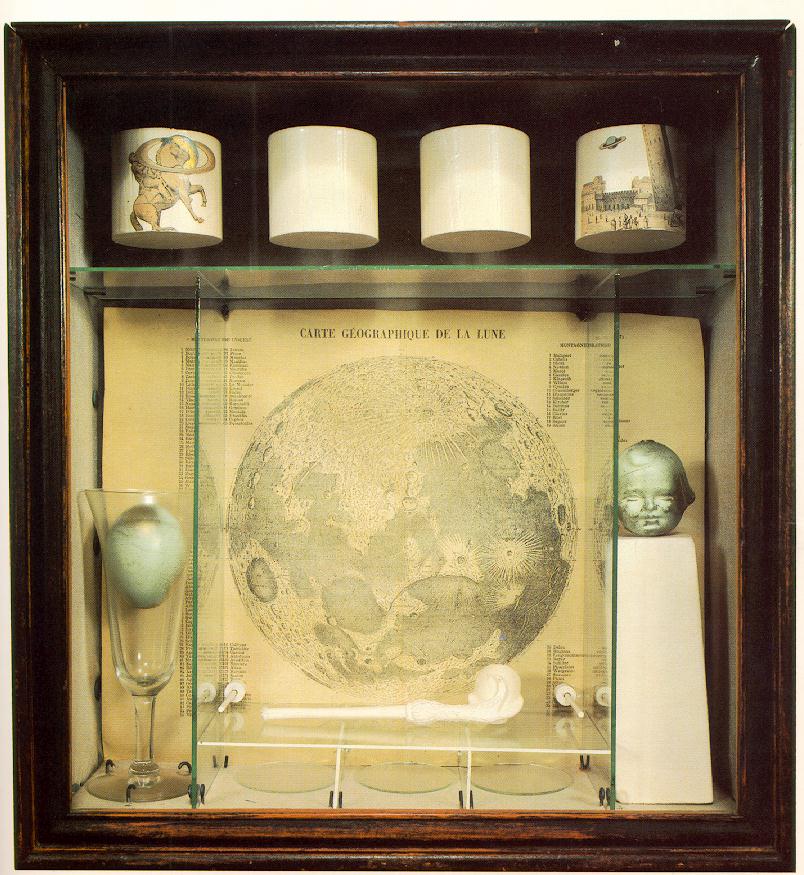
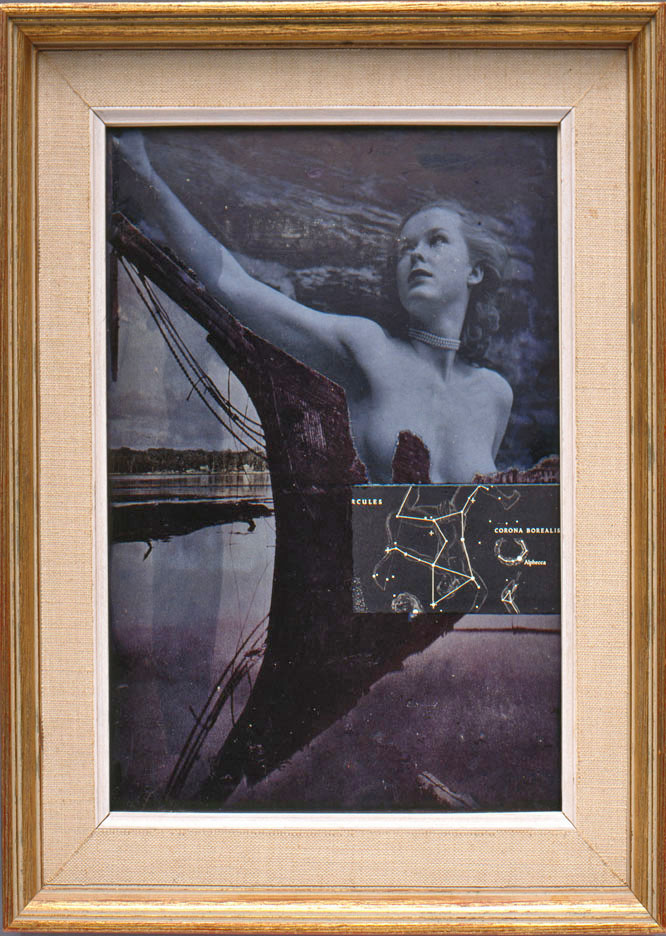
Looking at Malcolm Forbes’ toys in the previous posts reminded me of one of my favorite American artists, Joseph Cornell (1903-1972), who built windows into our dreams, into other times, and other worlds.
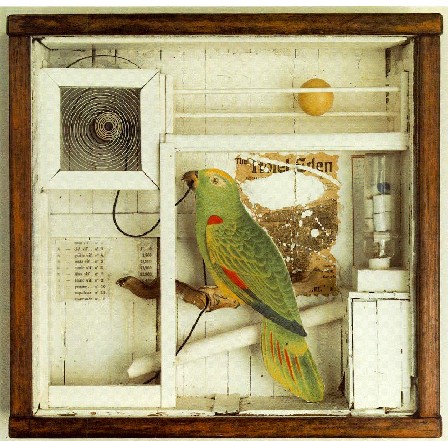
Untitled (Hotel Eden) ca. 1945

Cornell, who was wary of strangers and self-taught as an artist, led a reclusive life, most of it in a wood-frame house in a working class neighborhood in Queens. Though he had galleries and collectors from an early age, I have never seen him listed among the “major” American artists of the 20th century. One of my college art history professors suggested he was “ahead of his time,” in the missed-the-boat sense, noting that in the 60’s, Robert Raushenberg gained art world super-star status with constructions and collages similar to those Cornell had begun in the 30’s.
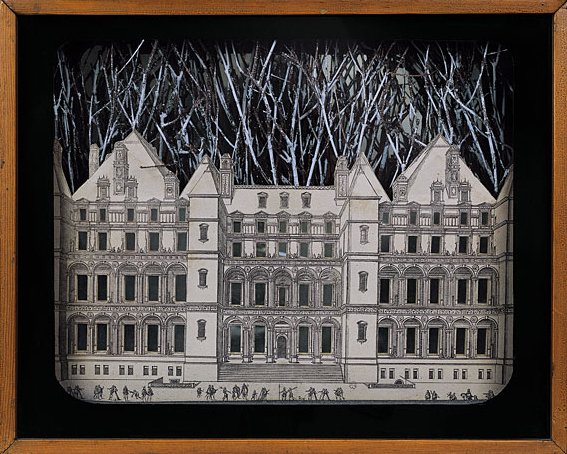
Setting For a Fairytale

I think there was much more to it than that; I find it significant that Cornell, described as “frighteningly well read,” had a special affection for the poetry of Emily Dickinson, another reclusive soul, and Arthur Rimbaud, who firmly rejected the literary and artistic “establishment” of his time.

Cornell said what he wanted in his art was “white magic.” It’s hard to imagine such a subtle ambition surviving the grand gestures and conscious self-promotion of the artists of Warhol’s generation. Cornell’s distance from that mileau seems to have been deliberate.
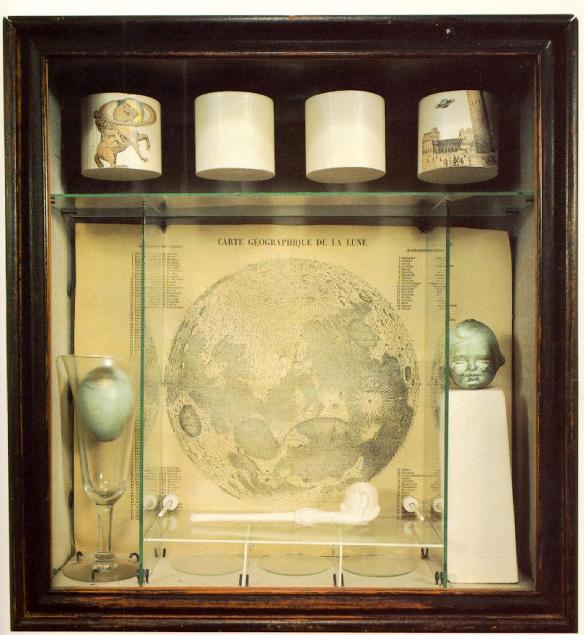
Untitled (Soap Bubble Set) 1936

In a wonderful article on Joseph Cornell in 2003, the centennial of his birth, Adam Gopnik says:

What’s nostalgic in Cornell’s art is not that it’s made of old things…What’s nostalgic is that, behind glass, fixed in place, the new things become old even as we look at them: it is the fate of everything, each box proposes, to become part of a vivid and longed-for past…a bottomless melancholy in the simple desolation of life by time. The false kind of nostalgia promotes the superiority of life past; the true kind captures the sadness of life passing.

http://www.newyorker.com/archive/2003/02/17/030217crat_atlarge?currentPage=1
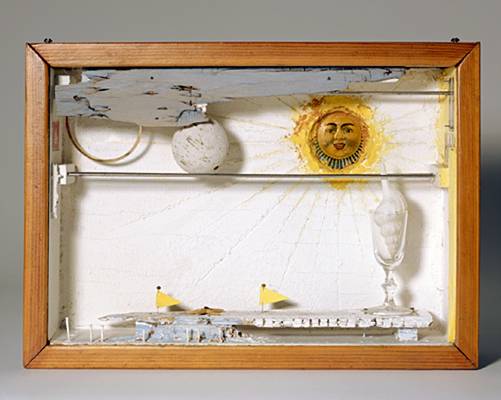
Gopnik says Cornell’s much-storied isloation was central to his way of working.

He had discovered the joys of solitary wandering. Beginning in the early nineteen-forties, his life was structured by a simple rhythm: from Queens via the subway to Manhattan, where he walked and ate and watched and collected, and then back home to the basement and back yard in Queens, where he built his boxes, talked to his mother, and cared for his brother (who had severe cerebral palsy).

Certain themes recur in the work of Joseph Cornell:  birds, ships, the requisite surrealist clocks, and bottles which hint at potions or hidden alchemical mixtures.
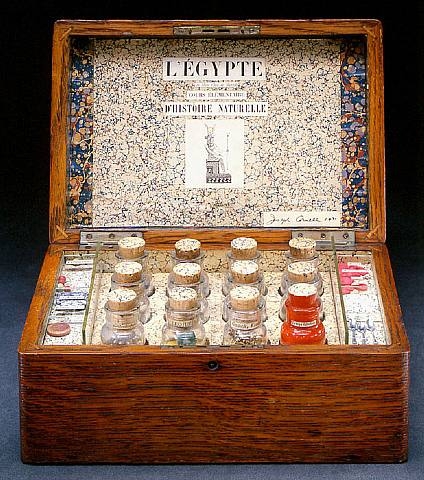
Another recurring theme is idealized images of women.
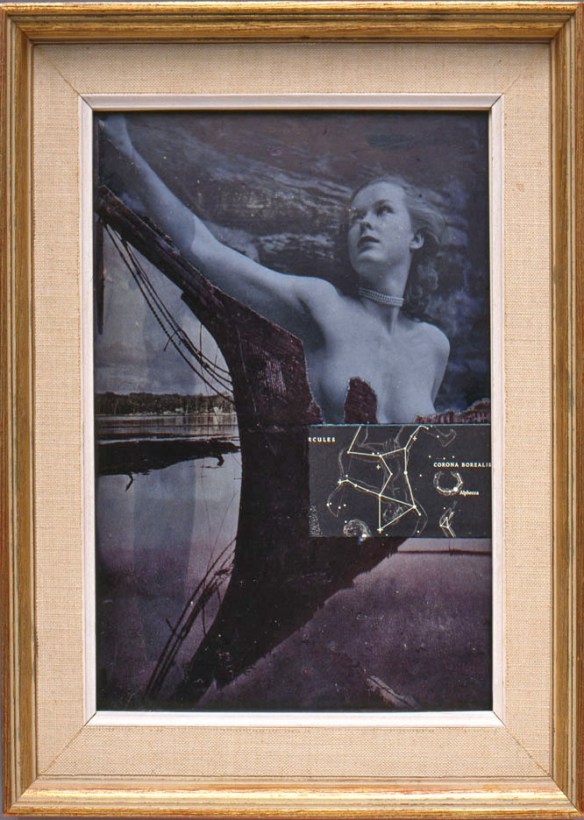
Ship With Nude

Although he professed devotion to unattainable women like Lauren Bacall and Marylin Monroe, his reserve kept him out of romantic relationships as far as anyone knows.   At the same time he was friends with numerous ballerinas, including Tamara Toumanova, a “superstar” in the world of ballet at a time when Cornell had gained some prominence in the world of art.  Several of his pieces are homages to Tourmanova.

The final exhibition Cornell worked on during 1972, the last year of his life, was for “children only.”  Everything was placed at their eye level, about three feet above the floor.  Denise Hare writes:  “Joseph Cornell often said children were his most receptive and enthusiastic audience.  They were filled with innocence and needed to see.”  Brownies and cherry coke were served as refreshments.

Cornell at an exhibition of his work for children at Cooper Union, 1972

In his 2003 article, Adam Gopnik says:

He is an artist of longings, but his longings are for things known and seen and hard to keep. He didn’t long to go to France; he longed to build memorials to the feeling of wanting to go to France while riding the Third Avenue El. He preferred the ticket to the trip, the postcard to the place, the fragment to the whole. Cornell’s boxes look like dreams to us, but the mind that made them was always wide awake.
***
Joseph Cornell showed us again and again that just a little shift in context, an altered point of view on the things of our lives will make them come alive, seem full of meaning, or appear as downright spooky.
The core importance of context in art was demonstrated forcefully in 1917 by Marcel Duchamp’s whose “ready-made” sculpture, Fountain, was named “the most influential piece of modern art” by 500 artists and critics.  Duchamp hung a urinal upside down in a gallery, signed it, “R. Mutt,” and to my mind, truly initiated the twentieth century in art.  Duchamps and Cornell were in regular contact in New York from 1942 to 1953.

Fountain, by Marcel Duchamp

Cornell never sought to shock as Duchamp did, or ask huge questions, like “what is art after all?”  But he regularily explored what happened when the faded postcard or torn photograph was removed from the shoebox or dusty album and given new life in a box on a wall.  And there, some of his birds and ballerinas still live mysterious lives and whisper to us messages which we have to become very quiet to hear, for as T.S. Eliot put it, Human kind cannot bear very much reality.
 
***
 

Click here for an interesting online Presentation of Cornell’s Work: http://www.pem.org/exhibitions/62-joseph_cornell_navigating_the_imagination