Stardust: a movie review

Stardust-3-NCGZF0OUJX-800x600

One day while Neil Gaiman was driving in England, he noticed a wall by the side of the road and imagined Faerie on the other side. He conceived the story of an American author visiting Britain who would discover the wall. Shortly after this, on the night he received a literary award, Gaiman saw a shooting star, and the idea for Stardust was born.

Stardust was first released as an illustrated series in 1997 and then as a novel in 1999, which won an award from the Mythopoetic Society.  A movie version in 2007 received favorable reviews.  After my recent review of Gaiman’s 2013 novel, The Ocean at the End of the Lane, I realized I’d never seen the Stardust movie.  It’s available for rent on iTunes, and I highly recommend it.

Stardust gives us the wall, a wonderful metaphor for much of human culture, erected to keep us out of Faerie, the realm of imagination, heightened emotion, wonders, terrors, true love, and our true selves.

Responsible citizens don't cross the wall.

Responsible citizens don’t cross the wall.

Tristan Thorn (Charlie Cox), a young man who lives in the town of Wall, is a classic dummling.  He’s a klutz who can’t keep a job and is infatuated with Victoria, a girl who won’t take him seriously and whose finance delights in tormenting him.  Yet Tristan’s father, who has been over the wall, says that might be a good thing – most people who find it easy to fit in “lead unremarkable lives.”  Then he tells Tristan the secret of his birth on the other side of the wall.

Tristan and Victoria see a shooting star fall into Faerie.  Still infatuated, Tristan vows to bring the star back to win her hand in marriage.  He forces his way through the wall to begin his search, but he is not the only one who saw the star.

The murderous sons of a dying king in the realm of Stormhold set off to find the star when their father vows that the one who finds it will be his heir.  And Lamia (Michelle Pfeiffer), senior member of a trio of witches joins the hunt – when stars fall to earth, the witches cut out their hearts and eat them, a little at a time, to preserve their youth and beauty.

Tristan reaches Yvaine the star (Claire Daines) first. Still intent on winning the hand of Victoria back in Wall, he uses a Faire chain to compel her to follow him.

Yvaine and Tristan

Yvaine and Tristan

At first they bicker constantly, but their time on the road and helping each other survive attempts on their lives creates a bond of friendship and finally love between them. Ever the dummling, Tristan is the last to realize this, but is helped when he finds a mentor.  Robert De Niro, in a virtuoso role as Captain Shakespeare, the gay captain of a flying steampunk pirate ship, teaches Tristan to fight, Yvaine to dance, and with a parting gift of  wisdom, whispers to Tristan, “She is your true love.”
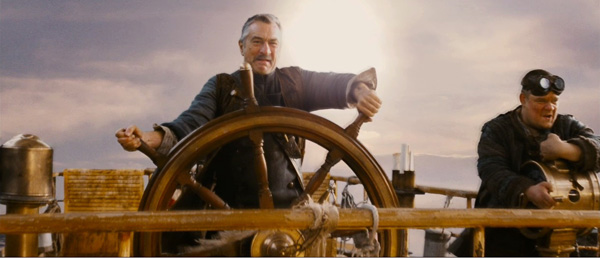
Captain Shakespeare at the helm

Captain Shakespeare at the helm

As with any good dummling story, the ending of Stardust will leave you happy.  Though rooted in the sensibility of a modern coming of age tale, with elements of character development that the old traditional stories lack, Stardust fits Tolkien’s paradigm of the classic fairytale – the wonders and terrors we mortals encounter when we venture into other worlds.

Faerie whispers to us in sunlight, in starlight, and in our dreams.  Those intimations may be what make us most truly human.  No wonder we have an endless appetite for wonder tales, and Stardust is one that thoroughly satisfies.

Artifacts of our ambition

artifacts1

Last night at dusk I went out to turn off a backyard sprinkler and noticed a broken garden plaque that lay among fallen leaves and plums.  It’s been there for quite some time, one of those objects I don’t know what to do with but like too much to throw away, so I leave it where it lies.  Last night, in the twilight, I noticed it.

A phrase sprang to mind:  “You look for the artifacts of their ambitions.”  This is the first line in Michael Koryta’s superb supernatural thriller, So Cold the River.  The main character goes on to say, “The reality of someone’s heart lay in the objects of their desires.  Whether those things were achieved did not matter nearly so much as what they had been.”

The plaque was a primitive image of the sun – the word “SOL” is still visible.  We got it in Mendocino a long time ago and hung it on the fence at a time when gardening was one of our major activities.  Its importance waned under the time pressures that came with more “gainful” employment,” but this little artifact, like a Velveteen Rabbit made out of stone, can still speak when I stop to listen.

After I snapped this photograph, I went looking for other such artifacts, both in a box of old pictures of mine and among vintage postcards, photos, and tintypes I’ve collected.  If you are a packrat like me, you surround yourself with such things. 

Dreams change, and ambitions, just like our lives, can be fleeting. The artifacts often outlive them. Nothing shows that more clearly than this picture of my father, my sister, and me by a stone wall I helped build.

father, me and jan

The Kodachrome is fading and my father is gone, but not long ago, I checked Google’s satellite view, and that stone retaining wall, some 3,000 miles from where I now live, still appears to be standing.  How can you even begin to say what it means when you’re five and your father shows you how to place stones in a wall and trowel the concrete into place between them?  “The reality of someone’s heart lay in the object of their desires.”

boys of summer

I’ve always liked this team photo, with its mix of bravado and shyness in front of the camera.  Did any of these boys of summer dream of playing in the majors?  Did any of them come close?  Did they love the game any less than the 2013 all stars who played in front of millions of viewers last week?  I’m guessing that at the moment this picture was taken, they may have loved it more.

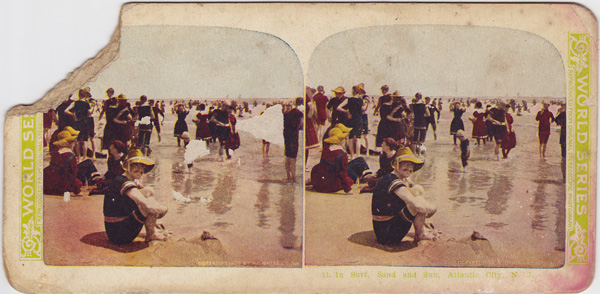
stereo picture

What about the fellow in the foreground of this stereopticon slide? Do we even want to know about his ambitions?  Close up, he looks like Groucho Marx in a yellow hat.  The picture is labelled “Surf, Sand, and Fun, Atlantic City, NJ.”

cemetary photo

This is a poignant image, from a photo I took of an arrangement in a glass box, embedded in a gravestone in an old Italian cemetery in Binghamton, NY.  Virgin Mary stands amid plastic roses, her image distorted by thick old glass.  I spent a summer there working in a factory, and returned again and again to this cemetery, which was full of angels and lambs and redeemers, for don’t these all speak of a nearly universal ambition – the longing for redemption, in the here, the hereafter, or both?  The world is alive and things within it can speak to us if we listen.

And finally, one of my more important artifacts.  I kept this photo of a young 19th century woman over my desk while writing my first novel.  This, I thought, was how the book’s heroine would have looked if she’d posed for a picture.  So this photograph, taken more than a hundred years ago, of a woman whose dreams I cannot begin to fathom, became an icon for one of my own ambitions.

old photo of young woman

I didn’t tell her story very well, but as the character in So Cold the River observes, that often doesn’t matter.  Sometimes when I look at this picture now, it holds a greater mystery than it ever did when I used it as a writer’s prompt.  Now I can see its own inscrutable mystery.

James Hillman often quoted John Keats who said, “Call the world if you please ‘The vale of Soul-making.’ Then you will find out the use of the world.”  In the same letter to his brother and sister, Keats added that our pains and troubles “school an Intelligence and make it a Soul.”

Artifacts of our ambitions are things we notice as the eyes of soul begin to open.


Your Own Damn Life: an interview with Michael Meade in The Sun

Michael Meade is an author, storyteller, and a passionate advocate of soul values in a world that increasingly ignores them; I’ve written about Meade or mentioned him in half a dozen posts.

In The Water of Life (revised, 2006) he shares his discovery that stories can be a matter of life and death.  As a teen in New York, when confronted by gang members from a rival neighborhood, Meade didn’t just lie his way out of serious injury or worse – he storied his way out, with an elaborate made-up tale that won over the assailants long enough for him to make his escape.  Readers of my recent posts will recognize a thriving trickster in Meade when he was just a kid!

I recently found an interview between Michael Meade and John Malkin in the The Sun that is as timely today, or more so, than in November, 2011, when it was published.  In the interview, “Your Own Damn Life,” Meade quotes an African proverb, “When death finds you, may it find you alive.”  Alive, he goes on to say, “means living your own damn life, not the life that your parents wanted, or the life some cultural group or political party wanted, but the life that your own soul wants to live.”

In the past, meaningful stories could guide soul evolution, but now, with the culture and the natural world both in crisis, Meade points to our lack of coherent, guiding tales.  A culture falls apart, he says, when youthful imagination and energy are stunted and when the traditional wisdom of elders is forgotten.  At one extreme, “You’re not supposed to be worrying about the end of the world as a teenager; you’re supposed to be bringing your dream to it. The world seems old and troubled now, and the young are no longer allowed to be as young as they should be.”  At the other extreme, we have a lot of “olders” but not many wise “elders.”

When traditional stories collapse, Meade says, the guiding and healing stories must come from within.  “That means going to the core of your own life and finding the story seeded within.”  Meade has tried to facilitate such explorations through his writings and talks, which first became known in the 80’s when he, James Hillman, and Robert Bly hosted a series of men’s conferences.

Meade continues to teach, write, and offer a variety of community services through the non-profit Mosaic Foundation he founded in Seattle where he lives.  If you’ve read this far, you will find Meade’s interview in The Sun and the Mosaic page hightly rewarding and likely sources for new ideas.


Lego Fairy Tales

Once again I’m pleased to feature a post by the amazing Lily Wight, who found some fairytale illustrations I doubt that you’ve seen before. I wonder what the career path is – Lego engineer has always seemed like a dream job!

Lily Wight's avatarLily Wight

     This month’s Lego fix features Little Red Riding Hood, Beauty & The Beast and a rather startled Little Mermaid.

     Just hover over the images for extra information…

View original post

The best graduation speech, ever.

It’s that time of year.  I seldom pay much attention to graduation speeches.  I can’t remember anything said at my own, nor do any quotes come to mind from celebrities whose commencement addresses get soundbytes played on the news every June.  But there is one graduation speech I’ve read and listened to many times and continues to be a source of inspiration.  You may know it.  If not, I’m happy to pass it on.

Steve Jobs at Stanford, 2005

Steve Jobs at Stanford, 2005

In 2005, Steve Jobs, whose academic career consisted of one semester of college and a few audited classes, was chosen as the graduation speaker at Stanford.  In his brief but memorable address, he spoke of finding one’s true vision, following our hearts, and not wasting our all-to-brief time walking someone else’s path.  Here are three of my favorite quotes from the speech:

“You have to trust in something — your gut, destiny, life, karma, whatever. This approach has never let me down, and it has made all the difference in my life.”

About getting fired from Apple:  “It was awful tasting medicine, but I guess the patient needed it. Sometimes life hits you in the head with a brick. Don’t lose faith. I’m convinced that the only thing that kept me going was that I loved what I did. You’ve got to find what you love…the only way to do great work is to love what you do. If you haven’t found it yet, keep looking. Don’t settle. As with all matters of the heart, you’ll know when you find it…keep looking until you find it. Don’t settle.”

“Your time is limited, so don’t waste it living someone else’s life. Don’t be trapped by dogma — which is living with the results of other people’s thinking. Don’t let the noise of others’ opinions drown out your own inner voice. And most important, have the courage to follow your heart and intuition. They somehow already know what you truly want to become. Everything else is secondary.”

I invite you hear everything this visionary had to say that day, in a  text version of the speech, and / or this video clip.

Jorinda and Joringel: a fairytale from The Brothers Grimm

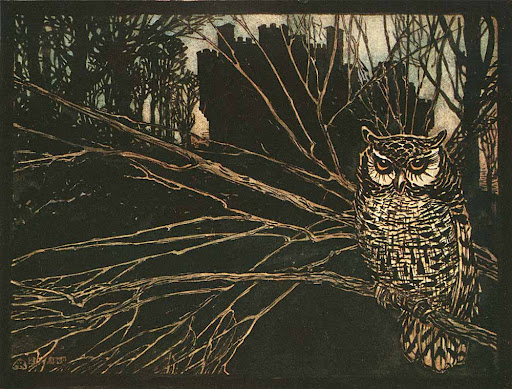
The witch as an owl by Arthur Rackham

The witch as an owl by Arthur Rackham

I have seen Jorinda and Joringel (sometimes spelled Jorindel) in many folklore collections, but I always passed it by.  A cursory glance led me to think it was much like Hansel and Gretel, not one of my favorite tales.  I’m not alone in skipping it:  I’ve never seen it discussed or analyzed by any of the writers on folklore I read.

I picked it up recently, intending to read myself to sleep, but stayed awake instead.  Jorinda and Joringel is a scary story with unexpected depths as well as features found in other celebrated stories.  One key image strikingly parallels a central symbol from India, which raises other questions.  Here is a summary of the tale:

***

Synopsis of “Jorinda and Joringel” in The Annotated Brothers Grimm

Once there was a witch who lived in a castle in the depths of a thick forest.  By day she took the shape of a cat or and owl, but at night she appeared as an old woman whose nose curved down to touch her chin.  She would kill and eat any bird or animal that ventured near.  If any human came within 100 feet of the castle, she would freeze them on the spot; they’d be unable to move until she released them.  She turned innocent girls into songbirds and keep them in cages inside the castle; she had 7000 birds and counting.

A beautiful maiden named Jorinda was betrothed to a youth named Joringel.  They enjoyed nothing more than spending time together, and one day they decided to walk in the woods.  “We just have to stay away from the castle,” Joringel said.

As the sun began to set, they heard the plaintive song of a turtledove. Jorinda began to weep while Jorindel sighed and felt oppressed with sadness. He noticed the wall of a nearby castle, but before he could utter a warning, Jorinda was turned into a nightingale. An owl with flashing eyes flew around them thrice and Joringel was frozen in place, a living statue unable to move.

The owl flew into a bush and a moment later an old woman emerged to carry Jorinda into the castle.  When she returned, she freed Joringel from the spell.  He fell to his knees and begged the witch to return his beloved, but she only said, “You will never see her again,” and departed.

Joringel wandered aimlessly in great despair.  He came to an unknown village where he worked for a long time tending sheep.  Sometimes he would circle the castle there but never too closely.

One night he dreamed of a blood-red flower with a beautiful pearl inside.  In the dream, he was back at the witch’s castle, and everything he touched with the flower was disenchanted.  When he woke in the morning, he started to search for the flower.  For nine days he roamed wilderness and village, and at last he found a blood-red flower with a large drop of dew inside that was as bright as any pearl.

He returned to the witch’s castle, boldly strode up, and touched the gate with the flower.  It flew open.  He found the room where the sorceress was feeding her birds.  When she saw Joringel, she was filled with rage, but she couldn’t come within two feet of him.  There were several hundred nightingales – how would Joringel find the right one?  Then he noticed the witch sneaking toward the door with a single cage.

Joringel ran to touch both her and the cage with the flower.  In an instant, Jorinda stood beside him and the witch lost her magical powers forever.  After freeing the other birds, Jorinda and Joringel departed.  They were married and lived with great happiness for a very long time.

*** 

After reading the story several times, I jotted down a few of the questions that came to mind:

  1. Why are Jorinda and Jorigel depicted as being so young?  In several translations, they are called “girl” and “boy” rather than “maiden” and “youth.”  Of the three illustrations I found, one depicts them as children.  Why?
  2. People are frozen or turned to stone in stories all over the world.  I thought of The Water of Life which I discussed here, as well as the ice queen in The Lion, the Witch, and The Wardrobe by C.S. Lewis.  What does it mean to be frozen like that?
  3. Why were the girls turned into songbirds?  Enchanted fairytale people usually wind up in far less appealing shapes.
  4. Another widespread motif is doing menial work for a very long time.   Here it is tending sheep.  More often it’s kitchen work.  Cinderella worked in the ashes for as long as it took a hazel twig, watered with her tears, to grow into a large tree.  Fairytale heroes and heroines wind up doing menial work when they are stuck or stalled in their quest.  If they do it well and for long enough, they find solutions.  Can this tell us anything useful?
  5. My final question concerned the pearl in the blood-red flower.  In western stories, such flowers are always roses; in the east, it would be a lotus.  Om Mani Padme Hum, is probably the world’s best known mantra and is usually (though incorrectly) translated as, “The jewel is in the lotus.”  Are the parallel images merely coincidence?  Or diffusion of stories?  Or the collective unconscious, or what?

These are the kind of things I always wonder about in stories like this.  I hunted and found a reference that doesn’t discuss this particular tale but casts light on these issues.  I’ll discuss them next time.  Meanwhile, if the story raised other questions for you, please post them.  Maybe someone here or a songbird in the tree outside will have an answer for you.

To Be Continued

The Second Coming by W.B. Yeats

We have all heard and read more words this week than we want or need. The ones that keep coming back to me were written in 1919, in a poem called “The Second Coming,” a haunting vision written by William Butler Yeats in the wake of the first world war.

W.B. Yeats by John Singer Sargent. Public Domain W.B. Yeats by John Singer Sargent. Public Domain

The Second Coming

Turning and turning in the widening gyre
The falcon cannot hear the falconer;
Things fall apart; the centre cannot hold;
Mere anarchy is loosed upon the world,
The blood-dimmed tide is loosed, and everywhere
The ceremony of innocence is drowned;
The best lack all conviction, while the worst
Are full of passionate intensity.

Surely some revelation is at hand;
Surely the Second Coming is at hand.
The Second Coming! Hardly are those words out
When a vast image out of Spiritus Mundi
Troubles my sight: somewhere in sands of the desert
A shape with lion body and the head of a man,
A gaze blank and pitiless as the sun,
Is moving its slow thighs, while all about it
Reel shadows of the indignant desert birds.
The darkness drops again; but now I know
That twenty centuries of stony sleep
Were vexed to nightmare by a rocking cradle,
And what rough beast, its hour come round at last,
Slouches towards Bethlehem to be born?

***

Yeats was a member of The Golden Dawn, an early 20th century occult organization centered in Britain that sought to recover lost elements of the western mystery traditions.  Their once-secret teachings are now posted online, where we can see that the group practiced the kind of visualizations that could give rise to spontaneous “images out of Spiritus Mundi,” the World Spirit, one of the Golden Dawn’s concepts.

Elsewhere we can read that the poet worked out his own concept of world cycles or “gyres” as he put it here.  We find theories of world cycles from many cultures in many times.  The Greeks said there once was a Golden Age, but now it is Iron.  We’ve all heard of the Age of Aquarius, though unfortunately astrologers now tell us it won’t begin for a few hundred years.  Eastern cultures envision vast cycles that rise and fall and rise again eternally.

In all of these visions, this is the Iron Age, the Kali Yuga, a time of degeneration, where the ceremony of innocence is drowned.  Different traditions differ on where it goes from here.

In one account, offered by Paramahansa Yogananda, the crucifixion marked the nadir of this particular world age.  Things are getting better; right now we are experiencing inertia, a last gasp of the dark ages.  Even in this hopeful account, nothing is fixed or pre-determined.  It’s up to us.  How we live our lives, what we think, and what we do, matter more than we know.  More than we can imagine.

In truth, we already know this, just as we know that despair is not an option.  It seems to me the only choice we have is to live moment by moment as if we are the people we want to be, living in the world we want to live in.  There may not be anything more important.  Isn’t it true that the sum of our collective thoughts and actions is going to shape our world and the one future generations are going to inherit?

Economic imaginings

The key aim of this blog, as stated on my “About” page, is to look at “the reality in our fantasies and the fantasy in our realities.”  The phrase was inspired by James Hillman, who used the word “fantasy” to suggest how imagination and the unconscious always elaborate “literal” facts.

These days, nothing seems more literal than “the economy.”  Its worldwide meltdown has caused and continues to cause untold suffering.  The suffering itself is not imaginary – losing a job or a house is all too real.  The fantasy, as Hillman used the term, is found in the fears that keep us up at night.  It’s lodged in the sharply differing stories we hear of what caused the crisis, who is to blame, how bad it is, and what we should do to fix it.

I want to share the best account I’ve ever heard of our impasse.  It’s a story of cause and  effect that reaches back two centuries.  It’s an account by Dr. Richard Wolff, Professor Emeritus of Economics at the University of Massachusetts, who was a guest on Moyers & Company on Feb. 22.

Dr. Richard Wolff on Moyers & Company

Dr. Richard Wolff on Moyers & Company

In an earlier lecture, ca 2008, Capitalism hits the fan, Wolff presented an historical framework to allow us to understand “how big, how serious, how profound” our current crisis is.

For 150 years, from 1820 to 1970, wages increased across every decade in America.  Wolff believes this is unique in the history of the world.

America was blessed with unimaginable riches – minerals, timber, water, and millions of acres of farmland (after the native populations were killed or contained).  Immigrants poured in from all over the world to work in factories and build railroads, convinced that their sacrifice could provide a better future for their children.  For a century and a half, they were right.  This gave rise to the myth of American Exceptionalism, the conviction that we as a nation are unique and this is our birthright.

Collectively, we began to measure our worth and success by this standard, but it failed in the mid 1970’s.  Inflation adjusted wages peaked around 1973.  There are four reasons according to Wolff.

  1. Beginning in the ’70’s, computer technology began to eliminate millions of jobs.
  2. The practice of exporting jobs and entire industries began.
  3. Huge numbers of women entered the workforce.
  4. Successive waves of immigration came to America’s shores.

The combination of many more applicants for fewer jobs held wages in check and has continued to do so.  Americans tried to compensate by sending more people out of each home to work and by working longer hours.  By 2000 we were working 20% more hours than we had in 1970 (why else invent fast food, Wolff asks).  When that didn’t work well enough, we went on a borrowing binge to prop up our “standard of living,” often in the form of credit card debt, at 18% interest.

Forty years later, according to Wolff, we have a working class that’s exhausted, with collapsing personal lives and the anxiety of “a population whose average level of debt exceeds its annual income.”  

With a workforce unable to carry more debt or work any harder, “We have reached the limits of this kind of capitalism,” Wolff says.  “That’s why our current crisis is not temporary.  It’s not a blip.” 

Photo by Ann Douglas, 2010.  CC by-NC-SA 2.0

Photo by Ann Douglas, 2010. CC by-NC-SA 2.0

The same period of stagnant wages saw an unprecedented bonanza for business.  Flat wages plus technology driven leaps in productivity delivered all time record profits.  Along with multi-million dollar compensation for upper management, more and more corporations got into the business of credit, and this, says Richard Wolff, is the key to understanding our economy over the last 30 years.  General Motors, for instance, made more money from interest in loaning people money to buy cars than it did making cars.

Banks and corporations began to loan workers the money they no longer paid them, and this is the system, says Wolff, that is now imploding.

Our leaders don’t know how to fix it.  Traditional economic measures, from stimulus to bailouts to regulation to austerity have been tried before.  They were tried by two administrations during the ’30’s without much success – it took a world war to end the depression.  These tactics have also been tried in Japan since 1989 with disappointing results.

What are the possible solutions?  Wolff does not propose any concrete answers but simply offers one alternative model, based on the cooperative structures pioneered by some Silicon Valley startups.  He claims such a structure offers a better hope of leading toward renewal than any other suggestions of which he’s aware.

“If we don’t take basic steps of this sort, to deal with a crisis that has built over this length of time; if we keep tinkering at the edges with our financial system, because we need to call this a financial crisis, rather than a crisis of capitalism, which is what it is, we will all be very sorry.” – Richard Wolf.

***

Work is a critical elements of our lives, one of the key factors of wellbeing or its lack.  As such, it is rife with fantasy and arouses huge passions.  Our current political climate of rancor makes that clear.  None of our other issues cause such concern.  What happens when the solutions offered by both political parties fall short?

Photo by windsordi, East Detroit, 2012.  CC By-NC 2.0

Photo by windsordi, East Detroit, 2012. CC By-NC 2.0

In last week’s interview with Bill Moyers, Wolff suggested that the nation as a whole is like the proverbial deer caught in the headlights. He went on to say, “if my psychiatrist wife is right, as she usually is, what happens after that period of stasis, of shock, is a boiling over of anger, as you kind of confront what has happened. And that you were deceived and betrayed in your expectations, your hopes. And then the question is, where does that go?”

Best case, he says, we begin to ask questions about the system as a whole: “I think there’s a wonderful tradition here in the United States of people feeling that they have a right, even if they don’t exercise it a lot, to intervene, to control. There is that democratic impulse. And I put a lot of stock in the hope that if this is explained, if the conditions are presented, that the American people can and will find ways to push for the kinds of changes that can get us out of this dilemma. Even if the political leaders who’ve inherited this situation seem stymied and unable to do so.”

If he’s right, this is the place for fantasy, the place for imagination to plumb the sea of possibilities to bring up something that works in a new world in a new century.