What is your quest?

Monty Python fans will recognize my title as a reference to Monty Python and the Holy Grail, a hilarious movie which is available on Netflix. Hero tales sometimes include riddles that must be solved or questions that must be answered in order to proceed. In Monty Python’s take on the Arthurian legend, the questions are: “What is your name? What is your quest? What is the airspeed velocity of an unladen swallow?”

On a more serious note…

The idea I want to discuss is that each soul comes into this world with with a purpose which is forgotten at birth and must be remembered for that life to be successful. This is an ancient notion that has appeared in written and oral form for millennia. We find the theme, with variations, in such places as “The Myth of Er” in Plato’s Republic, in The Silver Chair, one of C.S. Lewis’s Narnia Tales, and in James Hillman’s The Soul’s Code, the only one of his many books that became a bestseller.

The idea of such personal destinies came to mind recently as I watched a video by Michael Meade, a storyteller, mythologist, and former colleague of Hillman. He retold an African tale about souls in the Otherworld watching events on earth. When they are drawn to a particular place, situation, or family, they travel with a personal spirit guide to the place of birth. The guide is born with them, as an inner guardian, who will help that soul remember why it chose to be born, as it always forgets when it enters a womb.

In The Soul’s Code, Hillman proposes an “acorn theory” of human development, which he explains is more like a myth than a psychological axiom. As an acorn contains the pattern for the oak tree it will become if circumstances permit, so a child comes into this world with a destiny or “sense of fate.”

It’s important to note that in the first chapter of The Soul’s Code, Hillman explicitly says the book is not addressing questions of “the meaning of life…or a philosophy of religious faith…But it does speak to the feelings that there is a reason my unique person is here and that there are things I must attend to beyond the daily round.”

In an interview first published in 1998 and republished after his death in 2011, Hillman said of his acorn theory, “The same myth can be found in the kabbalah. The Mormons have it. The West Africans have it. The Hindus and the Buddhists have it in different ways — they tie it more to reincarnation and karma, but you still come into the world with a particular destiny. Native Americans have it very strongly. So all these cultures all over the world have this basic understanding of human existence. Only American psychology doesn’t have it.”

Hillman gives several examples of the difference between his “acorn theory” and the psychological theory of “compensation.” He mentions Manolete (1917-1947), a famous Spanish bullfighter who, as a child, was frail, shy, and “clung so tightly to his mothers apron strings” that even his sisters teased him. Traditional psychological theory would posit that he chose a macho profession to compensate for being a mama’s boy. Hillman turns that argument around. What if a dim awareness of his destiny was present during Manolete’s childhood (his acorn years)? No little boy could handle the intimation of facing charging, thousand pound bulls, so of course he stayed close to his mother!

Hillman never pretends to have a complete set of answers, especially to troubling questions like the origin of “bad seeds,” like Hitler, Manson, or serial killers. Hillman is also cautious of any formulation that would single out kids who are “troublemakers,” noting that Truman Capote was viewed as an “impossible child.”

Meade and Hillman are both concerned with how “ordinary” people find their inner calling, those of us who don’t begin to play the piano or chess at the age of four. Hillman said the “first step is to realize that each of us has such a thing [as a calling]. He then suggests we review our lives, looking especially at “coincidences” or “some of the accidents and curiosities and oddities and troubles and sicknesses and begin to see more in those things than we saw before. It raises questions, so that when peculiar little accidents happen, you ask whether there is something else at work in your life.”

One lifelong thread for me began in childhood, though I would only begin to understand its import years later.

I spent my first nine years in a semi-rural area, with trees to climb, woods to explore, and apples to snitch from the orchard of a farmer who lived over the hill. When my family moved to a quarter acre lot in a suburban California, it often felt claustrophobic. One late afternoon, after everyone had gone home, some impulse led me back to the schoolyard. I lay on my back in the grass of a baseball field and gazed into the clear sky. I don’t know how long I was there, but I didn’t want to get up. When I did, I experienced a refreshing sense of spaciousness and peace.

Several times over the years, at critical moments, I found that same peace and renewal in gazing into the sky, but it was only during the last decade that I learned from a Tibetan lama that sky gazing is a classic meditation practice, often used to teach students “the nature of mind” (clear, like the sky, and unaffected by passing “mental events,” just as the sky is not affected by clouds, rain, or smoke). Such practices became central during the second half of my life.

For both Hillman and Meade, the royal road to understanding and finding our deeper purpose is imagination, and with it, the willingness to listen to the “small” thoughts or impulses we often ignore. Like Joseph Campbell and the first generation Jungians before them, they both look to traditional stories, legends, and myths as means to unlock clues that are hidden within.

Finding our authentic selves, for our own good and the good of a world in transition is a key theme on Michael Meade’s website, Mosaic Voices, where he regularly presents writings, online workshops and podcasts that discuss this and related topics. (He’s presenting a free talk tomorrow, July 13, with a video available afterward – I have no personal stake in this, other than interest).

The consequences of ignoring inner promptings to discover our own authenticity can be devastating. In 1998 Hillman said:

“I think our entire civilization exemplifies that danger. People are itchy and lost and bored and quick to jump at any fix…They have been deprived of the sense that there is something else in life, some purpose that has come with them into the world.”

If this observation, made 25 years ago was relevant then, how much more it is now!!
James Hillman – on Changing the Object of our Desire

Watching this video in which Hillman so clearly shines a light on the core issues of so many of our current crises, it is hard to realize he left us 2011. It makes what so often passes for journalism and analysis of events seem trivial…

Soul Notes #4: The Chosen One(s)?

This morning I decided I needed a daylong fast from social media. I’m in the habit of doing something with my phone while the first cup of coffee brews, so I clicked on the USA Today app to check the NFL scores. Delighted to see that the Niners trounced Green Bay last night, I clicked the NEWS tab, and there it was, the morning’s lead story: “Rick Perry Told Donald Trump He Was God’s Chosen One.”

For an online news source, with a revenue stream dependent the number of visitors, aka “eyeballs,” it’s a pretty effective headline, designed to delight the right and offend the left, thereby generating “hits” from across the political spectrum.

Unfortunately, that itself is the problem! Think of some of the things these days that cause you to lose sleep. Now think what it means when profits drive a major news source to tell us that the most significant story of the morning concerns a politician who thinks he knows the will of God.

Especially during the last three years, I have often wondered what James Hillman would make of our current political environment. He’d certainly assign some of the blame to the discipline of psychology. One of his basic tenets was that if we only look inward for the root of our problems, we deprive the Anima Mundi, the World Soul, of our energy and our concern.

Above all, Hillman would point to literalism as the greatest ill in our thinking and view of the world, the tendency to mistake imaginal and symbolic truths for literal and historic fact. Soul whispers that each of us is special, but when we take that literally, we end up with a dark history of chosen ones believing they have a divinely ordained license to kill or oppress “the other.”

Even in ancient Israel, where the American concept of a chosen people originated, interpreting the Almighty’s will was not the business of every schmo with an opinion. A culture that venerated prophets knew there were a lot of fakes. On a lighter note, one urban legend suggests that Mr. Perry wasn’t the only politician with no business practicing theology.

Miriam Amanda “Ma” Ferguson (1875-1961), the first woman Governor of Texas, elected in 1924, is reputed to have said, during a controversy on bilingual education, “If English was good enough for Jesus Christ, it ought to be good enough for the children of Texas” (1). Unfortunately, similar quotes are attributed to others, as early as 1881 and more recently, to “an Arkansas Congressman,” and all these accounts lack reliable verification.

My basic instinct remains – when someone says, “God told me…,” get away as quickly as possible. And when it’s a politician, turn off the phone and have another cup of coffee!

Soul Notes #2: Flying a Sign

A friend who used to panhandle at freeway on ramps told me that “flying a sign” is slang for that activity. The signs are usually hand lettered on cardboard. This post concerns a man I’ve seen flying a different kind of sign.

Last July, when temperatures hovered near 100 degrees, I noticed a skinny guy in his early 30’s, with beard, jeans, backpack, and baseball hat, standing at one of the area’s busiest intersections.  His sign was larger than average, maybe 18″x24,” on a decent quality white board, although the lettering was crude. The sign read,

Nuclear invasion
Jesus saves
Sin no more

My first reaction was irritation – I have little patience with people arrogant enough to think they’ve got a handle on “the one true path.” I started seeing him almost daily, so it seemed he stood on that spot for hours. On days that were especially hot, he moved half a mile east, to the shade of a stand of oaks.

Curiosity overcame irritation. I figured he must be on some kind of public assistance, for he was out there too often to have a day job. If he had anything like independent means, he would have had a professionally lettered sign. I remembered a line from the poet, Theodore Roethke: “What’s madness but nobility of soul at odds with circumstance?” The sign bearer disappeared around the end of August. Now and then I wondered what happened.

Then, in a strange bit of synchronicity, on the day I posted the first of these Soul Notes, I stopped at a Starbucks on a different corner of his usual intersection, and out the window I thought I saw him holding a different sign as he sat on the bench at a bus stop. I could only see him from behind, and only a portion of his sign was visible, but it seemed different – well lettered, for one thing.

I finished my coffee and stopped at the restroom. As I came out, he passed me, carrying this new sign under his arm as he ducked into the other bathroom. I could only read the first line, “The Anti-Christ is Among Us,” and a portion of the second line, something about “One World Order.” I couldn’t see enough to tell whether he favored the idea or not, and I didn’t have the time or inclination to hang around and ask him after he came out.

Since that encounter, I’ve been mulling over a question. I believe that Soul connects us to meaning, passion, and calling, and also that Soul has a religion concern. If true, is this man expressing Soul, or something darker? After all, the Spanish Inquisition and countless religious wars have been perpetrated by people who found meaning, passion, calling, and religious concern in horrific acts.

My own opinion is that acts like proselytizing may be motivated by compassion or by the fear of hell, and although they may outwardly look the same, qualitatively, they are worlds apart. However, that doesn’t really answer my question.

I’m reminded of “the ability to distinguish between spirits” that St. Paul’s lists among “Gifts of the Holy Spirit” in 1 Co 12:9-10. Post Age of Reason western culture seems to be unique in disbelieving in “spirits,” although Jung reintroduced them in the guise of “archetypes.”

Regardless of what we call them, the essential point is that not all of our inner voices mean well for ourselves and others!

I believe that learning to distinguish between the spirits (or archetypes or voices) as best we can is an essential part of soul work, with serious implications for our own wellbeing and that of others!

Soul Notes: #1

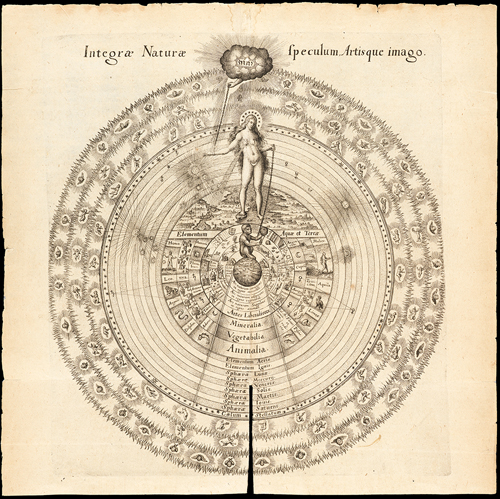
Art as the Mirror of All Nature, Matthaus Merian the Elder, 1617. Numerous Jungians have used this engraving as an image of “Anima Mundi,” the World Soul.

Last summer, after writing on soul and soul loss, I said I’d have more to say about these subjects, but I was stymied by an underlying assumption that such a weighty subject requires a weighty post, or realistically, weighty tomes, such as the writings of Jung and Hillman, who took soul and psyche (they used the terms interchangeably) as their central concern.

Google on “soul,” and you get two billion hits. “Soul loss” returns 213 million. Soul has been a central concern of humans and their ancestors for millennia. The earliest known burial with evidence of rites “that one might characterize as religious”(1), is a 300,000 year old Neanderthal tomb!

So how do you begin to talk about soul in a blog post?

Eventually, two realizations emerged.

The first was that if blogging doesn’t support weighty tomes, it is perfect for writing notes, a valid and necessary form.

The second, and even more important realization was that no one needs to be introduced to the concept of soul, for they already have one. I’m pretty sure that everyone reading this post has an idea of soul – it’s one of those terms like “angel” or “demon” – even those who don’t believe in angels or souls or demons have an idea of what it is that they don’t believe in.

So I figure I pretty much get to do what I usually do here – “think out loud,” in this case on the notion of soul, without any expectation that my ideas may or should match anyone else’s, though I suspect we think alike about many things connected to soul ( True or False – The music of B.B. King has soul? ).

I’m speaking of something in each of us, something we feel but cannot define, which carries supreme importance and value. No matter how badly I may have screwed up this day, this month, this year, this life, if I am in touch Soul, there remains something precious within something within me of value. Soul carries a sense of what’s holy. According to James Hillman, soul is intimately connected with love, religion, beauty, and mortality.

I take the position of Jung and Hillman, that soul, aka psyche, resides in the imaginal world, between the physical realm, which is apparent, and the spiritual, which is beyond our senses and ordinary conceptions. Jung said, “The psyche creates reality every day.” Hillman added, “To be in soul is to experience the fantasy in all realities and the basic reality of fantasy.” (2)

Soul carries meaning and purpose and keeps us energized when we’re on the right path. It is present at moments of great beauty, joy, or loss, and is always a part of any “peak experience.”

T.S. Eliot said:

I am moved by fancies that are curled
Around these images, and cling:
The notion of some infinitely gentle
Infinitely suffering thing.

So this is what I am going to reflect on here for a while, and we will see where it goes. The obvious question is “Why now?”

I suspect the answer has to do with the belief of many indigenous cultures, that soul can be lost by individuals and groups, but that it also has the possibility of being retrieved. Enough said…

Cycles, Gyres, and Yugas, Part 3: Soul in a Dark Time

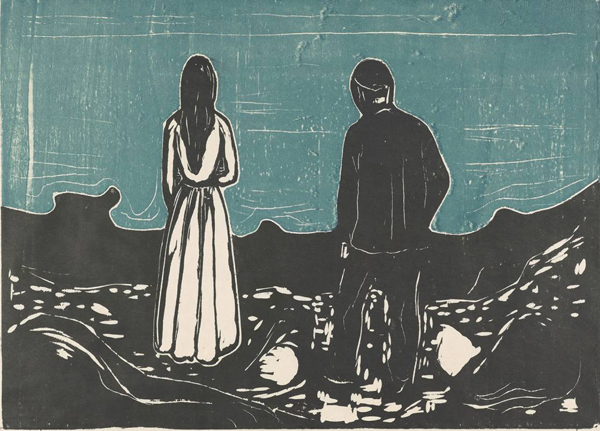
Edvard Munch, “The Lonely Ones,” woodcut, 1899

“the darkness around us is deep.” – William Stafford, 1960

“In a dark time, the eye begins to see,
I meet my shadow in the deepening shade;
I hear my echo in the echoing wood—
A lord of nature weeping to a tree.” – Theodore Roethke, 1963

“There’s a darkness at the edge of town.” – Bruce Springsteen, 1978

In a recent post I quoted Sri Daya Mata (Faye Wright), successor to Paramahansa Yogananda as president of Self-Realization Fellowship, describing a vision she had on a pilgrimage to the Himalayas in 1963:

“A huge black cloud suddenly swept over me, trying to engulf me. As it did so, I cried out to God…Through the practice of meditation, the all-knowing power of intuition develops in each one of us. I had intuitively understood what the Divine was telling me though this symbolic experience. It foretold a serious illness I was soon to undergo; and it also indicated that all mankind would face a very dark time during which the evil force would seek to engulf the world.

Daya Mata’s vision came to mind during the 2nd Democratic debate on July 30, when Marianne Williamson, a candidate I had initially dismissed as a lightweight, made the most pertinent observation of the evening:

“If you think any of this wonkiness is going to deal with this dark psychic force of the collectivized hatred that this president is bringing up in the country, then I’m afraid that the Democrats are going to see some very dark days.”

Both the concept of world ages and that of dark forces are pertinent metaphors for something we sense – and most cultures have explicitly believed – there are forces greater than what we can see behind and within what unfolds in the visible world.

An especially important image for me, is Soul as James Hillman used the word, (as when we say someone or something “has soul”), and the parallel image of soul loss. This metaphor has grown in importance for me as I’ve recently read both Hillman’s and his colleague, Michael Meade’s speculations on what loss of soul can mean for an individual or culture: Continue reading

James Hillman on “The Soulless Society”

I often wonder what James Hillman (1926-2011), the most widely known post-Jungian thinker and someone whose work continues to inspire me, would make of our current times.

Yesterday I found a clear indication in this excerpt from an interview, published on youTube four months before he died of bone cancer. To me, this brief conversation ( just over seven minutes) is far more important to consider than any other message I’ve seen on the eve of our nation’s birthday. In it, Hillman says:

“Where are we now? What’s psychology worth now? I mean look at the world, look at the USA. Look at all the people who have taken psychology courses and look at the lack of psychology in our government and in our attitudes. I mean we haven’t a clue!

We go around the world as if there was no such thing as a psyche, no such thing as a soul. I mean we bomb and exploit and take and kill as if this had no effect on the soul of our own people, let alone other people…I’m worried about the soul of our country from the effects of what we do.” Remember – this was said in 2011.

Hillman’s was never a “comfortable” psychology, for he always aimed to help us “see through” our comfortable illusions, ever deeper into the often uncomfortable dynamics that underly what is visible on the surface of personal and national life.

Some of the comfortable illusions I would like to believe but cannot include ideas like:

  • Our problems began in 2016.
  • One man (or) one party is responsible.
  • We are better than this.

This last one I find to be the most harmful illusion of all, for it suggests there may be (relatively) straightforward fixes, as if we simply got off on the wrong freeway exit.

If we were better than this, it wouldn’t be happening!

And if we aspire to be better than this, Hillman would likely suggest we take a clear eyed a look at where we are, and how we got here, and what we can do now in service to Anima Mundi, the Soul of the World.

James Hillman on Educating the Imagination

It’s no surprise to discover that the roots of our current national tribulations have deep roots. James Hillman died in 2011. I am unable to find a date for this talk, but he references the administration of George W. Bush, so I’m guessing at least a decade.

It is just as true or more so today. Please listen – it will be a most valuable half hour!

https://www.youtube.com/watch?v=cuYg3QKj2K4