Displacement: Psychiatry A psychological defense mechanism in which there is an unconscious shift of emotions, affect, or desires from the original object to a more acceptable or immediate substitute.
Any questions?

Displacement: Psychiatry A psychological defense mechanism in which there is an unconscious shift of emotions, affect, or desires from the original object to a more acceptable or immediate substitute.
Any questions?

2×2 Matrix: possible futures, by Gaurau Mishra. CC-BY-2.0
Almost four years ago, I posted Change is the Only Constant, a discussion of the December, 2012 report of the National Intelligence Council, a consortium of the 16 major U.S. intelligence agencies. Since 1997, they have issued comprehensive reports on future trends after each presidential election and posted the reports online. We can expect the next installment this winter.
The 2012 edition, which predicts alternate futures for the year 2030, outlines some things that are certain, like aging populations in the developed world; some which are possible, and some “black swans” – potential surprises for good or ill. Here are two key predictions.
Keep this in mind as we look at a some current events. I should preface these comments by saying I’ve long had a rule of thumb: never trust a politician who says, “I have a plan to create jobs.” Both presidential candidates have said those exact words this year.
The fantasy is that by pulling the right levers – cutting or raising taxes, threatening or cajoling China, building a wall at our southern border, and so on, we can restore whatever American golden age our imagination conjures. Maybe the 50’s, when we were the only industrial nation not ravaged by WWII. Maybe the 90’s dot com boom, when even your Starbucks barista had stock tips to share.
We all know that’s not going to happen. The truth is even harder to face than any elected or would-be elected American official has yet been willing to share.
On May 16, the BBC reported that China’s Foxconn, the largest electronics manufacturer in the world, where Apple and Samsung smart phones are made, replaced 60,000 workers with robots. Chinese manufacturers are investing heavily in robotics. So much for bringing jobs back from China.
For an article in the August 1 issue of Time, (“What to do about jobs that are never coming back”), Rana Foroohar spoke to Andy Stern, a former head of the Service Employees International Union: “Stern tells a persuasive story about a rapidly emerging economic order in which automation and ever smarter artificial intelligence will make even cheap foreign labor obsolete and give rise to a society that will be highly productive–except at creating new jobs. Today’s persistently stagnant wages and rageful political populism are early signs of the trouble this could generate.”
In a Common Dreams article published last week, You Can’t Handle the Truth, Richard Heinberg, steps back for a much longer view of our situation and says:
“We have overshot human population levels that are supportable long-term. Yet we have come to rely on continual expansion of population and consumption in order to generate economic growth—which we see as the solution to all problems. Our medicine is our poison.
“And most recently, as a way of keeping the party roaring, we have run up history’s biggest debt bubble—and we doubled down on it in response to the 2008 global financial crisis.
“All past civilizations have gone through similar patterns of over-growth and decline. But ours is the first global, fossil-fueled civilization, and its collapse will therefore correspondingly be more devastating (the bigger the boom, the bigger the bust).
“All of this constitutes a fairly simple and obvious truth. But evidently our leaders believe that most people simply can’t handle this truth. Either that or our leaders are, themselves, clueless. (I’m not sure which is worse.)”
“…any intention to “Make America Great Again”—if that means restoring a global empire that always gets its way, and whose economy is always growing, offering glittery gadgets for all—is utterly futile, but at least it acknowledges what so many sense in their gut: America isn’t what it used to be, and things are unraveling fast. Troublingly, when empires rot the result is sometimes a huge increase in violence—war and revolution.” (emphasis added)
The last major decline of empires, he notes, resulted in World War I. The US and the rest of the world are, in Heinberg’s words, “sleepwalking into history’s greatest shitstorm.”
“…Regardless how we address the challenges of climate change, resource depletion, overpopulation, debt deflation, species extinctions, ocean death, and on and on, we’re in for one hell of a century. It’s simply too late for a soft landing.
“I’d certainly prefer that we head into the grinder holding hands and singing “kumbaya” rather than with knives at each other’s throats. But better still would be avoiding the worst of the worst. Doing so would require our leaders to publicly acknowledge that a prolonged shrinkage of the economy is a done deal. From that initial recognition might follow a train of possible goals and strategies, including planned population decline, economic localization, the formation of cooperatives to replace corporations, and the abandonment of consumerism. Global efforts at resource conservation and climate mitigation could avert pointless wars.
“But none of that was discussed at the conventions. No, America won’t be “Great” again, in the way Republicans are being encouraged to envision greatness. And no, we can’t have a future in which everyone is guaranteed a life that, in material respects, echoes TV situation comedies of the 1960s, regardless of race, religion, or sexual orientation…”
Heinberg’s conclusions aren’t easy to digest, and are tempting to deny. Keeping attention on even a few of the significant points in the articles referenced here leads to disturbing conclusions.
If 16 US Intelligence agencies are anywhere near correct in their numbers, in 14 years, 8.3 billion people will be competing for 40% less water and 35% less food (in this case, living up to their name, the intelligence agencies don’t waste anyone’s time denying the effects of climate change).
Can we imagine “global efforts at resource conservation” in which nations co-operate, and at least try to send relief where it’s needed? Like after tsunamis or the earthquake in Nepal? Or are we headed toward a survivalist wet dream? Futures aren’t set in stone, said the NIA. It all depends on how we behave (sinking feeling in the gut…).
I can see it both ways. Speaking of our current election, someone recently said to me, “I haven’t felt this bad about things since 9/11. Maybe it’s even worse.” Maybe so. In the immediate aftermath of 9/11, we were a nation and a world largely united in awareness of our fragile humanity and revulsion at senseless suffering.
It strikes me that communities often pull together in the face of disaster when our leaders and governments won’t. That is Heinberg’s conclusion as well. Given our lack of competent leadership at the top, how can we build “local community resilience?”
I wish I knew. But since Iceland has more sense than to open it’s doors to American refugees, I’ll have time to think it over! Meanwhile this quote from the Dalai Lama comes to mind:
“We can live without rituals. And we can live without religion. But we cannot live without kindness to each other.”
Changes are certain but futures aren’t set in stone…
Studies in the psychology of happiness list the factors that contribute to wellbeing. Not surprisingly, good health is most important, followed closely by a satisfying social network. Having money for necessities and simple comforts is important, though the curve flattens out once we have “enough.”
Statistically, having children is a wash; those with kids and those without have the same chances of feeling satisfied in life. Two parents in China experienced the downside of little ones, when their four year old son, unable to read a “Do Not Touch,” sign, destroyed a $15,000 lego critter that had taken three days and 10,000 legos to create. Oops!!!
The creator, who identifies himself as Zhao, said he feels “frustrated and depressed,” though he understands the act was not intentional. I am reminded of Tibetan sand mandalas, especially as China is warming up to Buddhist practice again. The sand mandalas are ritually destroyed after use to demonstrate the impermanence of all created things.
Still, I certainly sympathize with Zhao. I managed to screw up or set back painstaking projects at work from time to time, even without a four year old to help. The end result was that I became very careful…
Here’s hoping Zhao gets back in his groove!
If you’re old enough, you will remember a time when reporters and news media aimed for the truth. We just lost one of the greats of that era, Morley Safer.
Here’s what truth-telling looked like during that time when the corporate media and the government allowed it, and we would not have settled for reality TV.
RIP Morley, after a life lived with courage and integrity.
You mean Belgium, right? That is, after all, the home of Anheuser-Busch InBev, parent company of Anheuser-Busch, maker of Budweiser, which shall henceforth be known as America beer. Until the election is over, that is.
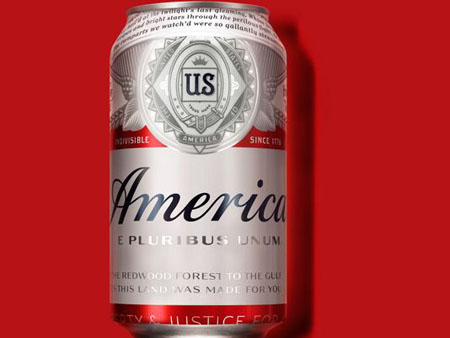
And who among us, cannot wait for that day?
Ad Age, which announced the change noted that the motto, “King of Beers” will become, “E Pluribus Unum,” and the bottom of the can will feature this text: “From the Redwood Forest to the Gulf Stream Waters this land was made for you and me.”
Yep, let’s hoist one for good old Woody Guthrie. I’d love to hear the songs he’d be writing this year!

Section of Hungry Ghosts Scroll, Kyoto, late 12th c., Public Domain
In traditional Buddhist cosmology, there are six major realms of existence. Only two of these, the human and animal realms, are visible. The other four, which include both heavens and hells, are not manifest to our physical senses. Unlike Christian heaven and hell, none of these are forever – the length of one’s sojourn depends on karma.
Many contemporary teachers, while not denying the metaphysical reality of these regions, focus on our inner “location” in the here and now. One who is filled with love and compassion dwells in heaven. The one seething with anger, red in the face, like a devil, at that moment experiences one of the hells.
Hungry ghosts have a region all to themselves; their dominant trait is insatiable craving. Hungry ghosts are depicted with huge bellies but tiny throats and mouths – desperate hunger and thirst that can never find relief.
“Never enough, there is never, ever enough,” is the mindset of hungry ghosts, both in the imagined subtle realm and in this world. Addictions and insatiable cravings of all sorts make us hungry ghosts. The pre-repentant Ebenezer Scrooge, the archetypal miser, is the best known western hungry ghost. Now, the Panama Papers reveal how widespread is this disease, and how it drives the leaders and elites in nations throughout the world. Nor do we, at least in “the free world,” get to sit back and righteously condemn “those bad people.” Not in Buddhist thought, at least, where everything is interconnected.
The people of Iceland forced their Prime Minister out of office within 48 hours of the time the story broke. They did the same with the bankers in 2008. We, who have elected officials of both parties who tolerate bailouts and corporate shell games, are are not separate from the hungry ghosts who are fucking this world.
In his public discourse, Buddha never commented one way or another on metaphysical truths. There’s plenty to worry about here and now, he said. If greed locks us into the hell of the hungry ghosts, generosity, the mindset of Scrooge on Christmas morning, opens the gates of heaven.

Ratnasambhava, the primordial Buddha of “the wisdom of equality,” manifests the virtue of generosity.
Perhaps there are no big or small acts of generosity. Our world, the people in it, and we ourselves, need nothing more urgently at this time.
Even to me, this title seems to refer to the sexual preference of breakfast pastries, rather than its real subject, their shape. This is because “croissant” is French for “crescent,” and who ever heard of a straight crescent outside of higher mathematics?

Well, our cousins across the water are embroiled in a debate on this very subject.
Tesco, the largest supermarket chain in Britain, will no longer sell curved croissants. Tesco croissant buyer, Harry Jones, spoke of “the spreadability factor.” Curved croissants typically require three strokes to cover their surface with jam, the preferred topping of most Brits, while a straight croissant can be covered by a single sweeping stroke, thus cutting the risk of sticky fingers or table cloths. (1)
As a veteran of many sticky finger incidents involving restaurant marmalade containers, I can attest a Daily Telegraph editorial is wrong: it is not necessarily safer to eat toast!
Discussions of ease of use and symbolism fail to consider health implications. French law declares that straight croissants must be made with butter, while the curved varieties can use margarine.
In a world where so many familiar structures are in flux, curved croissants are now one less thing we can count on.
I guess there’s no help for it. Benjamin Turquier, last year’s champion Parisian butter croissant maker, said “I can understand the importance of symbolism and tradition, but straight croissants are more practical to make.”
Sigh…we’ll just have to learn to deal…
Paranormal conspiracy theorists and science fictions fans from Area 54 to Roswell will recognize my title as the motto of FBI Special Agents Fox Mulder and Dana Scully, whose whimsical escapades have returned to television.

On a less amusing note, it’s the American attitude toward virtually all institutions, according to journalist, Jeff Greenfield, whose essay,”In Nothing We Trust,” aired on the PBS Newshour on Friday, February 5.
Greenfield cites a recent Pew Research poll showing that Americans mistrust most institutions; only 19% of us trust the government to do “what is right most or all of the time.”
In 1964, with a strong economy, the passage of the Civil Rights bill, and an easing of the cold war, the number was 77%. Ten years later, after a decade of war in Viet Nam and a scandal that drove a president from office, the number was 36%, and it has never topped 50% again.
It isn’t just our government, according to Greenfield. We don’t trust churches. Labor Unions. Banks. Large corporations. Medicine. Greenfield notes, in his TV news segment, that only 21% of us have “a lot of faith” in TV news.
In great measure, says Greenfield, there are good reasons to mistrust these institutions. Think of the movie, Spotlight. The government of Michigan and the City of Flint. Yesterday’s congressional hearings on 5000% price hikes in the pharmaceutical industry.
In a similar editorial, I once heard a journalist say that the first act of colonial governments was an attempt to discredit all the institutions of the colonized people; “obviously your god, your army, your government are not as good as ours or we wouldn’t be here.” We may be, said the journalist, the first nation in the history of the world to have colonized itself!
Our pervasive mistrust, according to Jeff Greenfield, makes things especially difficult, in a political year, for those seeking to gain the public trust. It may, in fact, reward those who fan the flames of discontent.
But how, he asks, can a republic long survive when it’s motto is, “In nothing we trust?”
 The First Gates