No discouraging words revisited

Embed from Getty Images

In an earlier post, Where seldom is heard a discouraging word, I announced an experiment. Following my wife’s efforts to suspend negative thinking and speech during Lent, I decided to refrain from critical posts through Easter. Here is the first of several observations I will share.

Avoiding negative and pessimistic topics leaves me a lot fewer subjects to blog about! Many of my posts begin with news stories, but often it seems, to paraphrase the old Hee-Haw song, “If it weren’t for bad news, I’d have no news at all.” More nights than not, when I’ve checked my usual source websites (CNN, NPR, USA Today, etc.), I haven’t found a single upbeat or funny or quirky post that I wanted to write about. Sure, there was the girl scout who sold 12,000 boxes of cookies, but even if it’s a good thing for a kid to become a marketing wizard, that isn’t my kind of story.

The real question for me, however, is not the content of this weeks’ or that weeks’ news, but the systemic nature of our news media, which makes trials and tribulations endemic. These are news stories, after all, and a good story demands tension, upping the stakes, and all that. The question is not whether these are gripping stories, but the degree to which they mirror “reality.”

I’m thinking of a book I have often cited here, Neal Gabler’s, Life the Movie: How Entertainment Conquered Reality (2000), in which the author says we are not just a post-modern culture but a “post reality culture.” Gabler locates the beginning of news-as-entertainment in America as “the penny press.” Prior to 1830, newspapers were single page “broadsheets” which appealed to the upper classes. Most of them cost six cents and the average daily circulation in New York City was 1200. Beginning with the Sun, which cost a penny, newspaper sales exploded. Gabler cites various reasons for the success of the penny press, but says that above all, it meshed with other sensational forms of entertainment:

“…for a constituency being conditioned by trashy crime pamphlets, gory novels and overwrought melodramas, news was simply the most exciting, most entertaining content a paper could offer, especially when it was skewed, as it invariably was in the penny press, to the most sensational stories. In fact, one might even say that the masters of the penny press invented the concept of news because it was the best way to sell their papers…”

In it’s first two weeks of publication, in 1835, the New York Herald ran stories that centered on “three suicides, three murders, the death of five persons in a fire, a man accidentally blowing off his head, an execution in France by guillotine and a riot in Philadelphia.” Needless to say, the Herald became wildly successful.

If it’s true that what we think of as “news” is an “invented concept,” we have to ask to what degree it mirrors reality and to what degree it creates it? Think about that the next time you open the paper or check your Tweets.

What I have discovered is how deep the contagion goes, even though I normally limit my sources, never watching the local news on TV, for instance. I confess that while I have cut negative posts from theFirstGates since March 7, I’ve probably doubled the number of depressing subjects I’ve posted on Twitter. In a way, I feel like I did a month after I quit smoking, and found that a nasty cough was still there. This is more serious than I thought at first. I’ll have more to say about it, but meanwhile, let’s change the tone as we end with a classic that came to mind at the start of this post.

Anatomy of the Deep State by Mike Lofgren

Be warned, this post has disturbing content.  If it was a movie, I’d rate it “R,” not because of sex or violence, but because it concerns a penetrating essay on the current state of the US government.  Change the channel now if you’re squeamish.

If you’re still here, good, because disturbing or not, I think everyone ought to read Anatomy of the Deep State, by Mike Lofgren, a former GOP Congressional aide who retired after 28 years as a staff member for Congress and the Senate.  This article is a distillation of ideas he explored in his recent book, The Party is Over: How Republicans Went Crazy, Democrats Became Useless, and the Middle Class Got Shafted.

party is over

Lofgren says what many of us have long suspected, that our visible political landscape is merely the tip of a much bigger iceberg – that our various issues, debates, and elections often have little to do with the real trajectory of power in this country.  Much of this “real” trajectory is hidden in plain sight.  With almost three decades inside the belly of the beast, Lofgren can show us where to look.

He cites many examples.  During the political circus surrounding the 2011 debt ceiling “crisis,” our leaders had no problem finding money to topple Gaddafi.  A few months later, during the government “shutdown”, while debates raged over canceling meat inspections and air traffic control, we gave $112 million to Syrian rebels, to keep that conflict going.  And since 2007, as our bridges collapse, schools fail, and cities go bankrupt, we’ve spent $1.7 billion on an NSA building in Utah the size of 17 football fields.  Its purpose is to house a yottabyte of data.  A yottabyte, the largest number computer scientists have so far coined, equals 500 quintillion pages of text.  “They need that much storage to archive every single trace of your electronic life,” Lofgren says.

The best news, according to Lofgren, is that what he calls the Deep State is far from invincible.  He notes how sufficient ineptitude draws pushback even from allies, citing our two failed wars and the Snowdon revelations among other things.  Past elites have often reacted to challenges in one of two ways.

Some have tried to “stay the course,” and Lofgren observes that,“The dusty road of empire is strewn with the bones of former great powers that exhausted themselves in like manner.”  Others have followed reformers, as diverse as Franklin D. Roosevelt, Charles de Gaulle, and Deng Xiaoping.  What each of these men developed in common was a deep understanding that their cultural stories and myths were ossified and that survival depended upon renewing both vision and action.

Mike Lofgren, a self-described “former proud Republican” now says, “there is…a deep but as yet inchoate hunger for change. What America lacks is a figure with the serene self-confidence to tell us that the twin idols of national security and corporate power are outworn dogmas that have nothing more to offer us. Thus disenthralled, the people themselves will unravel the Deep State with surprising speed.”

The first step in dealing with any problem is understanding its nature.  In this time of deliberate political and economic obfuscation, I highly recommend Anatomy of the Deep State as one of the best and most succinct diagnoses I’ve yet seen of what ails us.

Part-time penury

Serfs

Between 1981 and 1984, I worked as a part time instructor at a community college in northern California.  Like most part-timers, I dreamed of the tenure track.  I was lucky.  At one point during a faculty meeting, I looked at all the other hopefuls, did the math, and realized I was on, if not a sinking ship, one that was dead in the water.  I started building a lifeboat and made my escape.

According to a recent NPR story, a million part-time, or adjunct professors, have not been so fortunate.  That’s 75% percent of U.S. college teachers who are stuck in part time positions; like workers at McDonalds, many rely on food stamps to get by.  Current pay for adjuncts is $2,000 – $3,000 a class with no benefits of any kind.  “Freeway fliers” is what we called ourselves when I was in the ranks, zipping between nearby schools to pick up any available classes.

One adjunct interviewed in a parallel story on the PBS Newshour teaches six English classes at three Ohio universities.  With a family to support, he couldn’t afford to stay home when he had pneumonia last fall.

At the time, I assumed the dismal prospects were my fault; I only had an M.A. and taught at a small town, two year school.  The articles make clear that although the trend began at two year schools in the 1970’s, it soon spread to all types of colleges and universities.

Peter Brown, professor emeritus of the State University of New York at New Paltz says the average salary of adjuncts there is $12,000 a year – less than the custodial staff.  “Between 1970 and 2008, the adjunct pay has gone down 49 percent,” says Brown.  “The salary of college presidents has gone up 35 percent.” 

In the 80’s we talked of organizing, and finally, three decades later, some colleges are granting part timers collective bargaining rights.  Twenty-two percent of adjuncts now belong to a union.  The death last fall of an 83 year old Duquesne University adjunct, who had taught for 20 years with good reviews, only to die impoverished, served as a wake-up call, as did a January congressional report that found adjuncts are treated like “cheap labor.”

In general, we get what we pay for, and as college students go ever deeper into debt, it’s worth asking what their education dollars are buying.  Well-to-do college administrations.  Top notch football teams.  A lot of professors too sick or stressed or busy commuting to hold decent office hours.  Ever fewer real-world prospects.  And…?

If we don’t want to end up singing “Glory Days” when we think of the long-gone time when American education was the best in the world, something will have to change.

Phil sees his shadow!

Photo by Eddie~S, CC BY 2.0

Photo by Eddie~S, CC BY 2.0

In the key news event of the day, I’m sad to report that it was sunny in Punxsutawney, PA, spooking the groundhog and plunging us into another 6 weeks of winter.

This has not been a winter anyone wants to linger.  A mini-ice age threatens the east, while 11 western states are morphing into Death Valley.  And to add insult to injury, here in northern California, where legions of disgruntled football fans are settling in to watch those other teams play – all the while muttering that at least spring training starts soon – spring may be on hold!

So as the blues settle in like the overcast on this chilly, cloudy, but rainless day, only three suggestions come to mind:  (1)  book a flight to Hawaii, (2) drink some more caffeine, (3) watch a funny movie.

It just so happens that I have an idea for number 3:

"Don't drive angry!"

“Don’t drive angry!”

PostScript: For readers outside our borders, who may not get all my topical references, here is a brief glossary:

  1. February 2 is “Groundhog Day.”  When the groundhog emerges (most famously, Punxsutawney Phil, in Pennsylvania), if he sees his shadow, it will spook him and he’ll return to his burrow for another 6 weeks of winter.
  2. Here in the western US, where we have no groundhogs, it’s sometimes called Prairie Dog Day, but that hasn’t gained much traction in the media yet.
  3. Local sports fans are disgruntled because our beloved 49’ers were knocked out of the playoffs by the devil-spawned Seattle Seahawks.  No real rancor, although we hates them forever, my precious.

Let me know if I can be of any further assistance explaining my rant.

In memory of Pete Seeger

Pete Seeger, 1919-2014.  Photo by wfuv, Creative Commons

Pete Seeger 1919-2014. Photo by wfuv, Creative Commons

“The key to the future of the world is finding the optimistic stories and letting them be known.” – Pete Seeger, 1994

I was fortunate enough to hear Pete when he dropped by to play several informal concerts at the high school I attended during my sophomore and junior years.  Not even really “concerts” – they were too informal and intimate for that.  He sat on a folding chair with his banjo and sang, talked, joked and got us to sing along.  It should be clear to those who read this blog that I am not the sing along type, but it was different with Pete Seeger.

He had a presence, an authenticity, a naturalness that won us over.  He was instantly “one of us,” and this in an era when we said, and really believed, “Never trust anyone over 30.”  We had seen betrayal.  We knew what it looked like and felt like.  But Pete was one of us.  “We’re all in this together,” he seemed to say, “as brothers and sisters.”  You wanted to sing along, be part of a moment like that.

Just “small events” that I’ve never forgotten.  The memory jumped to mind when I heard that Pete has moved on from this world.  Our good fortune is that he gave us so many anthems to remind us that we are still in this together.

Cool water

“Cool Water,” a classic western song, was written in 1936 by Bob Nolan (1908-1980), a Canadian transplant to Arizona, who fell in love with the desert.  Nolan, an actor, poet, singer, and songwriter also wrote “Tumblin’ Tumbleweeds,” and is credited with the creation of “western music” as a distinct genre.

Bob Nolan in "The Lights of Old Santa Fe," 1944

Bob Nolan in “The Lights of Old Santa Fe,” 1944

“Cool Water” tells of a man and his mule, lost in the desert and beset with mirages.  The song has been widely covered by artists as diverse as Hank Williams, Marty Robbins, Joni Mitchell, Burl Ives, Johnny Cash, The Muppets, and Fleetwood Mac.

All day I’ve faced a barren waste
Without the taste of water, cool water
Old Dan and I with throats burnt dry
And souls that cry for water, cool, clear, water.

The song came to mind for obvious reasons last week:  Gov. Brown to declare California drought emergency.  Nobody here needs the newspaper to tell us we’re in trouble.  A glance at the brown lawns in January, and the American River, running lower than I’ve ever seen it at this time of year will do that.

My thoughts have been filled with many songs, stories, and images of water that I will be sharing here.  I was planning on writing a longer post today, but I never got past this clip of Marty Robbins’ version of “Cool Water.”

I first heard the song on my absolute favorite album as a kid, Robbins’ Gunfighter Ballads and Trail Songs.  Even though he’s kidding around with his friends (I think it’s a clip from “Hee Haw”), if you listen, it sounds like a prayer.  I think I’ll leave it at that for today.

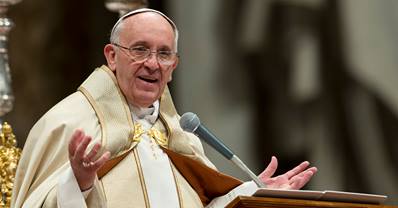
Pope Francis on Economic Justice

Pope Francis

“How can it be that it is not a news item when an elderly homeless person dies of exposure, but it is news when the stock market loses 2 points?” – Pope Francis (1)

On Tuesday, Pope Francis delivered a sharp rebuke of unfettered capitalism as “idolatry of money” that will lead to “a new tyranny.” (2)  His language was specifically directed at those in the United States who continue to defend “trickle-down economics,” which he said “has never been confirmed by the facts, [and] expresses a crude and naive trust in the goodness of those wielding economic power.”

“Meanwhile,” he said, “the excluded are still waiting.”

President Obama said he was “hugely impressed with the pope’s pronouncements.”  Nevertheless, on Wednesday, the US announced it will close its Vatican embassy as a “cost saving measure.” (3)  The seven embassy staffers will be retained, just moved beyond the borders of Vatican City, which is the world’s smallest sovereign nation.

Republican senators, many of whom still advocate the trickle-down policies the pope condemned, were quick to denounce the administration’s move as “a slap in the face to Catholic Americans around the country.”

Though I’m not a Catholic, I find myself deeply grateful on this day of thanks, for the current Vicar of Christ.  When politicians of all persuasions spend most of their time defending an increasingly dysfunctional status quo, it is refreshing and marvelous to find a world leader willing to speak the truth.


Trust and belated reflections on November 22

I was going to pass on adding my $0.02 to the discussions of the Kennedy assassination.  I have nothing to add concerning the event itself.  I am writing this post because of a comment I cannot get out of my mind:

“Like a tornado, the Kennedy conspiracy theories have spun off whirlwinds of doubt about other national traumas and controversies…The legacy of that shocking instant is a troubling habit of the modern American mind: suspicion is a reflex now, trust a figment.” – David Von Drehle in Time Magazine, Nov. 25, 2013

You can’t argue with Drehle’s conclusion, that suspicion of government is a reflex,  but when and how did it come about? I truly don’t remember it starting in Dallas.  People at the time expressed shock and grief, and everyone shook their head and said the killing of Lee Harvey Oswald was “pretty suspicious,” but no one I knew, and not a single history teacher I ever had, obsessed about the conspiracy like we do now.

I wonder if that’s a key – like we do now.  I wonder if the weight given this month to assassination conspiracy theories isn’t history revised in light of our current mistrust of government, a mistrust that came about from a long string of incidents rather than a single one.

There was the Gulf of Tonkin the following year, used to justify escalating the war in Vietnam, which Robert McNamara, then Secretary of Defense, later admitted never happened.  There was the 1970 National Guard shooting of 13 students in Kent, Ohio, when fear and loathing of government rose to heights I’ve never seen before or since.  There was Watergate, the non-existent Iraq WMD’s, and now let’s all say hi to the NSA, both I who am writing and you who are reading this post.

Trust is the foundation of any honest relationship, slow to evolve and quickly broken by deceit.  In interpersonal relationships, once it’s gone it is pretty much gone for good – “fool me once…” as they say.

The flags flying at half-staff yesterday brought to mind a childhood grief, but we have moved on from the loss of one man.  What lingers and haunts is the memory of how that man could invite a public trust – “Ask not what your country can do for you…” – and seem worthy of it.  That level of hope and public trust is gone, and I don’t see it coming back.

More than a man, that is what I found myself mourning yesterday.

HalfStaffFlagNotification