

Jorinda and Joringel, Part 2

Photo by Jon Sullivan, public domain

Photo by Jon Sullivan, public domain

This post continues my discussion of Jorinda and Joringel, a fairytale from the Brothers Grimm.  If you haven’t read Part 1, I suggest you do so.  What follows will make more sense.  Here is a summary of the story:

A young couple, betrothed to be married, stray too close to the castle of a witch in a dense forest.  The witch freezes the young man, Joringel, on the spot and turns the young woman, Jorinda, into a nightingale.  She cages Jorinda and carries her into the castle where she keeps thousands of other girl-songbirds.  

The witch then frees Joringel, who wanders to a strange town and works as a shepherd for a long time.  At last he dreams of a red flower enclosing a jewel which overcomes all enchantments.  After searching for nine days, he finds such a flower with a large drop of dew inside.  He uses the flower to free Jorinda and the other girls, and strip the witch of her magical powers.  Jorinda and Joringel marry and live happily for many years.

I have referred before to the writings of Marie-Louise Von Franz, Carl Jung’s closest associate, who wrote several books on folklore from a Jungian perspective.  In approaching this story, I reread parts of her Individuation in Fairy Tales (1977).

Individuation was  Jung’s central concept.  He used the term for the ultimate goal of inner-work, the lifelong struggle to realize the Self – not the ego-self but our unique totality, the union of all our tendencies, good, bad, and ugly.  This psychic wholeness can free us from the prison of neurosis.  

Jung and Von Franz listed numerous symbols for the Self:  the divine figures of all religions; the wise old man or wise old woman; the divine child, the helpful animal, mandalas, flowers, jewels, birds, golden balls, circular towers, and almost anything else that implies wholeness or completeness in itself. 

Rose windows in the cathedrals are well known western mandalas, symbols of unity in the cosmos, while our fairytale rose, which breaks all enchantments and hides a pearl, has a similar meaning for the lovers in this story.

English stained glass by William Wailes, ca 1865. Photo by TTaylor, 2006. Public Domain via Wikimedia Commons

Jorinda and Joringel, when they finally marry, embody another symbol of the Self in the Jungian view, the divine pair.  The mystery of the male-female union of opposites was often illustrated as a hermaphrodite in the alchemical texts that Jung studied, a western equivalent of the yin-yang symbol.

Fairytales don’t feature hermaphrodites, just normal weird being like giants and dragons, but I think we can look for this theme of “higher union” whenever a folktale ends with a wedding.  But before the happy ending, Jorinda and Joringel have to experience loss and getting stuck.

At the start of the story, they seem very young.  Young people don’t know the dark regions in the forest.  They play with golden balls, their original wholeness, but that is destined to go.  In folklore and in life, innocence makes a fall inevitable.

Everyone goes through stuck times. – the unsatisfactory job or relationship.  What once sustained us loses its flavor.  Marie-Louise Von Franz gave the example of one of her patients – a 43 year old unmarried man who lived at home and took care of his mother.  She had spells of illness whenever he talked of getting a place of his own.

Jorinda is caught in a different but similar trap.  Her transformation into a songbird is unique in my experience.  I haven’t come across this motif in any other tale.  A songbird is a pretty, entertaining, and unthreatening creature – perhaps what our culture wishes for young women and girls.  Yet to interpret the story like that amounts to projecting our modern sensibility onto earlier generations who shared this story around their hearths for hundreds of years – a risky proposition at best.

The witch is old.  Freezing people and caging them as songbirds can be seen as similar strategies for stopping time.  If we want to read this psychologically, we can imagine the witch as those places within that hate change, that cling to youth and beauty as if grasping will prevent them from slipping away.  It’s interesting that the healing flower contains a drop of dew, one of life’s more ephemeral things.

As happens when people are truly stuck, the solution doesn’t come from the characters’ ego selves – it comes from a transpersonal source, a “big dream” that leads Joringel to the magical flower.  And it doesn’t come immediately, but only after this one-time golden boy labors for a long time as a lowly shepherd.  Robert Bly has written in detail about the sobering quality of menial work in folklore.  Von Franz wrote about the value of work in helping the flighty, “eternal youth” in us get grounded.

The historical Saint Patrick was captured at 16 by Irish pirates and sold into slavery.  He worked for six years herding sheep.  He learned to pray in the wilderness and found his way to Christianity.  When the time was right, he heard a voice tell him his ship was ready, so he made his rather miraculous escape.  According to Jung and Von Franz, our inner center, the Self, does things like that.

To me, there is a beauty in these stories that equals scripture.  Faith, trust, kindness, belief in oneself and in the goodness of life, are implicit.  The heroes and heroines have to learn timing and instinct, when to trust and when to be wary, when to speak and when to be still.  They generally learn things the hard way (like us) after taking a fall – if their attention doesn’t falter in the forest, they wind up with a stepmother.  But those who listen to birds, to their own hearts, and to the voices in the wind, find a way to keep going and chose the right path.

jorinda

I don’t have any definitive answers about what the stories mean – the paths through the otherworld shift too fast for that.  I’m not sure that folklore meanings have that much meaning – I offer the ideas of Jung, Von Franz, and others as maps of where other explorers have gone.  In the end, I think it is living with these stories that matters most.  And then, as Joseph Campbell, another great explorer said, we enter the forest at the point that seems best us and watch for the birds or small creatures beside the road who can guide us.
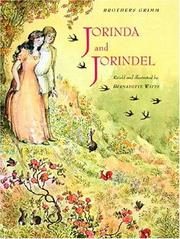
Jorinda and Joringel: a fairytale from The Brothers Grimm

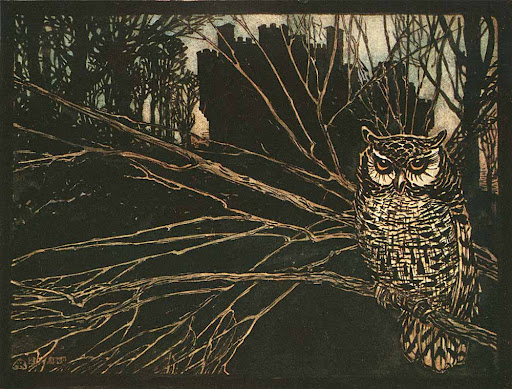
The witch as an owl by Arthur Rackham

The witch as an owl by Arthur Rackham

I have seen Jorinda and Joringel (sometimes spelled Jorindel) in many folklore collections, but I always passed it by.  A cursory glance led me to think it was much like Hansel and Gretel, not one of my favorite tales.  I’m not alone in skipping it:  I’ve never seen it discussed or analyzed by any of the writers on folklore I read.

I picked it up recently, intending to read myself to sleep, but stayed awake instead.  Jorinda and Joringel is a scary story with unexpected depths as well as features found in other celebrated stories.  One key image strikingly parallels a central symbol from India, which raises other questions.  Here is a summary of the tale:

***

Synopsis of “Jorinda and Joringel” in The Annotated Brothers Grimm

Once there was a witch who lived in a castle in the depths of a thick forest.  By day she took the shape of a cat or and owl, but at night she appeared as an old woman whose nose curved down to touch her chin.  She would kill and eat any bird or animal that ventured near.  If any human came within 100 feet of the castle, she would freeze them on the spot; they’d be unable to move until she released them.  She turned innocent girls into songbirds and keep them in cages inside the castle; she had 7000 birds and counting.

A beautiful maiden named Jorinda was betrothed to a youth named Joringel.  They enjoyed nothing more than spending time together, and one day they decided to walk in the woods.  “We just have to stay away from the castle,” Joringel said.

As the sun began to set, they heard the plaintive song of a turtledove. Jorinda began to weep while Jorindel sighed and felt oppressed with sadness. He noticed the wall of a nearby castle, but before he could utter a warning, Jorinda was turned into a nightingale. An owl with flashing eyes flew around them thrice and Joringel was frozen in place, a living statue unable to move.

The owl flew into a bush and a moment later an old woman emerged to carry Jorinda into the castle.  When she returned, she freed Joringel from the spell.  He fell to his knees and begged the witch to return his beloved, but she only said, “You will never see her again,” and departed.

Joringel wandered aimlessly in great despair.  He came to an unknown village where he worked for a long time tending sheep.  Sometimes he would circle the castle there but never too closely.

One night he dreamed of a blood-red flower with a beautiful pearl inside.  In the dream, he was back at the witch’s castle, and everything he touched with the flower was disenchanted.  When he woke in the morning, he started to search for the flower.  For nine days he roamed wilderness and village, and at last he found a blood-red flower with a large drop of dew inside that was as bright as any pearl.

He returned to the witch’s castle, boldly strode up, and touched the gate with the flower.  It flew open.  He found the room where the sorceress was feeding her birds.  When she saw Joringel, she was filled with rage, but she couldn’t come within two feet of him.  There were several hundred nightingales – how would Joringel find the right one?  Then he noticed the witch sneaking toward the door with a single cage.

Joringel ran to touch both her and the cage with the flower.  In an instant, Jorinda stood beside him and the witch lost her magical powers forever.  After freeing the other birds, Jorinda and Joringel departed.  They were married and lived with great happiness for a very long time.

*** 

After reading the story several times, I jotted down a few of the questions that came to mind:

  1. Why are Jorinda and Jorigel depicted as being so young?  In several translations, they are called “girl” and “boy” rather than “maiden” and “youth.”  Of the three illustrations I found, one depicts them as children.  Why?
  2. People are frozen or turned to stone in stories all over the world.  I thought of The Water of Life which I discussed here, as well as the ice queen in The Lion, the Witch, and The Wardrobe by C.S. Lewis.  What does it mean to be frozen like that?
  3. Why were the girls turned into songbirds?  Enchanted fairytale people usually wind up in far less appealing shapes.
  4. Another widespread motif is doing menial work for a very long time.   Here it is tending sheep.  More often it’s kitchen work.  Cinderella worked in the ashes for as long as it took a hazel twig, watered with her tears, to grow into a large tree.  Fairytale heroes and heroines wind up doing menial work when they are stuck or stalled in their quest.  If they do it well and for long enough, they find solutions.  Can this tell us anything useful?
  5. My final question concerned the pearl in the blood-red flower.  In western stories, such flowers are always roses; in the east, it would be a lotus.  Om Mani Padme Hum, is probably the world’s best known mantra and is usually (though incorrectly) translated as, “The jewel is in the lotus.”  Are the parallel images merely coincidence?  Or diffusion of stories?  Or the collective unconscious, or what?

These are the kind of things I always wonder about in stories like this.  I hunted and found a reference that doesn’t discuss this particular tale but casts light on these issues.  I’ll discuss them next time.  Meanwhile, if the story raised other questions for you, please post them.  Maybe someone here or a songbird in the tree outside will have an answer for you.

To Be Continued

The Secret of Getting Ahead?

Those who are old enough to have watched “Hee-Haw” will remember a song that Tennessee Ernie, Buck Owens, and the gang sang almost every week, “Gloom, Despair, and Agony on Me.”  One of the lines was, “If it weren’t for bad luck, I’d have no luck at all.”

These days, it sometimes seems like if it weren’t for bad news, we’d have no news at all, especially on the economic front.  I’ve been thinking about this a lot lately – not the economy per se, but the news, that is, the stories we tell about the economy.  I’ll have more to say about this later, but it’s increasingly clear that what we have beneath the headlines are dueling paradigms, different core assumptions of what is good and bad, what works and what doesn’t.

Here is a core assumption that never has gotten much air time:  altruism rather than self interest may be the greatest motivational force for people at work.  This is the thrust of the teaching and writing of Adam Grant, 31, the youngest tenured and highest ranked professor at the Wharton School of Business.  Sarah Dominus, a writer for the New York Times Magazine, profiled Grant in a March 27 article,  Is Giving the Secret to Getting Ahead?.

Grant first made a name for himself in the field of economics as a 22 year old grad student in organizational psychology, when he applied himself to boosting motivation and output at a university fund raising call center, a notoriously unpopular student employment option.

Realizing that the call center helped fund scholarships, Grant invited a scholarship recipient to address the callers to give them an idea of the value of their work.  Even Grant was amazed when the next month, revenues were up 171%.  In later studies, the jump was as high as 400%.  Since then, Grant designed other studies in other fields that gave parallel and equally quantifiable results.

Grant’s work has drawn criticism as well as praise, much of it centered on the potential for abuse of the findings.  Will corporations try to use them to keep workers happy while cutting their wages and benefits?  According to Sarah Dominus, Grant is skeptical of corporate motivation as well and says his effort is to understand the mechanism, not necessarily suggest implantation.

Two weeks ago, I attended a day long retreat with Norman Fischer, a long time teacher and former abbot at the San Francisco Zen Center.  The subject of his retreat was compassion.  “Self-cherishing never makes anyone happy,” he said.  “In the long run, concern for others is very practical.  It’s our only chance for living a satisfying life.”

I started thinking of the how and why of our bad news headlines when Fischer said he remains optimistic.  Despite the chaos and breakdowns of our traditional systems, he believes that interactions based on compassionate regard for each other are the future.  “Not in my lifetime and maybe not in yours, but I think it’s coming,” he said.

That’s why I was so pleased to discover Adam Grant’s work.  I don’t often think of economics as a likely field of compassionate action, but if, as the Buddha asserted, it’s an impulse at the core of our being, we should expect to find the evidence everywhere.  Adam Grant seems to have found it at the heart of “the dismal science.”  His first book for a wide audience, Give and Take, was published on April 9.

One Nation Under Stress

The title of this post comes from a new book reviewed on NPR, One Nation Under Stress:  The Trouble With Stress as an Idea, by Dana Becker, PhD.

According to Dr. Becker, “stress” is a recent concept.  The first article on stress in the New York Times was published in 1976.  The first diagnoses of “nervous disorders” or “neurasthenia,” came from the work of Dr. George Beard ca 1869.  In the NPR interview, Becker says that physicians of the time considered “American nervousness” to come from outside factors, related to the increasing pace of life after the civil war.  “Stress,” as we understand it today, is the polar opposite.

Now we have internalized stress, focusing on the risks to our health and the ways we should cope with it, through diet, exercise, yoga, and so on.  Our experience of stress derives from our ideas of stress, Becker says.  The internal emphasis on health is necessary, but we let it divert us from questioning the external causes of stress.  She gives an example in the NPR interview: many articles are written to help working mothers cope with stress – far fewer are written about the need for affordable daycare.  We may eat kale and do yoga to survive the 24/7 world, but we seldom ask why this is the norm and what the alternatives are.

This argument echoes a major concern of James Hillman, who I frequently write about here.  Though he was once Director of Studies at the Jung Institute in Zurich, in 1992 he co-authored a book called We’ve Had a Hundred Years of Psychotherapy and the World is Getting Worse.  In it, he said:

“Every time we try to deal with our outrage over the freeway, our misery over the office and the lighting and the crappy furniture, and the crime in the streets, whatever – every time we try to deal with that by going to therapy with our rage and our fear, we deprive the political world of something.”

In her NPR interview, Dana Becker presented a balanced view of stress – it’s fine to treat the symptoms, which are personal, as long as we don’t gloss over the underlying causes, many of which are not.  The promise of new view of a modern ailment is enough to put One Nation Under Stress near the top of my “to read” list.

Who would you choose to write your biography?

Although I enjoy reading and mulling over the WordPress Daily Writing Prompts, I’ve never used one as a subject before.  That changed on March 11 with a post called Ghostwriter by blogger Michelle W. who asked, “If you could have any author – living or dead – write your biography, who would you choose?”  The answer for me is Carl Jung, and it has been fruitful to remember why.

When I was in high school, a teacher who was a mentor to me said, “You should really study psychology.  Not all that behaviorist crap, but Jung.”  As a college freshman, I remembered his words when I spotted a copy of Man and His Symbols, an introduction to Jung’s ideas that he began and his close colleagues finished after his death in 1961.  After that, I read his autobiography, Memories, Dreams, Reflections.  These are excellent books to get the gist of his thought.

Dr. Carl Jung, 1875-1961

In our fast-food world, where medication and brief therapy are the norms, Jungian analysis survives at the margins.  Two key exceptions, where Jung’s ideas entered the mainstream, come to mind.  The Meyer-Briggs Personality Profile is structured on his theory of psychological types; even the words, introversion and extroversion were his.  And through one of his patient’s contact with Bill Wilson, co-founder of Alcoholics Anonymous, Jung’s insistence on the psyche’s spiritual orientation found its way to the core of 12 step programs.

More more widely known are Jung’s contributions to the study of literature and folklore.  The theory of archetypes, which found expression in areas like Joseph Campbell’s work on the hero myth, were first stated for our times by Jung.

All these credentials, however impressive, are not the reason I’d choose him as a biographer.  Here’s something he said in a lecture in London in 1939:

“We have no symbolic life, and we are all badly in need of the symbolic life. Only the symbolic life can express the need of the soul – the daily need of the soul, mind you! And because people have no such thing, they can never step out of this mill – this awful, banal, grinding life in which they are ‘nothing but.’ . . . These things go pretty deep, and no wonder people get neurotic. Life is too rational; there is no symbolic existence in which I am something else, in which I am fulfilling my role, my role as one of the actors in the divine drama of life.”

When I first read these words, at about the age of 20, I recognized a kindred spirit, one who could articulate things I only felt and struggled with.  I read the words now and still feel the sense of kinship.

There’s not that much in my outer life to write about.  Any biographer I’d hire would have to be the kind of person who looks beneath the surface and understands that it’s really about the effort to find one’s role “as one of the actors in the divine drama of life.”

If you could have anyone do it, who would you pick to write your biography?

Scott Fenstermaker’s blog, “People-Triggers,” aims to “Understand what makes us do what we do.” In a fine article called, “The Personal Myth,” Scott explores some recent research on the importance of the stories we tell ourselves in shaping and creating our experience of self and world. “People who come out of psychotherapy testing higher on well-being indicators tend to tell similar personal stories with themes of conquered demons and redemption.The newer story may be no more factually true than the old, because all personal stories are fables, but the newer version is healthier.” In 1983, James Hillman wrote Healing Fictions, a book with a similar argument. This article quotes and links to some up-to-date research emphasizes the importance of the “screenplays” we’re always composing in our heads.

peopletriggers's avatarPeople-triggers

“It ain’t so much the things we don’t know that get us into trouble, it’s the things we do know that just ain’t so.” —Mark Twain

MythsSome (very reputable) psychologists are absolutely convinced that DNA is destiny. Other (very reputable) psychologists are convinced that your personality is shaped by what happens to you as an infant – or perhaps even in the first few minutes of life. This is what I love about psychology: the theories are all over the map and yet somehow everyone is still credible.
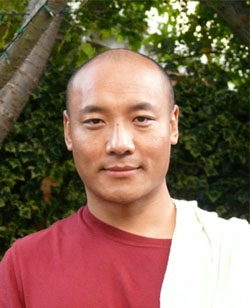
One very interesting dimension to personality has to do with the stories that we tell ourselves. Research has increasingly revealed that our personal life stories – our mental self-narratives – contribute substantially to our personalities and behaviors. An excellent New York Times article from 2007 summarizes much of this current research.

As the interpreter of our world, the mind is very…

View original post 707 more words

Who is it that can tell me who I am?

This line from King Lear is part  of the title of a 1999 lecture by Dr. Joanne Stroud, one of the founders, along with James Hillman, of The Dallas Institute of Humanities and Culture.

Lear:  Who is it that can tell me who I am?
Fool:  Lear’s shadow.  (Act 1, Scene 4)

The exchange is a fitting lead in to Stroud’s lecture which centers on ideas of identity in the western tradition, especially in Jungian psychology.  For Jung, “the shadow,” comprised of the disowned parts of a person or culture, is one of the first archetypal energies we encounter when we begin to look within, hoping to find out what and who we are.

I recommend Stroud’s transcript for its outline of Jung’s ideas as they bear on the western imperative, “Know Thyself,” which was inscribed at the entrance to Apollo’s temple at Delphi.

Temple of Apollo at Delphi by Navin Rajagopalan, CC By-SA 2.0

I’m guessing that the question “Who can tell me who I am,”  is an undercurrent in the lives of everyone who has read this far.  In addition to our own introspections, don’t we ask friends, teachers, novelists, religions, therapists, books, and even politicians in certain election years?

There is much to be learned from these sources, information that’s useful when choosing a career, a spouse, a place to live, or when plotting a novel or writing a poem.  But that’s not what Lear asked or Apollo demanded at Delphi.  The answer to the question of identity is like a rainbow, sometimes visible on the horizon, but elusive no matter how we chase it.  The time comes when we have to ask the Dr. Phil question,  “How’s that working for you?”  Could it be that “identity,” as it is commonly imagined – as a kind of cosmic birth certificate – cannot be found?

That’s very good news according to Anam Thubten Rinpoche, a Tibetan Buddhist master I have written about before.  I’ve taken some half-dozen daylong retreats with him since 2005, most recently in January of this year.  I’ve wanted to write about the event, but it isn’t easy.  Rather than add to our store of beliefs and concepts, Anam Thubten suggests we try letting them go.  In his second book, The Magic of Awareness 2012, he says, “Good concepts are like a golden chain.  Bad concepts are like an iron chain.  They all equally bind you in the end.”

Reading that, I always think of meeting new people in social settings.  “What do you do?” is usually one of the first questions.  Do you ever resist being pigeonholed when that happens?  At such moments don’t we understand that “I” am more than my roles and my vital statistics.  Anam Thubten would add that we are greater than all our ideas of identity, which are just more sophisticated pigeonholes.

Anam Thubten

Next time I will try to describe the simple ways he invites us to drop our stories long enough to glimpse the reality that lies behind them.  If that’s biting off much more than I can chew, at least it’s easier than trying to answer Lear’s question.

Huh, what? Oh yeah, I remember

Until the 20th century, most people in the western world believed in objective memory, that what we remember is an accurate mirror of events that actually happened.

With the birth of psychoanalysis and concepts of the Id and unconscious mind, that began to change. Modern brain research confirms that not only do memory and imagination overlap, but that memories can be deliberately changed or altered.  Such manipulation is a core element of The Cloud by Matt Richtel, a page turning thriller I started to read after seeing this interview with the author on Sciencthrillers.com  http://www.sciencethrillers.com/2013/author-interview-matt-richtel-the-cloud/

The Persistence of Memory by Salvadore Dali, 1931

Freud was ambivalent about the accuracy of his patients’ memories. At the start of his career, he attributed several several cases of hysteria to real childhood sexual abuse that his methods uncovered.  Later he said that such episodes were patient “phantasies.”

The issue surfaced again at the end of the 20th century, with “recovered memory” therapy causing tremors in the field, to say nothing of lives disrupted by allegations of sexual abuse, in what is now widely viewed as abuse by helping professionals who implanted memories in the course of trying to treat patients.  “False memory syndrome” still evokes passionate disagreement in the field.  The AMA and the American Psychiatric Association, as well as the Royal College of Psychiatrists in Britain have condemned recovered memory therapy, and in the late 90’s, a number of patients who once believed they’d been victims of childhood abuse successfully sued the therapists who had led them to that belief.

Since the turn of the century, the “hard science” of biology has confirmed what most therapists since Freud have known – that memory is always mixed with imagination.  The area of the brain that perceives an object overlaps the part of the brain that imagines the same object.  In 2009, scientists implanted memories (involving smells) in flies by using light signals to trigger “genetically encoded switches.”

The day after I started reading The Cloud, I heard “Sure, I remember that,” on Marketplace, in which the work of Elizabeth Loftus was highlighted. Loftus, of UC Irvine, is one of the key researchers who have demonstrated how easy it is to implant memories, in this case using altered photographs. http://www.marketplace.org/topics/life/freakonomics-radio/sure-i-remember.  I invite you to listen to this timely piece, which is only five and a half minutes long.

Yep.  We now something new to worry about – hacking at the cellular level!  I’ll have to remember to worry about it later, though.  Right now I have to get back to my novel…