Imagine by Jonah Lehrer: A Book Review

Update, July 31, 2012.

On July 30, author Jonah Lehrer admitted fabricating quotes in Imagine. He resigned his position as staff writer for The New Yorker, and Houghton Mifflin suspended sales of the book. You can read my full post on the topic here, which contains a link to the newspaper story. http://wp.me/pYql4-2hg

It is with much sadness that I’ve decided to remove the text of my review. Some of Lehrer’s observations on creativity remain insightful. At the same time, I think it is vital to stand up for ethics wherever we can find it in public life.

The California Wolf

On December 28, a 2 1/2 year old male wolf crossed the border into California after a 1,000 mile journey south through Oregon.  Wolf OR7, as he is called by Fish and Game, is the first wild wolf in the state in almost 100 years.  A young wolf will leave his pack to search for a mate to start a new one in situations like too many wolves competing for game in a certain region.

Wolf OR7

The new California wolf is a descendant of the 66 Canadian wolves who were relocated to Yellowstone in the mid 90’s.  He is one of an estimated 1600 wolves who now roam free in the Rocky Mountain states, in the southwest, and in Oregon.

According Tim Holt, a freelance writer in Dunsmuir, CA, “local ranchers and a few pandering elected officials have him in their cross hairs, saying he ought to be shot on sight.”   At the same time, “there are wolf advocates who practically worship this predator, seeing the wolf as symbol and martyr of a vanishing wilderness.”

Holt sees another possibility:

The removal of wolves, or their reintroduction, reverberates up and down the food chain. By culling deer and elk, new wolf populations help restore vegetation along streambeds, improving habitat for songbirds, beavers and river otters. And by going after weak and old members of deer and elk populations, they help strengthen their stock. Wolves, in other words, are instinctive wilderness restoration specialists.

So the wolves’ return to this state offers a litmus test of our commitment to the health of our remaining wildlands. But it goes beyond that. Allowing them to reintroduce themselves would be one more sign that we’re moving away from a human-centered view of nature, based on narrow economic interests, and have begun to see ourselves as a part of what might be called the broader economy of nature. http://www.sacbee.com/2012/01/29/4221053/wolf-can-help-us-balance-our-approach.html#storylink=cpy

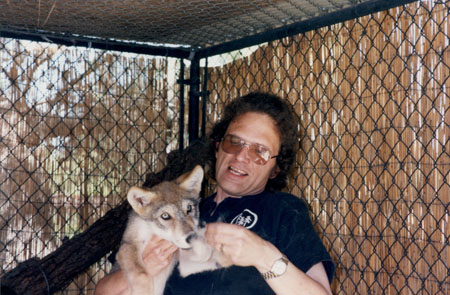
Somewhere deep within us as well, is a fear of wolves that makes generations of children shiver at Little Red Riding Hood.  That thrilled me when I read Jack London’s stores of wolves battling men.  I didn’t know at the time that London’s stories were pure fiction.  No such incidents ever happened.  During the ’90’s, I volunteered at the Folsom City Zoo because I wanted to interact with the wild canines – the wolves and foxes and coyotes.

Helping to socialize Redbud, a wolf pup, ca 1995

During the 90’s, all the texts on wolves agreed there were no confirmed cases of a non-rabid wolf attacking a human in North America.  I don’t think that has changed.  A classic account is 50 years old.  Farley Mowat, a Canadian author and conservationist, spent a summer living by himself among wolves.  In his 1963 book, Never Cry Wolf, he wrote:  “We have doomed the wolf not for what it is, but for what we deliberately and mistakenly perceive it to be — the mythological epitome of a savage, ruthless killer — which is, in reality, no more than the reflected image of ourself.”

Never Cry Wolf by Farley Mowat, 1963

The book, and the movie made of it in 1983, deserve much of the credit for reversing public attitudes toward the wolf, and allowing reintroduction to happen at all.

Never Cry Wolf movie, 1983

Gandhi said the character of a nation is revealed in the way it treats its animals.  Let’s hope the way we treat OR7 reveals something compassionate, wise, and generous in us.

Sage, at the Folsom City Zoo, ca. 1995

The 21st Century May Be Bad For Your Mental Health

To appreciate this post, you need to know a little of how it came about.  Yesterday morning, in my dentist’s waiting room, I started reading an article in  the Nov. 14 Newsweek by Dr. Andrew Weil.  He and others have noted that modern affluence breeds depression.  They have also observed that the Amish, with a 19th century lifestyle centered on simplicity, have only 1/10 the amount of depression of other Americans.  Just as I hit this tantalizing statement, the dentist, who was running ahead of schedule, called me in.  After my appointment, I finished the article.  “Our brains aren’t equipped for the 21st century,” says Weil.

One of the things we are not equipped for is our 24/7, hi-tech, multi-tasking world, a point that made me chuckle as I pulled out my smart phone, photographed the pages, and emailed them to myself.  Just call me a poster boy for the legions of technically savvy neurotics.  It turns out I didn’t need to send the page to myself.  Weil’s article is available online, and I highly recommend it:  http://www.thedailybeast.com/newsweek/2011/10/30/andrew-weil-s-spontaneous-happiness-our-nature-deficit-disorder.html.

The article is taken from his latest book, Spontaneous Happiness, just released this month, where Weil says it’s not just technology that’s the cupric in our epidemic of depression.  Increasing numbers of psychologists and therapists identify one of our key problems as Nature Deficit Disorder.  Weil says:  

“Behaviors strongly associated with depression—reduced physical activity and human contact, overconsumption of processed food, seeking endless distraction—are the very behaviors that more and more people now can do, are even forced to do by the nature of their sedentary, indoor jobs.
………………………………………………
“Human beings evolved to thrive in natural environments and in bonded social groups. Few of us today can enjoy such a life and the emotional equilibrium it engenders, but our genetic predisposition for it has not changed.”

Weil discusses the bad news in detail, but doesn’t end there.  He is firmly in the camp of “positive psychology,” the discipline that concentrates on human wellbeing rather than pathology.  He summarizes positive measures we can take, things he discusses in greater detail in the book.

  • Find a mindfulness practice.  (I was impressed that Weil listed this as suggestion #1.  I’ll follow this up by posting some resources soon).
  • Spend as much time as possible outdoors.
  • Find some form of aerobic exercise.
  • Sleep in total darkness, if possible, and avoid very bothersome noise, even if it means wearing earphones.  Weil discusses why uninterrupted sleep, and freedom from noise pollution are important.
  • Attend to diet – he has written of this in detail in previous books.
  • Cultivate social relationships.
  • Spend some time each day unplugged from all forms of gadgetry.

Finally, Weil, like almost everyone else who writes on wellbeing, cites gratitude as a critical factor.  This morning I ran into an acquaintance who has had a number of physical problems.  He has paid a price, but also found something diamond-solid that is now at the core of his life:  three times he has been clinically dead, and he’s seen and experienced “the light,” that people in that extremity sometimes encounter.  He knows it is waiting for him, and meanwhile, shares his experience with others he thinks will benefit.  He says he intends to do so, “as long as God decides to keep me around.”

Simply encountering him put me in tune with the theme of the season, and reminded me of all I have to be thankful for.  That is my hope for everyone reading this – may you find unshakeable joy in your life just as it is, and may you be able to share it with others.

A Scientist Talks About Alternate Worlds

I’ve spent the last 30 years deeply engaged in the study of Eastern and Western esoteric world views, so the topic of my last two posts, the legendary realm of Shambhala, does not seem impossible to me.  No more so than astral worlds or Faerie, or any number of things our senses do not perceive.  It’s not so often, however, that you hear a respected scientist support the existence of unseen realms, but I did this morning. Brian Green, a professor of physics and mathematics at Columbia, was nominated for a Nobel Prize for his first book, The Elegant Universe, 1999, a discussion of string theory for laypeople.

Brian Green

I heard him on NPR discussing alternate universes, in a January interview that was rebroadcast on the occasion of the paperback release of his latest book, The Hidden Reality:  Parallel Universes and the Deep Laws of the Cosmos, 2011.  (Link to the NPR Interview: http://www.npr.org/2011/11/04/141931728/exploring-the-hidden-reality-of-parallel-worlds ) According to Green, string theory is an attempt to bridge mathematical conflicts between Einstein’s theory of relativity, which accurately describes the behavior of large objects, and quantum mechanics, which details what is very small.  String theory, however, posits ten physical dimensions – that’s seven that we cannot perceive.

Green says:  “You almost can’t avoid having some version of the multiverse in your studies if you push deeply enough in the mathematical descriptions of the physical universe.  There are many of us thinking of one version of parallel universe theory or another. If it’s all a lot of nonsense, then it’s a lot of wasted effort going into this far-out idea. But if this idea is correct, it is a fantastic upheaval in our understanding.”

In addition to the half-hour NPR interview referenced above, you can check out more of what Green has to say about string theory on The Elegant Universe, a three hour presentation he hosted on Nova:  http://www.pbs.org/wgbh/nova/elegant/

As Mulder and Scully insisted, “The truth is out there.”

Occupied

I sat up and took notice the other night when a local news announcer complained that the “Occupy Sacramento” protestors “could not even say what they want.” In other words, they won’t play by the rules – you know, the unwritten rule that says when a TV station sends a van to cover your event, you need to have your sound-byte ready. How else can they work it into a one minute segment and move on? How else can you be neatly pigeonholed?

Actually, there is at least one articulate answer to the question of what the protestors want, supplied by Naomi Klein, a Canadian author and activist, at the “Occupy Wall Street” rally in New York. http://www.thenation.com/article/163844/occupy-wall-street-most-important-thing-world-now. This link comes courtesy of Genevieve’s blog, Look Who’s Blogging Now, which you can find on my blogroll. I suggest you check it out if you are interested in this latest eruption of frustration with the status quo, since Genevieve is off to check out the “Occupy Minnesota” protests, and will likely have more to say.

Occupy Wall Street protestors

Perhaps one reason I took special notice of the protests that night, was because I’d been reading of another famous entity that didn’t seem to be playing by the rules; I mean the universe we live in. If – and this is a big if – a large group of European physicists are right, and neutrinos really move faster than light, then some of our core assumptions about the nature of matter are wrong. Here’s a good article by Jason Palmer, science and Technology reporter for the BBC news: http://scienceblogs.com/startswithabang/2011/09/this_extraordinary_claim_requi.php

So this neutrino walks into a bar a moment after he’s ordered a beer…

Suddenly we’re faced with conclusions like these:

  • Twentieth century politics no longer works.
  • Twentieth century economics no longer works.
  • Twentieth century physics may need to be revised at its core.
  • As I have often discussed here, twentieth century publishing models are spluttering, and I’m sure you can think of other specialty areas where the past no longer functions as a reliable guide to the present.

Something similar happened a hundred years ago. In 1905, Freud published The Interpretation of Dreams, and Einstein published his special theory of relativity. Nineteenth century notions of human nature and the world no longer fit. The start of World War I nine years later marked the greatest failure of business-as-usual in the history of the world (up until then).

So what happens now?

Einstein said, “The mind that creates a problem is not the mind that can solve it.” In other words, we have people who are sick of the status quo, but for the moment, avoid easy answers. Analogies to the Tea Party are obvious enough that even this week’s Saturday Night Live picked up the thread. As I recall, the media was frustrated with the Tea Party in the beginning for the same reasons – no central spokesperson, no succinct Powerpoint agenda. Once they sent people to Washington, the Tea Party got buttonholed pretty fast as a one-issue-movement. “Balance the budget without raising taxes and life will be good again.” Does anyone, even a member of congress, really believe that?

Here’s an observation by a local man:

“The enemy of my enemy is my friend? Despite reasonable differences, tea partyers and “occupiers” have far more in common with each other than with the politicos they elected to represent them. Conversely, Republicans and Democrats have more in common with each other than they do with the people who voted for them.” Bruce Maiman, “Wall Street Protestors, meet the tea partners,” editorial in The Sacramento Bee, Oct. 7, 2011, p. 13

The news media, even NPR, refused to acknowledge the occupiers for more than a week, but they didn’t go away. I hope they stay out in the open long enough for people and especially politicians to really get a glimpse of the underlying disappointment, fear, and outrage that animates so many who can no longer be soothed by simplistic answers.

What do they want? For now, “None of the above,” is a valid answer!

Contagion: A Movie Review

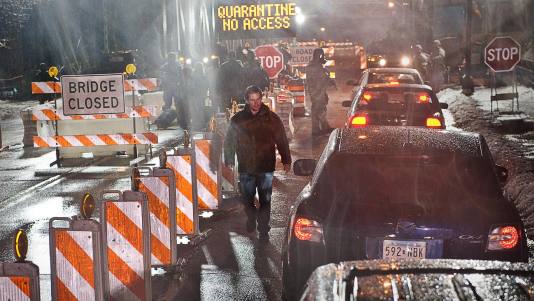
We’ve all seen pandemic movies before.  Andromeda Strain, The Stand, Outbreak, and 12 Monkeys come to mind, but all of these add something extra to the disease:  aliens, demons, time travel, or a government ready to nuke a California town.  Contagion adds something too, but unfortunately, it is all too plausible – visions of cracks in the thin veneer of order that covers our 21st century civilization.

First, let’s establish that such a disease is plausible.  Dr. Fatimah Dawood, an epidemiologist with the CDC confirms that animal viruses could combine to produce a deadly virus against which humans have no prior immunity.  Contagion is a vision of what people most feared during the H1N1 outbreak two years ago.

Can you imagine looting and outbreaks of violence if there was not enough food to go around?  What about people willing to profit from the distress or death of large numbers of their fellow human beings?  Can you imagine local governments delaying the closure of shopping malls at the start of an epidemic because of the Thanksgiving shopping weekend?  If not, please send me the location of a portal to the universe where you live.

Director, Steven Soderbergh, set out to make a scary and realistic disaster movie set in our post 9/11 and post Katrina world.  He builds and maintains suspense with restraint and subtlety.  Contagion opens with a dark screen and the sound of a woman coughing.  Then we see Gwyneth Paltrow reach into a bowl of nuts at a crowded airport bar.  Twenty seconds into the movie and I was gripping my seat.  The tension remained compelling throughout this two hour film.  As with many books and movies of the action/adventure genre, I didn’t deeply connect with the characters.  There were two many stories going on at once, and perhaps I instinctively held something back, not knowing who would live and who would die.  Most critics have given Contagion three stars out of four and I would agree.  Because of my emotional distance from the protagonists, I wouldn’t call it a great movie, but it is very very good.

We learn at the end of the film exactly how the virus mutation occurred.  Strangely enough, I thought of the novels of Thomas Hardy, where seemingly minor coincidence leads to disaster.  Hardy’s vision of the unfathomable relations between events actually mirrors certain concepts of modern science.  I remember hearing a pithy quote about the beating of a butterfly’s wings affecting weather on the other side of the globe.  One early 20th century physicist – I do not remember his name – said, “Bend down to pluck a flower and you affect the most distant star.”  What do the world views of Thomas Hardy, modern science, eastern religion, and Contagion, have in common?  A sense that events are connected and impact each other in ways beyond what the rational mind can ever grasp.

What is conspicuous by its absence, in the movie as in our culture, is a parallel understanding of ways that our fellow humans are interconnected for good or ill.  Some of the medical workers demonstrate selflessness and compassion, just like certain religious orders during the plague years in Europe, who ministered to the sick until they fell ill.  One thing the CDC people have in the movie which no one else does, is information.  We know from Katrina that orders, and curfews, and martial law, combined missing information, can drive people to the breaking point.

We identify with Mitch Emhoff (Matt Damon) and his daughter and hope we could do as well as they struggle to stay alive and keep their humanity while the social order crumbles.  Lawlessness is muted in Contagion, but it is there, and I found myself wondering what I would do, after standing in line for hours at a military food distribution point, only to have the rations run out and a soldier say, “You’ll have to come back tomorrow.”  What would I do?  Walk away like Emhoff or charge the empty truck like some of the others in a futile display of fear and frustration?

Contagion is a movie I will be thinking about for some time.  As an extra dividend, my hand washing habits instantly improved.  I’m sure yours will too if you see this movie.

Your Brain on Google

According to Alva Noe, Professor of Philosophy at UC Berkeley, Google is not making us stupid.  Good news, even though I wasn’t worried until I saw his article. http://www.npr.org/blogs/13.7/2011/09/20/140625802/google-is-not-making-you-stupid.

Noe is the author of, Out of Our Heads: Why You Are Not Your Brain and Other Lessons from the Biology of Consciousness.

He refers to results of a Columbia University study that found we are more likely to remember things we cannot find online than things we can.  The study caused some concern, but Noe says this is unwarranted and links to a blog with this quote from Einstein:  “Never memorize something that you can look up.”

Researchers are not picking on Google in particular but cite it because the phrase, “Google effect” has come to stand for the way many new technologies influence us.  Noe suggests that they are not qualitatively different from other tools we use to navigate the world and make sense of it:  “We use landmarks and street signs to find our way around; arithmetical notation makes it possible for us to calculate with big numbers; we wear wrist watches so that we can know the time without needing to know the time; and we build libraries so that we have access to what we need to know, when we need to know it.”

My predisposition to agree with Noe is based on Sherlock Holmes.  Conan Doyle’s famous detective told Watson he could not afford to fill his mind with information not relevant to his profession.  As a result, he could identify 37 varieties of cigarette ash but knew almost nothing about the solar system.

Beyond my lifelong fascination with Holmes, several things leap to mind.  I really don’t use the internet to remember things – I use it to find things.  Also, memory and intelligence are not the same.  If they were, I’m sure post-it-notes would have shaved several points off my IQ.

Though I don’t worry about Google and memory, Noe adds a link for further reading that raises more serious concerns.  In August, 2008, Nicholas Carr published an article in The Atlantic, called, “Is Google Making Us Stupid:  What the Internet is Doing to our Brains.”  http://www.theatlantic.com/magazine/archive/2008/07/is-google-making-us-stupid/6868/).

Carr is the author of, The Big Switch: Rewiring the World, From Edison to Google.

If nothing else, the internet is changing our brains, says Carr:  “I’m not thinking the way I used to think. I can feel it most strongly when I’m reading. Immersing myself in a book or a lengthy article used to be easy. My mind would get caught up in the narrative or the turns of the argument, and I’d spend hours strolling through long stretches of prose. That’s rarely the case anymore. Now my concentration often starts to drift after two or three pages.

Carr cites the work of Marshall McLuhan, who in the ’60’s observed that media not only supply the content of thought, but shape the process of thought.  Carr says, “what the Net seems to be doing is chipping away my capacity for concentration and contemplation. My mind now expects to take in information the way the Net distributes it: in a swiftly moving stream of particles.”

Before anyone panics, we should note that Carr is primarily talking about the fight “to stay focused on long pieces of writing.”  An acquaintance of his says he can’t read War and Peace anymore.  I couldn’t get through it even once.  Carr emphasizes intelligence as a series of very cerebral pursuits.  I suspect he and I have different ideas of “meditation and contemplation:”  I don’t think he’s talking of sitting meditation, something I’ve always used to counterbalance intellectual activity, and one I do not find impacted by time spent online.  Watching a violent movie may impact my ability to meditate, but so far, Google does not.  Maybe I’m in denial, but these concerns are fairly low on my hierarchy of worries.

Carr cites another concern that comes from the mouths of the founders of Google:  Sergey Brin and Larry Page, the gifted young men who founded Google while pursuing doctoral degrees in computer science at Stanford, speak frequently of their desire to turn their search engine into an artificial intelligence, a HAL-like machine that might be connected directly to our brains.  More than once, I’ve chatted with friends about how “they” will jack into our brains when the day comes:  USB?  Firewire?  The Matrix ruined my ability to take such a fantasies literally.

***

Serious research is underway, studying what is good and bad about our reliance on the internet.  Parallel hopes and concerns met Gutenberg’s invention of the printing press.  From the distance of centuries, we can see how it affected our brains.  No one in a literate culture has the memory of the tribal Griot in Alex Haley’s, Roots, or the ancient Homeric poets, but we have to ask, along with Einstein, how much should we care?  Is that kind of memory central to intelligence?  Does it’s loss have a negative human destiny?

The internet seems every bit as profound a change as the invention of printing, and it’s likely to take a long time for the dust to settle so that objective evaluations can occur.  Hopefully, as with printing, the good will outweigh the bad.

***

Everyone who has made it through this post should feel good about their ability to concentrate.  Having come to the end, I’m going to go for a walk – one of those those vitamin C for the brain type strategies that can hopefully inoculate me even against the dangers of Google!.

Petroplague by Amy Rogers: A Book Review

Dr. Amy Rogers

Dr. Amy Rogers

Neil, a disaffected eco-activist, meets an explosives expert at 2:00am.  They drive to a deserted gas station in south-central LA.

Christina Gonzales, a PHD student at UCLA, volunteers at the La Brea tar pits.  After monstrous gas bubbles burst over the tar, Christina and her co-worker smell vinegar, which doesn’t make any sense.

An elderly woman spots a huge puddle of “drain cleaner” in the alley behind her house.  She blames the neighbors and calls the police because this could injure her cats.  A moment later, explosions rock the entire block.

Christina learns that an apparent methane explosion at a deserted gas station has ruined her PHD project, an attempt to use genetically altered bacteria to break down heavy crude oil into easy-to-harvest natural gas.

If you think these events are coincidence, you have probably never watched a disaster film.  Like the best movies in the genre, or the novels of Stephen King, Amy Rogers takes a mixed group of people, with their individual hopes, plans, secrets, and strengths, and puts them in an impossible situation.  By the time I had read this far, I was hooked.  From here, Petroplague just gets better and better – meaning the tribulations of Rogers’s characters get worse and worse.

Imagine Los Angeles, or the largest car-dependant megalopolis you know.  Imagine a mutant bacteria in the underground oil supply and the local refineries that breaks down hydrocarbons, reducing petroleum  into acetic acid and highly flammable hydrogen, among other things.  Cars stall on the freeway.  Airplanes fall from the sky.  The acid corrodes gas tanks and lines, releasing hydrogen that the smallest spark can ignite.  Nothing that runs on gasoline moves:  no firetrucks or ambulances or police cruisers.  No food deliveries or garbage pickups.  The looting begins.  Instability under the Santa Monica fault leads to bigger and bigger earthquakes.  The La Brea Tar Pits “erupt.”   When Christina and her PHD supervisor discover an antidote for the plague, both an eco-terrorist network and ruthless corporate interests are willing to go to any lengths to suppress it.

Are you scared yet?  If not, as Yoda told Luke, You will be!  Because this is just the beginning.  Now that we care about Christina, the real chills and thrills begin.  Eco-terrorists smuggle the petroplague out of the LA quarantine area and plot to release it worldwide in a matter of days.  Christina and her allies face virtually every danger you can think of as LA spins into chaos – and some you can’t.  Think of all the seat gripping you do watching James Cameron movies like,  The Terminator and Titanic.  This is what Amy Rogers does; she throws the good guys into a tight situation and keeps cranking up the pressure.

I read lots of thriller/action adventure stories.  When you become familiar with a genre, you begin to recognize conventions and trends.  As anyone who has glanced at this week’s movie listings can attest, epidemics are a standard disaster scenario, but as far as I know, Rogers’s story question is unique – what would happen in our oil-dependant world if a petroleum-destroying plague got loose?

A lot of books in this genre suffer from forgettable heroes and two-dimensional villains.  Psychopaths are a dime a dozen these days, but not in Petroplague.  Several of the bad guys are idealists-gone-wrong, sometimes-conflicted fanatics of conscience, who you cannot hate even as you cringe at their actions.  One of the evil-doers is a corporate higher-up, willing to screw anyone or everyone in the name of profit.  Even if that is a stereotype, it is not hard to imagine in our post-economic meltdown world.

We bond with the heroes of the story because they are very human, even as events evoke courage they didn’t know they had.  When Christina first learns of the plague, all she can think of is her ruined dissertation, but her circle of concern and her actions rapidly grow beyond self-interest.  Her cousin, River, and River’s boyfriend, Mickey, are ready to run when things get tough – but they don’t.  A politician who survived a helicopter crash in Iraq, finds the courage to pilot another chopper filled with fuel that might have been compromised by the plague.

It’s always a pleasure to post here about a book I really enjoyed.  I couldn’t put this one down.  I urge you to stop by Amy Rogers’s web site to learn more about the author and the various formats in which you can read Petroplague.  http://www.amyrogers.com/