A Science Thriller by Amy Rogers

I met Dr. Amy Rogers at the Sacramento branch of the California Writer’s Club where she is Web Site Coordinator, and an author of science thrillers. What is a science thriller? Think of Frankenstein, Jurassic Park, and Contagion, coming soon to a theater near you. You can learn a lot more about the genre and read a number of reviews at Roger’s blog, http://www.sciencethrillers.com.
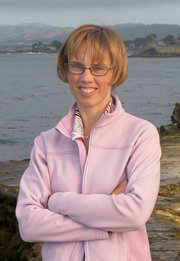
Dr. Amy Rogers

Dr. Rogers just published her debut thriller, Petroplague, in ebook format, with a paperback release due in November. She sent this synopsis:

UCLA graduate student, Christina Gonzalez, wanted to use biotechnology to free America from its dependence on Middle Eastern oil. Instead, an act of eco-terrorism unleashes her genetically-modified bacteria into the fuel supply of Los Angeles, turning gasoline into vinegar.

With the city paralyzed and slipping toward anarchy, Christina must find a way to rein in the microscopic monster she created. But not everyone wants to cure the petroplague – and some will do whatever it takes to spread it.

From the La Brea Tar Pits to university laboratories to the wilds of the Angeles National Forest, Christina and her cousin, River, struggle against enemies seen and unseen to stop the infection before it’s too late.

A former professor of microbiology, with a PHD from Washington University, Dr. Rogers has the background to make such a story plausible. In addition, Petroplague is one of two of her novels picked up by New York agents who were then unable to sell them. At this point, Rogers mentioned self-publishing, and her agent directed her to Diversion Books, which she says, “lies somewhere between self-publishing and a traditional Big Six contract. Diversion Books is loosely associated with a traditional literary agency – the first such publisher, though others have sprung up since.”

I plan to review Petroplague here, but you don’t have to wait for me. Click on the book cover photo above to go to the authors website, http://www.amyrogers.com, to view a trailer and read the first two chapters for free.

In addition, Amy has said she’ll be happy to write a guest post or answer interview questions here. So stop back soon, and visit Amy Rogers’ website and blog, for information on publishing, on scary microbes, and to check out what promises to be an exciting read!

The Ghost Star

Twenty-one million years ago, in the Pinwheel Galaxy – a close neighbor in cosmic terms – a white dwarf star exploded.  This week, as the moon sets early, we will have the rare chance to see this one-time sun’s final blaze of glory from our own back yards, with just a small telescope or a pair of binoculars.  Scientists are calling this a once in a generation event; type 1a supernovas like this are usually much farther away.

How do you find it?  Locate the last two stars on the Big Dipper’s tail, and imagine an equilateral triangle pointing north:

According to a Washington Post article, because type 1a supernovas are equal in intensity, astronomers use them to refine calculations of distance.  In the 1990’s, Robert Kirshner of Harvard:  “led a team that leveraged this property to make one of the biggest discoveries of the past century: The universe is flying apart, rapidly accelerating.

To explain this, cosmologists were forced into an uncomfortable conclusion. Either gravity does not work the way it is supposed to, or a mysterious force is pushing galaxies apart at a quickening pace. They called this unknown force “dark energy” and still have little idea what it is, even though they are able to calculate that it constitutes an astounding 73 percent of all mass and energy in the universe.”  http://www.washingtonpost.com/national/health-science/brightest-supernova-in-decades-serves-up-cosmic-clues-for-astronomers/2011/08/31/gIQA88CqwJ_story.html

Telescopes large and small, both on earth and in space (the Hubell) will be trained on this event, in the hopes that it may even clarify the nature of dark energy.  Though I don’t have a telescope, my father’s old film camera has a telephoto lens, and I’m hoping that on a tripod, we may be able to see the pinwheel galaxy.

I find this of interest from more than a scientific (or aging Trekkie) perspective.  The world’s religions tell us that things are not what they seem.  Most of the time we can only approach such truths through inference, faith, or meditation.  For the next few days we will have the chance to turn our physical eyes on something dramatic that has not existed physically for millions of years.

Something to think about…

So Long to the Space Shuttle

Yesterday afternoon, I stopped at a Starbucks and used an app on my smartphone to pay for a drink.  Then I glanced at my email while waiting for the barista to finish my frappacino.  I would not be doing any of that without the the US space program, which has reached the end of an era with the last space shuttle flight.

For it was during the ten year “space race” to put a man on the moon, that miniturization of electronices found the means, motive, and opportunity to thrive.  Intel opened its doors in July, 1968, a year before the moon landing, with 100 employees and a plan to make SRAM’s.  Three years later, when they introduced the first microprocessor, the game was afoot.

In hindsight, we can see that during the tech boom, the law of unintended consequences was operating full tilt, carrying many seeds of our current bust:  the sophistication of the internet which enables the “offshoring” of hundreds of thousands of jobs even as ever increasing “efficiencies” allow employers to do more with fewer people.

Where will the “next new thing” come from?  From dreamers like  Jobs and Wozniak, who built the first Apple computer in their garage.  Or from childhood friends, like Bill Gates and Paul Allen, who were inspired by the January 1975 issue of Popular Electronics to build and sell an early BASIC Interpreter and form a company that Allen named, “Micro-Soft.”

***

In 1972, when Adam Frank was ten years old, a collection of books on space exploration  in the local library changed his life.  He decided to become a scientist.  Now an astrophysicist, teaching at the University of Rochester, he asked a number of scientists across disciplines what set them on their path.  He found that fully three generations of dreamers claim they were inspired by NASA.  What is going to ispire the next generation of scientists, he asks, for:

The loss of that dream would feel terrible for the 10-year-old I was all those years ago. More importantly, it would be a terrible loss for all the 10-year-olds dreaming now of exploration and science. And for a nation that needs science and scientists to survive, it would the most terrible loss of all.  http://www.npr.org/blogs/13.7/2011/07/08/137678718/the-inspiration-gap-and-the-shuttles-last-launch

***

Beyond all practical considerations, the space program gave moments that those who lived through them will never forget.  If you’re old enough, you probably remember exactly where you were and what you were doing when Neil Armstrong stepped onto the moon.

You probably also remember that beautiful day in January day when Challenger exploded.  Who had any idea that the loss of that crew could cut so deep?

We all know there are rhythms of expansion and contraction, of dreaming and the end of dreams.  The stars aren’t going anywhere.  Let’s hope we are able to stretch ourselves toward them again soon.

Books for Brainiacs (literally)

I was browsing the NPR list of recommended Sci-Fi titles today, and could barely manage a ho-hum.  I’ve slipped into one of my periodic non-fiction moods, and I’ve learned to follow such whims to see where they take me.  I fear that my book queue may get even more unmanageable after stumbling upon these NPR recommendations:  Insane Science:  Five New Books that Explain the Brain.  http://www.npr.org/2011/06/08/136896426/insane-science-5-new-books-that-explain-the-brain  Here is a quick summary of the article:

The Compass Of Pleasure: How Our Brains Make Fatty Foods, Orgasm, Exercise, Marijuana, Generosity, Vodka, Learning, And Gambling Feel So Good  by David J. Linden.  Everyone probably guessed Fatty Foods, Orgasm, Vodka, and perhaps Generosity, but the author claims that Paying your taxes belongs in that category too.

The Believing Brain: From Ghosts To Gods To Politics And Conspiracies — How We Construct Beliefs And Reinforce Them As Truths by Michael Shermer.  Shermer, a former Evangelical Christian who became an agnostic in college claims that belief precedes the explanations we invent for them.  However, Shermer acknowledges that, “we could be wrong.”

The Psychopath Test: A Journey Through The Madness Industry by Jon Ronson.  The bad news:  an estimated 1% of the population is psychopathic.  The good news:  if you wonder if you are, you almost certainly are not.

The Optimism Bias: A Tour Of The Irrationally Positive Brain by Tali Sharot.  Even if you are a cynic, your brain is probably hardwired for optimism.  “Most people are programmed to predict happy endings in all facets of our lives.”  As you might have guessed, there is measurable survival value in thes.

A Billion Wicked Thoughts: What The Worlds Largest Experiment Reveals About Human Desire by Ogi Ogas and Sai Gaddam.  If you want to know what people really think about sex, look online, claim the authors, and that is what they did.  Their conclusion, after sifting through “reams” of data?  Men’s sexual brains “are more like Elmer Fudd,” and women’s, “like Miss Marple.”  That hook I think, is enough to get me to download this one.  Not that I would be crass enough to ever make a joke about Elmer Fudd and Congressman Wiener – nope, no way.

Happy reading, everyone, and I categorically deny all rumors that I have too much time on my hands!

California Indians and their Dogs

Three-thousand archeologists are on the loose in Sacramento, gathered for the 76th annual meeting of the Society for American Archaeology, which runs through sunday.  According to the local paper, members of this tribe are avid researchers one of humankind’s oldest recreational beverages.  The Bee reports that in 1993, they drank all the beer in the conference hotel, and this in St. Louis, hometown of Anheuser-Busch.

When they are not partying like ancient Egyptians (one theory holds that pyramid-builders were paid in beer), the Society’s members will hear numerous research papers.  One of them, by Paul Langenwalter, professor of archaeology and antropology at Biola University in La Mirada, contradicts a popular prevailing view, and asserts that California Indians had close personal relationships with their dogs. http://www.sacbee.com/2011/03/29/3510650/indians-dogs-were-companions-in.html
 

Native American Children and Dog, near Susanville, ca 1900 - From Sacramento Bee

This is good news for those who have wondered if we are the only culture in the historyof the world that buys our dogs presents at Christmas and Jackalope horns at Halloween.  Actually, we probably are.  Langenwalter, who has studied Indian burial sites dating to 1700 has not recovered any Jackalope horns, but he has found many other things of interest.  Native people and their dogs were often buried side by side, curled up in a sleeping position.  Dog graves were also marked with stone cairns. 

Early European observers noted the close relationship between native Californians and their dogs, and this is confirmed by Debra Grimes, a Miwok Indian, and cultural preservation specialist for her tribe.  Grimes agrees that dogs were historically buried as a member of the family, because they were.

I am reminded of a story I heard so long ago that I cannot even remember its source.  My best guess is that it is either a plains Indian legend or that it comes from the Pacific Northwest.

When the earth was young, humans and animals were natural allies, and the friendship of the animal tribes made us very powerful.  So powerful, in fact, that gods were worried.  (Even then we had a tendency to get too big for our britches).   The gods decided to separate the human and animal nations, so they opened a chasm between us in the earth.  From a small crack it grew deeper and wider, the animals on one side, people on the other.  At the very last possible moment, Dog jumped across the gap to stand with humans, and that is why dogs have been our special friend ever since.

Enjoy the article and wish the archaeologists well.  Who knows, they could find the Jackalope horns any day!

Deja-vue all over Again

Hydrogen bomb drill during the Cuban Missile Crisis

The Cuban Missile Crisis was one of the defining events of my generation’s childhood. On October 15, 1962, US spy-plane photos revealed installation of medium range Soviet nuclear missiles in Cuba.  President Kennedy ordered a naval blockade of the island – something very close to an act of war – and announced that any missile launched by Cuba would be regarded as an attack by the Soviet Union and would trigger full retaliation.  The world stood closer to the brink than it has before or after.

In grade schools all over the country, we had almost daily hydrogen bomb drills.  I was in the 5th or 6th grade, and there wasn’t one of my classmates who did not fully comprehend the absurdity of the exercise – be sure to cover your head with your hands in the event of a thermo-nuclear blast.  There was a lot of gallows humor.  The guy on the corner who dug a fallout shelter was branded a “f**king moron,” by the guy in our crowd who knew more exotic words than the rest.

I had already formulated my plan.  The papers said we’d have 20 minutes from the time the sirens went off until the first missiles struck.  I had timed myself, and knew I could run home in 8-10 minutes.  When the real alarm went off, I was going to bolt so I could die with my family and my dog.  I found additional consolation in an unlikely place.  I had a powerful transistor radio I would listen to under the covers.  Sometimes I could tune in a fundamentalist preacher in Bakersfield.  One night, quoting scripture to prove his point, he assured everyone that God had promised not to destroy humanity with a nuclear war.  I don’t remember his logic, but I do remember sleeping like a baby that night.

All this came to mind while reading of west coast fears of radiation from Japan.

I found myself wishing that preacher was still around.  I found myself also recalling my parents’ generation.  Maybe because the second world war was so close for them, they never pretended death was something you could avoid if you just managed things well enough.  Another thing that helped was all the scientific information that was published during the missile crisis.  Rather than seeming grisly, it was a comfort to know precisely what we’d be dealing with 10 or 20 or 50 miles from the blast.  Among other things, I learned that there wasn’t even the ghost of a chance that that kind of radiation could travel across an ocean.

Still, lack of credible information on what, precisely, we are dealing with, is sorely lacking now; critics of the government are right about that.

I was recalling something else I got from that preacher in Bakersfield – something I later heard other preachers confirm – that the most often repeated phrase in the New Testament is, “Fear not.”  Same thing in eastern religions; there is a hand gesture you see in pictures of Hindu and Tibetan deities that means, “Fear not.”  It looks like the Vulcan salute, (“Live long and prosper”).

It’s hard not to fear in the face of a scary unknown.  The tactics we used to cope when they ordered us to “duck and cover” under our desks won’t work anymore.  Still, when you listen to heroes they all seem to say the same thing:  they are “nobody special,” but at the critical moment, they were thinking of someone other than themselves and trying to do what they could.  That, in a seemingly small way – that maybe is a big way after all – is available to all of us.  We can give a few dollars and say a prayer for those who are suffering.  Feel free to click on the Red Cross link in the right column of this page or go to the organization of your choice.  It’s a far better use of money than buying Iodide pills.

Hamster Collaborates with Nobel Laureate

I love NPR!

During this morning’s commute, I learned how the spirit of play led two Russian-born scientists, Andre Geim and Konstantine Novoselov, to the discovery that won this year’s Nobel Prize in physics.

http://www.npr.org/templates/story/story.php?storyId=130344815

The pair teach at the University of Manchester in Britain, and the custom in their lab is to dedicate Friday afternoons to “crazy experiments.” One day, while picking up graphite with scotch tape, the idea that led to graphene was born. Graphene is a sheet of carbon one atom thick. It is the thinnest material on earth, 100 times stronger than steel, transparent, and an excellent conductor. Experiments with photovoltaic cells are already underway, and potential uses include better touch-screens, replacements for silicon transistors, and power generating clothing.

Geim, in particular, has a wacky streak. He once used magnetic fields to levitate a frog, and another time, listed his favorite hamster, Tish, as a collaborator on a scientific paper.

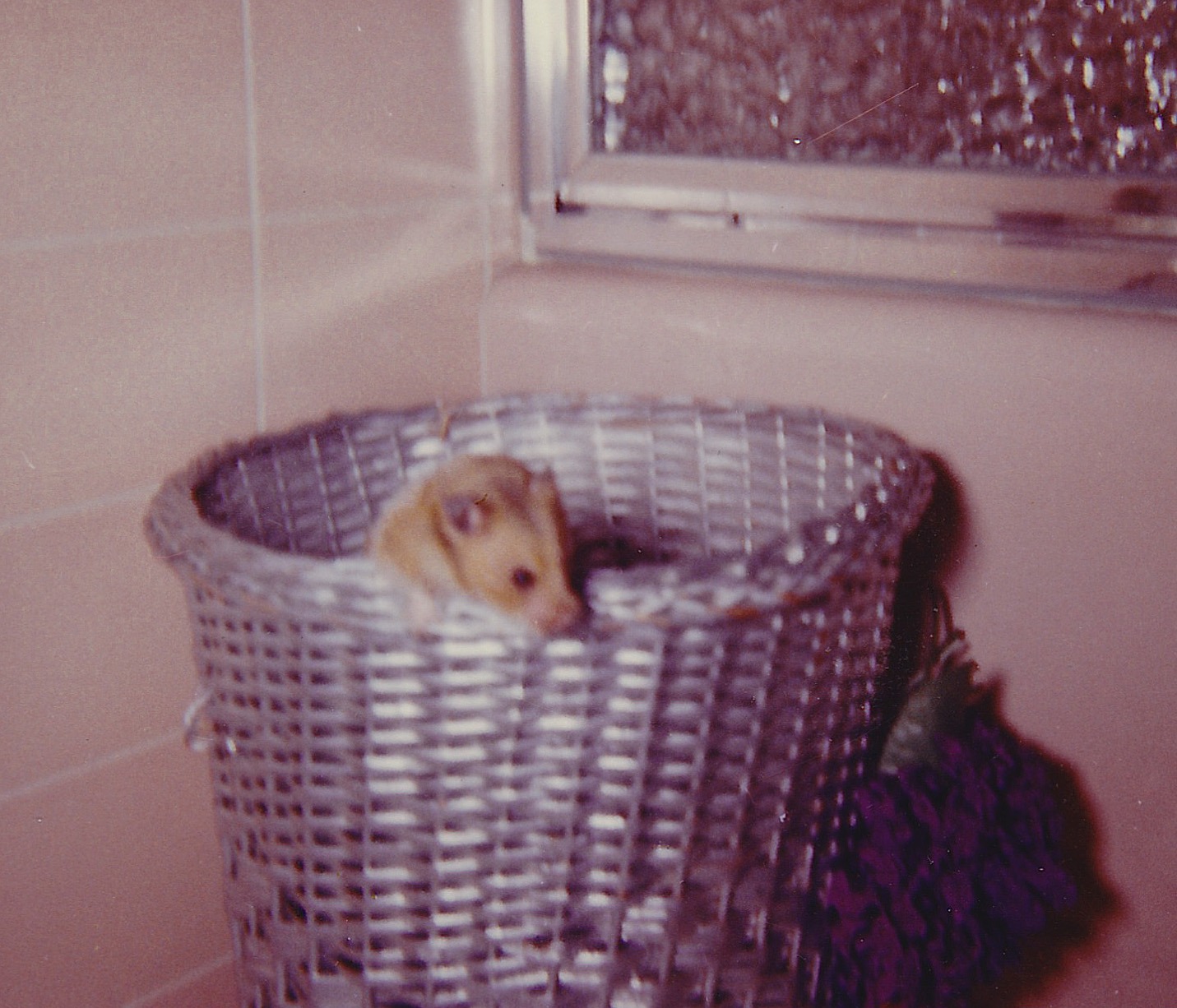
I can very much identify with that; my first serious literary project, in the fifth grade, was a sequel to Wind in the Willows, starring my hamster, Herman.

Herman gets some exercise

Doesn’t it seem like the funniest people are very, very serious about their humor?