Kung Fu Panda 2: A Movie Review

Figuring that the return of Captain Jack Sparrow was an excuse to venture out to the movies again, I suggested to Mary that we see the latest Pirates of the Caribbean, but she had other ideas.  She showed me the 4-star review of Kung Fu Panda 2.  Ever since Up, 2009 I have been ready to see any animated movie with that kind of review, so off we went.

Here’s my summary:  if you trust any book or movie review I have posted here; if you think there is any chance my opinions align with your own, see this wonderful film.  Take the entire family.  This is an absolute gem.

Po the Panda seems like an unlikely Dragon Warrior – think of Jack Black, who does his voice – but likely or not, there he is with his allies, the Formidable Five, defending the Valley of Peace.  That peace is shattered by Shen, the evil peacock, who has a terrible weapon and the ambition to conquer all of China.

Po has other concerns as well.  His kung fu master tells him he must find inner peace to have any hope of success.  “Inner piece of what?” Po asks.  Memories from his past arise too, drawing Po into the question of who he is and where all the other Pandas have gone.

I didn’t see the first Kung Fu Panda (I plan to now), so I cannot comment on the comparisons between the two movies other bloggers make, but I can say this story was flawlessly paced, the visuals were spectacular, and the 3D did not bother me as it has in the past.  In addition to being marvelous entertainment, I was delighted to see a “family film” pose some very serious spiritual questions and values in a completely non-preachy way:

  • Upon a foundation of inner peace, you can accomplish what needs to be done.
  • “Who am I, really?” is perhaps the most important question we all have to ask.
  • Courage matters, as does loyalty to your friends and a worthy cause.
As I left the theater, I thought of one of my heroes.  Recently I said on this blog that I didn’t have any heroes, but that was not correct – Jim Henson (1936-1990) has always been a hero of mine, and I thought of his breakthrough animated movie, Dark Crystal.  Anyone who harbors a lingering notion that animation is somehow “less than” other sorts of films should check out this pioneering effort, made in 1982.  I like to think how much Henson, who died tragically at 53, would have loved the newest developments in animated filmmaking, and how much he would have enjoyed this offering.

The Royal Wedding, Rowan Williams, and Generosity

Having declined the invitation from a British friend to watch the Royal Wedding live, Mary set the DVR, and we watched the event when we were home during the day.  I was busy with other things, but looked up at several points, for there is something hopeful and compelling about such a pageant.  At the same time, I’d watched Helen Mirren in The Queen the previous week, so I couldn’t help but think of Diana.  You have to wish this couple a happier fate.

What really caught my attention – and we backed this up to hear it again – was the homily delivered by Rowan Williams, the Archbishop of Canterbury, after the vows were taken.  The gist of it was, as faith in God or a Higher Power has receded, we do a disservice to our marriage partners by demanding of them a fulfillment another human being cannot provide.

I searched online this morning but could not find the sermon.  I did find this interview with Williams conducted before the ceremony.  The word I most often heard him use was “generosity.”  He hoped that watching this service might renew our sense of generosity to ourselves and to others.  It’s a very nice way to think of the Royal Wedding.

Any priest or minister conducting a wedding is bound to feel a huge sense of privilege.  You’re invited into some intimate places in people’s lives.  You’re invited to take part in a very significant moment, a moment of hope; a moment of affirmation about people’s present and future.  And I’ve felt very privileged to be part of this event for those reasons.  Here are young people sending a message of hopefulness, sending a message of generosity across the world.  And it’s my privilege to be able to bless that in the name of God, to witness it in the name of God, and to send them on their way. – Rowan Williams, the Archbishop of Canterbury

http://www.youtube.com/user/lambethpress?blend=23&ob=5

Spiritual Bypassing: An Interview with John Welwood

John Welwood has studied, taught, and written about the relationship of psychotherapy and spiritual practice for thirty years.  He is currently the editor of the Journal of Transpersonal Psychology and author of Journey of the Heart.

In an interview in the Spring issue of Tricycle, Welwood discusses the concept of “spiritual bypassing” which he presented three decades ago:  http://www.tricycle.com/interview/human-nature-buddha-nature.  According to Welwood, spiritual bypassing is the “tendency to use spiritual ideas and practices to sidestep or avoid facing unresolved emotional issues, psychological wounds, and unfinished developmental tasks.”

Both eastern and western world views implicitly or explicitly elevate spirit over flesh, absolute truth over relative truth, and the impersonal over the personal.  Welwood says such an attitude is fraught with danger:  “One might, for example, try to practice nonattachment by dismissing one’s need for love, but this only drives the need underground, where it is likely to become acted out in covert, unconscious, and possibly harmful ways.”

We’ve all seen that dynamic play out in headlines of scandals involving both eastern gurus and western clergy.  Other consequences of an exclusive focus on the transcendent are less dramatic but far more pervasive.  I once attended a talk presented by a large organization that teaches eastern spiritual practice.  The group is well regarded – never a hint of scandal.  During the Q&A following the talk, one young woman said, “I cried when cat died recently.  Was that okay?”  Everyone breathed a collective sigh of relief when the speaker said yes.

Is it all right to be myself?  Is it all right to think what I think and feel what I feel?  Not if the focus of practice is transcendence of all that is messy in the human condition.  Welwood has seen a lot of this in his therapeutic practice and says:

One Indian teacher, Swami Prajnanpad, whose work I admire, said that “idealism is an act of violence.” Trying to live up to an ideal instead of being authentically where you are can become a form of inner violence if it splits you in two and pits one side against the other.

For anyone interested in or engaged in spiritual practice, this is a worthwhile article to consider, as John Welwood tries to articulate the vision of a spiritual discipline that aims to fully develop both “poles” of our nature, the human and the divine.

On Fairy-Stories by J.R.R Tolkien

Once in a while, I worry that I have said everything I have to say, that I have nothing left to blog about.  The mood hit yesterday, after I hit the “Publish” button, and it lasted a good 20 minutes.

Then I remembered that for the last three years or so, my battered and yellowing copy of The Tolkien Reader has been stashed in the software cabinet, along with CD’s for Office, Photo-Shop, and Quicken.  I have no idea why I put it there, but that’s where it stayed because I knew where it is was and it seemed as good a place as any.

When I say yellowing, I mean the pages of this book are really yellow:  it must be at least twenty-five years since I opened it, but I remembered Tolkien’s essay, “On Fairy-Stories” and had a look.

It was downright eerie to see how certain passages I had underlined decades ago are relevant to my present writing interests and concerns.  For instance, those who followed this blog in February will remember a three-part series I wrote on shape-shifters.  “The trouble with the real folk of Faerie is that they do not always look like what they are,” says Tolkien.

Tolkien asks what a fairy story really is and notes that it is not just a story about fairies.  It is also not a story for children, a connection he dismisses as a cultural quirk.  Fairy stories are, he says, “stories about…Faerie, the realm or state in which fairies have their being.”

Faerie lies beyond this world, in an intermediate realm, between the extremes of heaven and hell.  Tolkien quotes the ballad of “Thomas the Rhymer (Child #37) where the Fairy Queen shows Thomas three paths.  They will take the third, which winds into the unknown hills:

O see ye not yon narrow road,
So thick beset wi’ thorns and briers?
That is the Path of Righteousness,
Though after it but few inquires.

‘And see ye not yon braid, braid road,
That lies across the lily leven?
That is the Path of Wickedness,
Though some call it the Road to Heaven.

‘And see ye not yon bonny road
That winds about the fernie brae?
That is the Road to fair Elfland,
Where thou and I this night maun gae.

Analogies jump to mind:  the imaginal realm of Archetypal Psychology, the place of soul, between the physical world and the formless world of transcendent spirit.  The astral world of Hindu cosmology, described in detail in Paramahansa Yogananda’s Autobiography of a Yogi, which is far more subtle than physical reality, and far more dense than the realm of spirit.  I am not just being scholarly here, but trying to point to a key fact:  Faerie is analogous to the place of dreams and nightmares, of angels and demons, in old and new traditions around the world.  I could cite a lot more examples.

According to Tolkien, some our most primal desires lie in our fascination with tales of Faerie:  the desire for “the realization, independent of the conceiving mind, of imagined wonder.”  Another is “the desire of men to hold communion with other living things.”  And finally, we look to “the land of the ever young” in our longing to escape death.  And though we can’t pull that off in physical reality, Tolkien says that “fully realized” or “complete” fairy tales end with “imaginative satisfaction” of some of our deep desires.  They give us “a fleeting glimpse of Joy, Joy beyond the walls of the world, poignant as grief.”

I’d recommend this essay, written in 1939, especially to writers of fantasy literature, but to writers in general, for Tolkien has much to say about another primal desire, the desire to be a creator of worlds – “sub-creator” is the phrase he uses.

***

And finally I will end with some unexpected good news for Tolkien fans.  Today’s Sacramento Bee reported that filming of The Hobbit has started after numerous delays.  This will be a two year, two film project, directed by Peter Jackson, staring Martin Freeman as Bilbo, and also featuring Elijah Wood, Ian McKellan, Cate Blanchett, and Orlando Bloom.   Release of film number one is expected in late 2012.  Something else to look forward to for those who love to explore the world that Tolkien created.

A Few Good Online Meditation Resources

In my previous post, I talked of the need to step away from our stories, drop the persona from time to time.  One of methods I use on a daily basis – and have for three decades – is meditation.

I was in high school when the Beatles went to India, and something about their trip to the east instantly resonated with me.  I wanted to learn how to meditate, but there weren’t very many resources – no centers where I lived, and just a handful of books.  The one I chose didn’t help very much – I now realize it must have been written by an academic, someone who was commenting on commentaries, probably without any personal experience.

Now the situation is just the opposite – an embarrassment of riches.  There is plenty of chaff in the wheat – how to sort it out?  I thought I would outline three classic styles of meditation, and provide some web links from reputable and expert sources.  One is the Buddhist practice of Vipassana, or Insight Meditation.  Two are ancient Christian practices, revived and restated for our times by such pioneers as Thomas Merton.  It is always an advantage to find a group of like-minded practitioners, and the links given below should lead to some of the centers that have sprung up, for those who are interested.

Vipassana or Insight Meditation

This is a Theravada Buddhist practice that consists of two steps, (1) learning to concentrate the mind by watching the breath, and (2) using the concentrated mind to observe the mind itself, attending to the sensations, thoughts, and feelings that pass through awareness.  It is non-sectarian.  It requires no profession of faith, or any belief whatsoever, aside from an acceptance that “Know Thyself” is possible and a good idea.

The most influential American teachers of insight meditation are Jack Kornfield, Sharon Salzberg, and Joseph Goldstein, who founded the Insight Meditation Society in 1975, and are still teaching.  An article by Kornfield and a recently published book by Salzberg are good starting places to explore.

Doing the Buddha’s Practice” by Jack Kornfield.  Published as an article in the July 2007 issue of Shambala Sun, available as a free PDF download at the Spirit Rock website:   http://www.spiritrock.org/display.asp?pageid=484&catid=3 The site itself has a wealth of information, a list of classes, and hundreds of audio teachings.

Real Happiness:  The Power of Meditation by Sharon Salzberg

This book was featured in a 28 day online meditation “challenge” in February, 2011 on Tricycle.com.  People who register as supporting members ($30/year) can access month-long Q&A and discussions with the author.   In addition to the the text, which presents theory and practice over 28 days, there is a CD which includes nine guided meditations.

Christian Meditation.

The World Society for Christian Meditation, formed by John Main, teaches a simple practice of mantra meditation, similar to “the Jesus Prayer,” which was first documented by John Cassian in the 4th century.  The simple technique, local groups, a newsletter and a listing of classes are all available at this website:   http://www.wccm-usa.org/

Centering Prayer

In the ’60’s, Thomas Merton was dismayed to see scores of young people looking to eastern traditions for contemplative practice.  After years of meeting with Buddhist teachers, he realized a very similar tradition of contemplation for Christians was hiding in The Cloud of Unknowing, a 13th century anonymous tract.  There other monks in Merton’s order, Thomas Keating, Basil Pennington, and William Menninger organized Contemplative Outreach to spread the discipline they called, Centering Prayer.   http://www.contemplativeoutreach.org/site/PageServer

This is just a starting point for anyone interested.  Any number of contemplative groups from all denominations have discovered the power of the web to make their teachings available.  Anyone who wants to learn to meditate can use this medium to learn how to do so.

The World as Shapeshifter: A Hindu Parable

Generalizations are dangerous, and here comes a big one:  western cosmologies posit a substantial world because God made it.  Eastern traditions declare the world to be illusory because God dreams it.  This naturally shapes traditional tales of the east, where the emphasis is not on sorting out truth and illusion, but waking up altogether.  As one online Zen teacher quipped, “Strictly speaking, the phrase, ‘true thought,’ is an oxymoron.”

Vishnu Dreams the Universe

Quips aside, the Hindu tradition asserts that nothing is more difficult or more important than waking up to the illusory nature of ordinary appearances, which makes true seem false and false seem true. The name for this cosmic illusion is Maya, beautifully illustrated in the following story, in which Krishna, an incarnation of God, gives his disciple, Narada, an experience of Maya.  The one thing worth noting at the outset is that Narada was already a fully enlightened being; the webs of illusion can even snare a sage.

***

One day as they were out walking, Narada asked Krishna to explain the nature of Maya.  Krisha replied, “Narada, Maya cannot be explained, it can only be experienced.  Come with me.”

Krishna led them to a desert.  Narada asked what a desert had to do with anything, and Krishna said, “Just wait.”

They walked on until Krishna collapsed and said, “Narada, my friend, I can’t go any farther.  Will you get me some water?”

Narada walked on until he came to a village.  At the well, a beautiful young woman drew him some water.  Narada was so taken with her, he followed her home, and was welcomed by her father, the headman of the village.  Before long, Narada asked for her hand in marriage.  Her father agreed, on the condition that Narada stay in the village and live in the family home.

Shortly after the wedding, the girl’s father died, and Narada became headman of the village.  He prospered, and in time, four children were born, but just at the height of his success, a devastating cyclone blew through the land.  Narada put his family in a boat but it capsized in the flood, and his wife and children were lost.

The poor man crawled onto shore and collapsed in the mud, lamenting.  “My wife is gone, my children are dead!  How can I live without them?”

Just then he found himself at the feet of Krishna who said, “Narada, did you remember my water.”

***

It just seems wrong to add anything to a story like this, so I won’t.

Christmas Tree Facts and Legends

 
I started out thinking of posting some kind of historical summary of Christmas trees but abandoned that notion after the first Google search.  Who knows when humans first noticed the start of the sun’s return at the darkest time of the year?  When did we first wonder why some plants stay green while others wither?

For a good overview, check out history.com: http://www.history.com/topics/history-of-christmas-trees. Rather than compete with the History Channel, I decided to simply post a few interesting tidbits and legends I happened across.

In Ancient Times:

The Egyptians did not have pine trees, but they did have palms, another evergreen tree, and they brought the fronds inside at the time of the winter solstice to celebrate the return of Ra, the sun god.

The prophet Jeremiah condemned the middle-eastern practice current in his time, of bringing trees indoors (often carved in the shape of a god or goddess) and decorating them.  Jeremiah 10:2-4 has often been cited by Christians who oppose the custom, even though the passage was written centuries before the birth of Christ.

As a Tool for Evangelism?:

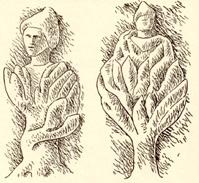
Early Christians in Rome apparently set the date for Christmas to December 25 in an effort to convert members of the popular cult of Mithras, a dying and resurected god whose birth fell on that date.  Supposedly, these early Christians incorporated trees into their celebration, as an additional appeal to the Mithraic cult.

Mithras in a tree

Tertullian (160-230) a church leader and prolific writer, complained of those Christians who adopted the pagan custom of lighting lamps and hanging laurel wreaths at the time of the solstice.  With or without trees, Constantine ratified Dec. 25 as the birth of Christ, a move aimed at followers of both Mithras and Saturn, who had major holidays at the time of the solstice.

The Evergreen Vs. the Oak:

On a mission to the Germanic people in 725, St. Boniface, in an effort to stop human sacrifice, cut down Thor’s tree, a scared oak, supposedly with one blow of the axe.   A little fir tree appeared on the stump, which Boniface said was the tree of the Christ Child, and a symbol of eternal life.  He instructed the people to take such trees into their homes and place gifts at the base, “as symbols of love and kindness.”

The Paradise Tree:

Beginning in the eleventh century, one of the popular “Mystery Plays” depicted Adam and Eve’s expulsion from the Garden of Eden.  The plays were presented in winter, so evergreens were the logical choice to represent the lush trees of the garden.  They were decorated with apples, the forbidden fruit, and over time, with communion wafers as well – the tree of knowledge became the tree of life.

This resulted in a very old European custom of decorating a fir tree in the home with apples and small white wafers representing the Holy Eucharist at Christmas time. These wafers were later replaced by little pieces of pastry cut in the shapes of stars, angels, hearts, flowers, and bells. http://www.eldrbarry.net/mous/saint/xmastree.htm

The First Written Record of a Christmas Tree:

1510, in Latvia.  Men of the Merchant’s Guild decorated a tree with artificial roses, set it on fire, and danced around it while it burned – well, okay, that might be just a little bit pagan… 

The rose was already a symbol of the Virgin Mary, which makes me wonder if they were using the smoke to send prayers or offerings to heaven.  Or maybe they just had a little too much mulled wine.

The First Lighted Candles on Christmas Trees:

One account credits Martin Luther, who was pondering a sermon while walking home, and happened to look up at a dazzling sky full of stars, shining through evergreen boughs.  As a result, he is said to have set up a lighted Christmas tree for his family.

Martin Luther's Christmas Tree

Another source claims the custom of lighted candles originated in France in the 18th century, but every other bit of European Christmas tree lore I’ve found is Germanic in origin, which makes me doubt that claim.

The First Christmas Trees in America:

On the night of December 25, 1776, while Washington led his rag-tag army across the Deleware in a driving snowstorm, unsuspecting Hessian troops in Trenton celebrated what they expected to be a peaceful Christmas night.  One source speculates that their Christmas trees, fueling nostalgia for home, helped draw them from their guard posts to go indoors and celebrate.  Hessians, including the mercenaries who fought with the British, are credited with bringing the custom in America.

The First Christmas Tree in a Church:

The prize for this innovation goes to Pastor Henry Schwan of Cleveland, OH, who decorated a tree in his church in 1851.  The congregation initially objected to this pagan practice, and Schwan received threats of physical violence, but “objections soon dissipated.”

The First Christmas Tree in the White House:

December, 1853, under the administration of Franklin Pierce.

The Christmas Tree Ship:

Thanks to Gordon Lightfoot, everyone knows of the Edmund Fitzgerald, a freighter that sank on Lake Superior in November, 1975, but an earlier disaster, “when the storms of November came early,” also captured the public imagination.  On Nov. 23, 1912, the Rouse Simmons (named for the industrialist whose name still appears on mattresses) was bound for Chicago with a load of Christmas trees.  She sank in a storm off Two Rivers, WI with fifteen men and one woman aboard.

The Rouse Simmons

Legend says the Rouse Simmons can sometimes be seen rising out of the fog on Christmas Eve.

The Christmas Truce:

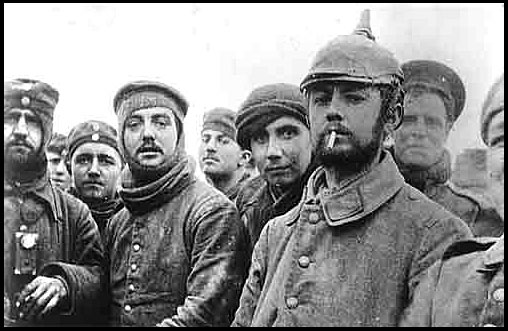
To the later consternation of generals, peace broke out all along the western front on December 25, 1914.  There was no plan, no prearrangement, and it seems to have happened differently in different sections of the line.  In one account, the Germans began singing, Stille Nacht, the British responded with Silent Night, and men on both sides spontaneously climbed out of their trenches, hands in the air,  to meet in no-man’s land.  They traded cigarettes, food, and song.  When daylight came, they played soccer.  The story usually has hostilities resuming the next day, but in some parts of the line, the men were able to resist orders to resume fighting for several weeks.

British and German soldiers together, Dec. 25, 1914
In one account, on FirstWorldWar.com: Along many parts of the line the Truce was spurred on with the arrival in the German trenches of miniature Christmas trees–Tannenbaum. The sight these small pines, decorated with candles and strung along the German parapets, captured the Tommies’ imagination, as well as the men of the Indian corps who were reminded of the sacred Hindu festival of light.

Festivals of Light:

Light is what the solstice is about all over the world, in any number of ways. Hanukkah is the eight day Jewish Festival of Lights in early December.  Diwali is the five day Festival of lights in early December for Hindus, Sikhs, and Jains.  Both holidays celebrate the victory of good over evil, of light over darkness.

Until the 20th century, December 13, was thought to be the longest night of the year in Scandanavian countries.  December 13 is the feast day of St. Lucy, one of the few festivals of a saint celebrated in Northern Europe.  On Saint Lucy, or Santa Lucia’s day, young girls in march in procession carrying candles or even wearing crowns of candles in the north, and in Italy, Malta, and the Balkans.

Paramahansa Yogananda said it only takes one little flame to drive a thousand years of darkness out of a cave.  In this time of cold and darkness, may we consider the way that light and warmth manifest and can manifest in our own lives.