The North Wind’s Gift: a trickster tale from Italy

If you haven’t already done so, I suggest you read the preceding post, Notes on Trickster stories, which provides a background and context for this article.  Both posts were inspired by “The North Wind’s Gift,” a tale from Italo Calvino’s Italian Folktales, 1956.  The story came to my attention in Allan Chinen’s discussion of tricksters and appealed because of its relative simplicity and relevance to our own times.
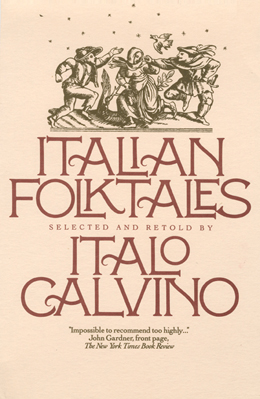
Italian Folktales

Here’s a synopsis of the story:

Once there was a farmer named Geppone who toiled in his fields every day of the year but could barely feed his wife and three children.  The North Wind blew at harvest time and ruined his crops.  Finally Geppone had enough and set out to find the North Wind and demand justice.  He reached the North Wind’s castle.  “Every year you ruin my crops,” he said.  “Because of you, my family is starving to death.”

“What can I do?” the North Wind asked.

“I leave that up to you,” Geppone replied.

The North Wind’s heart went out to the little farmer.  He brought out a box.  “This is a magical box which will give you food when you open it, but tell no one else about the magic or you’ll lose it.”

Geppone thanked the Wind and set out for home.  On the way, he opened the box.  Instantly a table appeared, piled with food.  When he got home, Geppone opened the box again and treated his family to a feast.  He told his wife not to tell anyone, and especially to say nothing to the priest, who was their landlord and a greedy man.

The next day, the priest spoke to Geppone’s wife and wrung the story out of her.  He summoned Geppone and  demanded the box on pain of eviction, offering seeds in return, which proved to be worthless.  As bad off as he was before, the farmer returned to the North Wind’s castle to ask for another boon.

At first, the North Wind refused, saying, “You ignored my warning.  Why should I help you again?”  Geppone pleaded, and reminded the Wind that he was still the cause of the family’s ruin.

“Very well,” said the North Wind at last.  He gave Geppone a magnificent gold box, but said, “Open this only when you are starving.”

On his way home, Geppone stopped and opened the new box.  This time a ruffian with a club jumped out and began to beat the farmer, who struggled to close the lid.  When he did, the ruffian vanished.  Geppone limped home, sore and bruised.  When his wife and children clamored to try the golden box, Geppone left the room.  This time two ruffians jumped out and began to beat the family.  Geppone slipped back into the room, closed the box, and the assailants vanished.

“This is what you must do,” he said to his wife.  “Tell the priest I brought home an even finer box, but say nothing else.”

Geppone’s wife understood and did as her husband instructed.  When the priest called the farmer and demanded the golden box, Geppone feigned reluctance, but at last agreed to trade it for the original box.  The priest rubbed his hands.  The bishop was due to join him for Mass the next day; a feast would be just the thing to win the approval of his superior.

The next day, after Mass, the priest, the bishop, and their retinue gathered for supper.  When the priest opened the box, six ruffians jumped out and beat the clerics.  Geppone, who was waiting at the window, took his time in closing the box to save them.

No one objected when he carried this second box home.  The priest never bothered Geppone again.  The farmer was careful to guard the North Wind’s gifts, and his family lived in ease and comfort for the rest of their days.

You can read the story as it appears in Italian Folktales here:  The North Wind’s Gift

***

It’s clear at the start of the story that we’re in a post-heroic fairytale world.  Geppone is not out to slay a dragon, rescue a princess, or win a kingdom – he just wants to survive.

Allan Chinen speaks of the different life stages that different fairytales address.  While the majority center on young people venturing into the world,  “middle-tales” like this have older protagonists with different kinds of problems.  From a Jungian perspective, Chinen notes that tricksters usually don’t show up in our dreams when we’re 18 and planning to take the world by storm – they visit us when we’re 40, with a mortgage, a couple of kids, and a car that needs an engine overhaul.

Geppone works from dawn until dark but can barely make ends meet.  His wife doesn’t listen to him, and the landlord threatens eviction.  This setup makes his story seem contemporary – if we’re not in this situation ourselves, one of our neighbors probably is.

We get the feeling Geppone has been down on his luck and taking it on the chin for a while.  Something finally awakens within him and spurs him to action.  As a result, he meets the North Wind, a wild spirit who will become his guardian and mentor and teach him the wiles of the trickster.

The North Wind is invoked in the Song of Solomon, in Aesop, and in Greek and Norwegian folklore.  He shows up in George McDonald’s novel, On the Back of the North Wind, in the stories of Hans Christian Anderson, and in Pokemon.  The North Wind is also associated with thunder gods like Zeus and Odin.  It’s not surprising that he is a shadowy trickster in Italy, where invaders and winter both arrive from the north.

Almost every successful fairytale character wins the help of a guiding spirit, and the North Wind’s help is just what Geppone needs.  It prompts him first to stand up for himself and ask for what he needs and then to learn enough strategy to overcome his oppressive priest and landlord.  To Jungians, fairytale allies like helpful animals, fairy godmothers, and nature spirits represent parts of the unconscious mind that are older and wiser than ego, which gets us into trouble in the first place.

What this means in practical terms is a vast subject, beyond the scope of a few blog posts.  Jung would suggest to patients who were comfortable in a religious tradition to return to it for guidance.  Much of Jung’s work aimed at helping people estranged from existing traditions who still needed to tap inner sources of wisdom.

In the “Power of Myth,” Bill Moyers asked Joseph Campbell where ordinary (i.e., busy) people might look to experience the wisdom of myth.  Campbell suggested we take 30 minutes or an hour a day in a quiet place where we can read what inspires us and perhaps keep a journal.

Just like this story, the psyche is home to ruffians and riches, and the old stories are not to be taken literally.  James Hillman, a prominent Jungian thinker, always insisted that literalism is the greatest enemy of inner wisdom.  So how does trickster wisdom manifest  in our world right now?  I don’t think we have to look very far.

A world that’s increasingly dysfunctional serves as a magnet for trickster energy, for good as well as for ill.  A Facebook friend mentioned that he once loaned out a book on trickster mythology and never got it back.  That fits the myths of trickster gods like Hermes who are also patrons of thieves.  Hermes may be the supreme image of the trickster.  As fluid as the metal which bears his Roman name, Mercury, he was the messenger between gods and humans who also conducted souls to the afterlife.  Patron of travelers, herdsmen, poets, orators, athletes, and inventors, his herald’s staff, the caduceus, is the symbol of healing to this day.

I find myself watching for positive manifestations of trickster energy, which usually turn up under the radar of corporate and government organizations which carry a vested interest in the status quo.  When you look, quite a few individuals and groups are trying out new solutions.  I’ll post at least one example in the near future.

In the meantime I would love to hear where you find trickster energy in yourself and in those around you.
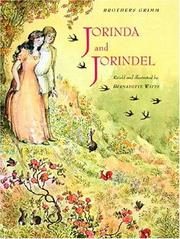
Jorinda and Joringel: a fairytale from The Brothers Grimm

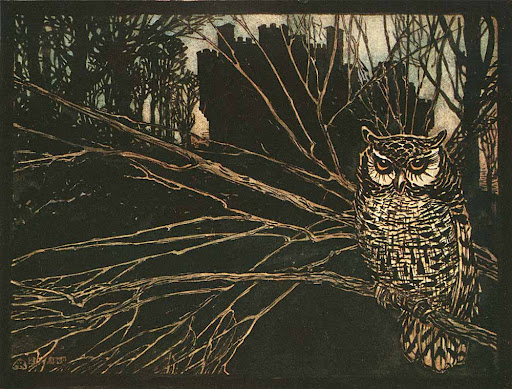
The witch as an owl by Arthur Rackham

The witch as an owl by Arthur Rackham

I have seen Jorinda and Joringel (sometimes spelled Jorindel) in many folklore collections, but I always passed it by.  A cursory glance led me to think it was much like Hansel and Gretel, not one of my favorite tales.  I’m not alone in skipping it:  I’ve never seen it discussed or analyzed by any of the writers on folklore I read.

I picked it up recently, intending to read myself to sleep, but stayed awake instead.  Jorinda and Joringel is a scary story with unexpected depths as well as features found in other celebrated stories.  One key image strikingly parallels a central symbol from India, which raises other questions.  Here is a summary of the tale:

***

Synopsis of “Jorinda and Joringel” in The Annotated Brothers Grimm

Once there was a witch who lived in a castle in the depths of a thick forest.  By day she took the shape of a cat or and owl, but at night she appeared as an old woman whose nose curved down to touch her chin.  She would kill and eat any bird or animal that ventured near.  If any human came within 100 feet of the castle, she would freeze them on the spot; they’d be unable to move until she released them.  She turned innocent girls into songbirds and keep them in cages inside the castle; she had 7000 birds and counting.

A beautiful maiden named Jorinda was betrothed to a youth named Joringel.  They enjoyed nothing more than spending time together, and one day they decided to walk in the woods.  “We just have to stay away from the castle,” Joringel said.

As the sun began to set, they heard the plaintive song of a turtledove. Jorinda began to weep while Jorindel sighed and felt oppressed with sadness. He noticed the wall of a nearby castle, but before he could utter a warning, Jorinda was turned into a nightingale. An owl with flashing eyes flew around them thrice and Joringel was frozen in place, a living statue unable to move.

The owl flew into a bush and a moment later an old woman emerged to carry Jorinda into the castle.  When she returned, she freed Joringel from the spell.  He fell to his knees and begged the witch to return his beloved, but she only said, “You will never see her again,” and departed.

Joringel wandered aimlessly in great despair.  He came to an unknown village where he worked for a long time tending sheep.  Sometimes he would circle the castle there but never too closely.

One night he dreamed of a blood-red flower with a beautiful pearl inside.  In the dream, he was back at the witch’s castle, and everything he touched with the flower was disenchanted.  When he woke in the morning, he started to search for the flower.  For nine days he roamed wilderness and village, and at last he found a blood-red flower with a large drop of dew inside that was as bright as any pearl.

He returned to the witch’s castle, boldly strode up, and touched the gate with the flower.  It flew open.  He found the room where the sorceress was feeding her birds.  When she saw Joringel, she was filled with rage, but she couldn’t come within two feet of him.  There were several hundred nightingales – how would Joringel find the right one?  Then he noticed the witch sneaking toward the door with a single cage.

Joringel ran to touch both her and the cage with the flower.  In an instant, Jorinda stood beside him and the witch lost her magical powers forever.  After freeing the other birds, Jorinda and Joringel departed.  They were married and lived with great happiness for a very long time.

*** 

After reading the story several times, I jotted down a few of the questions that came to mind:

  1. Why are Jorinda and Jorigel depicted as being so young?  In several translations, they are called “girl” and “boy” rather than “maiden” and “youth.”  Of the three illustrations I found, one depicts them as children.  Why?
  2. People are frozen or turned to stone in stories all over the world.  I thought of The Water of Life which I discussed here, as well as the ice queen in The Lion, the Witch, and The Wardrobe by C.S. Lewis.  What does it mean to be frozen like that?
  3. Why were the girls turned into songbirds?  Enchanted fairytale people usually wind up in far less appealing shapes.
  4. Another widespread motif is doing menial work for a very long time.   Here it is tending sheep.  More often it’s kitchen work.  Cinderella worked in the ashes for as long as it took a hazel twig, watered with her tears, to grow into a large tree.  Fairytale heroes and heroines wind up doing menial work when they are stuck or stalled in their quest.  If they do it well and for long enough, they find solutions.  Can this tell us anything useful?
  5. My final question concerned the pearl in the blood-red flower.  In western stories, such flowers are always roses; in the east, it would be a lotus.  Om Mani Padme Hum, is probably the world’s best known mantra and is usually (though incorrectly) translated as, “The jewel is in the lotus.”  Are the parallel images merely coincidence?  Or diffusion of stories?  Or the collective unconscious, or what?

These are the kind of things I always wonder about in stories like this.  I hunted and found a reference that doesn’t discuss this particular tale but casts light on these issues.  I’ll discuss them next time.  Meanwhile, if the story raised other questions for you, please post them.  Maybe someone here or a songbird in the tree outside will have an answer for you.

To Be Continued

Secondhand Lions: a movie review

“If you want to believe in something, believe in it. Doesn’t matter if it isn’t true.  You believe in it anyway.” Hub McCann (Robert Duvall) in Secondhand Lions

The recent death of country music star George Jones, reminded me of Robert Duvall’s Oscar winning performance in Tender Mercies (1983), the story of an alcoholic country singer who finds redemption with the help of a woman, as Jones did toward the end of his life.

The truth is, I never much cared for Jone’s music, but Robert Duvall is one of my favorite actors.  I started thinking of Secondhand Lions (2003) which also stars Duvall and is one of funniest and most satisfying movies I’ve ever seen.  I have the DVD and watched it again yesterday.  Now I’m wondering why it took me so long to write a review.

*** Spoiler Alert ***

It’s the summer of 1962 when Walter Caldwell, on the cusp of adolescence, is dumped by his irresponsible mother, Mae, at the remote Texas ranch of his two great uncles, Hub (Robert Duvall) and Garth McCann (Michael Caine).

secondhandlions - mom

“The last thing we need is some little sissy boy hanging around all summer,” Garth tells Mae.  Hearing this, Walter’s misery is palpable.  The first part of the movie shows how the trio eventually bonds.

The McCann brothers are rumored to have a hidden fortune, which brings a stream of salesmen and conniving relatives to their door. Hub and Garth spend their days shooting at salesmen, until Walter suggests they listen to one to see what he’s selling.

SecondhandLions_20

After listening to a seed salesmen, the trio plants a garden, only to learn they’ve been duped and sold nothing but corn seed.  The result is a huge cornfield they never really wanted.  The uncles also order a lion from a circus supply dealer.  They plan to hunt and kill it to hang its head over the fireplace, though Walter reminds them they don’t have a fireplace.  The lion turns out to be an aged female who is too sick to crawl out of her crate.  It wouldn’t be sporting to shoot her, Garth observes.

Secondhand lions - lion

Walter names the lion Jasmine, after a mysterious woman whose fading photo he finds in an attic trunk.  He nurses Jasmine back to health, and she takes up residence in the cornfield, the closest thing to a jungle in west Texas.  The lioness proves her worth by scaring away a family of greedy relatives, who campaign to have Walter shipped to an orphanage.

The movie would be pleasant enough – and forgettable enough – if it simply dealt with two lonely old men and a fatherless boy filling a void in each other’s lives, but deeper themes comes into play, notably the tension between ideals and what’s real, between story and truth and memory.

At the time Walter found the photo of Jasmine, he spied Hub sleepwalking down to the pond each night, where he brandished a toilet plunger like a sword, challenging invisible enemies.  Garth begins a long story of Hub and Jasmine, that’s like something from the Arabian Nights or a Douglas Fairbanks movie.  Hub rescued Jasmine, a desert princess, from a rich sheik in the Sahara after the two brothers were shanghaied into the French Foreign Legion at the start of World War I.

Garth continues the story in several segments, and Walter finally persuades his uncle Hub to finish it.  He tells Walter how he ran off with Jasmine.  How her jilted suitor, the sheik, sent assassins after the pair until Hub tricked him out of a hundred pounds of gold and defeated him in a duel.  Jasmine died in childbirth a few years later , and Hub never loved another woman.

Just then Walter’s mother returns in the dead of night with her latest boyfriend who claims to be a detective on the trail of the McCann brothers, a pair of infamous bank robbers who left an accomplice named Jasmine to die by the side of the road after she was wounded during a robbery.  When Walter challenges the story, the “detective” hits him.  His time with the uncles has changed Walter, who fights back, and with the last of her strength, Jasmine the lion, rushes to defend her “cub.”

Jasmine’s heart gives out in the struggle – “She died with her boots on,” says Garth.  Mae still wants Walter to come with her, but he’s learning to stand up for himself.  “I want to stay here,” he says.  “For once in your life, do something for me.”

Seventeen years later, Walter is a successful cartoonist, who draws a strip called “Walter and Jasmine,” the adventures of a boy and his lion.  The sheriff calls with bad news – his uncles, both 90 years old, have died in a hair-brained accident – with their boots on.  Walter both weeps and laughs when he learns the details.  The sheriff hands Walter the brothers will, which reads, “The kid gets it all.  Just plant us in the damn garden, next to the stupid lion.”

In the final scene, an oil company helicopter lands, and the son of the sheik from Jasmine’s story steps out.  “I was in Houston on business when I read the news,” he says.  “My father always talked about your uncles.  He called them his most worthy opponents, but I thought they were only stories.  So they really lived?”

“Yeah,” says Walter.  “They really lived.

There are many levels to this seemingly simple movie.  On one hand, some of the antics are hilarious.  It’s also a sensitive coming of age tale.  With the notable exception of Harry Potter, most such stories and movies over the last decade have centered on girls’ awakening.  Unlike Potter, however, Secondhand Lions reflects some of the features we know belonged to classic men’s initiation rites, such as “leaving the house of the mothers to join the fathers.”

But finally, what makes this movie great, and of universal interest to me, is its take on what is real and valuable in the stories we tell.  As Hub says to Walter:

“Sometimes, the things that may or may not be true are the things that a man needs to believe in the most: that people are basically good; that honor, courage, and virtue mean everything; that power and money, money and power, mean nothing; that good always triumphs over evil; and I want you to remember this, that love, true love, never dies.  You remember that, boy.  Doesn’t matter if they are true or not.  A man should believe in those things because those are the things worth believing in.”

A solid five stars for this movie.  I haven’t counted lately, but I’m sure it’s still up in my ten best for all time.

http://www.youtube.com/watch?v=-COMJckISVY

Scott Fenstermaker’s blog, “People-Triggers,” aims to “Understand what makes us do what we do.” In a fine article called, “The Personal Myth,” Scott explores some recent research on the importance of the stories we tell ourselves in shaping and creating our experience of self and world. “People who come out of psychotherapy testing higher on well-being indicators tend to tell similar personal stories with themes of conquered demons and redemption.The newer story may be no more factually true than the old, because all personal stories are fables, but the newer version is healthier.” In 1983, James Hillman wrote Healing Fictions, a book with a similar argument. This article quotes and links to some up-to-date research emphasizes the importance of the “screenplays” we’re always composing in our heads.

peopletriggers's avatarPeople-triggers

“It ain’t so much the things we don’t know that get us into trouble, it’s the things we do know that just ain’t so.” —Mark Twain

MythsSome (very reputable) psychologists are absolutely convinced that DNA is destiny. Other (very reputable) psychologists are convinced that your personality is shaped by what happens to you as an infant – or perhaps even in the first few minutes of life. This is what I love about psychology: the theories are all over the map and yet somehow everyone is still credible.

One very interesting dimension to personality has to do with the stories that we tell ourselves. Research has increasingly revealed that our personal life stories – our mental self-narratives – contribute substantially to our personalities and behaviors. An excellent New York Times article from 2007 summarizes much of this current research.

As the interpreter of our world, the mind is very…

View original post 707 more words

The Alchemist by Paulo Coelho: a book review

I started reading The Alchemist soon after its publication in 1988, but I didn’t finish it then, for reasons I don’t clearly remember. I picked it up again after author and writing friend, Amy Rogers, recommended the book for its affinity with the folk and fairytales I’ve recently spent so much time writing about.

She was right.  This time the story drew me in with its “Once upon a time” feeling.  It is not a fairytale by any measure; it’s far too sophisticated, yet it’s filled with folklorish magic.  The hero, Santiago, is named just once, when we meet him.  Through the rest of the tale, he is simply “the boy.”  Ironically, this generic quality, so typical of fairytales, allows us to identify with his journey, project our own yearnings into his far more closely than a modern, “three dimensional” characterization would have allowed.  In addition, the plot twist that ends The Alchemist is drawn directly from a folktale that appears around the world.

The Alchemist is a tale of spiritual self-realization.  From the start, Santiago tries to follow his “personal legend,” a term taken from alchemy.  At first, it is an instinct.  His search becomes explicit after a gypsy tells him his treasure lies near the pyramids.  A “chance” meeting with Melchizedek , the mysterious priest and king mentioned in Genesis, sets him on the path after he witnesses the unrequited longing of those who abandon the quest for their legends for the sake of expediency.  In order to follow his personal legend, Santiago learns to listen to the Soul of the World in his heart.  The world soul, or Anima Mundi is one of the key principles in the alchemical manuscripts that survive.

Anima Mundi, or Soul of the World, in alchemy

Anima Mundi, or Soul of the World, in alchemy

Paulo Coelho was born in 1947 in Rio de Janeiro.  When he was a teenager and told his mother he wanted to be a writer, she praised the steadiness of his father, an engineer, and asked if he knew what it meant to be a writer.  After research, Coelho concluded that a writer, “always wears glasses and never combs his hair” and “has a duty and an obligation never to be understood by his own generation.”

At age 16, because of his introversion and refusal to follow a traditional career path, his parents had him committed to a mental institution from which he escaped three times before his release at age 20.  He agreed to attend law school but dropped out to become a hippie and travel through South America, Mexico, North Africa, and Europe.  Upon his return to Brazil, he worked as a song writer, an actor, journalist, and theatre director.

In 1986, he walked the 500 mile pilgrimage road of Santiago de Compostela to the cathedral where St. James the apostle’s remains are believed to be buried.  Since the middle ages, it has been one of three major Christian pilgrimage destinations, along with Rome and Jerusalem.  On the way, Coelho had a spiritual awakening, which he described in his autobiographical novel, The Pilgrimage, 1987.  He published The Alchemist the following year, with a small Brazilian publisher that ran 900 copies and decided against a reprint.  Sales now total 65 million.

Paulo Coelho, 2012, by Sylvia Feudor.  Copyright free.

Paulo Coelho, 2012, by Sylvia Feudor. Copyright free.

I do not clearly remember why I disliked The Alchemist when I first read it more than 20 years ago.  I suspect, to put it in Santiago’s language, that at the time, I feared I’d lost hold of my own personal legend.  I’m glad I picked up The Alchemist again.  Our world is darker, harder, and more cynical now, and more than ever I think we need Coelho’s gentle parable.  However difficult it may be, it’s good to try to remember this conversation between King Melchizedek and Santiago:

“What’s the world’s greatest lie?” the boy asked, completely surprised.

“It’s this:  that at a certain point in our lives, we lose control of what’s happening to us, and our lives become controlled by fate.  That’s the world’s greatest lie.”

Once Upon a Time: On the Nature of Fairy Tales by Max Luthi

Why do fairytales continue to fascinate?  Why do we  think of Red Riding Hood when we find ourselves alone in the woods or even a city park?  Why does Hollywood still reap profit from retelling the old stories?  Why do they move us so deeply?

On the Nature of Fairy Tales by Max Luthi (1909-1991) is a wonderful place to begin to look under the surface of these deceptively simple tales.  The eleven essays gathered in this book explore different features of fairytales such as structure, symbolism, and meaning.  Luthi views the tales as a unique literary genre.  He knew and referred to the major schools of folklore research – the sociological, the psychological, and the comparative historical approaches – but he always returned to the stories themselves.  The meanings he found there were more than enough.

Fairytales have “a crispness and precision” in part, according to Luthi, because they eliminate most descriptions.  We hear of a dark forest, a cottage, a witch, but any and all details come from our own imagination.  In a similar way, there is no real character development.  “The fairy tale is not concerned with individual destinies,” but this lends the tales a universal meaning.  The prince or princess stands for all of us, “as an image of the human spirit.”

At its core, the fairytale is about our “deliverance from an unauthentic existence and [the] commencement of a true one.”    Prince or princess, goose girl or goatherd, all have lost their way.  Their radiance, which is our radiance, is hidden.  The kitchen lad wears a hat to hide his golden hair.

Sometimes the hero or heroine sets off into the forest alone.  Sometimes they sit and weep.  “Crying, the sign of helplessness, summons assistance – again a feature recurring in innumerable fairy tales.  Precisely as an outcast can man hope to find help.”  The caveat is that one must be kind and compassionate to all living creatures in order to find the right kind of help at the right time.  Even ants will repay a kindness that can save the hero’s life.

Luthi quotes Mircea Eliade who said that fairytale listeners experience an “initiation in the sphere of imagination.”  In Luthi’s view, fairytales echo the truths of the great spiritual traditions – both we and the world are far more than what we seem.

Thank you!

Thanks to everyone who stopped by this week to read and comment on “Tales of the Dummling” after it was freshly pressed.  I’ve been getting over a cold – fortunately not the nasty flu that’s going around, but bad enough that I was too tired to thank everyone who liked the post or signed up to follow thefirstgates.  Thank you now if I missed you then!

I’m grateful to the good folks at WordPress who singled out this particular post.  I was freshly pressed before, in 2011, which was exciting and encouraging, but this time the post truly mattered to me.  I won’t say I was, “Following my bliss,” because that phrase has been so over-used.  How about, “Following my feather?”  I didn’t think this kind of work would have that wide an appeal, but I’m happy to see that it does.

Your comments this week gave me many things to mull over.  Just like the very best stories, you raised questions I cannot easily answer.  Questions about the various goals that folktale characters pursue.  Questions about which attributes lead to success.  How and even whether to try to interpret fairytales – this is a topic I plan to address very soon.

Meanwhile, here is part of a post I started in December on what the stories tell us we need to do on a quest.  (Aren’t we are always on some kind of a quest?).

I called it, “What fairytales have to say about living in difficult times,” and though I don’t plan to finish it in its present form, I offer this portion of it as kind of an online journal entry, that’s bound to resurface later in some other form:

***

Dec. 12, 2012
In my previous post, I outlined a US intelligence report, Global Trends 2030, that listed factors likely to speed up the rate of change in our already fast moving world.  I ended with a question:  can fairytales tell us anything about living in difficult times?

I believe the answer is yes.  As James Hillman put it, “If we had more fairy tales when we were young, we’d need less therapy as adults.”  Fairytales always deal with crisis times.  Your father will die if you don’t find the water of life.  Your stepmother wants to kill you.  The king will cut off your head if you fail to capture  the firebird.

Lives are on the line in fairytales, and sometimes the characters don’t survive.  When they do, we find they share  certain characteristics which can be stated as guidelines for people on a quest, in the otherworld or in this one.

1. Never travel alone – successful quests demand allies.  Sometimes the hero or heroine assembles a group of companions with strange skills that prove to be essential.  At other times, a single helper is enough.  In longer tales the guide may change; a shaggy horse will become a spirit brother.  One of my psych professors claimed that the best chance of success in folklore belongs to those who win the help of an animal guide.  For Jung, such totem animals symbolize the “Self,” the center of our being, as well as our instincts, which get submerged in modern life.  On this point, all the world’s stories agree – our ordinary habits, ideas, and ways of doing things are never up to the most important tasks in life.

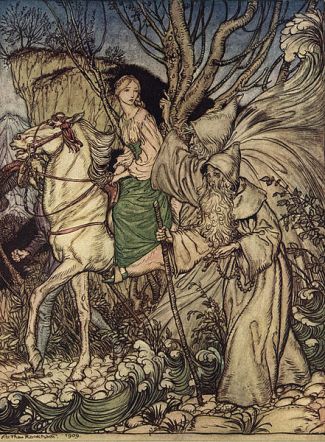
Undine by Arthur Rackham, 1909.  Public domain

Undine by Arthur Rackham, 1909. Public domain

Help often comes from people and places that “wise” people avoid.  The hideous hag or the strange man by the side of the road may hold the key to happiness and survival itself.  They reveal their secrets only to those who see and hear with the heart and their deepest wisdom.

2.  Be kind, but keep your wits about you:  In one story, a girl is kind to an ugly old hag and is rewarded.  Her step sisters mouth off, and forever after, toads fall from their mouths when they try to speak.  Kindness, respect, and compassion matter, yet some creatures are evil and we have to know the difference.  In the original version, Snow White falls for the witches tricks repeatedly (despite the dwarves warnings) before she finally takes a bite of the poison apple.  “Fool me twice, shame on me,” as the saying goes.  If strange little men give you shelter when you’re lost in the woods, you might want to heed their advice!

From an 1852 Icelandic translation of Snow White. Public Domain

3.  Be Flexible:  

4.   Trust Yourself and your instincts:

I cannot now remember what I was going to say about 3 and 4 – I’ll let you know when I figure it out, so please stay tuned!

Something is happening here…

Readers of a certain age will recognize the title of this post as part of the chorus of one of Bob Dylan’s iconic songs of the ’60’s, “Ballad of a Thin Man.”

And something is happening here
But you don’t know what it is
Do you, Mister Jones ?

What brought the song to mind was another simple phrase which seemed to sum up our own time in a similar pithy way.  Strangely enough, it came from a piece on CNN.com called “Why the best thing you can do is fail,” by Eddie Obeng, founder of a virtual business school  http://www.cnn.com/2012/12/30/opinion/obeng-business-disruption-ted/index.html.  Here is the passage that caught my attention:

“What’s happened in business is that the rules of the real 21st century aren’t clear to us, so instead we spend our time responding rationally to a world which we understand and recognize, but which no longer exists.”

We can substitute many other words for “business” and find the phrase rings equally true.  Try it.  “What’s happened in [publishing, school safety, government, warfare, economics, international relations] is that the rules of the real 21st century aren’t clear to us, so instead we spend our time responding to a world which we understand and recognize, but which no longer exists.”

Both the Dylan lyrics and Obeng’s observation put into simple words what we’ve known for some time but could not express so clearly.

One of my favorite words, liminal, stands for times like these, times of uncertainty and change in the life of an individual or a culture.  Webster’s Dictionary defines liminal as: “1 of or at the limen or threshold 2 at a boundary or transitional point between two conditions, stages in a process, ways of life, etc.”

I started a post in December concerning what fairytales have to say about living in liminal times.  Fairytales always happen in times of transition or crisis times.  Your father will die if you don’t find the water of life.  Your stepmother wants to kill you, or you find your new husband is a serial killer.  The king will cut off your head if you fail to capture  the firebird.

Can this be relevant to the 21st century?  I’m convinced that it can.

Right now I’m reveling in one of my Christmas presents, The Annotated Brothers Grimm, a fine new collection published to celebrate the bicentennial of Grimm’s fairytales.

Reading so many stories at the same time raises a number of questions.  What does it take for a character to survive their otherworld challenges?  Sometimes you have to obey a witch, and at other times you need to push her into the oven.  Sometimes not knowing is an asset and sometimes a fatal flaw.  You should listen to animals by the side of the road unless they are wolves and you’re wearing red.

I don’t expect to come up with definite answers, but I do expect to turn up some interesting questions.  This is my immediate plan; after that, I’ll do as I’ve always done on this blog, make things up as I go along.

I very much hope you’ll stay tuned.  And now, I’ll leave you with my wish for a joyous and prosperous 2013, and with a very old clip of Bob Dylan doing “Ballad of a Thin Man” in 1966 in Copenhagen…

http://www.youtube.com/watch?v=EpatC8sR-KU