The Yule Lads: Icelandic Christmas folklore.

The Yule Lads

In most Christian countries, Christmas was slower to catch on than other major church holidays.  The clergy may have been wary of pagan solstice celebrations which happened at the same time of year and included serious revelry.  Some early Christmas festivities mimicked the custom.  They were banned in 17th century England, and American Puritans outlawed them too.

According to Brian Pilkington, author of The Yule Lads, Iceland was ahead of the curve. A 16th century law stated that “All disorderly and scandalous entertainment at Christmas and other times and Shrovetide revels are strongly forbidden on pain of serious punishment.”

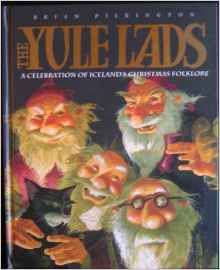
Icelandic winters are long and dark, with fewer than five hours of daylight at this time of the year.  Imagination tends to fill the darkness with what we fear, and Pilkington’s book describes “the lads” that kept Icelandic children awake at night.  The gentlemen pictured on the cover are not our shopping mall Santas!

The matriarch of the clan was the ogress, Gryla, who loved to eat stewed children.  It couldn’t be just any kid though.  It had to be one who was “naughty, lazy, or rude.”  In one 13th century account, Gryla had 15 tails, and tied to each was a sack full of naughty children.  It was not “the most wonderful time of the year” if you were young!  The Icelandic word for icicle is “grylukerti” which means “Gryla’s candle.”
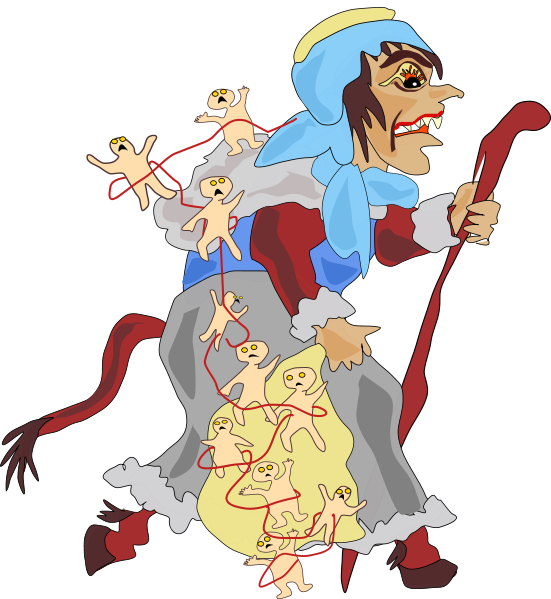
Gryla. CC-by-SA-2.5

Gryla had three husbands and 80 children, though legend now boils it down to 13 sons who visit the homes of children on successive nights from Dec. 12 – 25.  Time and the law have taken the edge off the Yule Lads, for a 1746 decree said “The foolish custom, which has been practiced here and there about the country, of scaring children with Yuletide lads or ghosts, shall be abolished.”  By the 19th century, the Lads had morphed from cannibals into rascals and petty thieves, who even began to leave gifts for good children who left their shoes on a window ledge.

The first to arrive was Stekkjarstaur, the “Sheep Worrier.”  He would visit the the sheep cot and try to suck milk from the ewes.  That doesn’t work in December and led author, Brian Pilkington to suggest that Sheep Worrier’s IQ is “somewhat less than three digits.”  These days  he heads for the fridge to get his milk.  If a child has been good, Stekkjarstaur leaves a sugary sweet.  Bad children get a potato.

Next comes Giljagaur, aka, “Gully Gawk” who travels through gullies and ravines, also in search of milk, but he looks for cow barns and inattentive milkmaids.  “Stubby” arrives the third night, as short as his name suggests.  He likes to raid the kitchen, as do the brothers that follow, “Spoon Licker,” “Pot Licker,” and “Bowl Licker.”  In their present forms all they do is mischief, but food thieves were no joke in earlier times.  For northern farming families, the time between Christmas and the spring thaw in April or May could be times of famine if food or fodder for livestock ran short.

The next lad to show up is Hurdaskellir, or “Door Slammer,” one of only two of Gryla’s sons who isn’t out to fill his belly.  Imagine loud bangs in the dead of night and you know how he gets his jollies.

And as if the sons of Gryla were not bad enough, children also had to contend with Jólakötturinn, the Yule Cat, a huge feral creature who hunts children on Christmas Eve instead of mice. Like the lads, the cat discriminates in choosing his victims, eating only those who have not received a new item of clothing for Christmas. Pilkington says that “Until fairly recently in Iceland, all clothing came directly from sheep. The wool had to be washed, combed, and spun before it was painstakingly crafted into a garment. It was a long, arduous process.”  Fear of the Cat induced lazy children to do their part!

This is a fun book and a fine counterbalance to the usual TV holiday movies.  You can picture families gathered around the fire as the wind howls outside, thinking as we do when hearing a good ghost story, “This can’t be true…can it?”  Something within the listeners then and within us now loves to be scared, to confront monsters and vanquish them in imagination.  On that score, Gryla & Sons and the Yule Cat satisfy!

A click on the book cover at the top of this post will take you a site where you can order The Yule Lads.

Tales of the Elves: Icelandic Folktales for Children

Tales of the Elves cover

One day God decided to visit Adam and Eve.  They welcomed him and introduced  their children – all except the ones Eve had not finished bathing.  After all, you want your kids to be clean when the Supreme Being drops in.  God was aware of this and said, “What is hidden from me shall be hidden from men.”  Those children became the elves who live in the hills and mounds of Iceland.  They can see us but we can’t see them unless they wish it.

I know this because I read a magical book, Tales of the Elves, based on the Icelandic folktales of Jon Arnason, adapted by Anna Kristin Asbjornsdottir and illustrated by Florence Helga Thibault.  I found the book on our visit to Iceland, which I wrote about in the fall.

Interest in elves isn’t limited to children in Iceland.  One day, as we toured the countryside, our driver pointed to a spot in a wide valley where the highway curved around a pair of volcanic rocks.  The stones were only 8′ – 10′ tall, nothing modern earth movers couldn’t remove.  That was the intention of the highway crew.  The problem was, the bulldozers broke down or stalled every time they  approached the twin rocks.  Every time.  Locals explained that the stones marked the entrance to an underground elven settlement.  The equipment worked perfectly after the construction crew decided to route the highway around the stones.

If this reminds you of Irish fairies, there’s good reason.  Genetic testing has proven that many Icelanders, especially the women, came from Ireland, specifically, the viking settlements there.  The stories themselves teach us similar lessons in coexisting with “the hidden ones.”

“Midwife to the elves” shows how the elven folk can give the gift of the sight and take it away again.  “Elf Wind” demonstrates the courage and cunning required to set things right if you do something foolish, like cut the grass on an elven mound.  “Payment for Milk” is about the boons the elves can grant if you treat them with kindness and goodwill.

I’d been looking forward to writing this review since I found Tales of the Elves, but unfortunately I couldn’t find any venue where interested readers can find the book.  Not on Amazon US or UK.  Not on bookfinders.com or ebay.  I couldn’t find ordering information on the publisher’s website.  I posted a request for information on the illustrator’s Facebook page, and I’ll pass along anything I discover.  Meanwhile, here is the information – if you love folklore and fine illustration of fantasy themes, it’s worth keeping an eye open for this book.

Anna Kristin Asbjornsdottir (adaptation), Florence Helga Thibault (illustration), Victoria Cribb (trans), Tales of the Elves, Bjartur publishing, Reykjavik, 2012

ISBN:  978-9979-788-80-5

Please post any information you may discover.

The Life of Pi: A movie review

What you’ve heard about this movie is true: it’s the tale of a boy who winds up in a lifeboat in the Pacific with a Bengal tiger. It’s also true that most critics have praised The Life of Pi. I’m with them; this is a magical film.

Pi Patel livess an idyllic childhood in Pondicherry, India.  His father owns a zoo, and Pi develops a love for the animals as well as a spirituality that embraces the Hindu gods, Jesus, and Allah.

As he tries to practice all three faiths, his father, convinced of the supremacy of reason, warns that “If you believe in everything, you will end up not believing in anything at all.”  Pi’s father also demonstrates graphically that tigers are not your friend, a lesson that shakes Pi’s trust in nature.  The real blow falls after economic hardship forces Pi’s family to relinquish the zoo.  They sail for Canada with all the animals on a freighter, but a storm sinks the vessel, and Pi is the only human to survive.

What god do you pray to and what do say when your way of life and your family are suddenly gone, and you’re alone in a lifeboat with a zebra, an orangutan, a hyena, and a tiger named Richard Parker?  Initially, there is little time for prayer in the struggle to survive.  Soon it’s just Richard Parker and Pi.  There are cans of water and boxes of biscuits for 30 aboard the lifeboat, as well as a book on survival and a pencil that Pi uses to journal in the margins.

An optimist, Pi’s spirituality returns with expressions of gratitude and surrender as the ocean moves through her various phases, with deadly storms, cornucopias of fish and rain, and scenes of unearthly beauty.

Einstein once said the only important question is whether or not the universe is a friendly place. The adult Pi, who narrates the tale, believes it is. Was his ocean a friendly place or not? Both and neither, his story seems to say; it’s far more vast than that.

The western fantasy of objective truth leads us to believe there are true stories and false ones. The eastern view, shared at least in part by novelists and movie makers, is that our stories create our realities.

What does your heart say?  What does it lead you to believe?  That’s the question the grown-up Pi seems to asks us with his story and a half smile on his face.  It’s the same enigma the ocean and Robert Parker put to him.

The One Thing

In my previous post, I talked about “Rosebud,” the sled that represented the unrequited desires of Charles Foster Kane in Orson Welles’ classic film, Citizen Kane.  I’ve been thinking a lot about metaphors for the deep yearnings that push and pull us through life, for good or ill, depending on whether they’re wise or foolish and if we know what they are.

Another of my favorite movie metaphors comes from the 1991 comedy, City Slickers. Three middle aged men, looking to reignite the passion in their lives, sign up for an old west style vacation that includes a cattle drive.  Things go wrong of course, and the dude ranch experience becomes a fight for survival, with nasty villains, a stampede, and raging rivers.

One night, after chasing stray cows into a canyon, timid Mitch (Billy Crystal) opens up to Curly (Jack Palance), the hardened trail boss.  Curly turns out to be wise as well as tough, and tells Mitch he needs to discover and follow “the one thing” that matters most in his life.

The one thing

Another phrase I love for our one thing, is “throughline,” a screenwriting term that was coined by Constantin Stanislavski, the great proponent of character acting.  A throughline propels the protagonist through a story.  It’s the core motivation that carries the hero from scene to scene and through all the gains and setbacks.

“Throughline” is great as a metaphor because it’s expected to change, just as our “one things” do in life.  Frodo initial goal is to carry the ring to Rivendell and place it in more capable hands, but just as in our lives, inner and outer events alter his goal.

Because of the election season, I recall the same dynamic in the life of Jimmie Carter.  In 1980, his goal was a second term as president.  After a resounding defeat, his life’s “through line” changed and deepened.  He threw himself into humanitarian work and extensive diplomatic travel and won the Nobel Peace Prize in 2002.  I read two books of his theological reflections and realized that Carter’s “one thing” is a dedication to Christian values that transcends what you usually hear from politicians still trying to get elected.

“Thread” is another common image for the one thing we use to chart our course in life.  In the Greek myth, Ariadne gives Theseus a ball of thread to find his way out of the labyrinth after slaying the monster within.

Ariadne and Theseus by Niccolo Bambini, Italian. Date unknown. Public domain.

I’ve already quoted my favorite thread image on this blog, but will do it again.  It’s William Stafford’s poem, “The Way it Is,” 1993:

The Way It Is

There’s a thread you follow.  It goes among
things that change. But it doesn’t change.
People wonder what you are pursuing.
You have to explain about the thread.
But it is hard for others to see.
While you hold it you can’t get lost.
Tragedies happen; people get hurt
or die; and you suffer and get old.
Nothing you do can stop time’s unfolding.
You don’t ever let go of the thread.

There may be people who know from the start what matters in their lives, but for the rest of us, there’s a lot of trial and error.  Awareness of “time’s unfolding” is what gives such reflections their force.  What is the one thing or few things I truly care about?  Is there any question more important than this?  Next time I will write about a man whose entire life is an exemplary answer.

Stories, Dreams, Politics, and Baseball

Yesterday, I struck up a conversation with another San Francisco Giants fan about the possible conflict between the National League Championship Series and Monday’s Presidential Debate.  The Giants are down three games to two.  If they pull off a win tonight, the final game will be Monday.

Later, considering which program I want to watch vs. the one I should watch, I thought of how clear it’s become to me that this election is not about the candidates themselves, but about the visions, or perhaps more accurately, the stories about America they embody.  Most people seem less than thrilled by the candidates themselves, but everyone takes the stories seriously.

A high school history teacher planted the seeds of this understanding decades ago.  At the time of another presidential election, he suggested that most voters are swayed by an image of times past, a story of “the good old days,” which probably never existed.  He argued that the imagination of the conservatives of his day echoed the television show, Bonanza.

The Cartwrights (l-r), Adam, Little Joe, Ben, and Hoss. Public domain.

Ben Cartwright and his three sons carved a fine spread out of the wilderness – they did it on their own, by the sweat of their own brows, thank you very much.  The only hint of government was the Virginia City sheriff, and generally the Cartwrights told him what to do and not vice versa.

In a similar manner, liberals dream of Kennedy’s “Camelot” and its precursor, The New Deal.  For the generation that came of age during The Great Society and the War on Poverty, “less government” is a codeword for Charles Dickens’ London: “Are there no prisions?  Are there no workhouses?”

Scrooge meets Ignorance and Want. Public domain.

And whenever you hear a politician of any persuasion invoke “family values,” you can bet their story embodies the world of Norman Rockwell.  Anyone grow up in a family like this?

Norman Rockwell mural. Public domain, courtesy Oregon Historical County Records Guide.

We’re dealing with powerful stuff here – nothing drives us more than our dreams, which means we need to be careful.  I liked Bonanza and still enjoy Norman Rockwell, but I try not to bring them into the voting booth.  Kids learn how to separate dreams from the world of make-believe:  they know that “I want to be a doctor” is different from “I want to fly like Super-man.”  What kids know, politicians seem to forget.

Tomorrow night, the presidential candidates are scheduled to discuss “foreign policy.”  Webster’s Dictionary defines policy as, “1.  wise, expedient, or prudent conduct or management.  2. a principle, plan, or course of action, as pursued by a government, organization, or individual, etc.

I expect to hear a story that goes like this:  “We are number one and if you want to keep it that way, vote for me.”  I’m not so sure we’ll hear much about policy, aka, “wise, expedient, or prudent conduct or management.”  For that we often have to look to outsiders.

I’ve done precisely that over the last few months, and was startled to find a clear and feasible foreign policy articulated with very similar features from both a liberal and a conservative point of view.  There’s a beautiful story in there too, one involving national renewal through shared effort and dedication.  A dream, to be sure, but it doesn’t require Superman.  This will be the topic of a post in the coming week.

Meanwhile, though I’ll be watching the debate, I’ll have my phone set to the instant scoreboard app.  “The Giants are number one,” is a dream that could happen, but if Superman is listening, we’re not above asking for help!

*** Update, Sunday Night ***

The Giants won, 6-1, so there will be a game 7!

Njal’s Saga, part 3

Gunnar looks back at his home, 1898 illustration. Public domain.

In order to follow this discussion, it will help if you’ve read two earlier posts:

  1. Njal’s Saga, an Introduction: http://wp.me/pYql4-2sS
  2. Njal’s Saga, part 2: http://wp.me/pYql4-2tb

Scholars suggest that the author wove together two separate stories, an oral “Gunnar’s Saga,” and a related but distinct, “Njal’s Saga.”  Both men die during attacks on their homes.  Historically 18 years passed between the events; Gunnar died in 992 and Njal around 1010.  In the last third of the saga, Njal’s son-in-law, Kari, mounts a campaign of revenge against the killers which threatens the stability of the nation.  A pitched battle breaks out at the Althing, the National Assembly, which was sacred ground where fighting was forbidden.  When reconciliation finally comes, it signifies the dawn of new vision of life and its purpose.

Once the saga gets going, certain scenes come alive like movies – I know there’s a screenplay here…

***

Soon after Gunnar and Hallgerd were married, they attended a feast with Njal and his wife, Bergthora.  In no time, the two women were at each other’s throat.  The insults grew so extreme that Gunnar dragged Hallgerd out of the hall. Soon after that, she had one of Bergthora’s slaves killed.  Bergthora paid her back in kind, initiating a feud that escalated and took the life of free retainers and then kinsmen on both sides.

The killings took place while the husbands were at the Althing which  convened for two weeks every summer.  Aside from social activities, this was the time for legal action on matters the lower courts couldn’t settle.  It was also where “compensation” for killings was determined.

If you killed a man, even in self defense, you confessed it in front of witnesses.  A hidden killing was treated as murder and could result in exile for life.  A killing confessed was manslaughter and terms of compensation could be set:  a slave was worth seven ounces of silver, a freeman fifteen, and a kinsman as much as 200.  It may seem cold, but the system was designed to break the cycles of revenge that the old ethic of “honor” and blood retribution entailed.

Gunnar and Njal tried to keep up with the legalities of the killings-for-hire their wives initiated, but it became harder as stakes were raised.  Each killing drew more people, bound by family and friendship, into the feud.  Into this deadly mix came Mord Valgardsson, son of Unn,  who despised Gunnar and Njal.

If Hallgerd spawned chaos and harm, she did so in a half-unconscious manner.  She was reactive, without clear designs or premeditation.  Mord, by contrast, was cunning, able to weave elaborate snares for his enemies.  Our tour leader, Robert Willhelm, pointed out the similarity of Mord’s name to Mordred, King Arthur’s  son and nemesis.

During a famine, Hallgerd sent a servant to steal food from a man who refused to sell any to her husband.  When Gunnar, with his concept of honor, discovered the theft, he slaped his wife, who had already buried two husbands who hit her.  Hallgerd warned Gunnar that she would never forget the blow.

Njal prophesied that if Gunnar killed two members of the same family and broke the legal settlement for the killings, he would die soon after.  Through trickery, Mord ensured that Gunnar killed the son of a man he’d already slain.  In addition to a financial settlement for the killing, the Althing court sentenced Gunnar to three years in exile.

In one of the most poignant scenes, as Gunnar and his brother rode to the harbor, Gunnar’s horse slipped while fording a river.  Springing off the horse, Gunnar looked back at his farm and said, “Lovely is the hillside – never has it seemed so lovely to me as now, with its pale fields and mown meadows, and I will ride back home and not leave.”

That autumn, Mord sent word that Gunnar was home alone and 40 of his enemies mounted an attack.  Firing arrows from the second floor, Gunnar killed two assailants and wounded eight.  Then a man named Thorbrand got close enough to cut Gunnar’s bowstring.

Gunnar defending his home, 1898. Public domain.

Gunnar turned to his wife and asked for two strands of her waist length hair for a new bowstring. Hallgerd said, “Does anything depend on it?”

“My life depends on it,” Gunnar said, “for they’ll never be able to get me as long as I can use my bow.”

“Then I’ll recall,” she said, “the slap you gave me, and I don’t care whether you hold out for a long or short time.”

Gunnar wounded eight more attackers before he finally fell, exhausted and wounded in fifteen places.  One of the attackers said, “His defense will be remembered as long as this land is lived in.”

Gunnar’s mother was ready to kill Hallgerd who fled the house.  Gunnar’s friends raised a burial mound, and one night, as two of Njal’s sons passed by, they saw the mound open.  Four lights shone and cast no shadows.  The brothers heard Gunnar’s spirt sounding content as it spoke skaldic verse.

***

Gunnar embodied the old warrior ideal of life and death with honor that won you a place in Valhalla.  The dark side of this ethos was an unending string of killings that threatened the nation itself.  Things were about to change.  Shortly after Gunnar’s death, a Christian missionary named Thangbrand arrived in Iceland.  He wasn’t the sort of evangelist you want on your doorstep, since he carried a crucifix in one hand and a sword in the other and didn’t much care which he used.

One autumn morning, as Thangbrand celebrated mass, a man named Hall of Sida approached.  “In whose memory are you celebrating this day?” he asked.

“The angel Michael’s,” Thangbrand said.

“What features does this angel have?”  Hall asked.

“Many,” said Thanbrand.  “He weighs everything that you do, both good and evil, and he is so merciful that he gives more weight to what is well done.”

Hall said, “I would like to have him for my friend.”

With his openness to new ideas and the simple way he voices his spiritual longing, Hall becomes the first convert.  In 999 or 1000, the Althing declared Christianity to be the new religion.  Mord continued to work behind the scenes fomenting trouble for Njal and his sons, and around the year 1010, 100 armed men attacked Njal’s home and burned it, with him and most of his family inside.  Only Kari of Orkney, Njal’s son in law, escaped.  He raised a force to attack the burners, and at the next Althing, when the retribution process broke down, a pitched battle erupted at Thingvellir, the spiritual heart of the nation.

Battle at Thingvellir. Public domain.

During a lull in the fighting, members of the assembly intervened to arrange a truce.  Hall of Sida stood between the combatants and said, “All men know what sorrow the death of my son Ljot has brought me.  Many will expect payment for his life will be higher than for the others who have died here.  But for the sake of a settlement I’m willing to let my son like without compensation, and what’s more, offer both pledges and peace to my adversaries.”

Things have changed.  A few decades earlier, such a statement would have cost Hall his honor, but the saga says that when he sat down, “much good was spoken about his words, and everybody praised his goodwill.”

The combatants submitted to judgement.  Cash payments were levied as well as three years exile from Iceland for the combatants.  During the exile, they slew each other in Orkney and along the coast of Ireland, but finally, when the leaders returned to Iceland, they pledged friendship to each other.  The old ways had cost too much in blood and suffering.  The survivors had no stomach for anymore fighting.  The saga ends with a sense that a new wind was blowing through the land.

Next:  reflections on the story.

Two hundred years of The Brothers Grimm

Statue of The Brother’s Grimm, Hanau Germany, by Syrius Eberle, 1895-96. CC-by-SA-3.0

In honor of the bicentennial of Children’s Household Tales (1812) by the Brothers Grimm, the University of Florida presents Grimmfest this month and next.  The university is home to the Baldwin Collection of Historical Children’s Literature, which features 2500 digitized children’s texts and a virtual exhibition of 19th century children’s book covers.

The Grimmfest page, http://www.clas.ufl.edu/cclc/fairy-tales.html, has links to other fairytale resources, including related contemporary books and movies.

Grimm’s Fairy Tales, 1865 cover. Public domain.

“Traditional fairy tales have their roots in our oldest stories, in myths and legends, in those primal tales that were formed when human beings first began to speak…However we may wish to define fairy tales, they remain an inescapable part of our psyches and our cultures.  They are why we celebrate the underdog, and secretly acknowledge “The Ugly Duckling” as our own autobiography.  Through their flights of fantasy, fairy tales set us free to seek our happiness, to follow our bliss — if only for the few minutes we are enfolded in a particular tale.”

This is a marvelous resource for anyone wishing to delve into the roots of the stories we love.

Skalholt, Iceland

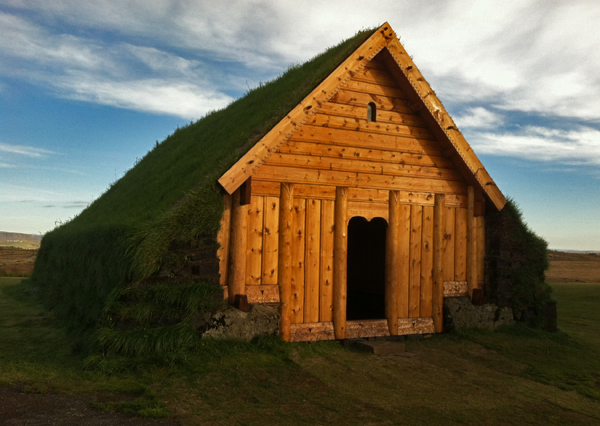
The view out my window is Skalholt Cathedal and this reconstructed chapel which is part of an archeological dig at one of Iceland’s key historical sites.  On the horizon behind the chapel likes Hekla, one of Iceland’s most active volcanoes.  In the middle ages, Europeans called it the Gateway to Hell.  Hekla last erupted in February, 2000, but with luck, it will continue to sleep through the rest of the week.

Mary and I are here for a different type of archeology – a dig into an ancient tradition of story.  We are here with three other storytellers to explore Njal’s Saga, the account of a feud with tragic consequences, not unlike the American tale of the Hatfields and the McCoys.  In both cases, events are based in history; we’re visiting some of the key locations mentioned in the saga.  Njal was shaped by an anonymous author into the masterpiece of a unique tradition that influenced Tolkien, among others.

Meeting of the continents: the North American tectonic plate (left) meets the Euro-Asian plate at Thingvellir, Iceland.

This week of the equinox, the temperature drops to freezing at night, but the guesthouse where we are staying is warmed by geothermal energy, by water bubbling up from hot springs that is shipped through pipes to cities and settlements throughout the island. Iceland is 99% energy independent.

I’ll have more to reflect on in future posts, but meanwhile it is seven hours later than west coast time – tomorrow is almost here, so it’s time to log out.  Please enjoy your week and stay tuned for future posts.