Gettysburg: The Eve of Battle

On the morning of June 30, 1863, Col. Joshua Lawrence Chamberlain, awoke with the aftereffects of the heat stroke he had suffered while marching the day before.  Chamberlain, 34, was a professor of rhetoric at Bowdoin College who spoke seven languages, but had always wanted to be a soldier.  He had asked for a leave to join the army the year before but was denied, so he applied for a sabbatical to study language in Europe.  When it was granted, he went instead to the Governor of Maine, who commissioned him a Lt. Colonel in the newly formed 20th Maine regiment.

Col. Joshua Lawrence Chamberlain

On the morning of June 30, Chamberlain had other problems as well:  120 men from another Maine regiment had refused to fight because of a controversy involving their enlistment papers.  They had been sent under guard to Chamberlain, with a note from the commander of the army saying Chamberlain could shoot them “if necessary.”

Instead, Chamberlain used his rhetorical skills to persuade 114 of these men to join the 20th Maine, which had lost more than 700 of its original strength of 1000 men to battle and to smallpox.  This was one of those destiny moments in history; two days later, Chamberlain and the men of the 20th Maine would save the Union army at Little Round Top.

***

Another key bit of destiny was in play the day before the battle.  Union general John Buford, a cavalry officer who loved the western territories, didn’t know how to curb his tongue, which has never been a good survival tactic in Washington – it got him assigned to a desk.  Just two weeks earlier, he had won command of a cavalry troop of 2500 men and 6 cannons.  His orders had been to shadow Lee’s army from a safe distance and communicate their movements back to the infantry.  But Lee had changed directions during the night.  Suddenly, at noon on June 30, as Buford rode into Gettysburg, that safe distance was gone!  He was faced with Confederate general Harry Heth’s column of 8000 infantry entering the town.

Then, incredibly, Heth retreated.  Buford correctly reasoned that Heth was under orders not to attack until the troops were in place with greater strength.  He could see that the heights around Gettysburg offered excellent field position and whoever occupied them first would have a huge advantage.  He had seen the slaughter that resulted from fruitless charges against such positions.  He sent couriers galloping to the main force and ordered his own vastly outnumbered troops to dig in and prepare to hold until help arrived.

http://www.youtube.com/watch?v=LzZOp-nPho8

To Be Continued

The Gettysburg Battlefield

I spent the spring and summer of 1973 working at IBM and living with my parents in the western New York factory town they had moved to a year before.  I had just gotten a VW van and while I was there, I offered to take each of them camping to the place of their choice.  My father chose the Jersey shore.  My mother wanted to tour Gettysburg, so that’s where she and I went.

My mother was born in Richmond and remembered seeing old gray-bearded veterans rocking on porches in nursing homes when she was a girl.  Her Uncle Bob was an avid Civil War historian and inspired the same passion in her, which she in turn passed on to me.  I think she first took me to see Gone With the Wind when I was six.  On a summer visit to Richmond, Uncle Bob toured us around local battlefields and bought me a minnie ball.  He had a civil war musket over his fireplace and gave my mother a first edition of General Sherman’s Memoirs.

It was natural then, for us to set out for Gettysburg, but it turned out to be far more than either of us expected.  Growing up on the east coast, I had visited other battlefields, but Gettysburg is about something more than history.  Everyone I have ever met who who has been there has the same thing to say:  Gettysburg is sacred ground.  These are the exact words people use.

Little Round Top, courtesy of TripAdvisor.com

First of all, the battlefield is incredibly beautiful.  In early June, 1973 everything was in bloom.  At the Devil’s Den, my mother said it looked like a team of Japanese gardeners had been working the land for a hundred years.  There was a distinct oriental feel to the granite boulders, the blooming dogwood, and the surrounding fields of wildflowers.

But our nation is filled with natural wonders, and the feeling at Gettysburg is not about beauty alone.  It is like the feeling of peace you sometimes experience in old cemeteries, especially the old ones on the east coast, with statues of sad angels silently keeping watch.  At the start of July, 1863, 150,000 men fought on this ground.  In the next three days, they suffered 50,000 casualties; one out of every three men was killed, wounded, or captured.

In a place of so much horror, you would expect a negative vibe, but Gettysburg is the opposite.  In some places, you lower your voice, as if you were standing in church.  Lincoln got it right in his address:  in some inexplicable way, the blood of so many young men forever hallowed this ground.

***

I think of Gettysburg and often watch the movie again at this time of the year.  Gettysburg was released in 1993 and was based on the best historical novel I’ve ever read, The Killer Angels, 1974 by Michael Shaara.  The book won a Pulitzer prize, and I believe it is still required reading in military academies.  Over the next few days, I am going to post about what happened there.  This was the turning point of the war.  At moments, the outcome depended on just a few men who did the right or the wrong thing under fire.  Some of these stories are better than fiction.

***

The soldiers of both armies showed incredible courage, but the south had dominated the battlefields for the first two years of the war.  They had brilliant generals, while the north put the wrong men in leadership roles at precisely the wrong times.  By the summer of 1863, Lee was convinced that a victory on northern soil would finish the north’s already flagging will to fight.

It was just at this pivotal moment that Lee’s own judgement and that of some of his key commanders failed.  At the same time, several Union field commanders made precisely the right moves, and all these actions combined to tip the outcome.  Part of Lee’s problem was beyond anyone’s control – he had lost Stonewall Jackson, the general he called his “right arm,” at the battle of Chancellorsville in May.  The new commanders of the Stonewall brigade did not have Jackson’s uncanny instinct for always doing the right thing.

What was avoidable was the serious lapse in judgement of Lee’s cavalry commander, J.E.B. Stuart.  Cavalry was the eyes and ears of the army, but Stuart had gone “joyriding,” as some of the other commanders put it – tearing through Pennsylvania, trying to sow confusion and panic in the population.  He succeeded, but left Lee without knowledge of the Union army’s location and strength.

On July 29, 1863, Lee’s army was stretched over miles of Pennsylvania roads, vulnerable to attack.  Late that night, an actor-turned-spy named Harrison reported to Generals Longstreet and Lee that elements of a stronger Union force were no more than four hours away.  Lee send word to all his commanders to assemble at a sleepy little town called Gettysburg where all the highways happened to meet.

To be continued.

State Parks That Are Going Away

Don’t it always seem to go, that you don’t know what you got till it’s gone – Joni Mitchell

An article in Sunday’s Sacramento Bee, “A State Park Bucket List,” gave pictures and descriptions of 15 favorites among the 70 parks and historical sites we may only have another 13 months to see. http://www.sacbee.com/2011/06/05/3673215/a-state-park-bucket-list.html

Casualties of the California budget crisis, all these sites are scheduled to close in July, 2012.  Without ongoing maintenance, many of these parks, and especially those with old or historic structures, may never open again.

This includes the Jack London State Historical Park, which I wrote about on this blog last fall. https://thefirstgates.com/2010/10/23/of-words-and-wolves-thoughts-on-jack-london/

It includes the Bidwell Mansion in Chico, home of Gen. John and Anne Bidwell, founders of the town, who donated a magnificent 3600 acre park where the Sherwood Forest scenes for the 1938 Robin Hood withErrol Flynn were filmed.  Sherwood is a pleasant walk or bycycle ride from the center of town.

Those who can might want to check the newspaper link and plan a trip to see some of these gems while they still are open.

PS – One of my facebook friends just gave me this website which is open for donations to help save these parks, under the auspices of the California Institute of Man in Nature:   http://www.johnolmsted.net/   Donation buckets with the John Olmstead logo are also going to be available at California parks this summer.  FWIW, I just made a small donation through paypal.

Indian Grinding Rocks State Park

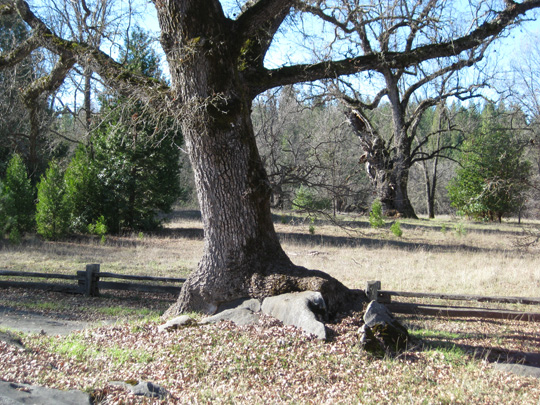
Every year about this time, when the days are mostly rainy or foggy, I find myself drawn to Indian Grinding Rocks Park, a gem of a state historical park in the foothills, east of Sacramento, and about eight miles east of Jackson.  At 2400′,  the skies are often blue in January, and green shoots poking up through the brown grasses hint at spring.

Grinding Rock Mortar Holes

The Miwok people called the place Chaw’se, meaning “grinding rock,” and camped here in the fall to gather and process acorns.  There are 1185 mortar holes on soft slabs of limestone where year after year the women pounded acorns into flour and meal while the men hunted, to lay in supplies for winter.  Petroglyphs are carved on the mortar slab, though some of them, estimated at 2000-3000 years old, are becoming faint.

An excellent museum displays arts, crafts, tools, and California tribal history.  Native American teachers demonstrate crafts like basket weaving and flint knapping on the second saturday of most months.  Native people use the reconstructed roundhouse for ceremonies at various times of the year, with the largest, the Big Time, at the end of September.  For several days, acorn harvest time is celebrated with native food, crafts, storytelling, and public dances during the day.  Tribal members hold privae ceremonies at night.

Chaw’se Roundhouse Entrance

Going in January is a great way to shake off cabin fever and simply enjoy the little valley, although it’s too early to get the full benefit of one of my favorite parts of the park, a self-guided trail along the creek and up a hillside, with markers for 18 plants the Miwok used for medicinal and other purposes.  Nothing is in yet in bloom, so aside from tree-based medicines like willow bark, there is no chance for real recognition.

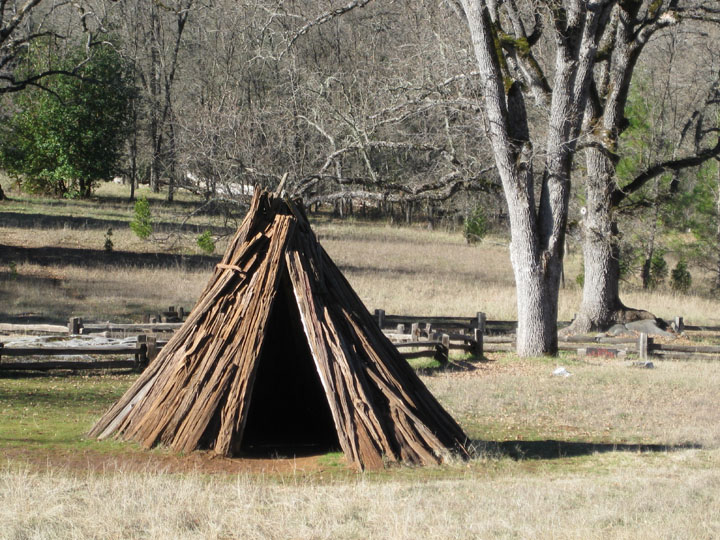
The park service has reconstructed the temporary bark structures the Miwok used during the acorn harvest.  A friend camped in one in the fall with a group of boy scouts and said the nights were really cold!

The elephant in the living room for all  California parks at this time is the impact of budget cuts in the wake of our fiscal crisis.  Hopefully Grinding Rocks, a living monument, will be spared from a dire  reduction of services, but anyone planning a visit, especially from far away, should call or check the website:   http://www.parks.ca.gov/default.asp?page_id=553

There are nice picnic facilities, but no concessions so you need to bring snacks at a minimum; the nearest town is three windy miles away.  A “primitive” campsite with 27 spaces overlooks the park; I’ve had friends drive up at the start of holiday weekends with no reservations and find room.

***

I have always found something compelling about winter in the California foothills, something plain or basic about the simplicity of sky, tree, and grass.  The abundance of foliage, humming insects – and crowds at a place like Chaw’se – will come later.  Now there is just the growing warmth of the winter sun, the voice of the wind, and a feeling of home that people have shared in this spot for thousands of years.

Good Grief – A Visit to the Charles Schulz Museum

Eleven years ago, in December, 1999, we managed to round up everyone and get to the mountains for Christmas. There was good health and good cheer in abundance, and we had an exceptionally nice holiday. One of my gifts was a watch with this picture of Snoopy and Woodstock, which I still have, and which still evokes the memory of family and dogs, together, warm, and happy.

Snoopy and Woodstock

The man who gave us Snoopy and Woodstock died six weeks after that Christmas, in February, 2000. When a long-planned museum opened in his home town of Santa Rosa, it instantly became a desired destination, one of those spots I “definately had to visit someday.” Funny how many trips of thousands of miles we took, perhaps because they seemed like real vacations, before getting to this gem in our own backyard.

Snoopy, Woodstock, and Me

The displays do a fantastic job of illuminating Schulz’s creative process. Anyone who has flipped through a Peanuts picture book has seen the evolution of drawing styles for Lucy, Charley Brown, and Snoopy, but this exhibit goes a lot farther. Schulz worked out ideas using doodles and notes, often on yellow legal paper, which he tossed. One secretary recovered these crumpled drafts from the wastebasket, took them home and ironed thm flat, and now several of them are displayed beside the published comic strips they inspired. We get to see themes, characters, and narrative styles that were tried and discarded, along with some of Schulz’s comments, like:  “That was a bust,” or, “If I’d known then…”  We really get to see how the Peanuts we know and love resulted from the fifty year struggle of a man with a lot to say in a very strict medium, who developed his own unique form of visual-verbal haiku.

Charley Brown outside the skating rink

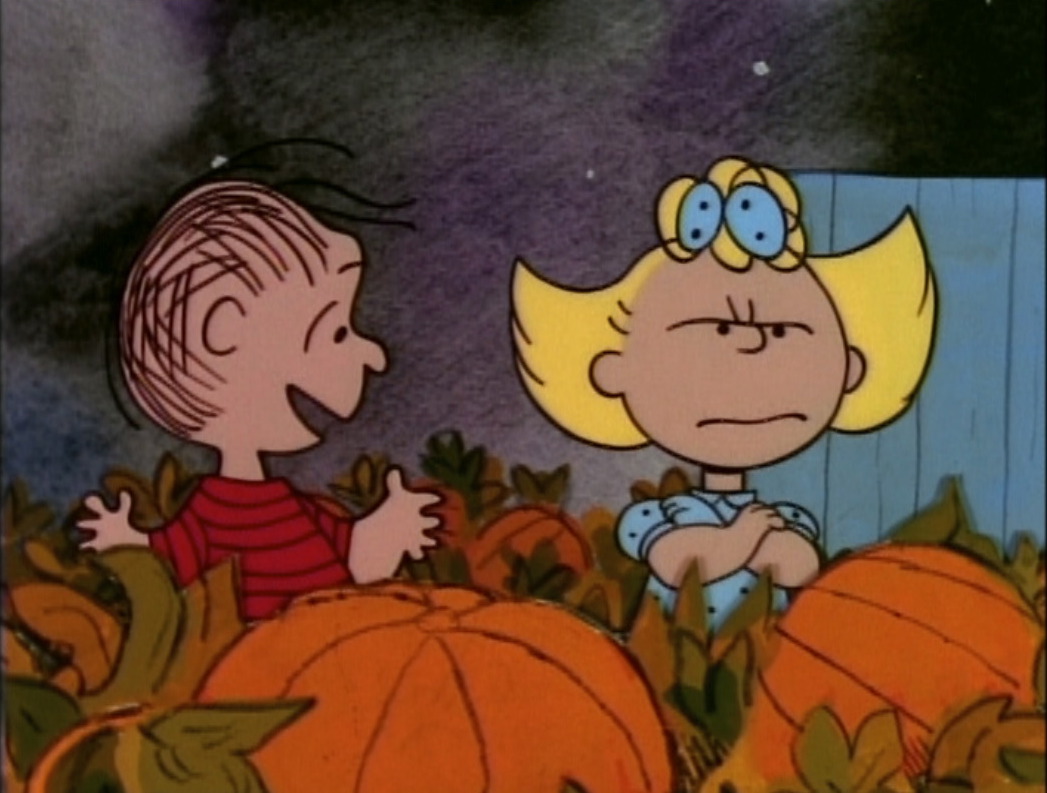
I just got up to fill my coffee cup and glanced out the kitchen window. How many rites of autumn have been forever shapped by Charles Schulz? Leaves. Football kickoffs. Hot chocolate. World series pitchers (GIANTS ROCK!!!!!!!). The eternal longing for the Great Pumpkin. And soon, our attention to the little orphan Christmas tree at the back of the lot, that nobody wants.

Waiting for the Great Pumpkin

One more hint if you visit:  the burgers at the Warm Puppy Cafe are exceptional, better than any fast food I can think of.  For those who can do it without breaking their necks, the attached ice skating rink is as fine as the rest of the facilities. 

Over by the door at the Warm Puppy is an empty table with a flower and a sign that says, “Reserved.” That is where Charles Schulz sat for lunch, where he watched the skaters and people passing outside. Where he dreamed and dreamed up a humble little comic strip that did things the medium hadn’t done before, and is still as much a part of starting the day as coffee.
http://www.schulzmuseum.org/

Of Words and Wolves: Thoughts on Jack London

By the end of grade school, I knew, or sensed, that vast forces – parents, teachers, and church – were arrayed against me in a vast conspiracy to civilize me. My relationship with them had become one of wariness and secrets. I had friends of course, but after changing schools fairly often, I regarded friendship as a tenuous thing, subject to disruption at any time. I tended not to get too close to anyone.

My one constant companion was Ranger, the German Shepherd I had grown up with since the age of six. Once, alone in the woods in my coonskin hat, something exploded out of the brush at my back – a buck, with Ranger at his heels. The twentieth century vanished. We were back in the era when Daniel Boone would pack up and move when things got so crowded he could see the smoke of a neighbor’s chimney.

By the sixth grade, there weren’t any woods. We had moved from rural New York to the San Jose suburbs, where you had to look hard to find a decent tree to climb. Ranger hadn’t fared well either – he grew listless in our little fenced in yard, and within a year, developed a tumor. We put him down when he was six.  I was on my own and largely clueless.  And then, something wonderful happened.

They used to bring carts of inexpensive books into the sixth grade class, and one day I spent my lunch money on a paperback because the dog on the cover looked like Ranger. I hadn’t heard of Jack London or Call of the Wild, and though I loved to read, I didn’t yet know how deeply an author could speak to your soul.

For several years I followed Jack London through his dreams of silent forests, solitary men, dogs, and wolves.  I read everything of his I could find, but especially his tales of the Klondike – Call of the Wild, White Fang, and the collected of stories.  This past week I finally got to visit Jack London State Park and learn much I didn’t know about this author.  I didn’t realize what a toll his various adventures took on his health.  During his year in the Klondike, he:

” developed scurvy. His gums became swollen, leading to the loss of his four front teeth. A constant gnawing pain affected his hip and leg muscles, and his face was stricken with marks that always reminded him of the struggles he faced.” http://en.wikipedia.org/wiki/Jack_London

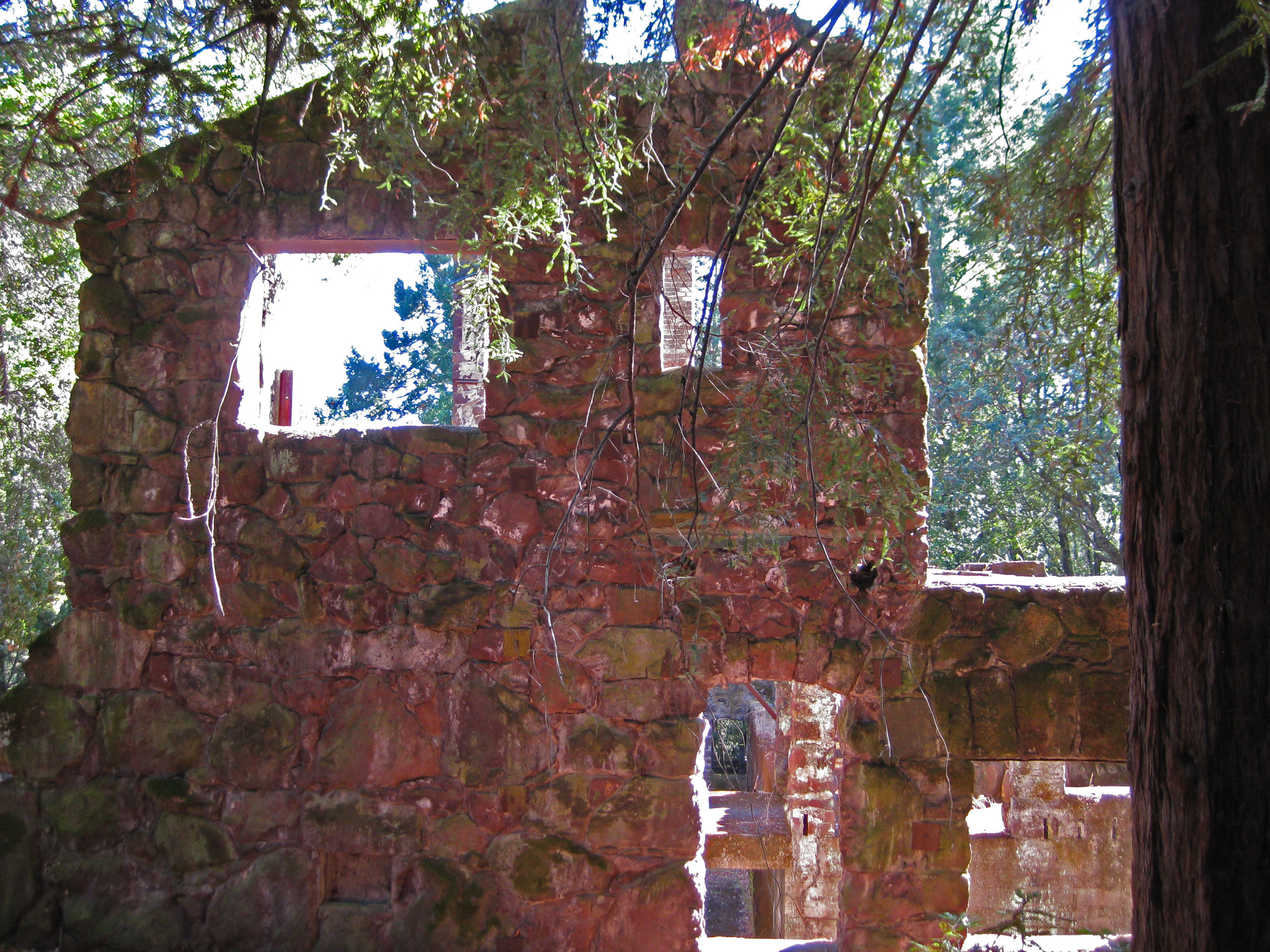
London tried to live out the dream of sailing to tropical islands.  He built a ship, the “Snark,” to carry him and his second wife, Charmian, on a seven year, round the world voyage.  Instead, plagued by mechanical problems with the ship, and health problems of his own, London sold the “Snark” after 27 months.  That was one of his heartbreaks.  http://www.parks.sonoma.net/JLStory.html Another was the miscarriages that prevented him and Charmian from having children.   A third was the fire that destroyed “Wolf House,” the 27 room, rustic mansion he and Charmain were building, at a cost of $80,000 pre-WWI dollars.  The house was nearly complete, and London remained severely depressed after its destruction.


Wolf House Ruins


In addition to these travels, London was constantly on the go. He’d been a war correspondent twice, had an active social life, tried unsuccessfully to make his ranch profitable, and wrote more than 50 books. For long stretches, he slept only 4 or 5 hours a night. His flesh could not keep up with his spirit, and he died in November, 1916, at the age of 40. The certificate lists the cause of death as uremic poisoning, complicated by hepatitis and kidney problems. The morphine he took for the pain of his other conditions apparently played a part, and though there was talk of suicide at the time, most historians now agree that if there was an overdose, it was accidental.  His correspondence and papers were always full of plans and projects for the future – his dreams were far bigger than his human capacity.


OF JACK LONDON’S WOLVES.


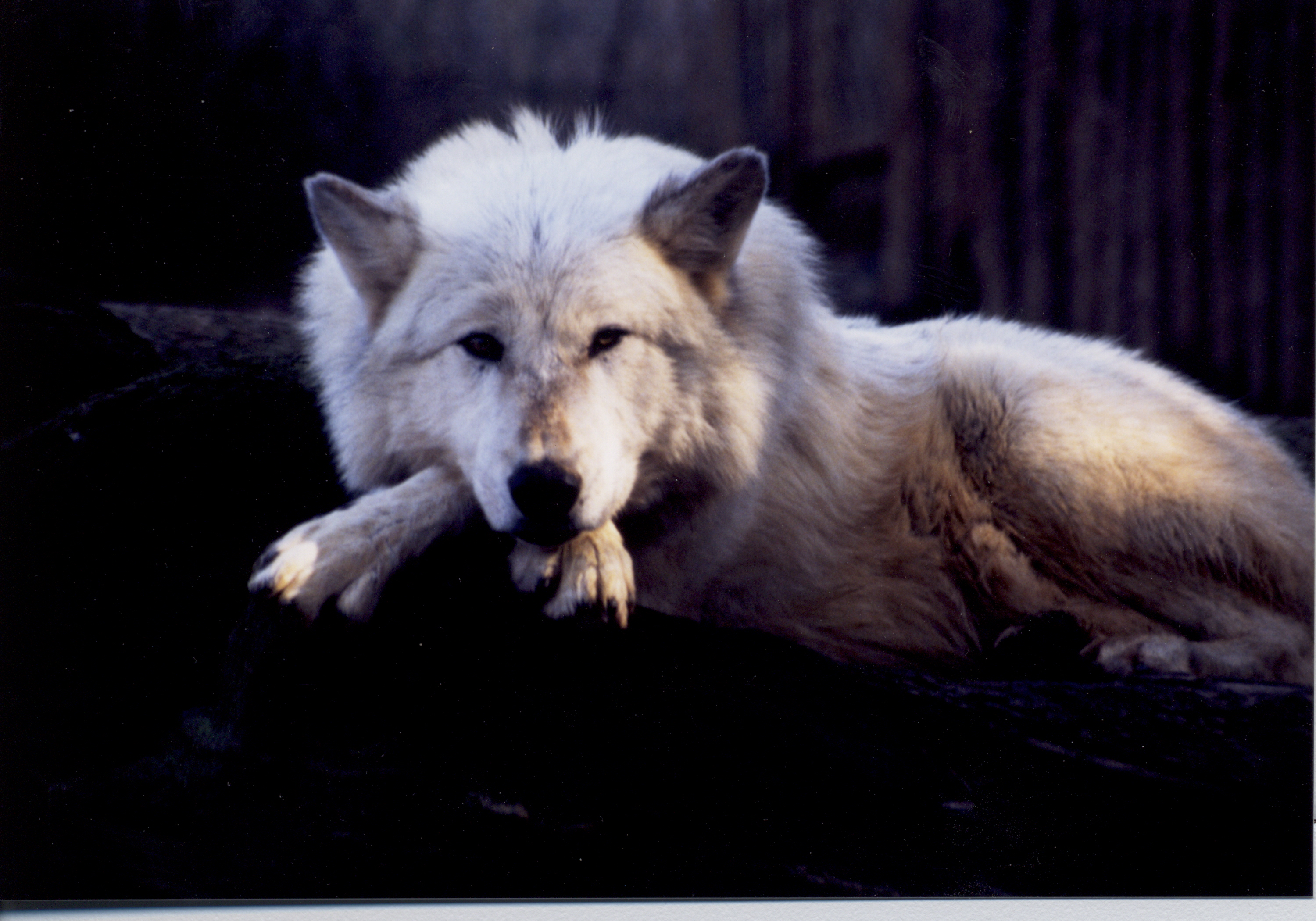
Sage at the Folsom City Zoo, ca. 1994


His best friend called him “Wolf.”  He named his dream home, “Wolf House.”  James Dickey notes how closely London identified with his totem animal, and says:

The reader should willingly…conjure up the animal in the guise of the mysterious, shadowy, and dangerous figment that London imagines it to be. We should encounter the Londonian wolf as we would a spirit symbolic of the deepest forest, the most extremely high and forbidding mountain range, the most desolate snowfield: in short, as the ultimate wild creature, supreme in savagery, mystery, and beauty.” – (Dickey’s intro to the Penguin edition of The Call of the Wild, White Fang, and Other Stories_

The “reality” of wolves as observed by biologists is very different, and Dickey says:

The mythic wolf that London “found” in his single winter spent…in the Klondike Gold Rush…bears in fact little resemblance to any true wolf ever observed. In studies…the wolf emerges as a shy and likable animal with a strong aversion to fighting. There is no evidence that any wild wolf has ever killed a human being in North America.

Reality and Truth can appear in different places depending on where and how we look for them. I don’t think I would have stayed up late as a kid – the old flashlight under the blanket trick – to read stories of lost trappers whose fires burn low while packs of shy, likable, creatures pace the perimeter.

Besides, it is the fact that wolves, like dogs, can accept humans as members of their pack, that allowed me to bond with several wolves when I was a volunteer at the Folsom City Zoo Sanctuary.  This was a marvelous opportunity I stumbled into – right place at the right time – and I often thought of Jack London, and imagined it as an inoculation of wildness – I got my fix without having to risk scurvy on the tundra.


A kiss from Redbud, a wolf pup, ca. 1996


OF JACK LONDON’S WORDS

Sometimes a degree of sophistication is a real pain in the ass.  I’d long lost my copies of Jack London’s books, so I picked up a collection on our visit.  I sat back that evening and looked at some of the stories, and noticed things I never saw as a kid:  in George Orwell’s words, “the texture of the writing is poor, the phrases are worn and obvious, and the dialog is erratic.” Yep – the agents at any writing conference would hammer him today.  And yet…

“The key to London’s effectiveness is to be found in his complete absorption in the world he evokes.  The author is in and committed to his creations to a degree very nearly unparalleled in the composition of fiction.  The resulting go-for-broke, event-intoxicated, headlong wild-Irish prose-fury completely overrides a great many stylistic lapses and crudities that would ordinarily cause readers to smile….Once caught in London’s swirling, desperate, life-and-death violence, the reader has no escape.” – James Dickey.

Fifty of Jack London’s stories and books have been made into movies. I’m not sure that can be said of any other author, let alone one whose youth was spent in abject poverty, and whose life was over at 40. And even those facts pale when the sight of a cold winter moon, or the scent of a pine, or the yip of a coyote in the distance sends shivers down the spine and spins you off, just for a moment, into arctic dreams.


Grave of Jack and Charmian London
 

Lighter Than Air

It was one of those things we had always wanted to do. I had witnessed the huge balloon festival in Albuquerque, and vaguely thought, “Well, next time we go to New Mexico…” Then Mary discovered balloon tours in Santa Rosa and called up Wine Country Balloons.   http://www.balloontours.com/

So one mid-October morning, we were up at 5:30 to meet the crew and other passengers for a winding drive of 45 minutes or so in the dark to get out of the fog.  Just after sunrise, we came to a field where another group was inflating their balloon.  “Do you know why we take off early?” Scott, the pilot, asked. No one did. “So we’re done by the time the wineries open, of course.”

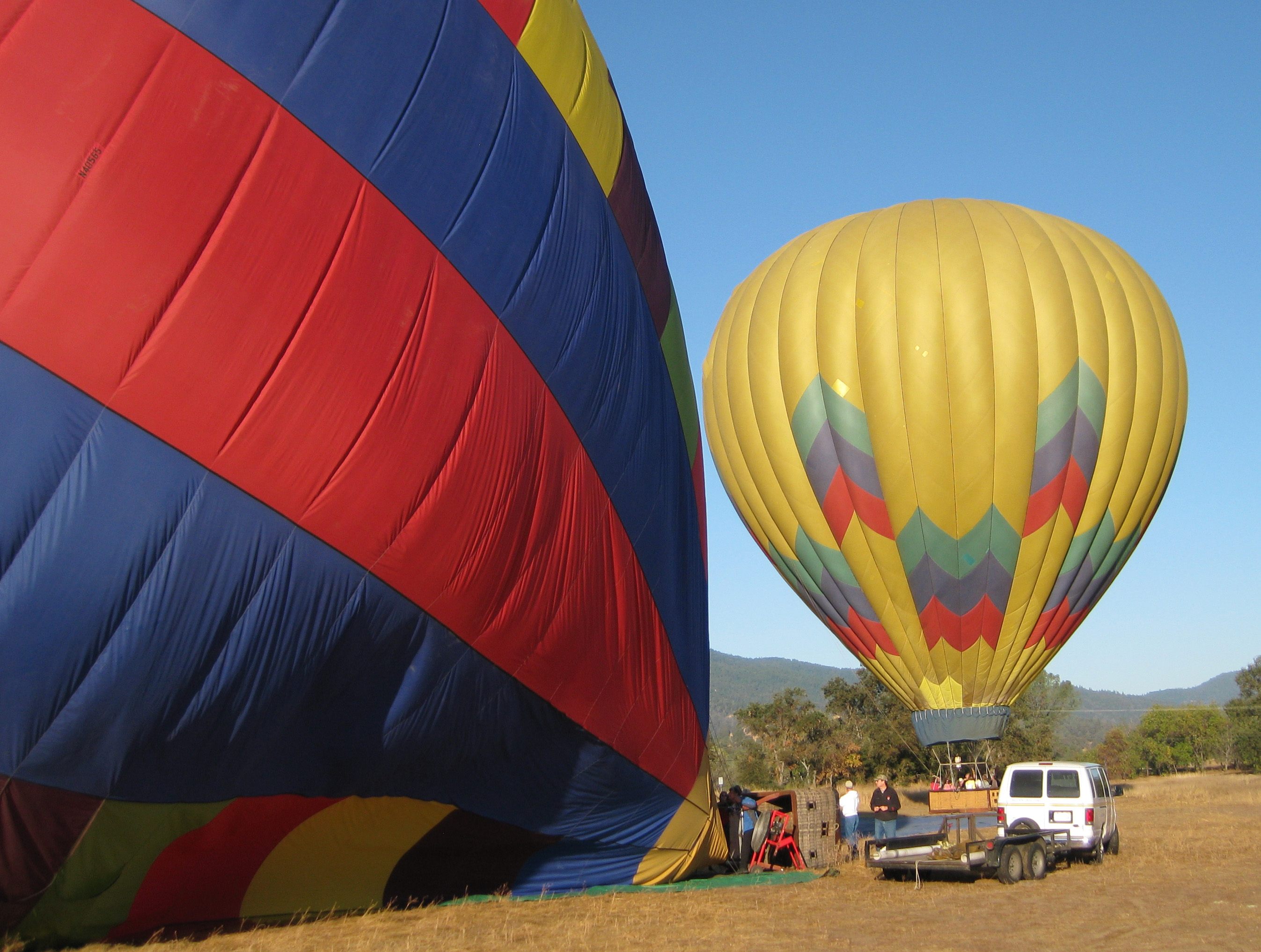
Balloon "envelopes" spread out in a field. The one behind Mary starts to inflate.

He did supply an alternative explanation for the scientifically minded among us – that the colder, denser, molecules outside the balloon push the lighter, heated ones inside, and this causes the lift, the way dense water molecules push an inflated beach ball to the surface.   The colder the outside air, the easier it is to gain altitude.

Using a generator and a large fan to inflate the envelope.

First ballon almost ready to go as ours expands.

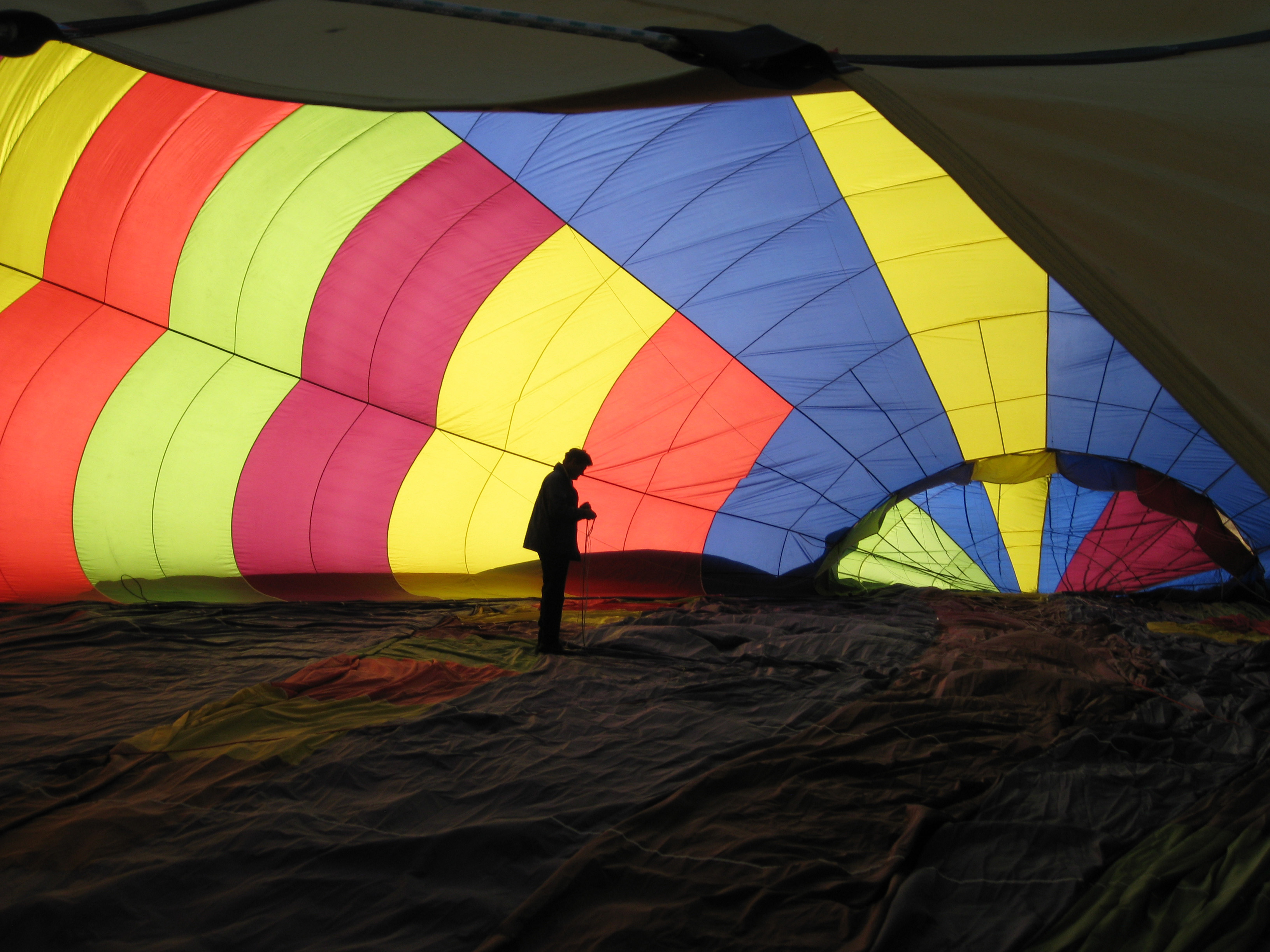
The pilot, checks cables inside the expanding envelope.


Gaining altitude lifts you into wind currents flowing at different speeds in different directions, and one of the disclaimers was, there are no guarantees on what we’ll find or where they will take us. “I can influence the outcome but not control it,” Scott said. “Which isn’t a bad metaphor for life itself.”

Scott, far right, fires the burners.  Liftoff is immanent.

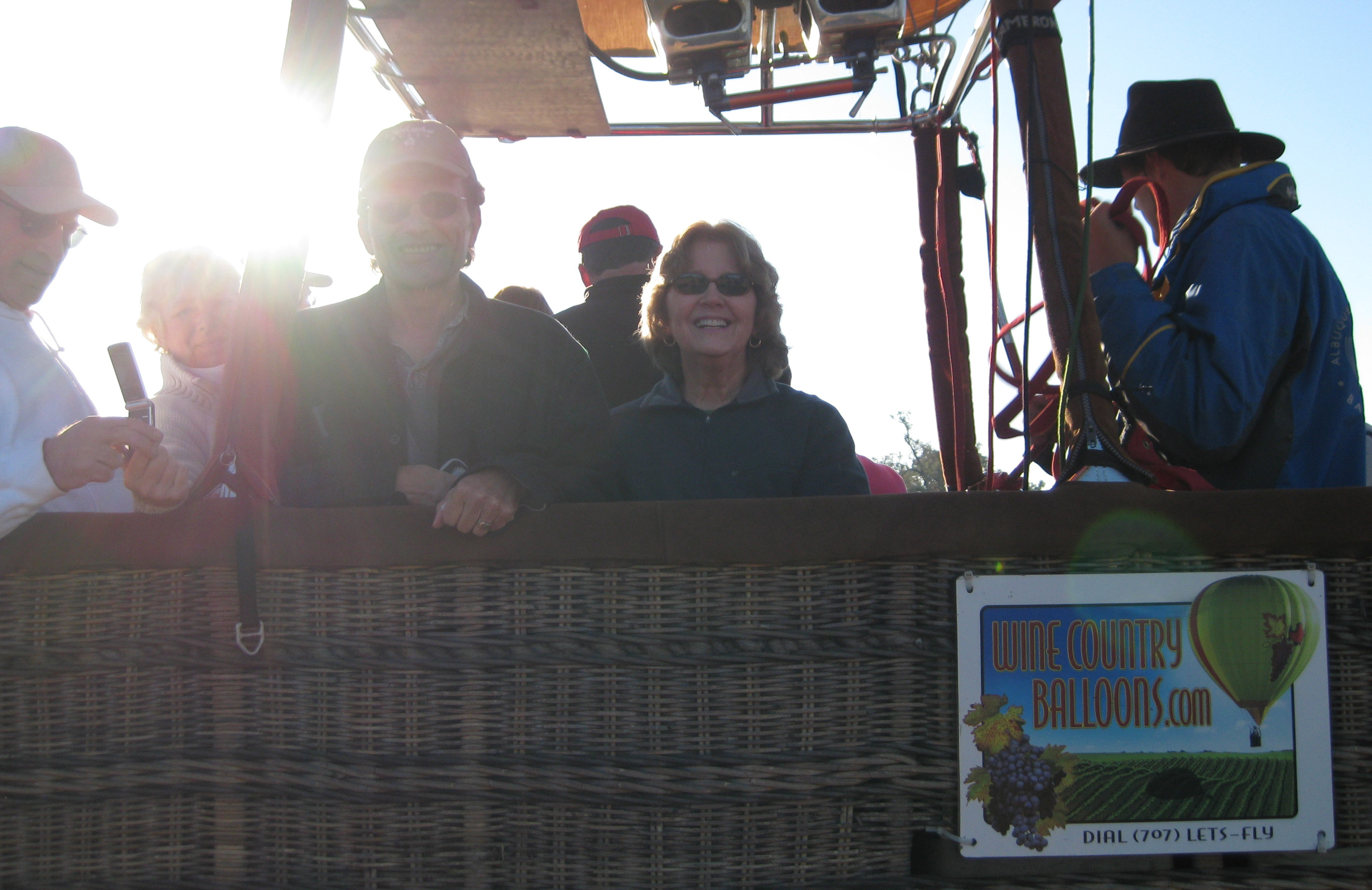
Mary and I mug for the camera, as Scott, far right, fires the burners for liftoff

You don't feel the wind while it carries you.

No one spoke much during the flight. Have you ever been drawn into the blue of the sky from a plane window? Much more so in this experience.

The shadow of our balloon in the foreground, another balloon in the distance

Given my own mindset, I really, really got why “space” is the image most often used to describe the indescribable “mind of clear light” that Buddhists hold to be our common core of awareness.

We rode until the cows came home

The first hot air balloon flight, in France, was witnessed by Louis XVI, Marie Antoinette, and Benjamin Franklin who was at the French court that day. The 20 minute voyage resulted from the experiments of a pair of paper-makers, and was celebrated with champagne. Scott related this piece of history after the ride back to town for a champagne brunch. Balloons and champagne have gone together since day one – and no one had any objections.