Full Faith and Credit: a personal story and parable.

My wife and I got married in Santa Fe in 1976.  We didn’t have a lot of money, but our mothers were gone and our families and friends were on the coasts, so there would only be eight in the wedding party.  We arranged to have the reception and put everyone up at the lodge in a nearby national monument.

I worked in a printshop that had been one of the finest in town.  We still did brochures for the Santa Fe Opera, but signs were clear that the glory days were over.  A husband and wife team had started the shop, but they divorced, and with only one of them running the business, glitches appeared in the billing system, the revenues, and the payroll.  About the time we booked the rooms and locked in arrangements, my paychecks started to bounce.

The pressmen and I started cashing our checks at grocery stores and the boss’s bank, since our own banks charged fees for deposits that bounced.  The day before the wedding, a teller said, “I’m sorry, I can’t cash this check.  Your employer’s account is $1000 in arrears.”

“Please,”  I said.  “We’re getting married tomorrow, and we have to pay the caterers.  If they’re $1000 in the hole, what does another $150 matter?”

She bit her lip and scrunched up her eyebrows, then smiled, and handed me the cash.  “Congratulations!” she said.  “Have wonderful wedding day.”

Crisis narrowly averted.  But

Do you think I ever put my faith in that employer again?

Do you think other nations will put their faith in United States credit again?

I’ll answer the first question.  We set about saving money to move back to California where economic prospects were better.

I don’t know the answer to question number two, but I do know that trust takes time to build and is easy to squander…

Stranger in a strange (and beautiful) land

Retreat house dining room, Skalholt, Iceland

Retreat house dining room, Skalholt, Iceland

This post was sparked by todays WordPress Daily Prompt, “Blogger in a Strange Land,” which asked, “What is the strangest place from which you’ve posted to your blog?”  My answer was easy:  the dining room of the Skalholt Retreat House in Iceland, where Mary and I and a small group of storytellers spent an amazing week just over a year ago.

If you search here on “Iceland,” you’ll find an account of the trip, photos, and a detailed discussion of Njal’s Saga, which was central to our purpose in traveling.  This post concerns the dining room.

Those are real grapevines and bougainvilleas twining through the rafters under the skylight.  Through the windows you see the autumn colors of a hedge and beyond that, fog.  It was late morning when this picture was taken, probably 40 degrees Fahrenheit  outside.  Imagine how inviting it was to sit with a cup of coffee and write in this bright room where it was warm enough for grapes, and flower petals sometimes drifted onto the table.

Guesthouse, Skalholt

Guesthouse, Skalholt

“Strange” can happen anywhere, but it’s always by one’s side when traveling.  When we leave our familiar contexts behind, there’s a chance to peek around corners and see things that day-to-day vision too often misses.

“Fare forward, travelers!  not escaping from the past
Into different lives, or into any future;
You are not the same people who left that station
Or who will arrive at any terminus” – T.S. Eliot

The Four functions of a living myth and the evening news

In The Masks of God: Creative Mythology, 1968, Joseph Campbell identified four major functions of a “living myth:”

1) ” To awaken and maintain in the individual an experience of awe, humility, and respect in recognition of that ultimate mystery, transcending names and forms.”
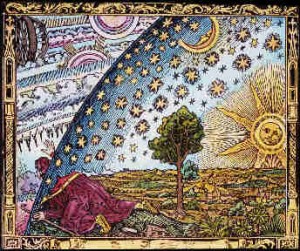
CC By-NC-ND-2.0

CC By-NC-ND-2.0

2) “To render a cosmology, an image of the universe.”  Today, Campbell notes, we turn to science for this.

Andromeda galaxy.  Nasa photo, public domain

Andromeda galaxy. Nasa photo, public domain

3) To shape “the individual to the requirements of his geographical and historically conditioned social group “
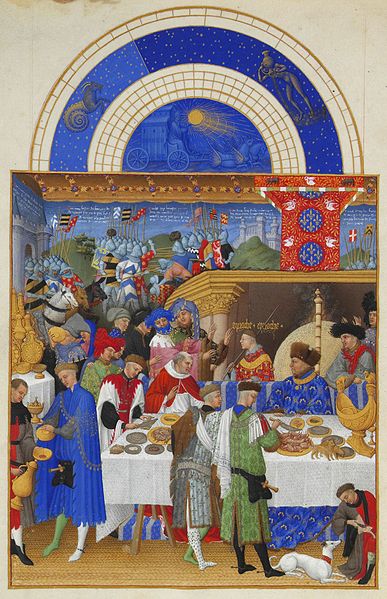
January from Les Très Riches Heures du duc de Berry, 15th c., public domain.

January from Les Très Riches Heures du duc de Berry, 15th c., public domain.

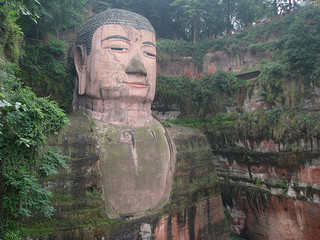
4)  “to foster the centering and unfolding of the individual…in accord with himself, his culture, the universe, and that awesome ultimate mystery.”

Leshan Giant Buddha, 2010, by Wilson Loo.  CC BY-NC-ND 2.0

Leshan Giant Buddha, 2010, by Wilson Loo. CC BY-NC-ND 2.0

Forty-five years ago, when conflict during the sixties was rending the social cohesion Americans had forged during WWII, Campbell wrote:  “The rise and fall of civilizations in the long, broad course of history can be seen to have been largely a function of the integrity and cogency of their supporting canons of myth.”

A mythological canon, said Campbell, is a group of symbols that “organize and focus the energies of aspiration.”  When the symbols no longer work for an individual, there is “dissociation from the local social nexus,” and, “if any considerable number of the members of a civilization are in this predicament, a point of no return will have been passed.”

In Creative Mythology, Campbell wrote at length of an earlier period of time when a different mythical canon broke down.  In 12th century Europe, Christianity ceased functioning as a socially cohesive world view.  Enough people stopped believing (even though belief was strictly enforced) that Europe went beyond the point of no return.

Many stories emerged during that era concerning the quest for the grail, which in the earliest written versions, had nothing to do with cup of the last supper, but everything to do with a quest to heal individuals and the land.  In Wolfram Von Eschenback’s Parzival, the grail was called lapis exiles, another name for the philosopher’s stone of alchemy.  The philosopher’s stone turns base metal into gold; the grail heals the wasteland, for that is what a country and culture become where there is a drought of aspiration and meaning.
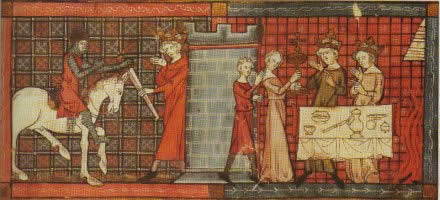
Scenes from Perceval's quest of the grail, 1385-1390.  Public domain

Scenes from Perceval’s quest of the grail, 1385-1390. Public domain

That is where we are in America today.  In the absence of a shared core of attitudes and beliefs to unify us as a people, we are a nation of warring factions at all levels of culture and government.  For now, the party is over in the land of opportunity.  Even if our politicos won’t admit it, a “considerable number of members of our civilization” know this is true.

Campbell ended Creative Mythology by asking what might feature in a new and vital mythology.  In my opinion, he dithered with his answer, as he sometimes did in his writing.  Twenty years later, he answered the same question when it was posed by Bill Moyers at the end of the Power of Myth series.  This time Campbell suggested that any world view adequate to our times and our future would have, as a mandala, a view of the earth from space.

Earth from space

Neither Campbell nor one else back then knew the full extent of the danger climate change would pose.  Now we know it’s worse than anyone thought, (see the Intergovernmental Panel on Climate Change report, released Sept. 27).  Our governments are as impotent as the wounded Fisher King of the grail legend when it comes to enacting meaningful change.

Yet as Campbell said, the quest for the grail of healing begins with individual searchers venturing into the forest alone, at the place that seems best to them.  Like Nelson Kanuk, a University of Alaska freshman, whose home in a remote Eskimo village was swallowed by the sea as a result of melting permafrost.  Kanuk sued the state of Alaska for not curbing carbon emissions and his case is now being heard by the Alaska Supreme Court.  Similar suits are pending in 12 other states.  Such headlines echo words I recently quoted by Wendell Berry, who puts his trust in “ordinary people” and said:

We don’t have a right to ask whether we’re going to succeed or not.  The only question we have a right to ask is what’s the right thing to do? What does this earth require of us if we want to continue to live on it?”

We don’t even have to rush out and sue our state governments, for as Campbell suggested, stories and world views spark action and change when a critical mass is reached.  Hopefully, we are at or beyond that point. All we, as individuals, have to do is be still enough to hear what the world is asking of us, and then enter the forest at the place that seems best.
Things you may not know about Winnie- the- Pooh

When I was young, I loved Winne-the-Pooh. There was a time when I carried my little volume – illustrated by Shephard, of course – everywhere. This fine article was posted on “The View from Sari’s World” on August 21, Christopher Robin Milne’s birthday. It’s filled with interesting facts about the historical Pooh and Christopher Robin, as well as the real Hundred Acre Wood and Poohsticks bridge. Enjoy!

sarij's avatarThe View From Sari's World

Christopher Robin Milne was born on August 21, 1920, so what better day to celebrate the world’s favorite bear!

Winnie-the-Pooh is unarguably one of the most recognizable characters in children’s literature, as are his friends: Christopher Robin, Piglet, Eeyore, Tigger, Rabbit, Kanga, Roo, and Owl. Generations of children (including my own) have loved Winnie-the-Pooh, the Best Bear in All the World.  To celebrate the birthday of the little boy Christopher Robin Miline and his favorite toy I give you:

Things you may not know about Winnie- the- Pooh

Winnie -the- Pooh was the name of the “Bear of little brain” in the stories created by A.A. Milne. A.A Milne’s son Christopher had a teddy bear who Winnie the Pooh was created after. He named his teddy Winnie after a Canadian black bear he saw at the Zoo in London. The real life bear was actually from the town of Winnipeg…

View original post 602 more words

Wendell Berry on His Hopes for Humanity

“It’s mighty hard right now to think of anything that’s precious that isn’t endangered.” – Wendell Berry

Wendell Berry by Lou Gold, 2012.  CC BY-NC-SA 2.0

Wendell Berry by Lou Gold, 2012. CC BY-NC-SA 2.0

Wendell Berry, 79, is a poet, farmer, and author of 40 books.  He is also an outspoken advocate and activist for a radical change in our treatment of the earth.  “We don’t have a right to ask whether we’re going to succeed or not,” he says.  “The only question we have a right to ask is what’s the right thing to do? What does this earth require of us if we want to continue to live on it?”

In a rare TV interview with Bill Moyers released on October 4, this gentle poet, who works a Kentucky farm that has been in his family for 200 years, reveals the fire of his determination.  Speaking of recent demonstrations against mountain top strip mining, which poisoned Kentucky rivers, Berry said,  “This is intolerable. There’s no excuse for it…there’s no justification for the permanent destruction of the world.”

I invite everyone to watch this brief trailer and if interested, tune into the full interview, or read the transcript here:  Wendell Berry on his hopes for humanity

Berry is eloquent in denouncing the “disaster of being governed by the corporations,” and he speaks of both the importance and the difficulty of holding onto hope.  He finds hope in the growing number of people who share his views and in his certainty that the present order of things cannot last because it runs counter to “creation itself.”  He also puts a lot of hope in “ordinary” people choosing to do the right thing.

There’s a eloquence in Wendell Berry’s interview, and there’s an equal eloquence in this poem, which fills me with hope and a sense of the love he feels for the forests and fields, the river and animals – the whole of creation – which he has spent a lifetime defending.

Manifesto:  The Mad Farmer Liberation Front
by Wendell Berry

Love the quick profit, the annual raise,
vacation with pay. Want more
of everything ready-made. Be afraid
to know your neighbors and to die.

And you will have a window in your head.
Not even your future will be a mystery
any more. Your mind will be punched in a card
and shut away in a little drawer.

When they want you to buy something
they will call you. When they want you
to die for profit they will let you know.
So, friends, every day do something
that won’t compute. Love the Lord.
Love the world. Work for nothing.
Take all that you have and be poor.
Love someone who does not deserve it.

Denounce the government and embrace
the flag. Hope to live in that free
republic for which it stands.
Give your approval to all you cannot
understand. Praise ignorance, for what man
has not encountered he has not destroyed.

Ask the questions that have no answers.
Invest in the millenium. Plant sequoias.
Say that your main crop is the forest
that you did not plant,
that you will not live to harvest.

Say that the leaves are harvested
when they have rotted into the mold.
Call that profit. Prophesy such returns.
Put your faith in the two inches of humus
that will build under the trees
every thousand years.

Listen to carrion — put your ear
close, and hear the faint chattering
of the songs that are to come.
Expect the end of the world. Laugh.
Laughter is immeasurable. Be joyful
though you have considered all the facts.
So long as women do not go cheap
for power, please women more than men.

Ask yourself: Will this satisfy
a woman satisfied to bear a child?
Will this disturb the sleep
of a woman near to giving birth?

Go with your love to the fields.
Lie down in the shade. Rest your head
in her lap. Swear allegiance
to what is nighest your thoughts.

As soon as the generals and the politicos
can predict the motions of your mind,
lose it. Leave it as a sign
to mark the false trail, the way
you didn’t go.

Be like the fox
who makes more tracks than necessary,
some in the wrong direction.
Practice resurrection.

Friday is World Animal Day

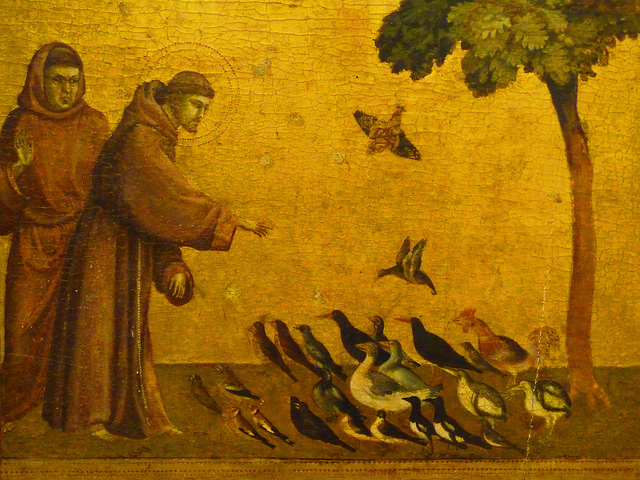
Saint Francis and the birds, by Giotto.  CC BY-NC-ND 2.0

Saint Francis and the birds, by Giotto. CC BY-NC-ND 2.0

“The greatness of a nation and its moral progress can be judged by the way its animals are treated.” – Mahatma Gandhi

October 4 is the Feast Day of Saint Francis, renowned for his love of animals. In 1931, a group of ecologists meeting in Florence, Italy, chose this date as World Animal Day to highlight the plight of endangered species.  Since then it has grown to a world wide day of celebration of animals by people who love them in all nations and religious traditions.

The Singapore SPCA held a three day celebration in September, with a theme of “Friends for Life.”  The Moscow Zoo is holding its celebration of Saturday.  World Animal Day celebrations are scheduled in Pakistan, India, Indonesia, Jordan, Dubai, France, Britain, Sweden, Bosnia and Herzegovina, the US, Canada, Serbia, Greece, Bolivia, Chile, Australia, the Ukraine, Palestine, Gambia – and these were just locations listed on a single website.

A revered Tibetan Buddhist teacher, Lama Zopa Rinpoche, urges his students to pray for the wellbeing of animals on October 4, and recite mantras to bring them auspicious rebirths.  If one is looking for a pet, he says, it’s a perfect day to visit a shelter and adopt, or adopt an animal via a contribution to an organization that benefits them.

Friday is a wonderful day to notice and appreciate the birdsong in the morning, the hawk in the noontime sky, and the creatures who bring so much to our lives.  What would our world be like without them?

Kit and Missy smiling

Ship of Fools

Ship of Fools.  German woodcut, 1549

Ship of Fools. German woodcut, 1549

I’m sure it won’t surprise anyone to learn that this is my second post of this title in two years.

“The ship of fools is an allegory that has long been a fixture in Western literature and art. The allegory depicts a vessel populated by human inhabitants who are deranged, frivolous, or oblivious passengers aboard a ship without a pilot, and seemingly ignorant of their own direction.“Wikipedia

The Wikipedia entry documents the origin of this image in a method that Renaissance people developed to rid themselves of their mentally challenged fellows.  As Michel Foucault put it in Madness and Civilization, “they were put on a ship and entrusted to mariners because folly, water, and sea, as everyone then ‘knew’, had an affinity for each other.”

OK, I gotta say it – don’t you wish we could send all members of the Federal government off on a Carnival cruise and hope the engine stalls at sea?

“Ship of Fools” has been a recurrent image in literature, art, and music for 500 years.  Somehow it’s comforting to to know that folly and madness are nothing new, even – or perhaps especially – at the helm of the Ship of State.