
The Dalai Lama on happiness
Image
3
Here’s some nice info to pass on. I’m already a fan of Paul Newman salad dressings and popcorn, and it’s great to hear of garments made in America once again. I like the idea of socially responsible funds too, though once when I looked at them (sometime ago) I discovered they trailed index funds in their returns. Many things have changed since then, but you’ll want to investigate or check with a financial advisor. At any rate, it’s great to hear of opportunities to shop with conscience.
It’s human nature to want to buy stuff…more and more stuff. That being said, why not try to buy from socially responsible companies? Many companies donate a percentage of their sales to charity (for example, Paul Newman’s company has donated over $400 million to charities since 1982 from the sale of grocery items.
A new company, Fed By Threads, specializes in Made-In-America organic ethical vegan clothing that feeds 12 emergency meals to hungry Americans via foodbanks per item sold. The company’s founders, Jade Beall and Alok Appurdurai, created the company when they learned about the tremendous suffering that sheep, silkworms, cows, goats and other animals experience in the production of clothing. They also are firm believers in paying fare wages to garment workers and in keeping these jobs in America.
Also, the number of socially responsible / sustainable investment mutual funds has grown over the years. Some lend money…
View original post 50 more words

“Don’t let reality control your imagination. Let your imagination be the user interface to steer your reality.” – Scott Adams.
How to Fail at Almost Everything is a quirky, funny, irreverent, and often inspiring “sort of autobiography” from the creator of Dilbert, that quirky, funny, irreverent, and often inspiring comic strip that lays out the truth of working in the trenches cubicles of corporate America.
This is not another collection of Dilbert cartoons or Dilbert philosophy. It’s more of a Dilbert origin story. We know we’re in for a different kind of kind of how-to-book when Adams begins by advising us to make sure our bullshit detectors are working before we take advice from a cartoonist.
He dismantles many self-help cliches in order to clear the way for fresh perspectives. “Goals are for losers,” he says, and recommends strategy instead. “I will finish my first novel,” is a goal. “I will write for an hour a day,” is a strategy. Every day we don’t attain a goal is slightly depressing, he says, and soon after we reach it, the “what next?” question arises. A strategy, on the other hand, brings a daily sense of satisfaction as we move in the right direction.
“I tried a lot of different ventures, stayed optimistic, put in the energy, prepared myself by learning as much as I could, and stayed in the game long enough for luck to find me…with Dilbert it did.” – Scott Adams
Adams gives a chronology of his many failed careers and entrepreneurial ventures. Shining through the story is a positive attitude that allowed him to find key lessons and life experience in every failure. His optimism is gold, and he spends a lot of time writing of health, especially, diet and exercise, although he cautions that there is a “non-zero chance” that health advice from a cartoonist could be fatal.
“I’m here to tell you that the primary culprit in your bad moods is a deficit in one of the big five: flexible schedule, imagination, sleep, diet and exercise.” The “big five” benefit mood, which builds personal energy, which is the driver of aspiration and effort.
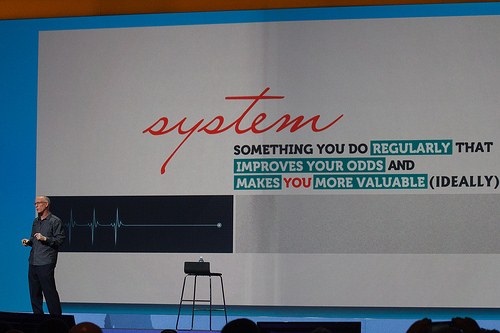
Scott Adams shares his ideas at IBM Connect 2014. Photo by Greyhawk68, CC BY-NC-ND 2.0
Adams packs an abundance of topics into his book. Not every one resonated, and several dragged for me, but much of my copy is highlighted and underlined, and I’ve reread several chapters already. If you like Dilbert, you will value this story of the life twists and turns of his creator, and you will benefit from the lessons he learned along the way.

by all means A ZEN CAUTIONARY TALE
“Growing up meant you were competent and stayed out of trouble…When you hit the wall, who or what would see you through?”
Traditional Zen practice is both very simple and very formal. Think of classic Japanese brush painting. In Zen, there are prescribed ways of bowing, walking, holding the hands in meditation, and so on.
At the end of by all means A ZEN CAUTIONARY TALE, Zen abbot, Edward Espe Brown, includes a photograph of himself, in full Zen regalia, with a stern expression on his face, and a pig puppet on a cushion beside him. Traditional Zen masters don’t give dharma talks with pig puppets any more than traditional authors use upper and lower case in their titles like Brown does here. by all means lies outside traditional book categories, which ironically, makes it very Zen.
When Edward, as an adult, rescues Ponce (two syllables) the Pig puppet from a cat named Turtle (not a puppet), his affection for Ponce allows him to explore many issues, especially those of abandonment: how others abandon us, how we abandon them and ourselves, and all the things we do to try to compensate:
“A lot of things that Edward did were very important because it was important to him to be doing important things and not just wasting his time. Otherwise how could he have any respect for himself? And wasn’t it important to be self-respecting? Because if you left it to the others, there didn’t seem to be a lot of respect going around, and you weren’t likely to get much.”
We learn how Edward lived in an orphanage after his mother died when he was three. We learn how he turned his anger on the stuffed animals he had as a kid after he got out. We see how childhood issues live on inside the adult and how Ponce the Pig reacts at a critical moment, when Edward abandons him. At first Ponce weeps, but then he closes his eyes to meditate (the pig is a dedicated Dharma practitioner):
“He found his heart swelling even though nothing changed outwardly. The space within was like that: vast and expansive, warm and tender without dimensions. All of his friends were gathering just as fast as he could think of them. A burst of astonishment flashed through Ponce. Left without any capacity for thinking about what was happening, he was one with everything, and everything was a part of him. No separation could be found. Dazzling! What was there to think about? Nothing needed figuring out…” Edward learns his lesson and reconciles with Ponce in the end because it’s that kind of a book.
I enjoyed by all means, but it’s not for every reader. It is not an instruction manual in Zen or a book of eastern philosophy. If you have no interest in Zen or have not spent time talking to puppets as I have, the book might not appeal.
If you are in doubt, I suggest you check out some of the Dharma talks Edward has made available on his website. If you like them, you’ll probably like the book. The talks, like this book, are simply another way that Edward, with abundant humor and compassion, tells his truths, using all means.

Edward Espe Brown
Saturday was the fourth time in as many years that I’ve attended a daylong retreat with Edward Espe Brown, Zen abbot, author, cook, and altogether a charming and extremely funny man. In 1965, Edward became a student of Shunryu Suzuki Roshi, author of Zen Mind, Beginner’s Mind. When his teacher founded the Tassajara Zen Center near Big Sur, Ed became the head cook (as an author, he is best know for the Tassajara Cookbook and the Tassajara Bread Book).
Much of his learning took place in the kitchen, which gave him several unforgettable teaching stories. He relates his frustration in trying, without success, to produce a “perfect” muffin. He tried numerous recipes and variations. Everyone else thought they were great, but he was never satisfied.
One day he managed to taste a muffin without his usual preconceptions and found it delicious. In that moment, he realized the source of his earlier discomfort – he’d been comparing his muffins to the “perfectly” shaped Pillsbury muffins he’d eaten as a kid. This discovery led to one of the core ideas he tries to communicate as a teacher: we have the choice of living our lives according to someone else’s recipe or trying to discover our own. “There is no by-the-book way for you to be you,” he says.
Given this background, it’s no surprise that he started the day by saying, “I’m not going to give you any meditation instructions, because then you might try to follow them – and be looking over your shoulder to ask, ‘How am I doing?” The simplest instruction in Zen, “Just sit,” is the hardest to practice. Similar things can be said for writing or painting (“Just write/paint what’s in your heart”) – and many other areas of life as well.
Such instructions (or lack thereof) assume the student knows the basics and some has experience. This was true for the group that gathered on saturday. It allows a generous teacher like Edward Brown to invite the student to seek what lies beyond a lifetime of learning how they are supposed to be.
Ed once said, “What is precious in us doesn’t come and it doesn’t go. It is not dependent on performance.” That’s a nice sounding aphorism, the kind of thing I jot down in notebooks. Saturday’s retreat was a chance to test the waters, and as I hope I’ve made clear, at its best, Zen is about everything in our lives. I’d heard that Ed had written a new book, and it proved to be a fine example of finding our own way.
He has several traditional books in print on Zen and cooking, and he also edited a collection of Suzuki Roshi’s teachings. When I’d read the title of his new book, By all Means A Zen Cautionary Tale, I assumed I’d be in for traditional reading. Instead, I was surprised and delighted to find he’d written a semi-fictional, semi-autobiographical story of his adventures a little pig hand puppet.
When I asked him to sign a copy, I said, “This is great. For my first 10 years, I had hand puppets. They were my closest friends and confidents.”
“Ah, then you know,” he said. “They’re powerful, aren’t they?”
In my next post, I’ll review By all Means, and after that, maybe the topic of conversing with inanimate things. Please stay tuned!
——————————————————————————————–
PS: When I posted this, I forgot to add a link to Edward’s home page, Peaceful Sea Sangha. In particular, I recommend the recordings of his talks, which give the flavor of his teaching style, his concerns, and his humor.
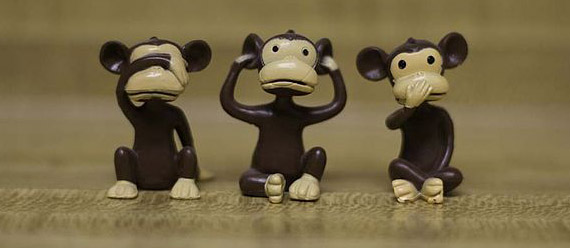
See no evil, hear no evil, speak no evil, by John Snape, CC-BY-SA-3.0
This morning I showed my wife a newspaper photo depicting a politician who closely resembles a recent movie villain. “No one will vote for him,” I said.
She laughed and agreed, but a little while later said, “Wow, that made it hard. I’m trying to give up criticism for Lent.”
I apologized, for I know how hard real spiritual discipline can be. Then I reflected that her resolution echoes a thought I’ve had on and off for some time – cutting, or at least reducing, the negative topics and posts in this blog. The period of Lent, about seven more weeks, seems like a good trial period, so I’m going to try this experiment and figure it out as I go along.
When considering this move in the past, I’ve had fears along the lines of becoming Pollyanna or having nothing to write about if I close my eyes to the world’s crap. I am confident, however, that tens of thousands of writers can take up the slack if I take a break.
There are many reasons to do so. First and foremost for me is this simple truth from Zen teacher, Cheri Huber, so simple and yet so easy to forget: “The quality of your life is determined by the focus of your attention.”
The same truth is expressed in completely different terms in Scott Adams’s new book, How to Fail at Almost Everything and Still Win Big. This cartoon genius who gave us Dilbert says: “Reality is overrated and impossible to understand with any degree of certainty. What you do know for sure is that some ways of looking at the world work better than others.” (I plan to review this book here soon).
A final, obvious example, given his recent visit to this country, is the Dalai Lama. Beyond doubt, he’s the most joyous person who lives in the public spotlight. I’ve never been in his physical presence, but I have met a few spiritual masters, men and women of several traditions, and for me, they all had one thing in common: when you get near them, you pick up their joy. And I mean a profound joy, the kind that sometimes has left my jaw aching from smiling so much more than I am used to. I’m sure the Dalai Lama is like that.

Dalai Lama with Christ University Choir, Bangalore, India
One of the many things he has said that always struck me concerns a difficulty he had when he first came to the west: he could not at first believe the degree of shame and self-hatred that are native to our culture. It was completely new and shocking to him to hear such a thing, for there was nothing like it at all in Tibet. I believe it’s no coincidence that you never hear the Dalai Lama say critical things about anyone else. He doesn’t even criticize the Chinese, saying only, “They helped me cultivate patience.”
As I end this post, I realize some readers outside the U.S. might not be familiar with its title, which comes from an old western song, “Home on the Range:”
Home, home on the range,
Where the deer and the antelope play,
Where seldom is heard a discouraging word,
And the skies are not cloudy all day.
“Home on the Range” is the state song of Kansas, and like “Somewhere Over the Rainbow,” that other great song that reminds us of Kansas, it seems to ask the question, “Why not I?” Or, “Why not us?”
Asking “why not” is itself a classic spiritual discipline. What factors hold me back from the kind of life I want to live. In my own case, criticism of self and others is part of that mix. Let’s see what happens here over the next seven weeks…
A few days after his birthday 110 years ago, here’s a wonderful list of wise aphorisms by Dr. Seuss, courtesy of Rachael at Street of Dreams
In honor of Dr. Seuss’s birthday, I’ve come across a fun little collection of life sayings (from his books) to live by.
I know I’ve posted similar things in the past, but everytime, I come across one of his books or a collection of his work, I am amazed at how insightful he was. And I am amazed at how complicated adults must make things.
Note: sorry this is a few days late. I thought I published this piece but apparently word press had other plans.

I find most alliterative titles, like “Media musings,” to be about 40% cute and 60% annoying, but in this case, it’s a good match for the headline that inspired this post: “Ellen’s Oscar ‘selfie’ a landmark media moment.”
“A what moment?” I mused. “A landmark media what?”
Because the media is falling over itself to celebrate Ellen’s tweet, and because nature abhors a vacuum, it has fallen to me to be the curmudgeonly voice of this “event.” One of the first things a curmudgeon does is reach for the dictionary. A “landmark event” is “an event, discovery, etc. considered as a high point or turning point in the history or development of something.”
At first I thought it must be the high point of product placement. The picture in question was taken with a Samsung phone, Samsung was a big Oscar sponsor, and the Academy Awards are the biggest post-Super Bowl marketing event. But that’s not really new news. Reading on, I realized the article referred to a landmark social media event. Since tweeting about TV isn’t new, an expert, in this case an Oscar co-producer, had to explain it to the likes of me:
“What it’s all about right now is creating a conversation, and social media allows for the conversation as it’s happening.”
Oh thanks, now I understand.
The dogs don’t like me being a curmudgeon, so while I was writing this post, Kit grabbed my (non-Samsung) phone and snapped a selfie, hoping to create a new conversation.

Kit snaps a selfie
“It’s all about what’s happening now,” she says, explaining why she wants to establish a social media presence.
So the price I pay for being a curmudgeon is having to ask all you loyal readers to give my dog a tweet (she accepts treats as well). After all, she is cuter than Ellen’s crew, and she hasn’t been real annoying since puppy days when she chewed up my wife’s phone. That really happened, but it’s a story for another day, and right now I need to let you log onto your twitter accounts. Don’t forget – it’s all about right now.


 The First Gates