The American Monomyth

In my so far disappointing effort to make sense of Tumblr, I have at least found several intriguing posts, including this one from josephcampbellwasright.tumblr.com called “The American Monomyth.”

The Monomyth is a world-wide mythic pattern that Joseph Campbell described in The Hero With a Thousand Faces, 1949:  “A hero ventures forth from the world of common day into a region of supernatural wonder: fabulous forces are there encountered and a decisive victory is won: the hero comes back from this mysterious adventure with the power to bestow boons on his fellow man.”

The Tumblr post references a lesser known book by Robert Jewett, The American Monomyth, 1977, that describes an interesting variant:

“In the American monomyth, the hero is an outsider who comes into a once-perfect community in peril (the “violated Eden”) to confront the evils that have caused trouble. The hero eschews such things as joining the community, standing apart from them in order to better keep them safe, in a manner that could best be described as vigilantism. Once the evil has been vanquished, the hero either allows himself to absorb into the community (through such means as moving in, marrying, etc.), or he moves on to the next violated Eden.”

The post lists several movies as examples, but doesn’t mention several key genres that raised the “Heroic Outsider” to the mythic status of true American Hero.  What of superheroes like Batman and Superman or crime fighters like The Untouchables?  What of the genre I grew up on, the western?

Clint Eastwood and Sidney Penny in Pale Rider, 1985, my favorite "Heroic Outsider" western

Clint Eastwood and Sidney Penny in Pale Rider, 1985, my favorite “Heroic Outsider” western

While Googling for westerns with the classic, “clean up the town” theme, I came upon an interesting syllabus for a course at Dominican University, The Western:  America’s Mythology – books it would be fun to add to my geometrically expanding list of things I would like to read!

Meanwhile, I suspect that everyone has personal favorite books and movies in this “swoops in and saves the day” genre.  What are some of yours?

Anatomy of the Deep State by Mike Lofgren

Be warned, this post has disturbing content.  If it was a movie, I’d rate it “R,” not because of sex or violence, but because it concerns a penetrating essay on the current state of the US government.  Change the channel now if you’re squeamish.

If you’re still here, good, because disturbing or not, I think everyone ought to read Anatomy of the Deep State, by Mike Lofgren, a former GOP Congressional aide who retired after 28 years as a staff member for Congress and the Senate.  This article is a distillation of ideas he explored in his recent book, The Party is Over: How Republicans Went Crazy, Democrats Became Useless, and the Middle Class Got Shafted.

party is over

Lofgren says what many of us have long suspected, that our visible political landscape is merely the tip of a much bigger iceberg – that our various issues, debates, and elections often have little to do with the real trajectory of power in this country.  Much of this “real” trajectory is hidden in plain sight.  With almost three decades inside the belly of the beast, Lofgren can show us where to look.

He cites many examples.  During the political circus surrounding the 2011 debt ceiling “crisis,” our leaders had no problem finding money to topple Gaddafi.  A few months later, during the government “shutdown”, while debates raged over canceling meat inspections and air traffic control, we gave $112 million to Syrian rebels, to keep that conflict going.  And since 2007, as our bridges collapse, schools fail, and cities go bankrupt, we’ve spent $1.7 billion on an NSA building in Utah the size of 17 football fields.  Its purpose is to house a yottabyte of data.  A yottabyte, the largest number computer scientists have so far coined, equals 500 quintillion pages of text.  “They need that much storage to archive every single trace of your electronic life,” Lofgren says.

The best news, according to Lofgren, is that what he calls the Deep State is far from invincible.  He notes how sufficient ineptitude draws pushback even from allies, citing our two failed wars and the Snowdon revelations among other things.  Past elites have often reacted to challenges in one of two ways.

Some have tried to “stay the course,” and Lofgren observes that,“The dusty road of empire is strewn with the bones of former great powers that exhausted themselves in like manner.”  Others have followed reformers, as diverse as Franklin D. Roosevelt, Charles de Gaulle, and Deng Xiaoping.  What each of these men developed in common was a deep understanding that their cultural stories and myths were ossified and that survival depended upon renewing both vision and action.

Mike Lofgren, a self-described “former proud Republican” now says, “there is…a deep but as yet inchoate hunger for change. What America lacks is a figure with the serene self-confidence to tell us that the twin idols of national security and corporate power are outworn dogmas that have nothing more to offer us. Thus disenthralled, the people themselves will unravel the Deep State with surprising speed.”

The first step in dealing with any problem is understanding its nature.  In this time of deliberate political and economic obfuscation, I highly recommend Anatomy of the Deep State as one of the best and most succinct diagnoses I’ve yet seen of what ails us.

An unplanned television fast

CC BY-NC-ND 2.0

CC BY-NC-ND 2.0

We are a week into a major home reconstruction project that has about 2/3 of our living space sealed off against dust.  Bedroom, study, kitchen, and bath are available.  Internet too, since I carried the modem down to this end of the house.  A little cramped at times, but overall, just fine for a short period of time.

What surprises me is how little I miss TV.  More than that, it’s refreshing in many ways not to have it.  The sound was on at one of the TV’s at the gym and I found it so irritating I moved away.

It hasn’t been a completely video-less week.  One day we ventured out to the cineplex to watch Frozen.  Another evening we viewed an Agatha Christie mystery on youTube (the 13″ screen of my mac was ample).  On Friday, I watched a 20 minute Newshour segment on pbs.org.  And last night, we clambered through the dust curtains, out to the living room where the furniture is clumped, to watch the finale of Downton Abbey.

I’m not going to waste any time with polemics against television.  I enjoy several shows and of course, Turner Classic Movies.  I expect to watch those when the house is back to normal.  But a cautionary story came to mind as I looked for images for this post.

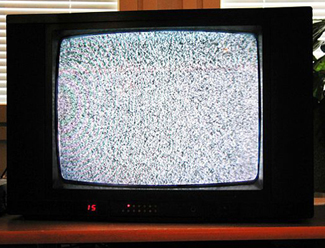
It’s possible some readers may not remember analog TV and the pre-404 no-signal pattern called “snow.”

Snow.  CC BY-NC-ND 2.0

Snow. CC BY-NC-ND 2.0

This always reminds me of Neal Stephenson’s visionary novel, Snow Crash.  Published in 1992, Stephenson envisioned a post-nation state world in which people lived as citizens of corporate territories.  The former United States still excelled at two things, computer micro-code and high speed pizza delivery, the latter because the mafia had taken over the business.

In 1992, the year I first got a windows computer, an 8K modem, and an AOL membership, Stephenson imagined virtual worlds where people created avatars to jack in and interact.  Then someone launched a virus that messed with people’s brains.  Anyone who opened this malware saw a pattern based on ancient glyphs that led to the Tower of Babel.  Viewing these symbols scrambled their neurons, in essence, turning their minds to snow.

What struck me this past week were the parallels to our current media world.  I can’t help thinking of all the ways that commercials, local news, political debates, and most of what passes for entertainment scramble our neurons, though much more slowly and in ways that leave us perfectly able to buy stuff.

I could say more, but this is enough – something to think about.

‘On the Supposed Unsuitability of Fairytales for Children” Guest Post by J. Aleksandr Wootton

This is, in essence, a double reblog, in which you will meet two interesting writers in the field of folklore. The first is Benton Dickieson of Prince Edward Island, Canada, who blogs at A Pilgrim in Narnia. The second is the author he presents, J. Aleksandr Wootton, self described “Author, Folklorist, Poet, Book-Worm, Faerie Historian, Cultural Critic, and Virginian.”

Writing on the “Supposed Unsuitability of Fairtales for Children,” Wootton has much to say including a fine summary of a subject I’ve circled about on several occasions, attributes of successful fairytale heroes and heroines:

“The world is fraught with danger, including life-threatening danger, but by being clever (always), honest (as a rule, but with common-sense exceptions), courteous (especially to the elderly, no matter their apparent social station), and kind (to anyone who has obvious need), even a child can succeed where those who seem more qualified have failed.”

Enjoy the websites of both of these folklore enthusiasts.

Brenton Dickieson's avatarA Pilgrim in Narnia

J. Aleksandr Wootton chairs the fictional Folklore Studies department at Lightfoot College, where his research focuses on post-war Faerie. He has authored Her Unwelcome Inheritance, an account of fairy refugees on earth, and has recently published a poetry collection titled Forgetting: Impressions from the Millennial Borderland

For more on his writing, or to contact him, visit www.jackwootton.com.

“On the Supposed Unsuitability of Fairytales for Children”

J. Aleksandr Wootton

Shortly after supporting a local library event promoting fairytale literature, the folklore department at Lightfoot College received an animated communication from a very concerned mother regarding, in short, the “unsuitability of fairytales for children.”As this seems to be a rather widespread idea (I might mention the Daily Telegraph article of February 12, 2012) as well as an oddly long-lived one, I take the liberty of public response.Dear Madame,

Though you may be unaware of it, your email represents sentiments that have…

View original post 1,656 more words

Remembering Kate Wolf

Lately I’ve been thinking about Kate Wolf (1942-1986), a singer and songwriter from this part of the country who was just beginning to draw national attention when leukemia took her at the age of 44.  Growing up, she listened to Dylan, The Weavers, The Carter Family, and Merle Haggard (1).  Her poetic lyrics celebrated backroads and small towns and her music wove the “high lonesome” sound of bluegrass into landscape of northern California.

Once I loaned a friend one of Kate’s albums.  When she returned it she mentioned that her 10 year old son listened to several songs and said, “Wow, that music is really sad.”  Pothos comes to mind, a Greek word I have used here before, that signifies a restlessness, an unrequited and unrequitable longing for what lies beyond the horizon.  Pothos is the affliction of dreamers and it’s woven as a minor chord through much of this music, even when it seems most concrete:

Here in California fruit hangs heavy on the vines,
But there’s no gold, I thought I’d warn you,
And the hills turn brown in the summertime.
– from “Here in California” by Kate Wolf

In April, 1986, Kate was diagnosed with leukemia.  After chemotherapy, she went into full remission, started work on a retrospective album, and scheduled another tour.  The disease returned in the fall, however, and we lost her on December 10.  Her long time friend and touring partner, Utah Phillips covered the remaining shows she’d booked, including one in Placerville Mary and I had tickets for.

He led the crowd in singing her songs and said something I’ve never forgotten. “At the end of her life, Kate told me she knew why she’d gotten cancer.  She took in people’s pain, the pain of living.  It was the source of her art, but she realized too late that she never learned to let it go.”  Phillips warned everyone to beware of clinging to grief and reminded us of the threads of hope and joy we also find in her music.

Kate’s music has been covered by musicians like Emmy Lou Harris, Nanci Griffith, and Peter Rowan.  You can sample her songs on katewolf.com, a website her family maintains, as well as on iTunes. Once you listen, these songs find a home in your head and heart, for as Kate Wolf put it in “Brother Warrior:”

We are crying for a vision
That all living things can share
And those who care
Are with us everywhere.

Posts I haven’t yet written

Quite a few of my posts begin with ideas that rattle around until research or mulling them over generates enough interest to get me writing.  Time for contemplation and research have been in short supply recently and are likely to be for the next week, so grabbing this moment, I decided to mention a few things I am working on that may or may not get posts of their own in the future.

Water

With the drought on everyone’s mind, I was tempted to write a piece on the symbolism of water.  The problem is, (1) the subject is huge, (2) it’s already been done, and (3) a Star Trek episode keeps me from starting.  Every time I remember the silicon creatures who called humans, “ugly bags of mostly water,” all my attempts to stay focused and serious fail.  According to Mr. Data, it’s an accurate description of our species.  Thanks, dude.

There’s another approach to discussing water in California that centers on economics and politics.  I could discuss the millions of gallons we pour into fracking wells.  Or I could mention the president’s three hour visit to Fresno, complete with a photo-op in a dry field before jetting off to Rancho Mirage, but I don’t think I will.  If I want to get depressed over water, it’s easier just to rent Chinatown.

I’m writing a letter

Not just any letter.  I’m writing a letter of condolence to someone whose dog recently died.  It’s one paragraph forward and two back.  Those who have lost a beloved pet will understand how this letter is siphoning off most of the emotional energy I’m willing to invest in writing at this time.

Too many choices

A chain of associations based on some of my own experiences led to a fascinating but huge subject, the difficulty of having too many choices.

photo by Alexander Acker, 2010, CC BY-ND-2.0

photo by Alexander Acker, 2010, CC BY-ND-2.0

In his 2004 book, The Paradox of Choice – Why More is Less, psychologist Barry Schwartz writes that seeking the “perfect” choice is “a recipe for misery.”  Other researchers say, “The current abundance of choice often leads to depression and feelings of loneliness,” and “Americans are paying for increased affluence and freedom with a substantial decrease in the quality and quantity of community.”

This kind of subject deserves elaboration, but if you don’t want to wait for me to get around to it, just Google on “too many choices” and see what you find.

I’m learning Spanish

Yup, I started last summer on Rosetta stone, for a variety of reasons, including (but not limited to, or necessarily in order of importance):

  1. It seemed like a good idea at the time.
  2. Languages are supposed to be good for the brain.
  3. One night, flipping through the TV listing, it seemed like it would be fun to watch El Codico DaVinci on the Spanish station.

One of my Facebook friends who knew me back when, reminded me that in 7th grade Spanish, I was a class clown.  The reason was simple.  I believed I was “no good at languages,” and it became a self-fulfilling prophecy.  There’s a lot of satisfaction in erasing that misperception.  I came upon the Spanish version of book I have in English yesterday and flipped through it before deciding I’d better start in the children’s section.  I wonder if they have cartoons on Saturday morning on the Spanish channels?

Meanwhile, I don’t know why mid-February should be so busy, but it is, and I have to move on to the next thing, so let me summarize this post.

  1. Water is good, though flooding is bad.
  2. Few things are harder than losing a dog.
  3. Choosing things can be iffy.
  4. Learning a language sometimes carries the kind of excitement that learning to read must have done when we were kids.

Feel free to quote me.  Until next time, when maybe I’ll manage to write a real post…

The Monuments Men: a movie review

George Clooney;Matt Damon;John Goodman;Bob Balaban

The Monuments Men, based on a 2009 book of the same name by Robert Edsel, tells of a small group of mostly middle aged men who risked their lives to recover thousands of looted works of art from the retreating Nazis in the final days of WWII.

George Clooney co-wrote, directed, and starred in the film.  A Washington Post review suggests why the project mattered to Clooney, saying the movie “continues his long-standing — even heroic — effort to preserve a certain kind of movie in the American filmmaking canon…the classical, even old-fashioned kind of film that, we’re so often depressingly reminded, Hollywood doesn’t make anymore.”

If you’re like me, that means movies that center on story and even dare to depict personal heroism.  Explosions and digital effects, if present, are subordinate elements.

The Monuments Men has not fared well with reviewers.  In an obvious comparison to Saving Private Ryan, another quest/buddy movie set in WWII, The Monument Men lacks tension at many points.  The Post review gives a plausible analysis of the structural cause of a lack of focus in the central part of the movie, that resolves in the ending sequence where the team races to save several key artistic treasures from destruction by the Nazis and capture by the advancing Russian army.

Whatever its flaws, I enjoyed The Monuments Men and recommend it as a good story that poses key questions on the way a people’s art and history is central to their identity, something Hitler knew very well when he tried to erase it from the lands he conquered.

Part-time penury

Serfs

Between 1981 and 1984, I worked as a part time instructor at a community college in northern California.  Like most part-timers, I dreamed of the tenure track.  I was lucky.  At one point during a faculty meeting, I looked at all the other hopefuls, did the math, and realized I was on, if not a sinking ship, one that was dead in the water.  I started building a lifeboat and made my escape.

According to a recent NPR story, a million part-time, or adjunct professors, have not been so fortunate.  That’s 75% percent of U.S. college teachers who are stuck in part time positions; like workers at McDonalds, many rely on food stamps to get by.  Current pay for adjuncts is $2,000 – $3,000 a class with no benefits of any kind.  “Freeway fliers” is what we called ourselves when I was in the ranks, zipping between nearby schools to pick up any available classes.

One adjunct interviewed in a parallel story on the PBS Newshour teaches six English classes at three Ohio universities.  With a family to support, he couldn’t afford to stay home when he had pneumonia last fall.

At the time, I assumed the dismal prospects were my fault; I only had an M.A. and taught at a small town, two year school.  The articles make clear that although the trend began at two year schools in the 1970’s, it soon spread to all types of colleges and universities.

Peter Brown, professor emeritus of the State University of New York at New Paltz says the average salary of adjuncts there is $12,000 a year – less than the custodial staff.  “Between 1970 and 2008, the adjunct pay has gone down 49 percent,” says Brown.  “The salary of college presidents has gone up 35 percent.” 

In the 80’s we talked of organizing, and finally, three decades later, some colleges are granting part timers collective bargaining rights.  Twenty-two percent of adjuncts now belong to a union.  The death last fall of an 83 year old Duquesne University adjunct, who had taught for 20 years with good reviews, only to die impoverished, served as a wake-up call, as did a January congressional report that found adjuncts are treated like “cheap labor.”

In general, we get what we pay for, and as college students go ever deeper into debt, it’s worth asking what their education dollars are buying.  Well-to-do college administrations.  Top notch football teams.  A lot of professors too sick or stressed or busy commuting to hold decent office hours.  Ever fewer real-world prospects.  And…?

If we don’t want to end up singing “Glory Days” when we think of the long-gone time when American education was the best in the world, something will have to change.