Chicken Wrangling.

Here’s an inspirational post in which Doug goes windmill tilting instead of tending the chickens. If this doesn’t get you singing a rousing chorus of “Man of La Mancha,” nothing will!

johnkurth.com's avatarDoug Does Life

Thou hast seen nothing yet. ― Miguel de Cervantes Saavedra, Don Quixote

Another Saturday out and about. Saturdays are our busy days and our fun days. As I mentioned before, we keep some hens on our property. They don’t take much work and they provide lots of good yard eggs…

Doug stayed home today, so I asked him to take care of the chickens. By take care of, I meant feed them and give them some water…

I knew something was wrong when I saw the gate to the chicken coop standing open.

I found Doug heading across the yard on his chicken mount.

He wouldn’t tell me what he was doing but I think the chicken said something about windmills… It’s hard to understand chickens though.

I’m left to clean up after Doug once again.

At least the damage was confined to our yard this time, and didn’t…

View original post 40 more words

About Rejoicing

Rejoicing is an abrupt theme change from the last two posts I’ve worked on, both of which have ground to a halt.  They seemed important at the time, but they were full of bad news, and there’s plenty of that to go around.

Recently I attended two teachings by a Tibetan lama visiting from the east coast, the Venerable Khensur Lobsang Jampa.  I’d heard him on a previous visit and on both occasions his teachings were all I expected and more.  I purchased a book he published this year and started to read it when I got home.

Ven. Khensur Lobsang Jampa Rinpoche.

Ven. Khensur Lobsang Jampa Rinpoche.

In the early pages, he gave an account of a king called Prasenajit who sought the Buddha’s advice.  King Prasenajit wanted to study the Dharma, and asked how he could do so when so much of his time was devoted to running his kingdom.  Like us, he was insanely busy, and didn’t have much time for spiritual practice.

Buddha gave him just three things to do, which he could practice in the midst of other activities:  generate bodhicitta, rejoice, and dedicate.

Bodhicitta is the core of Mahayana Buddhist practice.  It’s the desire and determination to seek spiritual awakening for the benefit of all living beings.  It parallels St. Paul’s first letter to the Corinthians, where he says no amount of spiritual prowess is worth anything without love.

Dedication means mentally giving the positive energy of spiritual practice, the good karma, for the benefit of all sentient beings.  The secret is that by giving it away, we do not lose anything, for like Jesus’ loaves and fishes, there’s always enough to go around.

Buddha’s final instruction, rejoicing, took on a special meaning this week.  Lama Khensur wrote:  “Rejoicing is simply cultivating happiness in the positive actions of others and in the good things that happen to others, thinking ‘How wonderful for them!'” He explained that rejoicing means celebrating the lives of spiritual masters, prophets and saints, as well as the positive actions of “ordinary” people.

Consider the world-wide rejoicing we saw this week for the life of Nelson Mandela.  How uplifting it was to reflect on the positive transformation he brought to his own nation and  to the lives and dreams of people everywhere.  The Buddha said that such uplift is ours anytime we deeply reflect on the good that people have done and can do.

Yesterday I attended the wedding of a long time friend.  I’m not ordinarily a fan of occasions like weddings, where I have to be on my best behavior for several hours at a time, but this was different.  Some 30 friends and family members gathered to witness the union of a couple who are such a good match that it was pure celebration and I didn’t look at my watch until after the cake.  It was easy to think, “How wonderful for them!”

The smallest event can spark this kind of rejoicing when we watch for such occasions.  Last week, when I stepped out of the rain and cold and into a local bagel shop, the young man who brought me a bagel and coffee with a genuine smile passed on something very valuable.  Many such moments are ours when we pay attention.

The clouds above us join and separate,
The breeze in the courtyard leaves and returns
Live is like that so why not relax?
Who can stop us from celebrating?
– Lu Yu

Creative Commons

Creative Commons

Neil Gaiman on libraries, reading, and daydreaming

Neil Gaiman, 2007, CC-BY-SA 2.0

Neil Gaiman, 2007, CC-BY-SA 2.0

Neil Gaiman visited China in 2007 for the first ever, party-approved, Science Fiction and Fantasy Convention.  He asked a top official what had changed; in the past, these genres had been disparaged.  The official said his government had realized they were good at making other people’s inventions, but they didn’t invent or imagine new things themselves.

“So they sent a delegation to the US, to Apple, to Microsoft, to Google,” Gaiman explained, “and they asked the people there who were inventing the future about themselves. And they found that all of them had read science fiction when they were boys or girls.”

Gaiman told this story while giving the 2013 Reading Agency annual lecture on the future of reading and libraries.  The Reading Agency is a British charity that supports libraries and literacy programs, with the mission of giving everyone “an equal chance in life by helping people become confident and enthusiastic readers.”  Another story Gaiman told underscores the importance of the Agency’s efforts.  In New York, he once attended a talk on private prisons – one of America’s growth industries.  In trying to predict the need for future facilities, prison industry officials have developed a simple algorithm based on one key factor – the percentage of 10 and 11 year olds who can’t read.

Gaiman spoke at length of fostering not just the ability to read, but the love of reading.  There are no bad authors or bad books for children, he said.  Adults can destroy a child’s love for reading by giving them “worthy-but-dull books…the 21st-century equivalents of Victorian “improving” literature. You’ll wind up with a generation convinced that reading is uncool and worse, unpleasant.”  Everyone is different and will find their way to the stories they like and need.

Because written fiction, as opposed to television or movies, requires our imagination to turn the authors words into a vivid world, we return to our own world as a slightly different person, with an awareness of other points of view.  Reading fosters empathy, Gaiman said, and:

“Empathy is a tool for building people into groups, for allowing us to function as more than self-obsessed individuals…You’re also finding out something as you read vitally important for making your way in the world. And it’s this: the world doesn’t have to be like this. Things can be different.”

In his inspiring lecture, Gaiman talked at length of his love for libraries and how critical it was for his own development to have supportive librarians at the small library near his home while growing up – librarians who simply wanted books to be read and showed him how to use inter-library loan when he finished all the local books on vampires, ghosts, and witches.  When government officials close libraries as cost saving measures, “they are stealing from the future to pay for today.”

Gaiman expressed what he believes to be our responsibilities to children and to our future.  Reminding the audience that everything made by humans begins with imagination, we have a responsibility to use and foster our imagination of a better world than the one we found.

Gaiman ended with a quote from Albert Einstein.  When asked how to foster intelligence in children, the great scientist said, “If you want your children to be intelligent, read them fairy tales. If you want them to be more intelligent, read them more fairy tales.”

The 2013 Ig Nobel Prizes

2013 Ig Nobel

Though I reported on last year’s Ig Nobel Prize ceremony, I missed the 2013 edition of this annual Harvard laugh fest, which was held in September.  I only heard the details yesterday, on NPR’s “Science Friday.”  Much better late than never for this look at the work of international scientists whose “research makes people laugh and then think,” according to Marc Abrahams, editor and co-founder of “The Annals of Improbable Research.”

The ten 2013 winners Ig Nobel winners, who received their prizes from (real) Nobel Laureates, include:

The Prize in Psychology, which went to a multinational team that confirmed empirically that “people who think they are drunk also think they are attractive.”  Their article, “Beauty is in the Eye of the Beer Holder,” was published in the May 15, 2012 issue of The British Journal of Psychology.

A Joint Prize in Astronomy and Biology, awarded to Marie Dacke, Emily Baird, Marcus Byrne, Eric Warrant, and Clarke Scholtz, proves that dung beetles use the Milky Way for navigation; they can push their balls in a straight line when the night sky is clear, but not when it is overcast.

A Probability Prize was given for two related findings: “First, that the longer a cow has been lying down, the more likely that cow will soon stand up; and Second, that once a cow stands up, you cannot easily predict how soon that cow will lie down again.”  Bert Tolkamp of the Netherlands accepted the award and expressed his team’s gratitude for the honor, noting that they need the laughs, since researching cows can be “really boring.”

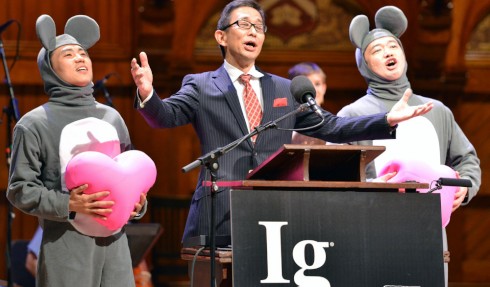
The Prize in Medicine went to a joint team from China and Japan for proving that post-heart transplant mice survive longer when listening to the Verdi opera, La Traviata, than to the music of Enya. (1)  These findings were chronicled in The Journal of Cardiothoracic Surgery.

The Operatic Heart Transplant team

The Operatic Heart Transplant team

This year’s prize ceremony, like those in the past, sold out early. As South African entomologist, Marcus Byrne, who took part in the dung beetle study, said, “It shows how much people appreciate good science. It doesn’t have to make money. It doesn’t have to save lives. It’s just part of the human condition to be curious.” 

And, I would add, to enjoy a good laugh!

Remembering George

George Harrison in the Oval Office at the invitation of President Ford, 1974.  Public Domain

George Harrison in the Oval Office at the invitation of President Ford, 1974. Public Domain

I didn’t call the Beatles by their first names – or even clearly know their names – when they first came to America.  Although the media wouldn’t let you forget Beatlemania, I was more of the Beach Boys persuasion at the time, and later got caught up in the San Francisco sound.  Then, in 1968, the Beatles did something amazing to me – they went to India to study with a guru.  They opened a door I had only vaguely known was there.

George was the Beatle whose life and work were forever altered by eastern religion, as was my own.  He learned to play the sitar with a master, while I learned the harmonium, (a wonderfully simple instrument that allows even a novice to produce a credible melody).  For a time he belonged to an organization I did, dedicated to meditation and the study of eastern philosophy.

In Vrindavan, India, 1996.  Public Domain.

In Vrindavan, India, 1996. Public Domain.

In early November, 2001 at the age of 58, he underwent a last ditch treatment in New York for lung cancer that had metastasized to his brain.  When that failed, he travelled to Los Angeles, where he died on November 29, surrounded by family and friends.  Deepak Chopra wrote:

“He always would say that when I die I want to be fully conscious of God, I want to be totally at peace, and I don’t want to have any fear of death. And believe me, being close to him, I know that he died very conscious of God and in peace and not afraid of death.”

Blood line ancestors pass on their physical substance to us.  Ancestors of the heart pass on their spirit, encourage us by example, and show us what a life well lived can look like.  For inspiration, I still listen to Harrison’s last album, Brainwashed, released posthumously in 2002.  His son, Dhani helped finish it and included this quote from the Bhagavad Gita in the liner notes:

“There never was a time when you or I did not exist. Nor will there be any future when we shall cease to be.”

Here is a very nice clip on one of my favorite George Harrison songs from the Concert for Bangladesh, 1971.

On this day, when I listen to his music, I remember a man I truly admire, who was genuine, who found his own path and followed it to the best of his ability.  “You got to walk that lonesome valley by yourself,” as the old song says, but we do not do so alone.  Somehow the spirits of those who went before are there to inspire us.

Pope Francis on Economic Justice

Pope Francis

“How can it be that it is not a news item when an elderly homeless person dies of exposure, but it is news when the stock market loses 2 points?” – Pope Francis (1)

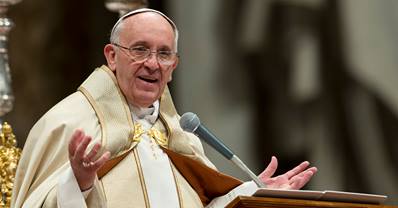
On Tuesday, Pope Francis delivered a sharp rebuke of unfettered capitalism as “idolatry of money” that will lead to “a new tyranny.” (2)  His language was specifically directed at those in the United States who continue to defend “trickle-down economics,” which he said “has never been confirmed by the facts, [and] expresses a crude and naive trust in the goodness of those wielding economic power.”

“Meanwhile,” he said, “the excluded are still waiting.”

President Obama said he was “hugely impressed with the pope’s pronouncements.”  Nevertheless, on Wednesday, the US announced it will close its Vatican embassy as a “cost saving measure.” (3)  The seven embassy staffers will be retained, just moved beyond the borders of Vatican City, which is the world’s smallest sovereign nation.

Republican senators, many of whom still advocate the trickle-down policies the pope condemned, were quick to denounce the administration’s move as “a slap in the face to Catholic Americans around the country.”

Though I’m not a Catholic, I find myself deeply grateful on this day of thanks, for the current Vicar of Christ.  When politicians of all persuasions spend most of their time defending an increasingly dysfunctional status quo, it is refreshing and marvelous to find a world leader willing to speak the truth.


Trust and belated reflections on November 22

I was going to pass on adding my $0.02 to the discussions of the Kennedy assassination.  I have nothing to add concerning the event itself.  I am writing this post because of a comment I cannot get out of my mind:

“Like a tornado, the Kennedy conspiracy theories have spun off whirlwinds of doubt about other national traumas and controversies…The legacy of that shocking instant is a troubling habit of the modern American mind: suspicion is a reflex now, trust a figment.” – David Von Drehle in Time Magazine, Nov. 25, 2013

You can’t argue with Drehle’s conclusion, that suspicion of government is a reflex,  but when and how did it come about? I truly don’t remember it starting in Dallas.  People at the time expressed shock and grief, and everyone shook their head and said the killing of Lee Harvey Oswald was “pretty suspicious,” but no one I knew, and not a single history teacher I ever had, obsessed about the conspiracy like we do now.

I wonder if that’s a key – like we do now.  I wonder if the weight given this month to assassination conspiracy theories isn’t history revised in light of our current mistrust of government, a mistrust that came about from a long string of incidents rather than a single one.

There was the Gulf of Tonkin the following year, used to justify escalating the war in Vietnam, which Robert McNamara, then Secretary of Defense, later admitted never happened.  There was the 1970 National Guard shooting of 13 students in Kent, Ohio, when fear and loathing of government rose to heights I’ve never seen before or since.  There was Watergate, the non-existent Iraq WMD’s, and now let’s all say hi to the NSA, both I who am writing and you who are reading this post.

Trust is the foundation of any honest relationship, slow to evolve and quickly broken by deceit.  In interpersonal relationships, once it’s gone it is pretty much gone for good – “fool me once…” as they say.

The flags flying at half-staff yesterday brought to mind a childhood grief, but we have moved on from the loss of one man.  What lingers and haunts is the memory of how that man could invite a public trust – “Ask not what your country can do for you…” – and seem worthy of it.  That level of hope and public trust is gone, and I don’t see it coming back.

More than a man, that is what I found myself mourning yesterday.

HalfStaffFlagNotification

Selling Thanksgiving

Norman-Rockwell-thanksgiving use

An article in our local paper’s Sunday Business Section both fascinated and sent a few chills up my spine at how effectively today’s marketeers can sell proverbial ice cubes to Eskimos.  They have persuaded large numbers of us to give up Thanksgiving as a day of gratitude for what we have, in favor of the chance to go buy more.

No one needs to wait for Black Friday now.  Major retailers will open their doors at 8:00 on Thanksgiving night, while Kmart’s shopping day will begin at 6:00 in the morning.  People like it and want it, the article says, but it’s instructive to look at the language used:

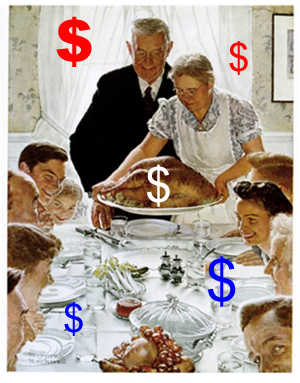
“The ever-earlier shopping frenzy is a source of dismay for traditionalists who view Thanksgiving more in terms of Norman Rockwell’s famous 1943 “Freedom from Want” painting…They ask: Isn’t the pace of life hectic enough without cutting into a day established for humble gratitude and quiet reflection?”

Is it just me or do you see a bias here?  Some implication that the traditional, quiet reflecting crowd, stuck in 1943, will probably spend the day watching reruns of “The Waltons.”

American Gothic by Grant Wood.  Public Domain

American Gothic by Grant Wood. Public Domain

The most interesting reason the article gave for jumping up from the table to hit the stores came from a “random” shopper at one of our malls, who said, “It’s fun, like a shared adventure for me and my friends.  We love it.”  An adventure is “an unusual, stirring experience,” according to Webster’s Dictionary, which isn’t what I equate with a trip to the mall, but hey, we all know Thanksgiving can be a chore.  

Millions of us have had the experience of traveling “home for the holidays,” only to remember exactly why we left in the first place.  And traditional Turkey Day roles still split along gender lines – who hasn’t heard women complain about working for hours preparing a meal, only to have the men snarf it down in 20 minutes, then pass out from tryptophans and beer in front of a football game?  From that perspective, a trip to the mall with friends might be, if not “an unusual, stirring experience,” at least a refreshing break.

Times are hard, and I can’t fault anyone for the Thanksgiving choices they make, but I do suggest a bit of reflection.  Many who read this blog are writers, and one of the best pieces of advice for writers is to create a mission statement; among all the choices I have now, what do I want from writing?  That’s a good question to ask as we face the holiday season.

Most of us long for peace and serenity, and a time of shared warmth in a community of family and friends.  Nobody wants to wake up on New Year’s Day saying, “Thank God all that is over,” though many will.  It’s a good time to review holiday options and “obligations” in light of the Dr. Phil question, “How does that work for you?”  

I’m no saint when it comes to keeping Thanksgiving “pure.”  For a number of years, when Tower Books was open, Mary and I and friends from work would gather for Thanksgiving dinner, then go browse Tower for an hour before having coffee and pumpkin pie.  Though we didn’t suspect it at the time, we may have been having a shared adventure.  So let’s admit that we’re free to spend Thanksgiving however we wish.  

It just saddens me to see corporate interests breech a once inviolate day, and turn it into an “ersatz” holiday, like Labor Day, stripped of all its original meaning and existing only so people can buy many things that they don’t really need.