Homer in Iceland

Saga_of_Carl_Carlson_promo_4

Readers of this blog know I am a fan of things Icelandic and a fan of The Simpsons.  I was delighted last night to discover a little known saga on the final show of season 24 of our longest running television show.

If I’d only been more active last week on Facebook, where I follow The Simpsons, I would have been able to pass along advanced notice, but sooner or later, “The Saga of Carl Carlson” will show up on Hulu, so here is a brief description to whet your appetite.

When the gang at Moe’s tavern wins the lottery, Carl mysteriously disappears with the loot.  Lenny, Moe and Homer track him to Iceland, his native country since he was adopted by the Carlson clan as a child.  His pursuers learn that his goal is to clear the family name from a stain in a thousand year old saga.

Greed hangs in the balance with male bonding, but at last Homer speaks up in defense of Carl.  There are some great scenes of volcanoes, tiny horses, and northern lights, as well as appearances by Sigur Ros, the internationally known Icelandic band.  They provide the soundtrack as well, and their own take on the theme song.

Reunited at last back at Moe’s, Homer reflects on the strength of male friendship: “We don’t get together to share our feelings, we come here to escape them!”

“The Saga of Carl Carlson.”  Remember that if you are a Simpson’s fan and missed the show.  Check back on Hulu.  This episode is a lot of fun.

The best graduation speech, ever.

It’s that time of year.  I seldom pay much attention to graduation speeches.  I can’t remember anything said at my own, nor do any quotes come to mind from celebrities whose commencement addresses get soundbytes played on the news every June.  But there is one graduation speech I’ve read and listened to many times and continues to be a source of inspiration.  You may know it.  If not, I’m happy to pass it on.

Steve Jobs at Stanford, 2005

Steve Jobs at Stanford, 2005

In 2005, Steve Jobs, whose academic career consisted of one semester of college and a few audited classes, was chosen as the graduation speaker at Stanford.  In his brief but memorable address, he spoke of finding one’s true vision, following our hearts, and not wasting our all-to-brief time walking someone else’s path.  Here are three of my favorite quotes from the speech:

“You have to trust in something — your gut, destiny, life, karma, whatever. This approach has never let me down, and it has made all the difference in my life.”

About getting fired from Apple:  “It was awful tasting medicine, but I guess the patient needed it. Sometimes life hits you in the head with a brick. Don’t lose faith. I’m convinced that the only thing that kept me going was that I loved what I did. You’ve got to find what you love…the only way to do great work is to love what you do. If you haven’t found it yet, keep looking. Don’t settle. As with all matters of the heart, you’ll know when you find it…keep looking until you find it. Don’t settle.”

“Your time is limited, so don’t waste it living someone else’s life. Don’t be trapped by dogma — which is living with the results of other people’s thinking. Don’t let the noise of others’ opinions drown out your own inner voice. And most important, have the courage to follow your heart and intuition. They somehow already know what you truly want to become. Everything else is secondary.”

I invite you hear everything this visionary had to say that day, in a  text version of the speech, and / or this video clip.

Where to find “Tales of the Elves: Icelandic Folktales for Children.”

In December, 2012, I reviewed a wonderful illustrated book of Icelandic folktales, Tales of the Elves.  I’d brought a copy back from our trip to Iceland in the fall, but was unable to find ordering information.

Tales of the Elves cover

At the end of the post, I invited anyone who discovered that information to pass it along, and a reader named Kimberly just did!  Here’s a link to page for this book at Eymundsson, the premier Icelandic bookseller.  This page, in English, gives a price of 2,499 kronur – at about 100 kronur per dollar, that’s $24.99, what I paid in-country.  If you’re still interested, read on, because now the fun begins:

When you add the book to your cart and move on, the next pages are in Icelandic.  With the aid of an online Icelandic to English dictionary, I came up with translations of these questions you’re asked:

Nafn: name
Heimilisfang: address
Postnumer: zip code
Baer: town
Land: That’s country, and there’s a pulldown
Netfang: email address
Simi: phone

Kodi gjafabrefs: Kodi is code, and I couldn’t find the second term. I’m guessing they mean country codes, which from Iceland to the US is 00 + 1 + area code + number.  Here is a look-up table if you live elsewhere.

Okay, fine!  No one ever said navigating through faerie was easy!  Eymundsson says they’re working to bring their international pages online, so one option is to check back with them in six months.

Would I order this book from them if I didn’t have it?

I have a collection of half a dozen illustrated fairytale books I’ve collected over the course of many years and they have an honored place on the bookshelf.  Each one reminds me of some special moment or place when I found it.  Tales of the Elves is the only souvenir I brought back from Iceland, as the sweaters were too warm for this part of California.

The illustrations inside are as fine as the one on the cover, so if you like this kind of illustrated book and have read this far, you won’t be disappointed.

The Worlds Revolve

As I scanned reviews of The Great Gatsby, I tuned in to one comment about the visionary quality of F. Scott Fitzgerald’s book:  he saw the end of the roaring 20’s in 1925, before almost anyone else.

Almost anyone else…

I’d argue that T.S. Eliot, in Prufrock and Other Observations (1917), saw where our 20th century mode of life was leading even before the party began.

Here is how the title poem, “The Love Song of J. Alfred Prufrock,” begins:

Let us go then, you and I,
When the evening is spread out against the sky
Like a patient etherised upon a table;
Let us go, through certain half-deserted streets,
The muttering retreats
Of restless nights in one-night cheap hotels
And sawdust restaurants with oyster-shells:
Streets that follow like a tedious argument
Of insidious intent
To lead you to an overwhelming question…
Oh, do not ask, “What is it?”
Let us go and make our visit.

And here is how Prufrock ends:

We have lingered in the chambers of the sea
By sea-girls wreathed with seaweek red and brown
Till human voices wake us, and we drown.

One of the best professors I ever had helped me engage Eliot with the visual imagination, which helped me see how radical he was compared to the literary establishment of the day.  A kind of tired, watered down romanticism was the norm before the war, so describing the sky as “a patient etherized upon the table” was shocking.  “Have you ever seen someone unconscious?” the professor asked.  “Or very sick or dead?  Eliot isn’t describing a postcard sunset.”

But perhaps my most unforgettable poetic image came from another piece in Eliot’s first book.  Regarded as a minor work, “Preludes” is even less cheery than Prufrock.  Here’s how the poem ends:

Wipe your hand across your mouth and laugh;
The worlds revolve like ancient women
Gathering fuel in vacant lots.

“Picture it,” the professor said, so I did.  I imagined an empty field on the outskirts of London, on a dark winter’s day.  Old women with scarves, patched sweaters and faded coats circle slowly, eyes on the ground, looking for sticks or slats from a discarded crate they can burn at home to stay warm.  Half a dozen figures or more in slow orbit.  They might as well be 100 miles apart, even though they are next to each other, doing the same thing.

Which worlds revolve like ancient women?  I’ve entertained many answers over the years, but one came up this week that helped clarify a sensation I’ve had very strongly since the November election.

The May 20, Time Magazine cover story featured our current crop of young people who are tagged as “Millennials.”

Time cover, May 30

I’ve read such generational articles since the days when they were written about me and my cohorts.  If you don’t take them too literally, they yield some interesting insights.  In this case, when author, Joel Stein, wrote “Millennials aren’t trying to take over the establishment; they’re growing up without one,” I literally jumped to my feet and ran out to brew some coffee.  I do that a lot when a light bulb goes on.

Millennials are growing up without an establishment.  Bulls-eye.  We’re all growing up without an establishment!

The worlds revolve like ancient women,
gathering fuel in vacant lots.

We’ve always had personal areas of concern, particular to our interests, our regions, and the groups that we align with, but have we ever been so lacking in the kind of national ethos and ideology that used to weld us together as one nation under one official God?

When journalists wrote about my generation, the lines were clear.  We had an ugly war which you were either for or against, yes or no, no ambiguity.  Now it’s all too inviting to forget that we’re still in a war no one believes in anymore, and maybe hasn’t for years.  In earlier days, we knew who was good and who was bad.  Now our enemies change on a regular basis.  Who is our biggest threat this month?  The worlds revolve and I can’t remember.

This week, if you live in Boston, you are concerned with the dead bomber’s burial.  In Washington, you follow the Benghazi hearings.  If you’re in congress or one of the 1%, you care about the deficit, though polls show that 92% of the rest of us do not.

If you live in Pennsylvania, you’ve got a new worry.  The legislature decided it’s probably unconstitutional to ban guns from public college campuses.  Think of armed drunken students on Friday night.  A well regulated militia, indeed.

My own new biggest concern springs from a report that our CO2 levels are higher than they have been in three million years.  I drive a hybrid car and use pumps instead of sprays, but clearly that’s not enough.  Some still say it’s a made up problem, and a few believe these are the end-times, so it’s a moot point.  What do I do if I’m not convinced?  Does anyone write to their senators anymore about anything?

No establishment means no one at the helm.  We’re on a ship without a rudder, or rather, many ships, going in circles like women gathering fuel in vacant lots.  The guy next to you at the stoplight is either talking on bluetooth or talking to himself.  You hope that if it’s the latter, he isn’t too angry and doesn’t have a gun.

House behind vacant lot, 2008, by Samuel A. Love, CC by-NC-ND 2.0

House behind vacant lot, 2008, by Samuel A. Love, CC by-NC-ND 2.0

These days some of those ancient women have concealed weapons and none have had background checks.  You spot a piece of wood at the same moment as another who narrows her eyes as if to say, “Are you feeling lucky today?  Well, are you?”

Yesterday’s paper featured an article on the current generation of survivalists, who now call themselves, “preppers,” a terrible name that sounds like a table condiment or the slacks and sweater look for high school students.  They are getting ready for the big collapse, which they say is just a matter of time.  They make a compelling point – ships without rudders run aground.  One local prepper who teaches his skills to others asks, “What would you do if you hadn’t had any water or food for three days?”

Strictly speaking, I think you die after three days without water, but it’s a good question.  I know what I hope I’d do in a crisis, though I don’t think anyone knows in advance for sure.  I recall stories of people helping each other during disasters and others doing just the opposite.  What’s scary is that I think you tend to help people you view as neighbors, and we all have fewer neighbors than ever before.

The survivalists are right about one thing – you have to plan the future you want and practice for it.  Isn’t that the real question, “the overwhelming question,” as Eliot put it? What do we want our lives to be like?  What kind of lives are worth surviving for?

What would happen if those ancient women teamed up to help each other gather fuel?  That’s so un-20th century, but now that we have no establishment, all bets are off.  That kind of future is so foreign to our current way of life that even with the best intentions and effort, many of us won’t see it in our lifetimes.  But that doesn’t really matter.

Outcomes are not as important as the questions.  What do we want our lives to be like?  How do we want to live?  Better to start asking now, lest the day come when human voices wake us and we drown.

Jorinda and Joringel, Part 2

Photo by Jon Sullivan, public domain

Photo by Jon Sullivan, public domain

This post continues my discussion of Jorinda and Joringel, a fairytale from the Brothers Grimm.  If you haven’t read Part 1, I suggest you do so.  What follows will make more sense.  Here is a summary of the story:

A young couple, betrothed to be married, stray too close to the castle of a witch in a dense forest.  The witch freezes the young man, Joringel, on the spot and turns the young woman, Jorinda, into a nightingale.  She cages Jorinda and carries her into the castle where she keeps thousands of other girl-songbirds.  

The witch then frees Joringel, who wanders to a strange town and works as a shepherd for a long time.  At last he dreams of a red flower enclosing a jewel which overcomes all enchantments.  After searching for nine days, he finds such a flower with a large drop of dew inside.  He uses the flower to free Jorinda and the other girls, and strip the witch of her magical powers.  Jorinda and Joringel marry and live happily for many years.

I have referred before to the writings of Marie-Louise Von Franz, Carl Jung’s closest associate, who wrote several books on folklore from a Jungian perspective.  In approaching this story, I reread parts of her Individuation in Fairy Tales (1977).

Individuation was  Jung’s central concept.  He used the term for the ultimate goal of inner-work, the lifelong struggle to realize the Self – not the ego-self but our unique totality, the union of all our tendencies, good, bad, and ugly.  This psychic wholeness can free us from the prison of neurosis.  

Jung and Von Franz listed numerous symbols for the Self:  the divine figures of all religions; the wise old man or wise old woman; the divine child, the helpful animal, mandalas, flowers, jewels, birds, golden balls, circular towers, and almost anything else that implies wholeness or completeness in itself. 

Rose windows in the cathedrals are well known western mandalas, symbols of unity in the cosmos, while our fairytale rose, which breaks all enchantments and hides a pearl, has a similar meaning for the lovers in this story.

English stained glass by William Wailes, ca 1865. Photo by TTaylor, 2006. Public Domain via Wikimedia Commons

Jorinda and Joringel, when they finally marry, embody another symbol of the Self in the Jungian view, the divine pair.  The mystery of the male-female union of opposites was often illustrated as a hermaphrodite in the alchemical texts that Jung studied, a western equivalent of the yin-yang symbol.

Fairytales don’t feature hermaphrodites, just normal weird being like giants and dragons, but I think we can look for this theme of “higher union” whenever a folktale ends with a wedding.  But before the happy ending, Jorinda and Joringel have to experience loss and getting stuck.

At the start of the story, they seem very young.  Young people don’t know the dark regions in the forest.  They play with golden balls, their original wholeness, but that is destined to go.  In folklore and in life, innocence makes a fall inevitable.

Everyone goes through stuck times. – the unsatisfactory job or relationship.  What once sustained us loses its flavor.  Marie-Louise Von Franz gave the example of one of her patients – a 43 year old unmarried man who lived at home and took care of his mother.  She had spells of illness whenever he talked of getting a place of his own.

Jorinda is caught in a different but similar trap.  Her transformation into a songbird is unique in my experience.  I haven’t come across this motif in any other tale.  A songbird is a pretty, entertaining, and unthreatening creature – perhaps what our culture wishes for young women and girls.  Yet to interpret the story like that amounts to projecting our modern sensibility onto earlier generations who shared this story around their hearths for hundreds of years – a risky proposition at best.

The witch is old.  Freezing people and caging them as songbirds can be seen as similar strategies for stopping time.  If we want to read this psychologically, we can imagine the witch as those places within that hate change, that cling to youth and beauty as if grasping will prevent them from slipping away.  It’s interesting that the healing flower contains a drop of dew, one of life’s more ephemeral things.

As happens when people are truly stuck, the solution doesn’t come from the characters’ ego selves – it comes from a transpersonal source, a “big dream” that leads Joringel to the magical flower.  And it doesn’t come immediately, but only after this one-time golden boy labors for a long time as a lowly shepherd.  Robert Bly has written in detail about the sobering quality of menial work in folklore.  Von Franz wrote about the value of work in helping the flighty, “eternal youth” in us get grounded.

The historical Saint Patrick was captured at 16 by Irish pirates and sold into slavery.  He worked for six years herding sheep.  He learned to pray in the wilderness and found his way to Christianity.  When the time was right, he heard a voice tell him his ship was ready, so he made his rather miraculous escape.  According to Jung and Von Franz, our inner center, the Self, does things like that.

To me, there is a beauty in these stories that equals scripture.  Faith, trust, kindness, belief in oneself and in the goodness of life, are implicit.  The heroes and heroines have to learn timing and instinct, when to trust and when to be wary, when to speak and when to be still.  They generally learn things the hard way (like us) after taking a fall – if their attention doesn’t falter in the forest, they wind up with a stepmother.  But those who listen to birds, to their own hearts, and to the voices in the wind, find a way to keep going and chose the right path.

jorinda

I don’t have any definitive answers about what the stories mean – the paths through the otherworld shift too fast for that.  I’m not sure that folklore meanings have that much meaning – I offer the ideas of Jung, Von Franz, and others as maps of where other explorers have gone.  In the end, I think it is living with these stories that matters most.  And then, as Joseph Campbell, another great explorer said, we enter the forest at the point that seems best us and watch for the birds or small creatures beside the road who can guide us.

Data-mining for Screenplays

the-history-of-3d-cinema-0

‘“It’s the movies that have really been running things in America ever since they were invented. They show you what to do, how to do it, when to do it, how to feel about it, and how to look how you feel about it.” – Andy Warhol

I had planned to continue discussing the story of Jorinda and Joringel from the Brothers Grimm, but a pair of articles I saw on successive days suggested a compelling interlude.  We’ll return to the forest shortly.

The first article, “Big data,” outlines ways that new software and methods can identify structures in parts of the oceans of data that retailers and governments have not been able to access before.  Everyone knows that advertisers target us based on our Facebook likes.  Now there are ways to do the same with the photographs we post and other aspects of our online behavior.  New algorithms find new patterns in all our activities, online and off.  This includes the movies we pay to watch.

The second article appeared in the May 5 New York Times, “Solving Equation of a Hit Film Script, With Data.” In it, Brooks Barnes writes about Vinny Bruzzese, a highly paid script consultant, who charges up to $20,000 for a sophisticated analysis of a screenplay in terms of past box office performance.  Bruzzese, a former statistics professor, can tell you which sort of demons do best in horror films and warn you that bowling alley scenes are a hallmark of low-grossing movies.

Though Bruzzese’s services are still too taboo for most movie people to cop to, Barnes says studios have hired him to analyze at least 100 scripts, including an early version of Oz the Great and Powerful.  Meanwhile, Scott Steindorff, who produced The Lincoln Lawyer said, “Everyone is going to be doing this soon.  The only people who are resistant are the writers.”

“This is my worst nightmare,” says Ol Parker, who wrote the script for The Best Exotic Marigold Hotel.  “It’s the enemy of creativity…It can only result in an increasingly bland homogenization, a pell-mell rush for the middle of the road.”

I wonder if there is a greater nightmare lurking for writers like Parker – not just computer driven analysis, but computer driven generation of screenplays?  I’m certain it’s possible.

First of all, interactive online books have been around for some time.  Secondly, I’ve seen how this works in the field of computer graphics.  My day job involved microchip design automation, starting over 15 years ago – chips helping to draw the next generation of chips.  But what really convinces me that elements of screenplays could be synthesized is a computer generated astrological profile I ordered on whim last winter.

I plugged in my birthdate, place, time and, paid $50.  Sixty seconds later, I was reading a 20 page, Jungian-style analysis of my natal chart, that was uncanny in describing my relationship with parents, among other things.  It’s not that hard to understand how it is possible.  The Sun in Aquarius, at one degree, forty-four minutes, in the second house, has a defined meaning.  Assemble text to match the possibilities, and the rest is just number crunching.  A literary outline would have fewer data points.

Colonel Mustard in the library with a wrench, for those who remember Clue.

Or this.  Pick your genre – teenage slasher movie.  Choose setting (urban, suburban, rural).  Choose decade.  Chose your villain (insane human, mutant, supernatural creature).  Choose your hero (I’ll go with brainy nerd who has a congenital limp and can’t get a date for the prom).  Choose the hair color of a cheerleader he will rescue.  Finally, pick a screenplay structure (Save the Cat), add any notes, and hit send.  A few minutes later, you’ve got your outline and pitch, with no hint of a bowling scene.

Oh brave new world!  Andy Warhol saw it coming 50 years ago when he said, “Some day everybody will just think what they want to think, and then everybody will probably be thinking alike; that seems to be what is happening.” 

The alternative is simple too – we keep our day jobs and write all the damn bowling scenes we want to.  Life is to short to let someone else dictate our demons.  As my computer generated horoscope said: “You need to face your fear of the world’s criticism, and your tendency to sabotage your creative efforts out of a deep need to be approved of by society.”

Feel free to borrow that bit of advice whenever you want to.

Jorinda and Joringel: a fairytale from The Brothers Grimm

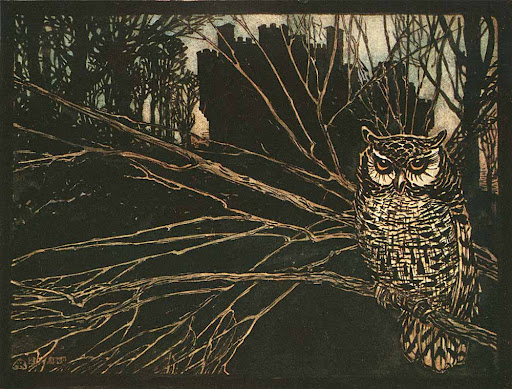
The witch as an owl by Arthur Rackham

The witch as an owl by Arthur Rackham

I have seen Jorinda and Joringel (sometimes spelled Jorindel) in many folklore collections, but I always passed it by.  A cursory glance led me to think it was much like Hansel and Gretel, not one of my favorite tales.  I’m not alone in skipping it:  I’ve never seen it discussed or analyzed by any of the writers on folklore I read.

I picked it up recently, intending to read myself to sleep, but stayed awake instead.  Jorinda and Joringel is a scary story with unexpected depths as well as features found in other celebrated stories.  One key image strikingly parallels a central symbol from India, which raises other questions.  Here is a summary of the tale:

***

Synopsis of “Jorinda and Joringel” in The Annotated Brothers Grimm

Once there was a witch who lived in a castle in the depths of a thick forest.  By day she took the shape of a cat or and owl, but at night she appeared as an old woman whose nose curved down to touch her chin.  She would kill and eat any bird or animal that ventured near.  If any human came within 100 feet of the castle, she would freeze them on the spot; they’d be unable to move until she released them.  She turned innocent girls into songbirds and keep them in cages inside the castle; she had 7000 birds and counting.

A beautiful maiden named Jorinda was betrothed to a youth named Joringel.  They enjoyed nothing more than spending time together, and one day they decided to walk in the woods.  “We just have to stay away from the castle,” Joringel said.

As the sun began to set, they heard the plaintive song of a turtledove. Jorinda began to weep while Jorindel sighed and felt oppressed with sadness. He noticed the wall of a nearby castle, but before he could utter a warning, Jorinda was turned into a nightingale. An owl with flashing eyes flew around them thrice and Joringel was frozen in place, a living statue unable to move.

The owl flew into a bush and a moment later an old woman emerged to carry Jorinda into the castle.  When she returned, she freed Joringel from the spell.  He fell to his knees and begged the witch to return his beloved, but she only said, “You will never see her again,” and departed.

Joringel wandered aimlessly in great despair.  He came to an unknown village where he worked for a long time tending sheep.  Sometimes he would circle the castle there but never too closely.

One night he dreamed of a blood-red flower with a beautiful pearl inside.  In the dream, he was back at the witch’s castle, and everything he touched with the flower was disenchanted.  When he woke in the morning, he started to search for the flower.  For nine days he roamed wilderness and village, and at last he found a blood-red flower with a large drop of dew inside that was as bright as any pearl.

He returned to the witch’s castle, boldly strode up, and touched the gate with the flower.  It flew open.  He found the room where the sorceress was feeding her birds.  When she saw Joringel, she was filled with rage, but she couldn’t come within two feet of him.  There were several hundred nightingales – how would Joringel find the right one?  Then he noticed the witch sneaking toward the door with a single cage.

Joringel ran to touch both her and the cage with the flower.  In an instant, Jorinda stood beside him and the witch lost her magical powers forever.  After freeing the other birds, Jorinda and Joringel departed.  They were married and lived with great happiness for a very long time.

*** 

After reading the story several times, I jotted down a few of the questions that came to mind:

  1. Why are Jorinda and Jorigel depicted as being so young?  In several translations, they are called “girl” and “boy” rather than “maiden” and “youth.”  Of the three illustrations I found, one depicts them as children.  Why?
  2. People are frozen or turned to stone in stories all over the world.  I thought of The Water of Life which I discussed here, as well as the ice queen in The Lion, the Witch, and The Wardrobe by C.S. Lewis.  What does it mean to be frozen like that?
  3. Why were the girls turned into songbirds?  Enchanted fairytale people usually wind up in far less appealing shapes.
  4. Another widespread motif is doing menial work for a very long time.   Here it is tending sheep.  More often it’s kitchen work.  Cinderella worked in the ashes for as long as it took a hazel twig, watered with her tears, to grow into a large tree.  Fairytale heroes and heroines wind up doing menial work when they are stuck or stalled in their quest.  If they do it well and for long enough, they find solutions.  Can this tell us anything useful?
  5. My final question concerned the pearl in the blood-red flower.  In western stories, such flowers are always roses; in the east, it would be a lotus.  Om Mani Padme Hum, is probably the world’s best known mantra and is usually (though incorrectly) translated as, “The jewel is in the lotus.”  Are the parallel images merely coincidence?  Or diffusion of stories?  Or the collective unconscious, or what?

These are the kind of things I always wonder about in stories like this.  I hunted and found a reference that doesn’t discuss this particular tale but casts light on these issues.  I’ll discuss them next time.  Meanwhile, if the story raised other questions for you, please post them.  Maybe someone here or a songbird in the tree outside will have an answer for you.

To Be Continued

Happy 94th birthday to Pete Seeger!

Pete Seeger, June 2007, by Anthony Pepitone.  CC-by-SA-3.0

Pete Seeger, June 2007, by Anthony Pepitone. CC-by-SA-3.0

I was lucky enough to hear Pete Seeger in a small, intimate venue when I was in my teens, and I was impressed by his humor, talent, and humility.  How wonderful that he just keeps going and going and going!

Here’s a nice five minute interview he did in 1994 with Bill Moyers, “Pete Seeger on What it Takes to Change the World.”

And here, just for the fun of it, is Bruce Springsteen and the band he formed to record,”The Seeger Sessions,” a tribute to Pete and one of my favorite albums. The song is “Mrs. McGrath,” an Irish anti-war song published in 1815 that Pete Seeger popularized and Springsteen set to rock-jazz-celtic rhythms. Enjoy!