Jorinda and Joringel: a fairytale from The Brothers Grimm

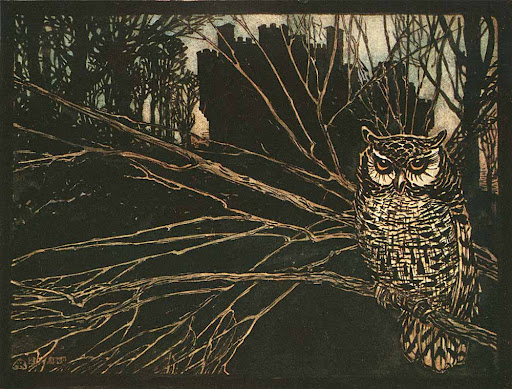
The witch as an owl by Arthur Rackham

The witch as an owl by Arthur Rackham

I have seen Jorinda and Joringel (sometimes spelled Jorindel) in many folklore collections, but I always passed it by.  A cursory glance led me to think it was much like Hansel and Gretel, not one of my favorite tales.  I’m not alone in skipping it:  I’ve never seen it discussed or analyzed by any of the writers on folklore I read.

I picked it up recently, intending to read myself to sleep, but stayed awake instead.  Jorinda and Joringel is a scary story with unexpected depths as well as features found in other celebrated stories.  One key image strikingly parallels a central symbol from India, which raises other questions.  Here is a summary of the tale:

***

Synopsis of “Jorinda and Joringel” in The Annotated Brothers Grimm

Once there was a witch who lived in a castle in the depths of a thick forest.  By day she took the shape of a cat or and owl, but at night she appeared as an old woman whose nose curved down to touch her chin.  She would kill and eat any bird or animal that ventured near.  If any human came within 100 feet of the castle, she would freeze them on the spot; they’d be unable to move until she released them.  She turned innocent girls into songbirds and keep them in cages inside the castle; she had 7000 birds and counting.

A beautiful maiden named Jorinda was betrothed to a youth named Joringel.  They enjoyed nothing more than spending time together, and one day they decided to walk in the woods.  “We just have to stay away from the castle,” Joringel said.
As the sun began to set, they heard the plaintive song of a turtledove. Jorinda began to weep while Jorindel sighed and felt oppressed with sadness. He noticed the wall of a nearby castle, but before he could utter a warning, Jorinda was turned into a nightingale. An owl with flashing eyes flew around them thrice and Joringel was frozen in place, a living statue unable to move.

The owl flew into a bush and a moment later an old woman emerged to carry Jorinda into the castle.  When she returned, she freed Joringel from the spell.  He fell to his knees and begged the witch to return his beloved, but she only said, “You will never see her again,” and departed.

Joringel wandered aimlessly in great despair.  He came to an unknown village where he worked for a long time tending sheep.  Sometimes he would circle the castle there but never too closely.

One night he dreamed of a blood-red flower with a beautiful pearl inside.  In the dream, he was back at the witch’s castle, and everything he touched with the flower was disenchanted.  When he woke in the morning, he started to search for the flower.  For nine days he roamed wilderness and village, and at last he found a blood-red flower with a large drop of dew inside that was as bright as any pearl.

He returned to the witch’s castle, boldly strode up, and touched the gate with the flower.  It flew open.  He found the room where the sorceress was feeding her birds.  When she saw Joringel, she was filled with rage, but she couldn’t come within two feet of him.  There were several hundred nightingales – how would Joringel find the right one?  Then he noticed the witch sneaking toward the door with a single cage.

Joringel ran to touch both her and the cage with the flower.  In an instant, Jorinda stood beside him and the witch lost her magical powers forever.  After freeing the other birds, Jorinda and Joringel departed.  They were married and lived with great happiness for a very long time.

*** 

After reading the story several times, I jotted down a few of the questions that came to mind:

  1. Why are Jorinda and Jorigel depicted as being so young?  In several translations, they are called “girl” and “boy” rather than “maiden” and “youth.”  Of the three illustrations I found, one depicts them as children.  Why?
  2. People are frozen or turned to stone in stories all over the world.  I thought of The Water of Life which I discussed here, as well as the ice queen in The Lion, the Witch, and The Wardrobe by C.S. Lewis.  What does it mean to be frozen like that?
  3. Why were the girls turned into songbirds?  Enchanted fairytale people usually wind up in far less appealing shapes.
  4. Another widespread motif is doing menial work for a very long time.   Here it is tending sheep.  More often it’s kitchen work.  Cinderella worked in the ashes for as long as it took a hazel twig, watered with her tears, to grow into a large tree.  Fairytale heroes and heroines wind up doing menial work when they are stuck or stalled in their quest.  If they do it well and for long enough, they find solutions.  Can this tell us anything useful?
  5. My final question concerned the pearl in the blood-red flower.  In western stories, such flowers are always roses; in the east, it would be a lotus.  Om Mani Padme Hum, is probably the world’s best known mantra and is usually (though incorrectly) translated as, “The jewel is in the lotus.”  Are the parallel images merely coincidence?  Or diffusion of stories?  Or the collective unconscious, or what?

These are the kind of things I always wonder about in stories like this.  I hunted and found a reference that doesn’t discuss this particular tale but casts light on these issues.  I’ll discuss them next time.  Meanwhile, if the story raised other questions for you, please post them.  Maybe someone here or a songbird in the tree outside will have an answer for you.

To Be Continued

Happy 94th birthday to Pete Seeger!

Pete Seeger, June 2007, by Anthony Pepitone.  CC-by-SA-3.0

Pete Seeger, June 2007, by Anthony Pepitone. CC-by-SA-3.0

I was lucky enough to hear Pete Seeger in a small, intimate venue when I was in my teens, and I was impressed by his humor, talent, and humility.  How wonderful that he just keeps going and going and going!

Here’s a nice five minute interview he did in 1994 with Bill Moyers, “Pete Seeger on What it Takes to Change the World.”

And here, just for the fun of it, is Bruce Springsteen and the band he formed to record,”The Seeger Sessions,” a tribute to Pete and one of my favorite albums. The song is “Mrs. McGrath,” an Irish anti-war song published in 1815 that Pete Seeger popularized and Springsteen set to rock-jazz-celtic rhythms. Enjoy!

Permission to be ourselves

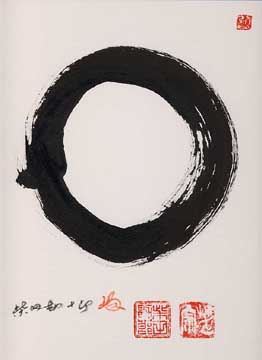
Not long ago, I came upon a post by Zen practitioner, Tomas Qubeck, called “Zen: How to Recalibrate Myself Back to Zero.”  Tomas discusses his love of solitary retreats.  I’m with him on that score, but then he adds an unusual twist – “Just recently I have realized that this ‘zero’ refers to ‘zero purpose’.”

Enso circle.  CC-by-SA-3.0

Enso circle. CC-by-SA-3.0

I know from experience that letting go of purposeful action for any length of time is a very difficult practice.  Why would one even bother?  Tomas observes that an urge to be purposeful often “shows up in my mind, [as] an image or…a sense of how I want to feel or be. All of this necessarily involves a moving away from how and what I am just at this very moment.”  Sometimes busy-ness can be an addiction, he says.

I’ll leave you to read his reflections, which have nothing to do with quitting our jobs, living in caves, or any other oddball decisions his title might suggest if you take it literally.  My own thoughts veered in a different direction.  Thinking of “purposeful action,” reminded me of something I heard Zen teacher, Edward Espe Brown say at a day long retreat:

“No matter what you do, your inner authorities will not be pleased.”

I’ve written several posts about Edward Brown.  I enjoy his humor, the deceptively “simple” depth of his insights, as well as the wisdom he gained as a chef and the recipes he shares in his Tassajara Cookbook.  I’ve attended three retreats with him in as many years and jotted down some of his pithy statements.  In Zen, one carries such sayings in the mind, turning them over until fresh meaning emerges.  Here are four others I’ve found valuable.  I often remember them at interesting moments.

What is precious in us doesn’t come and it doesn’t go.  It is not dependent on performance.

Are you going to be a rule follower, or are you just going to be you?

No one else can give us permission to be who we are.

There is no by-the-book way for you to be you.

As you might guess, Edward Brown, who was trained in traditional Zen by Shunryu Suzuki Roshi, is charting his own course these days.  If you want to learn more about his style of cooking and Zen, you can visit his home page and and listen to some of his teachings at The Peaceful Sea Sangha website.

Secondhand Lions: a movie review

“If you want to believe in something, believe in it. Doesn’t matter if it isn’t true.  You believe in it anyway.” Hub McCann (Robert Duvall) in Secondhand Lions

The recent death of country music star George Jones, reminded me of Robert Duvall’s Oscar winning performance in Tender Mercies (1983), the story of an alcoholic country singer who finds redemption with the help of a woman, as Jones did toward the end of his life.

The truth is, I never much cared for Jone’s music, but Robert Duvall is one of my favorite actors.  I started thinking of Secondhand Lions (2003) which also stars Duvall and is one of funniest and most satisfying movies I’ve ever seen.  I have the DVD and watched it again yesterday.  Now I’m wondering why it took me so long to write a review.

*** Spoiler Alert ***

It’s the summer of 1962 when Walter Caldwell, on the cusp of adolescence, is dumped by his irresponsible mother, Mae, at the remote Texas ranch of his two great uncles, Hub (Robert Duvall) and Garth McCann (Michael Caine).

secondhandlions - mom

“The last thing we need is some little sissy boy hanging around all summer,” Garth tells Mae.  Hearing this, Walter’s misery is palpable.  The first part of the movie shows how the trio eventually bonds.

The McCann brothers are rumored to have a hidden fortune, which brings a stream of salesmen and conniving relatives to their door. Hub and Garth spend their days shooting at salesmen, until Walter suggests they listen to one to see what he’s selling.

SecondhandLions_20

After listening to a seed salesmen, the trio plants a garden, only to learn they’ve been duped and sold nothing but corn seed.  The result is a huge cornfield they never really wanted.  The uncles also order a lion from a circus supply dealer.  They plan to hunt and kill it to hang its head over the fireplace, though Walter reminds them they don’t have a fireplace.  The lion turns out to be an aged female who is too sick to crawl out of her crate.  It wouldn’t be sporting to shoot her, Garth observes.

Secondhand lions - lion

Walter names the lion Jasmine, after a mysterious woman whose fading photo he finds in an attic trunk.  He nurses Jasmine back to health, and she takes up residence in the cornfield, the closest thing to a jungle in west Texas.  The lioness proves her worth by scaring away a family of greedy relatives, who campaign to have Walter shipped to an orphanage.

The movie would be pleasant enough – and forgettable enough – if it simply dealt with two lonely old men and a fatherless boy filling a void in each other’s lives, but deeper themes comes into play, notably the tension between ideals and what’s real, between story and truth and memory.

At the time Walter found the photo of Jasmine, he spied Hub sleepwalking down to the pond each night, where he brandished a toilet plunger like a sword, challenging invisible enemies.  Garth begins a long story of Hub and Jasmine, that’s like something from the Arabian Nights or a Douglas Fairbanks movie.  Hub rescued Jasmine, a desert princess, from a rich sheik in the Sahara after the two brothers were shanghaied into the French Foreign Legion at the start of World War I.

Garth continues the story in several segments, and Walter finally persuades his uncle Hub to finish it.  He tells Walter how he ran off with Jasmine.  How her jilted suitor, the sheik, sent assassins after the pair until Hub tricked him out of a hundred pounds of gold and defeated him in a duel.  Jasmine died in childbirth a few years later , and Hub never loved another woman.

Just then Walter’s mother returns in the dead of night with her latest boyfriend who claims to be a detective on the trail of the McCann brothers, a pair of infamous bank robbers who left an accomplice named Jasmine to die by the side of the road after she was wounded during a robbery.  When Walter challenges the story, the “detective” hits him.  His time with the uncles has changed Walter, who fights back, and with the last of her strength, Jasmine the lion, rushes to defend her “cub.”

Jasmine’s heart gives out in the struggle – “She died with her boots on,” says Garth.  Mae still wants Walter to come with her, but he’s learning to stand up for himself.  “I want to stay here,” he says.  “For once in your life, do something for me.”

Seventeen years later, Walter is a successful cartoonist, who draws a strip called “Walter and Jasmine,” the adventures of a boy and his lion.  The sheriff calls with bad news – his uncles, both 90 years old, have died in a hair-brained accident – with their boots on.  Walter both weeps and laughs when he learns the details.  The sheriff hands Walter the brothers will, which reads, “The kid gets it all.  Just plant us in the damn garden, next to the stupid lion.”

In the final scene, an oil company helicopter lands, and the son of the sheik from Jasmine’s story steps out.  “I was in Houston on business when I read the news,” he says.  “My father always talked about your uncles.  He called them his most worthy opponents, but I thought they were only stories.  So they really lived?”

“Yeah,” says Walter.  “They really lived.

There are many levels to this seemingly simple movie.  On one hand, some of the antics are hilarious.  It’s also a sensitive coming of age tale.  With the notable exception of Harry Potter, most such stories and movies over the last decade have centered on girls’ awakening.  Unlike Potter, however, Secondhand Lions reflects some of the features we know belonged to classic men’s initiation rites, such as “leaving the house of the mothers to join the fathers.”

But finally, what makes this movie great, and of universal interest to me, is its take on what is real and valuable in the stories we tell.  As Hub says to Walter:

“Sometimes, the things that may or may not be true are the things that a man needs to believe in the most: that people are basically good; that honor, courage, and virtue mean everything; that power and money, money and power, mean nothing; that good always triumphs over evil; and I want you to remember this, that love, true love, never dies.  You remember that, boy.  Doesn’t matter if they are true or not.  A man should believe in those things because those are the things worth believing in.”

A solid five stars for this movie.  I haven’t counted lately, but I’m sure it’s still up in my ten best for all time.

Remembering Ritchie Havens

richie-havens_esc

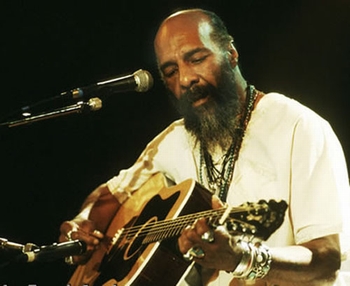
Lots of people are writing memorials to Ritchie Havens who died today at the age of 72.  “Folk singer and guitarist” is what the newspapers say.  Factually correct but nowhere near the experience of hearing his music, especially for the first time.

I was just a kid who found himself, through a strange karmic twist, at the Village Theater in New York, for the first show of Cream’s first American tour.  First we had to sit through a set by some folksinger none of us had ever heard of.  Some Ritchie something guy – and he stunned us. Left the main act in the dust  On our feet, open mouthed, one of those “never heard anything like this before” musicians.

A few years later he did the same thing for half a million at Woodstock.  All I can think to do now is pass on a couple of songs, especially for those who may not be familiar with his music.

Ritchie Havens at Woodstock

Ritchie Havens at Woodstock

Freedom was a theme that ran through most of his music.  One of his best known songs bore that name, but here is one of my favorites that isn’t as well known. He recorded this version of “Follow the Drinking Gourd” for an album of Civil War songs following Ken Burns’ documentary.  Slaves escaping north on “the underground railroad” were told to travel only at night and “follow the drinking gourd,” the constellation we know as the big dipper, where the north star would show them the way.

His songs songs were woven with hopes and dreams.  Here’s another one someone just posted, wanting to share some expression of this beautiful soul.

I keep wanting to say, “Rest in peace,” but for Ritchie Havens, I think it’s a given.