Not long ago, I came upon a post by Zen practitioner, Tomas Qubeck, called “Zen: How to Recalibrate Myself Back to Zero.” Tomas discusses his love of solitary retreats. I’m with him on that score, but then he adds an unusual twist – “Just recently I have realized that this ‘zero’ refers to ‘zero purpose’.”
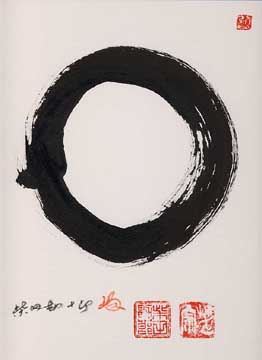
Enso circle. CC-by-SA-3.0
I know from experience that letting go of purposeful action for any length of time is a very difficult practice. Why would one even bother? Tomas observes that an urge to be purposeful often “shows up in my mind, [as] an image or…a sense of how I want to feel or be. All of this necessarily involves a moving away from how and what I am just at this very moment.” Sometimes busy-ness can be an addiction, he says.
I’ll leave you to read his reflections, which have nothing to do with quitting our jobs, living in caves, or any other oddball decisions his title might suggest if you take it literally. My own thoughts veered in a different direction. Thinking of “purposeful action,” reminded me of something I heard Zen teacher, Edward Espe Brown say at a day long retreat:
“No matter what you do, your inner authorities will not be pleased.”
I’ve written several posts about Edward Brown. I enjoy his humor, the deceptively “simple” depth of his insights, as well as the wisdom he gained as a chef and the recipes he shares in his Tassajara Cookbook. I’ve attended three retreats with him in as many years and jotted down some of his pithy statements. In Zen, one carries such sayings in the mind, turning them over until fresh meaning emerges. Here are four others I’ve found valuable. I often remember them at interesting moments.
What is precious in us doesn’t come and it doesn’t go. It is not dependent on performance.
Are you going to be a rule follower, or are you just going to be you?
No one else can give us permission to be who we are.
There is no by-the-book way for you to be you.
As you might guess, Edward Brown, who was trained in traditional Zen by Shunryu Suzuki Roshi, is charting his own course these days. If you want to learn more about his style of cooking and Zen, you can visit his home page and and listen to some of his teachings at The Peaceful Sea Sangha website.
“If you want to believe in something, believe in it. Doesn’t matter if it isn’t true. You believe in it anyway.” Hub McCann (Robert Duvall) in Secondhand Lions
The recent death of country music star George Jones, reminded me of Robert Duvall’s Oscar winning performance in Tender Mercies (1983), the story of an alcoholic country singer who finds redemption with the help of a woman, as Jones did toward the end of his life.
The truth is, I never much cared for Jone’s music, but Robert Duvall is one of my favorite actors. I started thinking of Secondhand Lions (2003) which also stars Duvall and is one of funniest and most satisfying movies I’ve ever seen. I have the DVD and watched it again yesterday. Now I’m wondering why it took me so long to write a review.
*** Spoiler Alert ***
It’s the summer of 1962 when Walter Caldwell, on the cusp of adolescence, is dumped by his irresponsible mother, Mae, at the remote Texas ranch of his two great uncles, Hub (Robert Duvall) and Garth McCann (Michael Caine).
“The last thing we need is some little sissy boy hanging around all summer,” Garth tells Mae. Hearing this, Walter’s misery is palpable. The first part of the movie shows how the trio eventually bonds.
The McCann brothers are rumored to have a hidden fortune, which brings a stream of salesmen and conniving relatives to their door. Hub and Garth spend their days shooting at salesmen, until Walter suggests they listen to one to see what he’s selling.
After listening to a seed salesmen, the trio plants a garden, only to learn they’ve been duped and sold nothing but corn seed. The result is a huge cornfield they never really wanted. The uncles also order a lion from a circus supply dealer. They plan to hunt and kill it to hang its head over the fireplace, though Walter reminds them they don’t have a fireplace. The lion turns out to be an aged female who is too sick to crawl out of her crate. It wouldn’t be sporting to shoot her, Garth observes.
Walter names the lion Jasmine, after a mysterious woman whose fading photo he finds in an attic trunk. He nurses Jasmine back to health, and she takes up residence in the cornfield, the closest thing to a jungle in west Texas. The lioness proves her worth by scaring away a family of greedy relatives, who campaign to have Walter shipped to an orphanage.
The movie would be pleasant enough – and forgettable enough – if it simply dealt with two lonely old men and a fatherless boy filling a void in each other’s lives, but deeper themes comes into play, notably the tension between ideals and what’s real, between story and truth and memory.
At the time Walter found the photo of Jasmine, he spied Hub sleepwalking down to the pond each night, where he brandished a toilet plunger like a sword, challenging invisible enemies. Garth begins a long story of Hub and Jasmine, that’s like something from the Arabian Nights or a Douglas Fairbanks movie. Hub rescued Jasmine, a desert princess, from a rich sheik in the Sahara after the two brothers were shanghaied into the French Foreign Legion at the start of World War I.
Garth continues the story in several segments, and Walter finally persuades his uncle Hub to finish it. He tells Walter how he ran off with Jasmine. How her jilted suitor, the sheik, sent assassins after the pair until Hub tricked him out of a hundred pounds of gold and defeated him in a duel. Jasmine died in childbirth a few years later , and Hub never loved another woman.
Just then Walter’s mother returns in the dead of night with her latest boyfriend who claims to be a detective on the trail of the McCann brothers, a pair of infamous bank robbers who left an accomplice named Jasmine to die by the side of the road after she was wounded during a robbery. When Walter challenges the story, the “detective” hits him. His time with the uncles has changed Walter, who fights back, and with the last of her strength, Jasmine the lion, rushes to defend her “cub.”
Jasmine’s heart gives out in the struggle – “She died with her boots on,” says Garth. Mae still wants Walter to come with her, but he’s learning to stand up for himself. “I want to stay here,” he says. “For once in your life, do something for me.”
Seventeen years later, Walter is a successful cartoonist, who draws a strip called “Walter and Jasmine,” the adventures of a boy and his lion. The sheriff calls with bad news – his uncles, both 90 years old, have died in a hair-brained accident – with their boots on. Walter both weeps and laughs when he learns the details. The sheriff hands Walter the brothers will, which reads, “The kid gets it all. Just plant us in the damn garden, next to the stupid lion.”
In the final scene, an oil company helicopter lands, and the son of the sheik from Jasmine’s story steps out. “I was in Houston on business when I read the news,” he says. “My father always talked about your uncles. He called them his most worthy opponents, but I thought they were only stories. So they really lived?”
“Yeah,” says Walter. “They really lived.”
There are many levels to this seemingly simple movie. On one hand, some of the antics are hilarious. It’s also a sensitive coming of age tale. With the notable exception of Harry Potter, most such stories and movies over the last decade have centered on girls’ awakening. Unlike Potter, however, Secondhand Lions reflects some of the features we know belonged to classic men’s initiation rites, such as “leaving the house of the mothers to join the fathers.”
But finally, what makes this movie great, and of universal interest to me, is its take on what is real and valuable in the stories we tell. As Hub says to Walter:
“Sometimes, the things that may or may not be true are the things that a man needs to believe in the most: that people are basically good; that honor, courage, and virtue mean everything; that power and money, money and power, mean nothing; that good always triumphs over evil; and I want you to remember this, that love, true love, never dies. You remember that, boy. Doesn’t matter if they are true or not. A man should believe in those things because those are the things worth believing in.”
A solid five stars for this movie. I haven’t counted lately, but I’m sure it’s still up in my ten best for all time.
Lots of people are writing memorials to Ritchie Havens who died today at the age of 72. “Folk singer and guitarist” is what the newspapers say. Factually correct but nowhere near the experience of hearing his music, especially for the first time.
I was just a kid who found himself, through a strange karmic twist, at the Village Theater in New York, for the first show of Cream’s first American tour. First we had to sit through a set by some folksinger none of us had ever heard of. Some Ritchie something guy – and he stunned us. Left the main act in the dust On our feet, open mouthed, one of those “never heard anything like this before” musicians.
A few years later he did the same thing for half a million at Woodstock. All I can think to do now is pass on a couple of songs, especially for those who may not be familiar with his music.
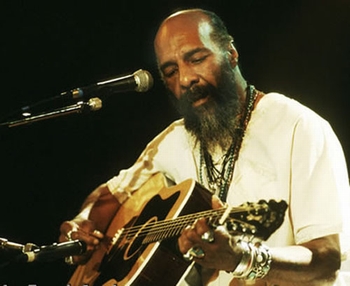
Ritchie Havens at Woodstock
Freedom was a theme that ran through most of his music. One of his best known songs bore that name, but here is one of my favorites that isn’t as well known. He recorded this version of “Follow the Drinking Gourd” for an album of Civil War songs following Ken Burns’ documentary. Slaves escaping north on “the underground railroad” were told to travel only at night and “follow the drinking gourd,” the constellation we know as the big dipper, where the north star would show them the way.
His songs songs were woven with hopes and dreams. Here’s another one someone just posted, wanting to share some expression of this beautiful soul.
I keep wanting to say, “Rest in peace,” but for Ritchie Havens, I think it’s a given.
OK, I’ll admit it – I’m up for a bit of humor and frivolity these days. And as a fan of Iceland as well as Ragnar and the gang on “The Vikings,” I’m grateful to Orkinpod for introducing me to a new mythic creature, the fearsome Viking Chicken (shudder).
We have all heard and read more words this week than we want or need. The ones that keep coming back to me were written in 1919, in a poem called “The Second Coming,” a haunting vision written by William Butler Yeats in the wake of the first world war.
W.B. Yeats by John Singer Sargent. Public Domain
The Second Coming
Turning and turning in the widening gyre
The falcon cannot hear the falconer;
Things fall apart; the centre cannot hold;
Mere anarchy is loosed upon the world,
The blood-dimmed tide is loosed, and everywhere
The ceremony of innocence is drowned;
The best lack all conviction, while the worst
Are full of passionate intensity.
Surely some revelation is at hand;
Surely the Second Coming is at hand.
The Second Coming! Hardly are those words out
When a vast image out of Spiritus Mundi
Troubles my sight: somewhere in sands of the desert
A shape with lion body and the head of a man,
A gaze blank and pitiless as the sun,
Is moving its slow thighs, while all about it
Reel shadows of the indignant desert birds.
The darkness drops again; but now I know
That twenty centuries of stony sleep
Were vexed to nightmare by a rocking cradle,
And what rough beast, its hour come round at last,
Slouches towards Bethlehem to be born?
***
Yeats was a member of The Golden Dawn, an early 20th century occult organization centered in Britain that sought to recover lost elements of the western mystery traditions. Their once-secret teachings are now posted online, where we can see that the group practiced the kind of visualizations that could give rise to spontaneous “images out of Spiritus Mundi,” the World Spirit, one of the Golden Dawn’s concepts.
Elsewhere we can read that the poet worked out his own concept of world cycles or “gyres” as he put it here. We find theories of world cycles from many cultures in many times. The Greeks said there once was a Golden Age, but now it is Iron. We’ve all heard of the Age of Aquarius, though unfortunately astrologers now tell us it won’t begin for a few hundred years. Eastern cultures envision vast cycles that rise and fall and rise again eternally.
In all of these visions, this is the Iron Age, the Kali Yuga, a time of degeneration, where the ceremony of innocence is drowned. Different traditions differ on where it goes from here.
In one account, offered by Paramahansa Yogananda, the crucifixion marked the nadir of this particular world age. Things are getting better; right now we are experiencing inertia, a last gasp of the dark ages. Even in this hopeful account, nothing is fixed or pre-determined. It’s up to us. How we live our lives, what we think, and what we do, matter more than we know. More than we can imagine.
In truth, we already know this, just as we know that despair is not an option. It seems to me the only choice we have is to live moment by moment as if we are the people we want to be, living in the world we want to live in. There may not be anything more important. Isn’t it true that the sum of our collective thoughts and actions is going to shape our world and the one future generations are going to inherit?
He was just arrested on Tuesday, but already they’re writing ballads about the North Pond Hermit:
Nobody seen his face in twenty-seven years, Since that day in ’86 when he up and disappeared.
The story has travelled around the world, and unless you are living in the woods, you’ve heard the rudiments of Christopher Knight’s story:
At the age of 19, he disappeared and set up a camp in the woods near Rome, Maine, where he lived for 27 years by stealing sleeping bags, food, propane, and books from nearby vacation cabins and a summer camp. He spent the long winters wrapped in multiple sleeping bags and never made a campfire for fear of being discovered. He spent his time reading and meditating. His only conversation in 27 years was a greeting exchanged with a hiker he met on the trail in the ’90’s.
Christopher Knight
When he was arrested, Knight was neatly groomed and clean shaven. He’s up on current affairs thanks to a transistor radio he used to listen to rock music, news, and Rush Limbaugh. That’s about all we know, since Knight politely refuses to talk to journalists or explain himself to anyone. This guy is going to pass on his 15 minutes of fame, his shot at a spot on Letterman, and the chance for a best selling ghost-written bio!
He walked away into the pines to live out in the woods He turned his back on everything and he was gone for good.
I think the story resonates so deeply because part of us too, wants to walk away from all that crap. “Lives of quiet desperation” in the words of Thoreau, who lived for two years in relative solitude at Walden Pond, but never made or intended to make a break as complete as that of Christopher Knight.
Into an unimaginable mystery like this, each of us will project our own biases. For me, Knight’s practice of meditation aligns him with spiritual seekers who have sought out caves of one sort of another for millennia, but they never threw off all human connections.
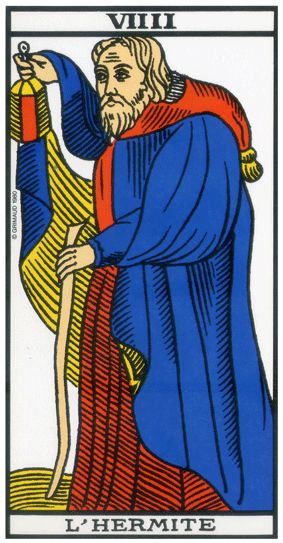
The Hermit, from the Tarot de Marseille
Christians have maintained a hermit tradition from the desert fathers through Thomas Merton, but none of them relinquished all human company. Milarepa, a famous Tibetan yogi, lived in a cave for years eating boiled nettles, which gave his skin a greenish cast, yet once he attained awakening, he returned to teach what he’d learned to others.
Did Christopher Knight intend to return someday, to tell us what he’d discovered about the mushrooms and eagles who were his only companions? We don’t know and won’t unless he decides to tell us. In a way, I hope he doesn’t. Whatever his story may be, it will be trivialized and forgotten a week after the tabloids get ahold of it. I don’t want Christopher Knight’s tale to be forgotten.
Some of his old friends have said he was “intelligent, quiet, and nerdy” in high school – just like millions of us, in other words. What could make an intelligent man who is one of us, simply decide to walk away, to opt out? I hope we will wonder about that for a long, long time.
The North Pond Hermit, livin’ in the woods, The North Pond Hermit, they’d catch him if they could.
Troy Bennet and his dog, Hook, who brought you this great ballad, have posted a link to an MP3 version we can download for an optional contribution via Paypal. Bennet says it isn’t his very best song, but it’s the one he’s written about a hermit this week.





 The First Gates