Swan Maidens and Fairy Lovers, Part 2

It’s good to know that glasses can help us drink.  The problem is, we don’t know the purpose of thirst. – Antonio Machado

I hope I didn’t create the impression that I have any solid answers to the questions The Bride of Llyn y Fan Fach raises. Just “hints followed by guesses,” to quote T.S. Eliot.

In stories of this type, from all over the world, beautiful Otherworld women enter the lives of mortal men and then leave.  It’s not too great a stretch to imagine they represent the beauty, the love and fulfillment, the joy and intensity we long for in the world, but usually find to be fleeting.  The occasion for the lake woman’s departure is a tap on the shoulder that counts as a “blow.”  In a literal sense, this is absurd.  I take it to mean that the radiance of the Otherworld is like a spectacular sunset:  it illuminates our world but does not endure.  If it hadn’t been a tap, it would have been something else.  Perhaps as T.S. Eliot said, “Human kind cannot bear very much reality.”

Renunciation is not giving up the things of this world, it’s giving up the idea that they last – a Zen master.

Traditional fairytales are not linked to specific dates and places, but this one is.  This indicates a modern sensibility shaping the story pattern, and it seems especially clear in the lake woman’s belief that the world is a veil of tears.  The usual fairytale heroine does not cry at weddings, where people are “entering trouble,” nor does she laugh at funerals where people are “leaving their troubles.”  Her legacy is the gift of healing to help alleviate suffering.

In the lake woman’s view, this world is not our home, but while we are here, compassion is the highest virtue.  This sentiment could have come from Celtic Christianity.  It is also very eastern and reminds me of the theory that the Celts are linked, by diffusion, with the Aryan warriors of India.  Either way, this is a very different world from the Cinderella tales or stories like The Water of Life which suggest you can find your prince or princess and live a happy life together.

And you know the sun’s setting fast, And just like they say, nothing good ever lasts. – Iris DeMent

At the opening of this story, we learn that the young man’s father “died in the wars.”  The dates vary in different texts. One says the end of the 12th century, and others, the 13th century.  The latter date would coincide with the conquest of Wales by Edward Longshanks, the villain in Braveheart.  Edward invited all the bards in Wales to a council and had them killed, understanding that a nation without stories ceases to be a nation.  What Longshanks didn’t understand was that Celtic stories survive wherever there is a pub, a hearth fire, or a quiet country lane, yet I think the sadness of a conquered people infuses the story.

We know there is another world.  The question is, how far is it from midtown and how late is it open? – Woody Allen

Twenty years ago, Mary and I travelled with a small group of storytellers on a tour called, “The Quest for Arthur’s Britain.”  Our guides were a remarkable couple, Robert Bella Wilhelm and his wife, Kelly, who have devoted their lives to storytelling and the sacred.  I’m happy to say they are still at it.  You can check out their website for details on storytelling trips to the Orkney Islands in May, to Iceland in September, and to Hawaii in Jan., 2013:  http://www.storyfestjourneys.com/
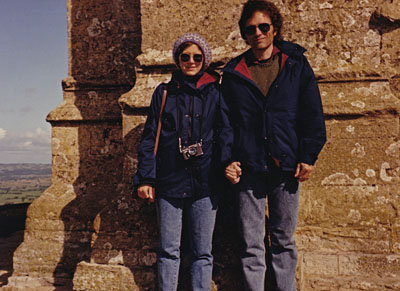
On Glastonbury Tor, Sept., 1991

We spent the last days of this journey at an Elizabethan manor house in the Black Mountain foothills, not too far from Llyn y Fan Fach.  It was one of a very few times in my life that I heard no traffic sound at night and saw no lights of a city.  When the moon was down, it was pitch black.  You could see the shapes of trees against the stars, but little else.

One night I strolled to the end of the yew walk.  The lights from the manor were hidden.  No light, no wind, no sound.  That alone was uncanny, but there was something more.  My Jungian training, which had taught me to understand spirits and fairies as archetypes of the psyche, vanished in a visceral rush of ice down the spine.  Part of me wanted to know what lay beyond, out in the open fields, but I couldn’t bring myself to take another step.  The hair on my neck stood up until I got back to the manor.

Do I believe in other worlds?  I did that night, and I think I do still.  I’m glad I knew the old stories and their lesson:  as human beings, this world is our home, for good or ill.  The peril is very great – too great – for those who venture too close to any other.

Swan Maidens and Fairy Lovers, Part I

When I was an active storyteller, I loved to tell one of the best known legends of Wales.  It’s found in many collections under various names, most often, “The Bride of Llyn y Fan Fach.”  Variations of this story are found all over the world.  A mortal man marries an Otherworld woman who breaks his heart, but sometimes brings marvelous children into the world.

Llyn y Fan Fach and the Bannau Sir Gaer by Rudi Winter. CC by-SA 2.0

I’ve started to write about this legend on other occasions, discarding drafts that rapidly grew beyond the scope of a blog post or two or three.  What prompted me to begin again was a visit to Barnes & Noble.

Barnes & Noble knows what sells.  An entire row is now filled with “Paranormal Romance.”  The covers feature illustrations of winsome teenage girls.  The genre isn’t new; Charles de Lint, a Canadian author, has written stories like this for thirty years.  The popularity is new, and almost all of today’s novels invert the usual folklore setup, in which a mortal man meets a fairy woman.  Not only that, but the odds of a happy ending in these tales are worse than the chance of hitting a single number at roulette.

The Swan Maiden

The Swan Maiden is the most widespread “mixed marriage” type of folktale.  It is also considered the most primitive, since the Otherworld woman’s native form isn’t human.  Usually it’s a bird.  Swan maiden stories are found all over Europe, as well as the middle east, Russia, India, China, and Japan.  There’s a parallel water buffalo woman story in Africa.  According to one researcher, the motif is 30,000 – 40,000 years old, as shown by a bison-woman cave painting.

In swan maiden tales, a man sees a flock of swans glide to earth at night.  Removing their swan robes, they change into beautiful women who bathe or dance together.  Enamored of one in particular, the man takes her robe so she won’t fly away, and eventually persuades her to marry him. Later they have children.  One day the swan-wife hears her children sing of where her husband has hidden the robe, or they tell their mother when they see her in tears.  The swan maiden puts on her robe and flies away forever, leaving the children with their father.

The Welsh Stories

I have a passion for Celtic stories, and those from Wales in particular, but Celtic fairies seldom give a mortal a break.  They put out a Scottish woman’s eye simply because she could see them.  When Thomas the Rhymer succeeded in pleasing the fairy queen for seven years, what did she give him as a reward?  A tongue that could only speak the truth!  Think about how that would serve you at work.  No mystery about why Thomas never married – “Does this make me look fat?”

In Welsh mixed-marriage tales, a mortal man wins the hand of a fairy wife who agrees to stay with him under certain conditions.  They have children, the husband accidentally breaks a condition, usually by touching his wife with iron, and she leaves.  He never sees her again, though she sometimes slips back to visit her children, whose descendants are beautiful and wise.  Here is the best of these stories:

The Bride of Llyn y Fan Fach

At the end of the 12th century, a young man lived with his mother, a war widow, in Carmarthensire in Wales.  Every day he drove their small flock of cattle to the lonely tarn known as Llyn y Fan Fach.  The cows preferred the grass there to any other pasture.

Llyn y Fan Fach, copyright Stuart Wilding, licensed for reuse CC by-SA

One morning, the man (who isn’t named in the tale) beheld a beautiful woman sitting on the water combing her hair.  All he had to offer was a bit of bread, but he walked to the shore and held it out.  She glided over the water and said, “Hard baked is thy bread.  Hard am I to hold.”  Then she dove under the waves.

Unable to think of anything else but her, he brought unbaked dough the next day.  She appeared at noon, glided to the shore, and said, “Unbaked is thy bread.  I will not have thee.”

The lady combs her hair on the water

The third time, the bread was just right.  The lady gave her assent and her father offered a sizable dowry of cattle, goats, and horses, after the young man agreed to one condition – his wife would leave him if he struck her three blows without cause.

Things went well at first, and they had three sons.  Then one day the couple was to attend a christening.  The lady delayed getting ready.  She sent her husband back to the house for her gloves, saying she would saddle the horse.  When she didn’t do so, the young man playfully tapped her on the shoulder with the gloves.  “Not ready yet?”

“Be more careful,” she said.  “For you have just struck the first blow without cause.”  [This incident echoes other stories where the husband touches his fairy wife with an iron bit while bridling a horse, but that detail is missing here.]

A few years later, at a wedding, the wife burst into tears.  The husband tapped her shoulder and asked why she wept.  “I weep for this couple who are now entering trouble,” she said.  “Be careful, my love, for your trouble draws closer.  That was the second blow without cause.”

The man stayed vigilant, and things went well for several more years.  Then one day his wife burst into laughter at a funeral.  He tapped her on the shoulder again and asked why she laughed.  “I laugh because this man has left a world full of trouble,” she said.  “But now your trouble is here.  Farewell, my husband.  You have just struck the third blow without cause.”

Ignoring his protests, she marched to the lake, and all her father’s animals followed.  A pair of oxen dragged a plow six miles to the lake, and the furrows can be seen to this day.  Of the unfortunate husband, we know nothing more.  Longing for their mother, the three sons went to the lake at night and she appeared.  “You are to be of help to the world,” she said.  “I shall instruct you in the arts of medicine.  You and your descendants will be great and skillful physicians.  Whenever you need my advice, I will appear.”

In time, they became the personal physicians of the Prince of South Wales.  The legend of the Bride of Llyn y Fan Fach comes from a book called The Physicians of Myddvai, 1861, by a Welsh printer named Rees.  The Welsh Historical Society has herbal recipes attributed to the lake woman’s descendants, and the last of the line, Dr. C. Rice Williams lived into the 1890’s.

***

What do we make of a story like this?  First, we can recall Marie-Louise Von Franz’s comparison of myth and folklore. The great myths and legends tend to be more polished.  Their plots are coherent enough to satisfy modern demands.  In contrast, folktales are more primal and more opaque.

One unique feature of this tale is the specificity of location and the lake lady’s descendants.  Greek families traced their ancestry to the heroes of Troy, and my mother had a coat of arms dating back to the Normal Conquest.  A similar dynamic is one explanation for the unique segue of this fairy tale into history.

The real mystery for me has always been, why is the husband is doomed from the start?  Who would count a shoulder tap as a “blow?”  Why do mortals never win when they give themselves to Otherworld lovers?

I’ve asked myself why since the day I found a book of local fairytales in a used bookstore in Wales on a visit 20 years ago.  Though I don’t have certain answers, I have some thoughts which I will offer next time.  Meanwhile, does anyone else have any ideas?  Why would the girl’s father set an impossible condition, and why would she actually leave over such a minor slight when the text says she really loves her husband?  I welcome any suggestions you may have.

Bill Moyers Interviews Andrew Bacevich on the Middle East

On January 4, I published a post called, “Sabre Rattling Over Oil:  Better Get Used to It.”  http://wp.me/pYql4-1AT

I quoted from a 2008 interview between Bill Moyers and Col. Andrew Bacevich in which Moyers says, “Our finest warriors are often our most reluctant warmongers.”  Now we the privilege of hearing these two in a new discussion on Moyers & Company as we seem to drift helplessly toward our third war in a decade, and voices of reason and restraint are drowned out in the hysterical ranting of politicians.

Please be sure to look for the show on PBS this weekend, or watch it on billmoyers.com  http://billmoyers.com/episode/moving-beyond-war/

Andrew Bacevich on Moyers & Company

This week, on an all-new Moyers & Company, Bill Moyers and Bacevich explore the futility of “endless” wars, and provide a reality check on the rhetoric of American exceptionalism.

“Are we so unimaginative, so wedded to the reliance on military means that we cannot conceive of any way to reconcile our differences with groups and nations in the Islamic world, and therefore bring this conflict to an end?” Bacevich tells Moyers.

Bacevich also answers the question of whether Iran is a direct threat to America with a definitive no. “Whatever threat Iran poses is very, very limited,” he tells Moyers, “and certainly does not constitute any kind of justification for yet another experiment with preventive war.”

Andrew Bacevich is a West Point graduate and Vietnam veteran who retired as a colonel after 23 years in the military, to teach history and international relations at Boston University.

Imagine by Jonah Lehrer: A Book Review

Update, July 31, 2012.

On July 30, author Jonah Lehrer admitted fabricating quotes in Imagine. He resigned his position as staff writer for The New Yorker, and Houghton Mifflin suspended sales of the book. You can read my full post on the topic here, which contains a link to the newspaper story. http://wp.me/pYql4-2hg

It is with much sadness that I’ve decided to remove the text of my review. Some of Lehrer’s observations on creativity remain insightful. At the same time, I think it is vital to stand up for ethics wherever we can find it in public life.

The Muppets Get Their Star

On March 20, the first day of spring, The Muppets received the 2466th star on Hollywood’s Walk of Fame.  The cast, which has charmed TV and movie viewers for 50 years, now joins a select group of “fictional” stars, which includes Mickey Mouse, Godzilla, Shrek, and The Simpsons.  Miss Piggy pointed out during the news conference, however, that all movie stars are fictional.

Photo by Frazer Harrison / Getty Images

Lisa Henson, CEO of Jim Henson Enterprises remarked that The Muppet’s star, in front of the El Capitan Theater, is very close to her father’s.  Henson created Muppet prototypes in 1955, for a show called Sam and Friends, which ran for six years on WRC-TV in Washington, DC.

Jim and Jane Henson with the cast of "Sam and Friends"

Henson died in 1990, at the age of 53, of complications from a severe strep throat infection.  Associates and family say he was so busy working, he didn’t seek medical help until it was too late.

During the last year of his life, Henson negotiated to sell the Muppets to Disney. The sale was finalized in 2004. The latest Muppet movie was released to DVD yesterday too, a seemingly successful effort to revitalize the cast and introduce Walter, a new character, who was present at the dedication ceremony.

Kermit received his own Walk of Fame star in 2002, but Henson’s little frog would be the first to say The Muppets are a group effort. The group finally has the recognition it deserves.

Blogging Reflections

Have you noticed how people use the word “whisperer,” where they once used “guru?”  Both terms imply a super-normal expertise, in some cases justified.  I’d love to have the Dog Whisperer visit our home!  Meanwhile, a quick check revealed you get 13,800,000 hits when you google on “blog whisperer?”

Last year, at a local writer’s conference, a “social media expert” who I think called himself a blog whisperer, offered to critique the blogs of those willing to come for the pre-session and pay $20.  That’s a bargain compared to the first blog whisperer to pop up on google, who charges $900 for a 90 day course on how to speak with “the voice of your soul.”

Think about that.  Though we might balk at the price, we live in a world that accepts the idea of hiring a coach to teach us to speak from our soul.  Afterwards, I guess we can look for a seminar on how to reclaim our power.

We live in a world of specialization and necessarily rely on experts in every phase of our lives.  In many cases, I think it’s a boon.  Those who long for the good old days are not in the throes of a toothache or facing surgery.

I have nothing against experts.  I like to have them around when the car breaks down or I break down.  For the garden, or home repairs, or internet security.

Yet something within us demands room to make our own discoveries and mistakes.  To come to our own conclusions.  To find out where we stand on things, what we really believe, regardless of the experts.

I used to think of writing as such an activity, but no longer.  Google on “writing, how to” and you get 1.9 trillion hits.  That’s a lot of whisperers!

The one little niche that is still free and clear, as far as I can see, is blogging, a medium that is unique because it allows us to think out loud in public.  For me, it is like a journal, a place to explore ideas, but the threat and promise of the “Publish” button forces me to go a step further.  When I pull the weeds from a first draft, I may find the seed of a new idea, or two, or three, or none.  Sometimes a draft lies fallow for weeks, and sometimes I publish within the hour.  More than a few get deleted.  One time I hit “Publish” when I meant to “Save” and got some practice in really fast editing.

I’ve heard some expert advice on blogging, and tend to ignore it all.  Before you say, “I knew it,” let me tell you what I mean – tips like:

  • Don’t write more than 250 words in a post.
  • Do not write about politics or religion.
  • Pick a single theme for your blog and stick to it.

The feedback I really take seriously comes from readers.  First there are simply the stats; people vote with their eyeballs.  Beyond that, is the power of even a single comment.

I’ve recently gotten enthralled, as I have in the past, with looking at old stories and legends.  When Adam, who blogs at Reviews and Ramblings http://blizzerd03.wordpress.com/ said he likes such posts, that was all the confirmation I needed.  “Yeah, this is road I have to follow.”  I value some of your comments more than 1.9 trillion articles on how to write.

As I have quoted more than once, as Joseph Campbell told the legends of the Holy Grail, he said every knight sought their own path into the forest; it would have been shameful to follow another’s trail.

This post is a way of thanking you all and a wish that we may all find our own way through the forest.

Doh! Now we (guys) are in for it!

NPR reports that in response to you know what, Democratic women legislators in six states have proposed new limits to male access to reproductive health care. http://www.npr.org/blogs/health/2012/03/15/148695307/in-protest-democrats-zero-in-on-mens-reproductive-health.   Consider:

House Bill 116 in Georgia states that:  “Thousands of children are deprived of birth in this state every year because of the lack of state regulation over vasectomies.”

An Oklahoma state senator proposed new legislation to regulate sexual acts:  “Any action in which a man ejaculates or otherwise deposits semen anywhere but in a woman’s vagina shall be interpreted and construed as an action against an unborn child.”

In Ohio, a female state senator sponsored a bill requiring men seeking drugs like viagra to:

  1. Have a cardiac stress test to ensure they are ready for sexual activity.
  2. Obtain written certification from a recent sexual partner that they are indeed experiencing erectile dysfunction.
  3. See a sexual therapist who would explain certain nonprescription lifestyle choices, such as celibacy, as alternate treatments for the problem.

***

It’s the very passion that people bring to these issues make them such effective smokescreens.  If “they” can get us asking the wrong questions…

We slide toward a third war in a decade with no hint of a national debate.  Recent news on Citigroup and Goldman Sachs reveal that the players who brought us the last financial meltdown are on track to do it again.  People know about Rush Limbaugh.  How many have heard of Greg Smith?

It used to be that “Nero fiddling while Rome burned” was the ultimate paradigm of irresponsible leadership.  Now it’s the 2012 presidential election.

The Water of Life, Part 2

If you have not already done so, please read the first part of this article in the preceding post.

The Water of Life by Rogasky and Hyman, 1991.

Marie-Louise von Franz, a close colleague of Carl Jung, wrote extensively of fairytales.  She believed that these “simple” stories reveal the core of the psyche better than the great myths and sagas, shaped by poets and spiritual thinkers.  Reading these tales with the same respect the young brother shows the dwarf can reward us with nuggets of wisdom shaped by generations of storytellers sitting beside the hearth fire.

The opening of The Water of Life reminds us that when we don’t know the way, it pays to admit it, at least to ourselves.  We need to pay attention to everything, listen to everything, for we don’t know the shape of the messenger who may show us how to proceed.  Here is the rest of the story:

The dwarf told the third son where to find the castle where The Water of Life flowed.  He gave the prince an iron wand to open the gates, and two loaves of bread to appease the lions who guarded the entrance.

The third son throws the loaves to the lions

In the great hall, he found men turned into stone.  As he left the hall, he spotted a sword and another loaf of bread and picked them up.  Venturing on, he met a beautiful woman who welcomed him.  She said he had set her free. “This realm will be yours and all the enchantments broken if you return in a year to marry me.”

The woman directed him to the Fountain of Life and urged him to leave with the water before the clock struck noon, when the gates would close again. The young man hurried on until he came to a room with a freshly made bed.  Realizing how tired he was, he settled down for a nap.  He woke at quarter to twelve, and just had time to find the fountain, fill a cup with The Water of Life, and race back to the gate.  As it swung closed, it sliced off a piece of his heel.

The dwarf was waiting and told him the sword would defeat any army, and the loaf would feed any multitude and never be diminished.  The young prince then begged the dwarf to free his brothers.  The little man said to forget them, his brothers would only betray him, but he gave in at last to the younger brother’s pleading.

On the way home, the brothers passed through three kingdoms plagued by war and famine, and the youngest used his sword and loaf to save them.  At the same time, he told his older brothers about his success and his betrothal to the Lady of the Fountain.  Before he could give his father the Water of Life, the older brothers swapped it for sea water, which made the king worse.  The older pair then gave the king the true healing draught and claimed the young brother had given him poison.  The king ordered a huntsman to kill his youngest son in the forest, but the huntsman could not bring himself to do it.

The kingdoms the young prince had saved sent riches by way of thanks, and the king began to reconsider.  As the year drew to a close, the Lady of the Water had the road to her castle paved with gold.  She ordered her servants to chase off anyone who walked up the side of the road but welcome the one who strode up the center.  The two older brothers, anxious not to scuff the precious metal, walked beside it and were driven away.  The young prince, able to think of nothing but his love, had no care for gold and walked up the middle of the road.  

The Lady of the Fountain. Detail of an English tapestry

The Lady ran out to meet him.  He became Lord of her realm, freed all the frozen men, and reconciled with his father.  The two older brothers sailed away and were never seen again.

***

If the start of the tale presents a fairly clear dynamic, what follows is more obscure.  The question of how and when to interpret folklore goes far beyond the scope of one or two blog posts.  Folktales may be more primal than myths, as Marie-Louise von Franz suggests, but they leave more open questions.  I tend to follow James Hillman’s advice – “stick with the image.”  When scenes in movies and books, or events in our lives leave us puzzled, we may turn them over in memory and imagination for years without rushing to ask what they “mean.”  In doing so, we let them nourish us without draining their power by settling for simple answers.

For instance, the Lady of the Water of Life gives the youngest son clear instructions to find what he came for and get back through the gates before noon.  So what does he do?  Hits the sack when he spots a bed.  Strange behavior for a lad who has gotten as far as he has through doing what he’s been told.

I’ve come to believe the bed is another trial on the way to the Water of Life.  It took warrior courage and dwarf tricks to get by the lions guarding the gates.  Here the trial is staying awake – not always easy in life.  At the wrong time, if you “look neither right nor left,” you miss the chance of renewal.  At the right time, it’s essential.  If the prince hadn’t made it out by noon, I believe he would have turned to stone like the others in the courtyard.  There is nothing in this text to support this a view; my opinions are based on other stories.  One is a fuller account of stone people in a tale from The Arabian Nights.  The other is a trial-by-bed that Sir Gawain undergoes on a mysterious “Isle of Women.”  When he succeeds, he too becomes the champion of the Otherworld queen.

Such hunches are tentative and subject to change.  It isn’t answers but wrestling with the questions that draws my imagination again and again to this kind of story.

*** 

Two decades have passed since I found The Water of Life, and since then, “Look for the dwarf by the side of the road,” has become something I tell myself every time I’m stuck.  Such renewal is open to everyone – it’s our birthright, though certain attitudes, embodied in the older brothers, will chase inspiration away.  Older brothers pretty much run the world:  they are the movers and shakers, the ones who get things done, which means they keep going even as the walls close in.

That’s one reason I love blogging.  It’s an excuse to discover and celebrate people who talk with dwarves:  those who build little libraries.  Those who buck the trend and open small bookstores.  Those who publish their own books, in the grand tradition of Walt Whitman, who initially sold his poems door-to-door.  People, in other words, who try to occupy their own lives, which is what this story is really about.

A world where the Water of Life flows is filled with individual acts of courage.  A world where the waters are choked off looks very different, for as Michael Meade observes:

“There is something incurable in this world that makes the soul long for the healing and beauty of the otherworld.  Each visit to the other realm requires stopping the business and busy-ness of the daily world in order to listen to the questions being asked from the inner-under-other sides of life…Unless the inner voice and the little people are heard from again, the world will continue to drain of meaning and will keep turning a cold heart to the immensity of human suffering.”