Lunch with Ebook Advocate, Mark Coker

According to Time Magazine, in 1812, the year Charles Dickens was born, 66 novels were published in Britain.  Many were written by “Anonymous,” since novels were not very reputable.  No one dreamed of making a living writing them.  Dickens, the first literary celebrity, whose bicentennial we celebrate this year, was instrumental in changing that, but he never could have imagined today’s literary landscape, which his work helped to create.

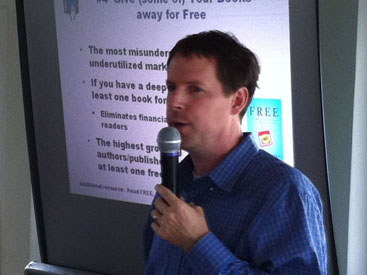
Mark Coker, guest speaker for January’s California Writer’s Club lunch, described an experience that is emblematic of the challenges faced by new writers today.  Coker and his wife co-wrote a novel.  They went through the revision process, and eventually became clients of a prestigious New York agency.  Two years later, their book remained unsold.  Coker’s solution was Smashwords, an ebook publishing service he started in 2008 that is at the forefront of changes rippling through the industry.
Mark Coker

Coker says that large publishers “look in the rearview mirror” for what has worked in the past.  There is little financial incentive for them to risk new concepts and new authors.  Even an author who wins the publishing game and gets a book on the shelves has no guarantee that a title with slow sales will not be remaindered within a matter of weeks.  That may not be enough time to establish the buzz that drives success.

Publishing on Smashwords is free and fast.  Correctly formatted books are distributed to all the major ebook publishers, and authors receive 85% of the sales.  Books do not go out of print, so there’s time for word of mouth to evolve.  Smashwords usage is growing exponentially.  Authors uploaded 140 books in 2008.  In 2011, the total was 92,000.

Smashwords historical usage, from a chart on their blog

Coker’s talk was animated with a sense of mission.  He said what gets him up in the morning is, “enabling writers to express themselves.”  He never suggested it’s easy, however, and most of the rest of his presentation detailed what is required.

First in importance, of course, is a really good book.  Coker suggested as many revisions and beta readers as necessary, and possibly professional editing.  At stake is the trust of readers, hard to build and easy to lose.

Next in importance are a well designed cover and compelling blurb.  Coker says polls reveal that “discovery” accounts for 50% of ebook sales – in other words, we still buy books by their cover.  This is good news for indie authors.  Only 18% of readers polled reported sticking with authors they know.  This means that for independent authors without design skills, hiring an artist is almost essential to come up with a cover that will capture attention as readers scroll through pages of thumbnails.  An email to list@smashwords.com will generate an auto reply listing 3d party artists and people who handle format.

Coker presented more information than I can cover in one article.  He has free guides to ebook formats and marketing at https://www.smashwords.com/.  Other topics are covered on the Smashwords blog, (referenced on the blogroll here) and at http://www.huffingtonpost.com/mark-coker.

With ebook sales continuing to climb; with Apple’s move into electronic textbooks; with Smashword’s impending foray into library distribution, it becomes increasingly clear that ebooks are where the future of publishing lies.  Mark Coker used the phrase, “democratization,” which again brought to mind the Time article on Dickens I referenced to begin post.

“The flood of books in the 19th century elicited two powerful institutional responses:  the rise of prize culture and the rise of literature as a field of study.  The message (sometimes subliminal, sometimes not) was that the masses needed help figuring out what to read, and the cultural elite…was going to provide it.”  (“Charles in Charge” by Radhika Jones in Time, Jan. 30, 2012)

Noting that such elitism broke down well before the advent of ebooks, (for example, with the rise of Oprah as our great taste-maker), Radhika Jones ends her article with a question that would likely delight Mark Coker and maybe Charles Dickens as well:  “Will the readers of the future find their 21st century Dickens on the Pulitzer roster or the best-seller list or FanFiction.net?”

“The future is in your hands,” said Coker at the end of his talk.  “The power of publishing is shifting to the authors.  Go and serve your readers.”

The Lightning Thief by Rick Riordan: A Book Review

I’ve been less active on my blog this week because of the happy event of finding a book I couldn’t put down. Like most such discoveries, I came to it by word of mouth.  In December, we called my sister-in-law to ask what our fifth grade nephew might want for Christmas.  She said he had really enjoyed  The Lightening Thief by Rick Riordan, the first book in a middle grade series called Percy Jackson and the Olympians.  Without even stopping to read the blurb in that hectic season, we ordered the boxed set on Amazon, had it shipped as a gift, and forgot about it – until this month, when I spotted a display of the series at the local Barnes&Noble.

I was instantly impressed as I realized these books feature the 12 year old son of Poseidon and a mortal woman in a 21st century America where the figures of Greek mythology – and their numerous offspring – are on the loose.  If you remember your Greek myths, you recall that the gods were best avoided by mortals.  There was a lot of collateral damage in the Olympians’ constant bickering.  Think of Troy.

Percy Jackson, our half-blood (aka, demigod) hero, would not wish his fate on anyone.  Dyslexic, diagnosed with ADHD, and a D student, he has been shuffled from school to school six times in six years.  And that was when his life was easy – before one of the furies and the Minotaur try to kill him.  By sheer luck, he finds refuge in Camp Half-Blood, but not for long.  Zeus believes Percy has stolen his thunderbolt thrower.  If Percy does not return it in ten days time, a battle will erupt on earth, “that will make the Trojan war look like a water-balloon fight,” according to Chiron the centaur, Percy’s mentor.

Though this book is aimed at a young audience, it has all the attributes writers are taught to build into their novels:  an engaging protagonist, a unique premise, tension on every page, and ever-rising stakes.  I love the way this story encourages younger readers to explore the classics.  One of the items I saw on display at the Barnes & Noble was an illustrated summary of the figures of Greek myth, presented in contemporary form.  Zeus had shoulder length hair, a pin stripe suit, and the good looks that could land him on the cover of a romance novel.  Dionysus was a pudgy, middle-aged reprobate, given to loud Hawaiian shirts.  Such images make the gods more immediate than the older toga and grape-eating portraits.

I am late to this party.  The Lightning Thief was published in 2005. A movie version was made in 2010. I don’t know if it was ever released, but the Wikipedia summary shows it diverges significantly from the novel.  That makes me wary since I liked the book so much.

Most of the online reviews I read were written by adults who enjoyed Riordan’s stories as much as younger readers. Several mentioned the kind of pleasure they found in Harry Potter.  I can’t say for sure, since I’ve only read the first book, but I know I’m looking forward to reading the others.

Bill Moyers is Back!!!!

On Sunday evening, I was delighted to catch the first episode of the new PBS series, Moyers & Company.  You can view it, and a lot more, on the new website, http://billmoyers.com/.

Moyers interviewed political scientists, Jacob Hacker and Paul Pierson, authors of, Winner-Take-All Politics:  How Washington Made the Rich Richer–and Turned Its Back on the Middle Class.

The conversation startled me, as Hacker and Pierson said they were startled during their research.  They found that the current income gap in this country – greater than in some third world countries like Egypt – was not an inevitable consequence of free market dynamics or trends like globalization.  It was politically engineered over the last 30 years.  Hacker and Pierson argue that the current American leadership more closely resembles a third world oligarchy than the democracy our parents knew.

“Who’s the culprit? “American politics did it– far more than we would have believed when we started this research,” Hacker explains. “What government has done and not done, and the politics that produced it, is really at the heart of the rise of an economy that has showered huge riches on the very, very, very well off.”

Bill considers their book the best he’s seen detailing “how politicians rewrote the rules to create a winner-take-all economy that favors the 1% over everyone else, putting our once and future middle class in peril.” – (from billmoyers.com)

Jacob Hacker and Paul Pierson on Moyers & Company

Winner Take All Politics is going into my already overcrowded book-queue, since it appears to be of critical importance.  The first step in correcting a problem is gaining an accurate understanding of its nature.  The fact that the assault on the middle class was created and not fated is good news, according to Hacker and Pierson.  Something done can be undone.  Along with Moyers, they agree that our current national sense of outrage is a positive sign.

Moyers’ work and website are important to bring up today.  On the website you can find an April, 2010 interview with two African American lawyers, discussing what Dr. King would have made of America today. Lawyer Bryan Stevenson said:

“I think in America, the opposite of poverty is justice. I think there are structures and systems that have created poverty, and have made that poverty so permanent, that until we think in a more just way about how to deal with poverty in this country, we’re never gonna make the progress that Dr. King envisioned.”  http://billmoyers.com/content/bryan-stevenson-and-michelle-alexander/

These are important things to consider, especially today.

Of Football and Family

I’m anything but a diehard sports fan, but I’ve noticed over the years that certain sporting events become unforgettable when they mark key moments in my life or our collective life.  Do you remember how moving the Super Bowl was in Feb., 2002?  Our nation was still hurting after the 9/11 attacks, but here was proof that we were not going to let anyone stop us from celebrating life.

I thought of my father yesterday.  Football was one of the ways he and I connected.  Thirty years ago, he and I talked on the phone with growing excitement as the season progressed, and this new quarterback, with the unusual name of Joe Montana, led the formerly hapless 49ers to their first ever Super Bowl victory.  The best game of the season, however, was the Division Championship game. Montana won it with an 89 yard drive after the two minute warning, and a justifiably famous touchdown pass to Dwight Clark with less than a minute to play.  This wasn’t just a persona moment; it set the entire region on fire after a difficult decade.

Montana to Clark, with 59 seconds in the game, Jan, 1982

My father moved up here to be with us in 1999, after he was diagnosed with a wasting illness. Mary and I spent most of our Sunday afternoons with him during football seasons. First lunch and then the afternoon game. My father died in 2007, and we haven’t watched much football since. Until this season. Until our “formerly hapless” 49ers took off so dramatically you couldn’t help but notice and want to follow along.

Yesterday it happened again, 30 years later, almost to the day. The niners won the Division Championship game with another spectacular drive and touchdown pass, this one with only seconds left. Another on-your-feet, unforgettable moment. Hopefully, something to rouse all of northern California after a difficult decade. My father would have loved this game.

Smith to Davis, with 9 seconds in the game, Jan, 2012

I don’t go in for sentiments like, “Maybe he was looking down from heaven.” Hopefully those in the afterlife have better things to do than peer over our poor shoulders. But I do believe – and I’ve heard various spiritual teachers hint at this – that the ancestors and those who are gone can pick up our prayers and love and kind thoughts. That’s a pretty good deal. And if football is the occasion, there is nothing wrong with that.

As the poet Lu Yu put it (quoted in The Tao of Pooh):

The clouds above us join and separate,
The breeze in the courtyard leaves and returns.
Life is like that, so why not relax?
Who can stop us from celebrating?

The News on Page 13

Just some quick notes on a story I have been following, in large part because it is so important and yet so downplayed in the US media. By coincidence (I assume), the latest saber-rattling news was back on page 13 of the Friday the 13th edition of the Sacramento Bee.  The front page headline story involved the closing of a local shopping center.

US carrier in the straits

Thanks to the internet, and especially British news sources, we learn that yesterday, Iranians accused the US of sending one of its ships into the 10 mile “maneuver zone” where the Iranian navy is conducting war games.  In response, Iran threatened to close the straits.  The Obama administration said this would be a “red line act,” that would provoke a military response.

On Wednesday, a top Iranian nuclear scientist died in a bomb blast after a passing motorcyclist attached a bomb to his vehicle.  He was the fourth top scientist to be targeted in the past two years according to a Jan. 12, editorial in the Los Angeles Times, which said, “That’s the kind of clean, covert assassination method favored by Western intelligence agencies.”  Although Secretary of State Clinton denied US involvement, the Iranians don’t believe her, and the Times was skeptical:

“[Clinton] went on to deliver a lecture about the need for Iran to shut down its nuclear program, which we agree with. But we also think the bombing merited something more – a strong statement that the United States decries political assassinations. The U.S. is already on shaky legal and ethical grounds with its own program of targeted drone assassinations of suspected terrorists. But at least we’re at war with al-Qaida. State-sponsored extrajudicial killing is a serious violation of international law, and car-bomb assassination is a tactic little different from the methods used by terrorists. It would be nice to hear Clinton, or President Obama, emphasize such principles.”

The Times editorial went on to say economic sanctions do not appear to be working, but that may depend on who you ask.    I caught an NPR interview with a correspondent in Iran who said, yes, they are working, just not perhaps as we want them to.  He said he went to the store to buy an Oral B toothbrush and there wasn’t even toothpaste available.  The citizenry doesn’t really understand the nuclear issue, but it does blame the US for mounting hardships.  Meanwhile, I’m guessing Iranian leaders are not suffering a lack of toothpaste.

Iranian warship test fires a missile in the Straits, Jan 1

The LA Times noted, you can’t assassinate collective knowledge.  Sooner or later, Iran will have nukes.  Another middle-east war will not close Pandora’s Box.  Yet I still find it hard to believe that this is all about nukes.  I’m thinking of Col. Andrew Bacevich’s 2008 predictions.  http://wp.me/pYql4-1AT.  Until we take the quest for energy independence seriously, armed conflict over oil will be our future.

In 2011, Wikipedia estimated that the price of Tomahawk cruise missile was $830,000.  How many scholarships would that buy for future energy scientists?  How many studies of alternative fuels would that fund?  How many lives and dollars are we prepared to spend trying to push back the river?

Are You Now, or Have You Ever Been Normal?

When I was a kid, I believed that my family was the standard by which all families should be judged.  In the ’80’s, however, when family psychology met popular culture and some of us went questing for our inner child, the news was not so good.  We learned that 96% of families were dysfunctional; that crazy had become the new normal; that 24 out of 25 of us had grown up with the Griswalds and not the Cleavers!

Who's your daddy?

Just when we thought we had that settled, when I thought my cred as a free thinker and iconoclast was safe, a new book threatens all that: Are You Normal?, by Mark Shulman.  According to a Washington Post article, Shulman’s book has 176 pages of questions for kids, scored against other answers, which allows you rank yourself on a “weird-o-meter.”

With some trepidation, I answered the sample questions in the article, going for the perspective I would have had in grade school.  Feel free to ride along – if you dare:

1) Do you have a brother or sister:  

Yep – one sister, making me one of the 87.5% who have a sibling.  So right of the bat, it’s not looking good for the bohemian persona.

2) Have you ever faked being sick to get out of school?

Well duh, of course I did!  Can we say, “World Series?”  That boosted my weirdness quotient, since only 25% answer yes to this one.

3)  Where do you bite the chocolate bunny first?

The ears of course, along with “more than half”  of those polled.  Interestingly, 1 in 25 go for the bum…now that is strange!

4)  Smooth or Chunky peanut butter?

I started to say “chunky,” but that’s revisionist history.  As a kid, it had to be smooth, lest it tear my Wonder Bread.  “Slightly more than half,” share that predilection.

5) TV in your bedroom?

Not then, not now, though it wasn’t nearly as common when I was a kid as it is now (56% answer “yes”).  My parents had a portable with rabbit-ears, but those were the days when, if the TV “went on the fritz,” you pulled the tubes and carried them down to the tube tester at the local grocery store.

6)  Did you ever bite your fingernails?

Rarely but on certain stressful occasions, yes.  The answer to that was a 50/50 split.

7)  Did you ever bite your toenails?

Ewww!  And that reaction is not unique.  A full 90% say they “could not or would not” do such a thing, so most of us are plain vanilla on that score.

The Washington Post review concludes by saying “the real point of the book is to show that nobody is perfectly normal or perfectly weird.  We’re all unique, and that’s part of what makes us special.”  Not such a bad conclusion to reach.

However, if “special” is now normal,  but normal normal is weird…I guess I better not go down that road, just quit while I’m ahead.

Save the Cat by Blake Snyder: A Book Review

I love (good) books on screenwriting, because of all the available guides to writing fiction, these focus most squarely on the primacy of story; first the forest, then the trees.  Last week a fortunate weblink led me to Save the Cat, 2005, a brief but idea packed gem of a book by Blake Synder (1957 – 2009).

Snyder was a successful screenwriter and a respected teacher who began his career in movies doing voice-overs for his father at the age of eight.  By his own admission, when he started writing for movies, he had only a vague idea of structure.  Discovering Syd Field’s Screenplay was a revelation:  “truly career-saving,” Snyder says, but there were still gaps in his sense of movie architecture.  Snyder developed the methods he presents in this book in response.  Because he spun things in an unusual way, and uses his own terms for concepts that may have become overly familiar, his methods move the imagination in fresh ways.

Blake Snyder 1957-2009

The title of his book, for instance, is a code for his belief in the primacy of creating characters we want to follow.  In the opening scenes of older movies, the protagonist often did something nice – like saving a cat – to bond with the audience, a step contemporary movies often skip in favor of showing a lead who is hip, slick, and cool.  Snyder cites this as the cause of failures of several recent films.

His approach is top down.  He begins with the log line and the title, and demands that the writer polish them before moving on, because they are a touchstone for writing the script itself as well as a key selling point.  This single sentence and title, when well crafted, reveal what the movie’s about, its genre, the lead characters, and (ideally) pique curiosity.  Snyder gives examples like:  “A cop comes to L.A. to to visit his estranged wife and her office building is taken over by terrorists – Die Hard.”

Snyder then suggests we do something that few writers ever dream of – pitch the concept to strangers.  He would literally pick people out in a Starbucks line, and say, “Excuse me, I’m working on a movie concept, and I wonder if I could get your feedback.”  Since he lived in L.A., the answer was often yes, but he challenges us to do the same wherever we are.

He moves through ever increasing levels of detail as he takes the reader through the development of the script, and one thing I really appreciated was his in-depth knowledge of stories:

“Jaws is just a retelling of the ancient Greek myth of the Minatour or even the dragon-slayer tales of the Middle Ages.  Superman is just a modern Hercules.  Road Trip is just an update of Chaucer’s Canterbury Tales – isn’t it?  To not know the roots of the story you’re trying to create, either from the last 100 years of movie storytelling or the last thousand, is to not honor the traditions and fundamental goals of your job.”

Though Blake Snyder died suddenly in 2009, a website serves as a blog on his methods, and offers a bulletin board as well as classes geared to both screenplays and novels.  http://www.blakesnyder.com/

I’m sure this is old news to the screenwriters who read this blog.  If so, pass it along to your novelist friends; it seems we don’t get out often enough.