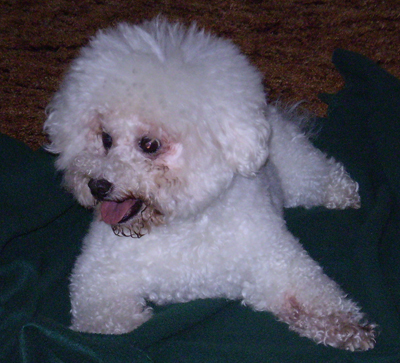
Saying goodbye to Missy

Missy, June 21, 2008 to July 11, 2024. RIP

On July 11, three weeks after her 16th birthday, we took Missy to the vet. Although she had other issues, our biggest concern was her back legs and hips. Walking and balance had grown harder for her since the new year. Joint and pain medications had given her some relief and we hoped the vet could do more. This time Missy stumbled and fell in the vet’s office. I’d brought a video showing how hard it could be for her to cross a room. Our vet watched it and said the problem was neurological, probably a spinal cord issue. She said it would not get better and she couldn’t do anything more. We made the compassionate choice. The hard one.

Missy’s passing was peaceful. We knew we had done the right thing, but there still are no words to describe what it was like to come home to a silent house, to the food bowl, the water dish, the bed, and the blankets that she would never use again. Those who have been through it know what it’s like. This wasn’t our first time, but in some ways it was the hardest.

*****

Missy was seven months old when we adopted her on Valentine’s Day, 2009. Her first owners were going through a divorce. There was shouting, and Missy was left by herself in a crate for long hours each day. During her formative months as a puppy, she never had a chance to bond with other dogs or humans. This deficit would be a problem all her life.

Her owners took her back to the breeder who gave her to nearby church that trained dogs to be companion animals for veterans with PTSD. Mary saw Missy and cuddled her in the church office and told me about the beautiful puppy she’d met who couldn’t stop trembling. On Valentine’s Day, the director of the program told Mary that Missy’s PTSD was worse than that of the veterans and asked if we wanted to adopt her?

Mary called me and I leashed up our other two dogs and brought them over. Missy instantly bonded with them. After watching them play and get to know each other, I picked Missy up. She fit in one hand and wasn’t trembling. I carried her out for a private chat. I asked if she wanted to come home with us and instantly knew the answer. By day’s end, she knew she had a home and a family. During those first few weeks, I felt I had known her in a previous life, something I never experienced with any other animal.

“It’s love, they say. You touch
the right one and a whole half of the universe
wakes up, a new half.” – from “On Choosing a Dog,” by William Stafford

Holly, our older dog, was slowing down. Missy and Kit, our other rescue, became inseparable – our dynamic duo. Most of the time, Kit was the ringleader and Missy the sidekick.

The happy memories of more than a decade of good health and good times with those two blend together, but many moments stand out, like the day Missy and I got caught in a rain shower during a walk in the park.
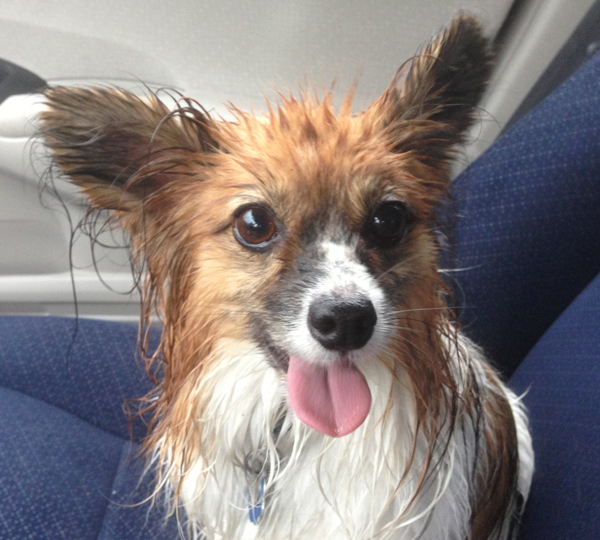
Missy and Kit always brought joy to our days, but never more so than during the pandemic shutdown. As often as possible, we’d start each morning with a walk in the park. We came to know other dog walkers and strollers, and sometimes those conversations were the only outside social contacts that day.

Kit had been diagnosed with a heart murmur in 2016. We’d been treating her with an increasing number of meds since then, but it caught up with her in 2021. The day after Christmas, she had a heart attack and died in her sleep the next night. Missy was never the same.

Though we moved her bed down to our room, at night she’d sometimes pace the kitchen where she and Kit had slept. We took her to doggie day care hoping she’d find new canine companionship, but without Kit, she was fearful and bared her teeth when other dogs approached. Sometimes we’d have to hand feed her to get her to eat.

More than any other picture, this image reminds me of that time. Missy appears to be gazing out at a world she does not understand.

In time, Missy settled into her role as top dog, enjoying the extra attention and morning walks and even getting the zoomies now and then, running six or seven laps around the house, something she’d never done in younger days.

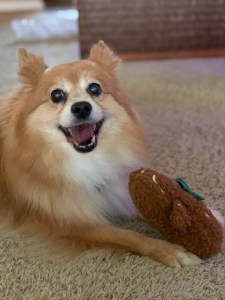
She was never big on “traditional” canine pastimes. When she was younger, Kit would fetch a tennis ball until your arm was too tired to throw it, while Missy would wander off, uninterested. She was never a big fan of squeaky toys either, but she would invent her own little games. One such game led to one of my favorite photographs of her.

Last summer, before the trouble with her legs began, she went through a phase of hooking her front legs over the sides of her bed and using her hind legs to drag it out of whichever room it was in and into the hall. We never could figure out why.

Her bed was usually next to ours or in the meditation room where I sit at the end of the day. Missy usually joined me, but that summer she sometimes wouldn’t settle until she’d moved the bed into the hall. One evening she dragged it the wrong way – into a corner. It was hilarious and I made a video and this photograph of her efforts. Then I moved the bed into the clear so she could drag it the rest of the way out of the room.

July 24, 2023

I love this picture. This was not the last time she was playful, but it’s the last photo I have of one of her quirky styles of play. During her last six months, her physical and cognitive problems grew worse. She was less active, but up until the end, I think she felt loved.

Her vet sent a nice note that said, “You gave her a great life.” We always did the best that we could for her.

*****

“I wondered if God might have an easier time using animals to communicate who God is, since they do not seem as devious and willful as we are.” – Fr. Richard Rohr

2020 Notes 3: Apple Blossom Time

Apple blossoms are out on the tree in the back yard.

My grandmother had a  habit of blurting out snatches of song, without warning, at family dinners, or quiet evenings, or on Sunday afternoon drives, back when people thought it was fun to hop in the car and go somewhere.

One of her favorite songs was, “Apple Blossom Time.” Another was (I believe) part of the chorus of a 1920’s era song about Little Orphan Annie, “And it gets all over icky!” That would piss off mom, much to my sister’s and my amusement. I suspect my grandmother used to sing that during my mom’s teenage years, and she still hadn’t fully gotten over the embarrassment.

****

In other news of the day, our oldest rescue dog, Kit, a chihuahua / pomeranian mix, is almost 13. She still has so much energy you wouldn’t guess she’s on three medications for serious heart problems.

At the start of February, after a checkup, the vet said, “I’m guessing she has a year or 18 months left.” No way, I thought. That got me back to daily practice of a Tibetan long life sadhana a few weeks before COVID-19 motivated all of us to pursue safety measures, both physical and non-physical in nature.

After talking to the vet, I wanted to make sure we had enough of one of her critical meds, called Vetmedin, that mitigates her leaky heart valve. I had a standing prescription at Costco for three months worth, but when I called at that time, they said it had been on backorder for some time. I wondered then if that was a result of the epidemic in China, for I’d heard that that China manufactures the components of lot of our pharmaceuticals.

I got some Vetmedin from our vet, but because it’s cheaper at Costco, I called again yesterday and was able to place an order that was ready today. They told me when I came to tell one of the people at the entrance that I was there for a prescription only.

Costco is one of those stores now dedicating the first hour of business, from 8:00 – 9:00 am, to people over 60 – a thoughtful practice, but one not exempt from the law of unintended consequences. When I got there at 8:20, I found several hundred people, most with shopping carts in line. With most observing the recommended six foot spacing, the line snaked around the front and side of the building, before disappearing around the back of the store and out of sight

I was just about to leave, to try in the afternoon, when a woman came out to urge everyone to patience, saying they were letting in 75 shoppers at a time. I told her what the pharmacist had said on the phone, and she very kindly allowed me to go in to pick up the prescription. I was in and out in less than 10 minutes.

While I was there, I asked the pharmacist if things generally slowed down later in the day. “By 11:00 it’s usually pretty quiet,” he said – a message I thought I’d pass on to anyone locally who is thinking of getting up early for special shopping opportunities – be ready to queue up really early, or wait and have a good breakfast and coffee first!

Soul Notes #3: A Dog’s Life

Seven years ago today, we lost Holly, our second dog. She was 16 1/2, which objectively, is a good long life, but when it’s your dog, it’s never long enough. She was about two in this picture. At that time, I’d get up around 5:30, do some stretches, and spend about 20 minutes in the meditation room before getting breakfast for myself and the dogs.

One morning I found Holly sitting in my chair, gazing at the altar. She looked over her shoulder at me, with a “Yes, may I help you?” expression before turning back to her object of contemplation. I thought of the incident this year, when a Tibetan lama mentioned an old saying that many dogs will be reborn as humans, and a lot of humans will be dogs in their next life. It all has to do with having a good heart…

One other notable thing about Holly was her love of water. One time Mary and I were walking her by a stream in Yosemite, talking as she stopped for a drink. After a splash we looked down to see her paddling about with delight.

On her first visit to the ocean, she insisted on playing tag with the waves and letting them win:

Mary and Holly, Bandon, OR, ca. 2000

In honor of Holly, here is an article I posted in 2013, called Dreaming With Animals. The pictures and text are just the barest glimpse of how deeply intwined with Soul the animals are, all the more so now that most of them have been banished from our lives.

An Avian Stray

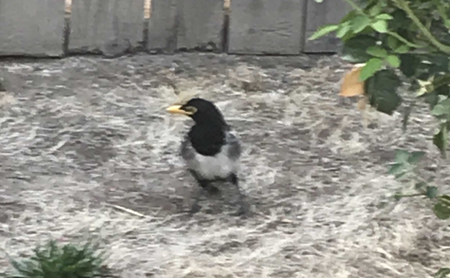
The wounded magpie

Last Friday afternoon, I came home from various errands to find a magpie with a broken wing in the back yard. Seeming dazed, it was swung its head back and forth, as if its vision was impaired, and flapped wings in unsuccessful effort to fly. Then it would run, often in circles, falling over because its balance was off. The afternoon was hot, but the bird was fast enough to scoot away when I tried to set a water bowl nearby.

In the evening, I turned on sprinklers. As the sun got low, other magpies flew into the yard to peck at seeds or insects. The injured bird joined them to eat, but when they flew away, it made it’s way alone to a section of fence behind the cover of bushes. Hours later, when I took the dogs out before bed, I shone a flashlight to look, and the bird hadn’t moved. I wondered if the magpie, left behind by its tribe, felt something akin to loneliness.

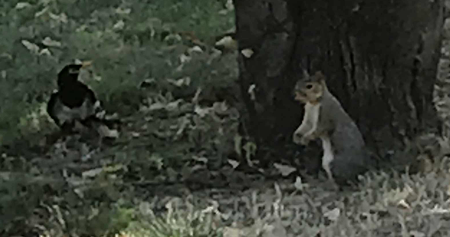
I hadn’t been sure the bird would last through the night, fearing that injuries or a cat would finish it off, but in the morning, it was dashed around with more energy and coordination than the day before. I checked on it through the day, and that afternoon, was surprised to see it approach a squirrel that climbed down a tree in the shade where the bird was resting.

Magpie and squirrel

The magpie came close to the squirrel, who at that point, charged and drove it away, but this close encounter between two species I’d never seen interact before made me wonder again if the bird was experiencing something we would call abandonment.

We’ll never know, but such speculations can no longer be dismissed as mere projection or pathetic fallacy. I’ve seen numerous examples of this recently, including an article this week in The Atlantic, about an Alaskan Orca who carried her dead calf with her for 17 days:

“It is hardly anthropomorphic to ascribe grief to animals that are so intelligent and intensely social. Tahlequah’s relatives occasionally helped her carry her dead calf, and may have helped to feed her during her mourning…

The Lummi Nation, who live in the Salish Sea and also depend on salmon, have long understood this side of the southern residents. ‘We’ve fished alongside them since time immemorial,’ says Jay Julius, the nation’s chairman. ‘They live for the same thing we live for: family.’”

Our role in the magpie’s story came to a happy ending. We managed to scoop it into a cardboard box I’d drilled with air holes, and on Sunday morning, carried it to the Sacramento Wildlife Care Association, a wonderful organization that rehabilitates injured or orphaned birds and animals.

As I’ve said before, both modern physics and ancient Buddhist teachings agree that there really isn’t “a world out there,” out there.  The physical world we experience is what our limited senses configure out of swirling masses of energy and light. The meanings we experience are those we impute on a world that is far more dream than solid “reality.”

I never named the magpie for fear it wouldn’t survive, but in my favorite version of the dream, this bird, healed and nourished until it is strong again, will rejoin its fellow magpies, stronger than it was before, as a result of its time of trial and solitude.

The White Snake – An Enigmatic Tale from the Brothers Grimm

Illustration for “The White Snake” by Walter Crane, ca. 1886, Public Domain

I once had a professor who made an extensive study of world folklore and said the greatest predictor of success for a fairytale hero is winning the help of an animal guide. Most often, the helpful animals are mammals, like Puss-in-Boots or talking horses.

“The White Snake,” a story from the Brothers Grimm, alters this pattern in startling ways. The helpful creatures are far more primitive, and the hero actually kills his horse – yet things come out right. The story has stayed with me since I first encountered it, as a wisdom tale centered on the theme of knowing the right thing to do at the right time, even when it violates norms and expectations.

Commentary on myth and folktales is a recent tradition that arose after the old ways of absorbing these stories, around hearth and campfire, disappeared. We can imagine earlier listeners holding the stories in imagination, letting the magic sink in over time, as we do with favorite novels and movies. This is a great way to experience a story, and we’re fortunate to have a good eight minute recording of The White Snake, accompanied by the text from the Brothers Grimm.

I suggest you read and listen to the story if you don’t know it, for the rest of this post will simply be my reflections on a few of the key questions The White Snake raises. Continue reading

The Goat Speaks

A wise goat indeed!  Such great news in a season where that has grown rare.

Christine Valentor's avatarHistories and Mysteries

white-goat-pd

Oh, you silly, silly humans. Why all the nail biting, my dears? Clearly, at the beginning of this World Series, I promised you I would lift the curse.  I signed the agreement with my hoof print, did I not?

Now, a goat such as myself may possess a good deal of deceptive qualities. But one thing I guarantee is my sincerity!  A promise is a promise and I, Murphy the Billy Goat, namesake of the Billy Goat Tavern and former pet of Mr. William Sianis, am as good as my word.

The question of the Cubs winning was never in doubt.

What’s that you say? The rain? Yes, of course I sent the rain! And with it I brought a seventeen minute game delay.

rainout

There was a method to this madness, for it allowed the players to contemplate their fate. They regained their bearings and therefore could more fully…

View original post 276 more words

A kinder, gentler, Jurassic World

psittacosaurus, at the Prehistoric Gardens, Port Orford, Oregon

psittacosaurus, at the Prehistoric Gardens, Port Orford, Oregon

Dinosaurs continue to fascinate. My first ambition in life, after a trip to the New York Museum of Natural History, was to become a paleontologist. Eventually, my life goals changed, and the T-Rex envy faded.

calvin-hobbes-dinosaur-005

Yet decades before Jurassic Park was a gleam in some screenwriter’s eye, Ernie Nelson, of Eugene, Oregon, did not outgrow his fascination with dinosaurs. He made them his life’s work in a most unusual way.

In 1953, Nelson gathered his family and left Eugene, where he worked as a CPA and owned a Mill supply company, to relocate to a valley near Port Orford, where rainfall averaged seven feet per year – he needed a rain forest.

In 1955, he opened the Prehistoric Gardens, and over 30 years, built 23 full size and anatomically correct dinosaurs. This unique roadside attraction is still in the family. Ernie’s granddaughter welcomed Mary and me in August, after we’d driven down from Bandon to see the dinos.

Not what you expect to see when you round the bend on the coast highway, but then, to paraphrase Monty Python, no one EVER expects a Tyrannosaurus!

Not what you expect to see when you round the bend on the coast highway, but then, to paraphrase Monty Python, no one EVER expects a Tyrannosaurus!

Nelson’s process was painstaking. His research was constant and thorough, and included a  trip back east to visit the Smithsonian. Each dinosaur began with a steel frame, which was then covered with a metal lath. A layer of concrete followed, and then another layer to define the visual features.  The Brachiosaurus, 86′ long snd 46′ high, took four years to complete and was his pride and joy.

Ernie working on the peterandon

Ernie working on the peterandon

The Prehistoric Garden’s website says the 23 sculptures were painted according to available scientific research. We normally don’t think of dinosaurs as colorful, though plenty of lizards, chameleons, and snakes in our world are.

I’m willing to trust Ernie on his color choices, but what I liked best was the aspect where I think imagination overrode research. Some of these critters are just so darn cute in, a wide-eyed sort of way.  I don’t want make Ernie turn over in his grave by calling his critters “cute,” but there’s just no other word for this triceratops, which has the same expression as one of my dogs!

triceratops small_edited-1

Some of us can remember the days of wacky roadside attractions on Route 66 or Hwy. 99 – giant oranges, strange animals, and gas stations designed to look like flying saucers.  There were animal parks, fairytale towns, and north pole villages in the days when Ernie Nelson moved his family to southern Oregon to shape his dream in concrete and steel.

The ichthyosaurus is suffering from the drought this year just like we are.

The ichthyosaurus is suffering from the drought this year just like we are.

Nowadays the most frequent sights, as we blow past towns on the interstate, are fast food joints and the same old big-box stores. Santa’s Village has long been shuttered, and the kids have video games and DVD’s to mitigate the boring view out the windows.

Like the dinosaurs, the Prehistoric Gardens speaks of a different era, one in which peace had come, America was unrivaled, and more people than ever before had jobs, cars, money, cheap gas, kids, health care, and paid vacations.

All those attributes can ebb and flow, but there is one precious thing we can always borrow from Ernie Nelson – the example of what an individual can do when he rolls up his sleeves, opens his mind and heart, and lets his creativity flow.

Strays

When the year turns, I tend to watch for events, private or public, that set a tone for the days ahead. I witnessed something on January 6 that I can’t forget, that seems important, like something I need to remember and pass on.

We took our dogs to the local park for a walk in the late afternoon, a beautiful clear winter’s day. Soon after we started, two bedraggled and pitiful looking stray dogs began to follow us. They were small, of no breed I can name, but clearly siblings, and clearly they had been dumped in the park.  No tags, and they were shaggy, dirty, smelly, and seemingly desperate for the company of our dogs.

We kept ours moving – not wanting this pair to come too near – fleas and/or disease came to mind. We circled the park and dropped our own dogs back in the car. One of the strays fell behind, but the other kept up the pace, though it must have been painful, for its nails were overgrown, and walking was difficult. I planned to go to the Arby’s at the edge of the park to get a couple of sandwiches for the dogs, but this little bedraggled one shied away from humans and wouldn’t even come near enough to pick up our doggie treats. It turned back toward it’s companion somewhere behind on the trail.

Words can’t convey how forlorn these two little dogs appeared. How their abandonment evoked the thought of all abandoned, discarded, and unloved beings. How their plight aroused such a strong desire to do something, to relieve their suffering, but what?

Call animal control? They’d be warm and well fed, at least for a while. But who could predict their odds of being adopted or being put down?

In the end, we left them in the park. Once before, I encountered a similar stray, who followed our dogs back to the car and even managed to jump in. Later I learned he’d been adopted by a friend who works in the Parks and Recreation Department. I can only hope someone who wants a dog will find them before cold and hunger or coyotes do them in.

The feeling of compassion never guarantees the wisdom to do the right thing. In the end, all we can do is take our best guess and do our best. As I think of these dogs, as well as the human strays I see from time to time in the park, I think of these U2 lyrics:

Every sailor knows that the sea
Is a friend made enemy
And every shipwrecked soul, knows what it is
To live without intimacy.

The dogs, at least for a while, had each other, but plenty of others do not. Haven’t we all been there at times? And it’s not always people who visibly live at the margins, for margins are not always visible. To watch for a chance to reach out with kind words or a helping hand – is there anything more important to consider at the start of the year?