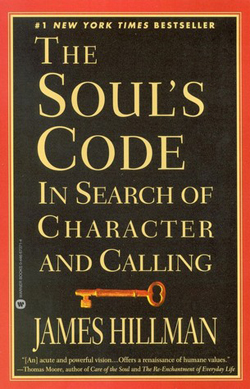
The Soul’s Code by James Hillman

the soul's code

James Hillman (1926-2011), a prolific post-Jungian psychologist, thinker, and cultural critic, wrote more than 20 books, but The Soul’s Code: In Search of Character and Calling (1997) is probably his best known work.

In a head-on attack upon the reductionist nature of both the nature and nurture camps of western developmental psychology, Hillman proposes a view of individual destiny based on Plato’s Myth of Er. Are we nothing but helpless products of our mothers in the first year of life or our luck-of-the-draw genetics? Or is there a deeper meaning to how we grow and unfold?

Hillman proposes an “acorn theory,” arguing that each acorn holds the pattern of the oak it may become, just as each soul that enters the world may bear a destiny shaped by intelligence rather than random chance: “what is lost in so many lives and what must be recovered [is] a sense of personal calling, that there is a reason I am alive.”

Hillman expounds his theory in a number of biographical sketches. He writes of Manolete, the most famous bullfighter of 20th century Spain. As a child, he was sickly and frail. “He stayed so much indoors and clung so tightly to his mother’s apron strings that his sisters and other children used to tease him.” Then, at the age of 11, he became fascinated with bulls.

Current psychology theory would hold that Manolete chose a macho vocation to compensate for his mama’s-boy childhood. Hillman wonders if somewhere deep inside, was “the acorn” that realized his destiny was to face down charging, thousand pound bulls, including the one that gored him to death at age 30. Of course that was too frightening a vision for a boy of 8 or 9 to hold!  Of course he held tight to his mother!

Hillman also discusses the childhood of Eleanor Roosevelt, one of the 20th century’s most influential women. As a child, Eleanor was “funny,” as well as “sullen, stubborn, spiteful, [and] sour…She lied; she stole, she threw antisocial tantrums in company.”

She lost her mother, a brother, and her “playboy father” before she was nine, but all the while carried on a vivid fantasy, “the realest thing in my life,” in which she lived with her father in a large household and traveled the world with him.

Psychotherapy would have regarded her fantasies as delusions and prescribed psychotropic medications to try to return her to normal. But what of the possibility that her visions meant something? What if her fantasies were “invented by her calling,” Hillman asks, and “were indeed more realistic in their orientation than her daily reality.”

“Imagination acted as a teacher, giving instruction for the large ministering tasks of caring for the welfare of a complex family, of a crippled husband, of the state of New York as the governor’s wife, the United States as its first lady, and even of the United Nations. Her fantasies of attending to “Father” were a preliminary praxis into which she could put her call, her huge devotion to the welfare of others.

Hillman is always provocative, inviting us to look deeper into, or “see through” the ideas that limit soul and it’s individual expression. Psychological literalism is often in his crosshairs, as when he says, “Our lives may be determined less by our childhood than by the way we have learned to imagine our childhoods.”

James Hillman, 1926-2011

James Hillman, 1926-2011

The Soul’s Code is a challenging book, but valuable as it sheds new light on many unquestioned assumptions about development, the individual, and destiny that need to be questioned.
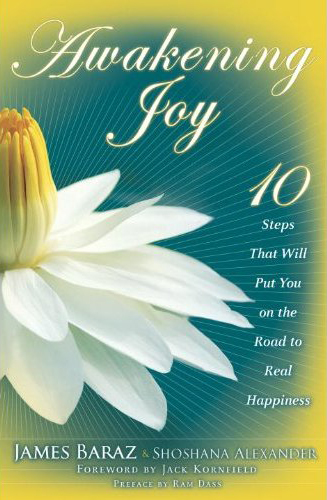
Awakening Joy by James Baraz: a book review

Awakening Joy cover

In March, I reviewed Scott Adams’ latest book, How to Fail at Almost Everything and Still Win Big. It has much in common with the book I’m reviewing today: both focus on the myriad, day-to-day choices we make and how they can steer us toward or away from the lives we want to live.

Though one of the numerous “failures” Adams recounts was a book on meditation, he wrote How to Fail in purely secular terms. Baraz, who took up the study of mindfulness meditation in 1974, writes from a Buddhist perspective, but says, “many people, including myself, consider Buddhism to be more a philosophy than a religion, a way to live a harmonious life.” This tone should make Awakening Joy accessible to people of any faith or no faith.

Baraz, a founding member of Spirit Rock, first taught an Awakening Joy class in his living room in 2003. In working with initially interested but skeptical students, who didn’t just want to sit around singing Kumbaya, Baraz honed the presentation that is encompassed in his book and a five month online class.

The book has ten chapters or “Steps,”  which center on topics like mindfulness, compassion, forgiving oneself, and letting go. In some ways the first step is most challenging – figuring out what “joy” means personally and accepting that we want it and deserve it, now and not at some future time when we will have “earned” the right to feel good.

Baraz quotes the Buddha who said, “Whatever the practitioner frequently thinks and ponders upon, that will become the inclination of the mind.” Can it really be that simple? Anyone who has ever tried to meditate knows that working with the “inclination of the mind” may be simple but isn’t easy.

Awakening Joy is written with simple concepts, personal stories, and exercises designed to cut through our suspicion that feeling good means becoming Pollyanna. We’ve all seen small children manifest joy. What happened to us along the way? Baraz presents a series of simple steps designed to help us turn back toward the direction we’d rather travel.

Thoughts on Maleficent and retelling folktales

maleficent

Maleficent opens in a world of beauty, threatened by a greedy human king. The visual contrast between human actors and fantasy animation was great enough to take a few minutes for suspension of disbelief to kick in. After that, I was in for the ride, through an ambitiously re-crafted tale of the Disney arch villainess who gave kids of my generation nightmares in Sleeping Beauty (1959). As the poster implies, this movie belongs to Angelina Jolie, whose performance is gripping.

The Sleeping Beauty themes of love and betrayal remain but they manifest very differently in the two Disney versions of the story. Men betray and women love; implicit in Disney’s previous blockbuster, Frozen, the theme is explicit in Maleficent. For now at least, it’s Disney’s key to box office success.

Retelling fairytales with a modern twist is nothing new. Fantasy authors like Nancy Kress, Jane Yolen, Steven Brust, and Roger Zelazny, to say nothing of Neil Gaiman and George R.R. Martin have been doing this for decades. I’m currently reading a 1994 collection of short retold fairytales, Black Thorn, White Rose, edited by fantasy writers, Ellen Datlow and Terry Windling. There are two different versions of Sleeping Beauty. In both, it is the prince who needs to be rescued.

I take this as an inevitable pendulum swing from earlier Disney movies where princesses mostly sat around singing, “Someday my prince will come.” We have to remember that no Disney movie, then or now, is “real” folklore, nor is any work fantasy fiction. By “real” folklore, I mean stories shaped by the collective imagination of generations of members of a culture, region, or tribe. Strictly speaking, any talk of folktales now must be in the past tense. Nowadays the events that might spawn new fairytales, over a generation or two, become headlines or tweets, “details at 6:00,” to be forgotten in a day or an hour.

Among other things, the old fairytales were full of hints on wise living for those who knew how to listen. Here is one simple list of some of the lessons they taught:

  • Sorrow is real, and so is joy
  • Joy is freely available to all, just as sorrow comes freely to all, whether rich or poor, and without regard to changes in material fortune
  • The world is fraught with danger, including life-threatening danger, but by being clever (always), honest (as a rule, but with common-sense exceptions), courteous (especially to the elderly, no matter their apparent social station), and kind (to anyone who has obvious need), even a child can succeed where those who seem more qualified have failed.

Much as I love them, I don’t find that fantasy movies and novels teach lessons like these in a visceral or unforgettable manner, which leaves us sadly impoverished. Dragons have not gone away – any glance at the headlines makes that clear. What is gone is the wisdom to know how to deal with them.

Alternate views of the evil empire

Here is another take on the Amazon / Hachette controversy by Barry Eisler, a former CIA operative and best-selling author of thrillers. Eisler made headlines in 2011 when he turned his back on traditional publishing (which he calls “legacy publishing”) to publish his work independently on Amazon.

In this June 4 article in The Guardian, Eisler ticks off these pluses for Amazon: it “singlehandedly created a market for digital books, [is] now the greatest source of the legacy publishing industry’s profitability (though of course legacy publishers are sharing little of that newfound wealth with their authors)…built the world’s first viable mass-market self-publishing platform, a platform that has enabled thousands of new authors to make a living from their writing for the first time in their lives. And [it] pays self-published authors something like five times as much in digital royalties as legacy publishers do.”

Eisler makes some interesting arguments while waving a red flag (Amazon-hating authors are the literary “one-percent”). I recommend the article to anyone interested in this current publishing brouhaha. My biggest takeaway was Eisler’s simple observation, in an otherwise complex debate, that individual attitudes are probably based more on personal interest than selfless concern for the future of literature. To blame Jeff Bezos for the loss of bookstores, he says, is like buggy makers blaming Henry Ford for the development of internal combustion. Though some of his analogies may be questionable, they point toward two facts that are not: (1) new technologies never go back into the box, and (2) their ramifications are never known at the outset.

I was halfway through the paragraphs above when the postman brought the June 16 issue of Time, with an essay on the back page by Joel Stein, Hachette author of Man Made: A Stupid Quest for Masculinity.

Stein ventured, “with trepidation,” to Amazon “to see what barbarism it had committed on my book’s page – changing my author photo go one of my high school mullet shots, perhaps, or allowing yet more people to start their one-star reviews with ‘No, I haven’t read this book.'”

When he found nothing amiss, Stein sadly reflected that Amazon, with its cutting edge algorithms, had to know how much it would hurt his ego and confidence to be left out of the feud. “I have no idea who will publish my next book,” he says, “though I do know they’ll be sorry they did.”

Diversity and variety are central to the richness of life. I’m old enough to remember and miss various mom and pop stores of all kinds, not just bookstores. A local nursery used to employ master gardeners, who could look at a sick leaf and tell you exactly what to do. Through no fault of their own, the people who work in the Lowe’s garden section can only tell you, “Fertilizers are down aisle one.” As a kid, I learned to make flying airplanes out of balsa wood and tissue paper at a local hobby shop; it was a far more interesting place than any Toys ‘R Us.

Right now, perhaps all we can do in the publishing battle is watch and wait, and opt for diversity and richness in whatever way we can.

Those Who Wish Me Dead by Michael Koryta: a book review

those who wish me dead

If you could find that and hold it there within yourself, a candle of self-confidence against the darkness, you could accomplish great things. He knew this. He’d been through it.

Fourteen year old Jace Wilson witnesses a murder-for-hire near his home in Indiana. Witness protection will not help, for the system has been compromised. U.S. Marshals appear to be involved. At the suggestion of an executive bodyguard, Jace’s parents send him to the Wyoming-Montana border, to the wilderness survival school for troubled youth that Ethan Serbin, a retired military survival expert teaches. Once he is in the wilderness, away from computers and cell phones, Jace will be safe, right?

Of course not. Even as Jace, who has been fearful all his life, begins to learn about trusting himself, about building confidence as he learns to build a fire with flint and steel, the killers, Jack and Patrick Blackwell, relentless sociopathic brothers, are  close behind. To hide the murder of a local sherif, the Blackwells set a hillside on fire that burns out of control and into the mountains where Ethan and his young charges are camped.

Realizing they’ve found him, Jace slips away by himself. Killers and searchers, Ethan and his injured wife, Jace and Hannah, a guilt-ridden fire lookout whose lover died in a wildfire saving her, struggle to survive mountain thunder storms, each other, and a fire that grows to monster size as it races into the high country.

I’ve reviewed three of Koryta’s books, including So Cold the River (2010), perhaps my all time favorite thriller. This one is just as good; I devoured it in less than two days. In Those Who Wish Me Dead, the author serves up a near perfect blend of sympathetic protagonists, villains who are fascinating in their complexity, and tension that is finely tuned, neither too loose nor too tight. There really aren’t that many books that I literally cannot put down, but Those Who Wish Me Dead was one.

Michael Koryta

Michael Koryta

To the barricades! No, the other barricades.

Printing, ca. 1568.  Public domain.

Printing, ca. 1568. Public domain.

“Right now, bookstores, libraries, authors, and books themselves are caught in the cross fire of an economic war. If this is the new American way, then maybe it has to be changed — by law, if necessary — immediately, if not sooner.” – James Patterson

I haven’t blogged about ebooks and independent publishing lately. Over the last few years, it’s become clear they are here to stay. Success breeds acceptance, and the “vanity press” stigma is gone. In olden days (ca. 2011), I found a kind of “blows against the empire” satisfaction in promoting ebooks, writing reviews, and encouraging Indie authors. The evil empire was big publishing. This was the time of the little guy.

I still like Indie authors, though the “righteous cause” fantasy is gone. Now suddenly, at least to a casual observer like me, the situation appears reversed, with Amazon in the role of bully-boy, and those same publishers (perhaps) fighting for their existence, and with them (maybe) hangs the fate of a lot of remaining brick and mortar stores.

I first learned of the Amazon-Hachette duel from Michael Koryta, a favorite action-adventure writer I follow on Facebook. On May 19, Koryta reported serious problems pre-ordering his new book, due out June 3, from Amazon. He said the situation goes far beyond the interests of one author, and provided some of the links posted below.

On May 29, USA Today quoted James Patterson as saying “the future of our literature is in danger.” Patterson says that “Amazon wants to control book buying, book selling and even book publishing,” and laments that federal anti-trust laws no longer have teeth.

Here are several editorials on the situation:

Amazon vs. Hachette: When Does Discouragement Become Misrepresentation? From the NY Times Blog

Amazon said to play hardball in book contract talks with publishing house Hachette The Washington Post

AAR Calls Out Amazon in Hachette Dispute, From a statement sent by Association of Authors Representatives to Amazon.

And if I was only going to read one account of this dispute, I’d chose this one by Mark Coker, founder of Smashwords and early champion of ebooks, who believes in the vitality of a diverse writing and publishing world: Amazon’s Hachette Dispute Foreshadows What’s Next for Indie Authors

I’ve heard Coker speak on several occasions, and he’s a keen observer of a complicated landscape and future. His predictions on publishing tend to be right. In this post, he explains that the conflict centers on “agency pricing,” and who gets what profit margin for ebooks. Amazon is demanding a greater share. Here is what is at stake, says Coker:

“Books represent only one of hundreds of layers of icing on the cake of Amazon. Amazon can lose money on books while still operating a profitable business. Pure-play book retailers – Kobo and Barnes & Noble for example, must earn money from book sales. Unlike Amazon, they don’t have the financial resources to sell books at a loss forever…If Amazon can abolish agency pricing it will have the power to put its largest pure-play book retailing competitors out of business. This will make the publishers even more dependent upon Amazon, which further weakens their power.”

That’s the bad news. The really bad news, according to Coker, is that next they’ll come after Indie authors, just as they have in their audio book division, Audible. Gone are the 70% margins for authors that the agency model protects. Instead, exclusive Audible authors get 40% while the non-exclusive rate is 25%.

Coker winds up with with advice for independent authors, who, he says, are “the future of publishing.” It’s well worth reading the details in his article, but here are his main suggestions:

  1. Choose your partners carefully.
  2. Favor retail partners that support the agency model.
  3. Avoid exclusivity.
  4. Support a vibrant ecosystem of multiple competing retailers.

Remember the vibrant ecosystem of multiple competing book retailers? Though it is on the ropes, it’s not yet extinct. That’s worth thinking about and will be the subject of my next post.

It’s In His Kiss by Vickie Lester: a book review

IIHKCover5x8final291p copy

Death is a sidewinder. It strikes from a place concealed and unthinkable, triggering a reality completely unexpected. – Vickie Lester

Anne Brown, a New York teacher and author of literary novels is on her way to Palm Springs in the middle of winter. Movie studio bigwigs are flying her out to renew the option on her first novel, a decade out of print. Why do the rich and beautiful people welcome her with open arms? Is it because she’s the out of wedlock daughter of a retired movie mogul?

No, it’s a bit more sinister than that, Cliff, the most beautiful person there, tells Anne. An acting agent, he fills her in and offers to help her navigate the proverbial shark infested waters. And draws her into a whirlwind affair that is hardly the norm for Anne, a confirmed bachelorette, who thinks of herself as the girl that guys just want to be friends with.

It seems too good to be true, but it is, until the following morning, when Cliff is found dead by the side of the road in his Ferrari. It looks like a tragic heart attack until the coroner finds he overdosed on the kind of drug cocktail used to enhance pleasure at the gay sex club up the road. Cliff hardly seemed gay to Anne, and everyone who knew him swears he was straight in every sense of the word.

Filled with grief, anger, and curiosity, Anne begins to ask questions. It soon becomes apparent that everyone at the Palm Springs house that weekend was hiding something. “Was there not one single normal person in all of L.A.?” she wonders. And then a black Escalade tries to chase her down on the freeway…

Vickie Lester, who blogs at Beguiling Hollywood, used to write screenplays, “Horrid, arty, little things,” she says, “that were…optioned again and again, but never made into movies. Perhaps, because they were neither commercial or cinematic?”

Now she has turned her considerable talent and insider’s knowledge of Hollywood into a gripping mystery, with an ending I never saw coming.  It’s In His Kiss is funny and smart and offers an insider’s view of a world of illusion that still fascinates.

The City of Angels was named for beings most often seen by children, visionaries, and the insane. The best novels out of LA are woven with a noir tone – all that sun and all those palm trees have to cast a shadow. Anne Brown and Phillip Marlowe are very different characters, and yet I imagine the spirit of Raymond Chandler is pleased. As a fan of both authors, I know I was!

Vickie Lester at Joshua Tree

Vickie Lester at Joshua Tree

Gabriel García Márquez, 1927-2014

Gabriel Garcia Marquez, 2009. Creative Commons

Gabriel Garcia Marquez, 2009. Creative Commons

“On a day like today, my master William Faulkner said, ‘I decline to accept the end of man’. I would fall unworthy of standing in this place that was his, if I were not fully aware that the colossal tragedy he refused to recognize thirty-two years ago is now, for the first time since the beginning of humanity, nothing more than a simple scientific possibility. Faced with this awesome reality that must have seemed a mere utopia through all of human time, we, the inventors of tales, who will believe anything, feel entitled to believe that it is not yet too late to engage in the creation of the opposite utopia. A new and sweeping utopia of life, where no one will be able to decide for others how they die, where love will prove true and happiness be possible, and where the races condemned to one hundred years of solitude will have, at last and forever, a second opportunity on earth.”

– Gabriel García Márquez, from his Nobel Prize acceptance speech, December 8, 1982