The Water of Life

“Amidst a world increasingly disoriented and at war with itself, each person carries with them the seeds of a unique and valuable story trying to unfold. The youngest part of each psyche still longs to find the holy waters that can ease the pain of living and make life whole and meaningful again.” – Michael Meade

The Water of Life is a German folktale collected by the Brothers Grimm.  It shares a pattern with stories found all over the world:  the youngest brother or youngest sister, the one whom everyone else regards as incompetent, succeeds in a task or quest where the “wise” siblings fail.  In doing so, they bring new life to themselves and to the land.

Carl Jung analyzed The Water of Life in detail because it so neatly aligns with his theory of the four functions – thinking, feeling, intuition, and sensation – which are known to many through the Myer-Briggs Personality Profile.  Jung believed that at critical points in our life, renewal comes through “the inferior function,” the one that is least developed.  This “least competent sibling” lives closest to the unconscious where the healing waters lie.

The story has been a favorite of those who write about folklore from a psychological perspective.  One of these is Michael Meade, who wrote, Men and the Water of Life: Initiation and the Tempering of Men in 1994.  The original version, which analyzed six classic folktales, was based on the work he did hosting large men’s gatherings with James Hillman and Robert Bly.  In 2006, he revised the book and renamed it, The Water of Life:  Initiation and the Tempering of the Soul in an effort to broaden the scope to include both genders.  One more update preceded Meade’s release of an ebook last year.

A new urgency informs the latest version in light of the economic and ecological crises we face.  All along, Meade emphasized that the story speaks to cultures as well as individuals, for both can become rigid and stuck.

So let’s look at the story.  Here is the whole text for those who wish to pursue it: http://www.authorama.com/grimms-fairy-tales-51.html).

A king lies dying.  He calls his three sons and tells them only the Water of Life can save him.  The oldest sets out, looking neither right nor left and soon passes a dwarf by the side of the road.

“Where are you riding so fast, looking neither right nor left?” asks the little man.

“What’s it to you, runt?” asks the prince.

The dwarf is furious.  He speaks a few words, and before long, the oldest son finds the valley walls closing in on him.  He keeps going, looking neither right nor left, until he and his horse are wedged in the rocks unable to move forward or back.

The second son sets out, disrespects the dwarf, and soon he too is stuck.

When neither of his older brothers returns, the youngest begs permission to go on the quest.  Figuring his last son, who has  reputation for being odd, has no chance if the clever brothers are lost, the king is reluctant.  At last the third son wears him down and wins permission to venture forth.

When the dwarf asks where he is going, the youngest son gets off his horse and says, “I seek the Water of Life for my father who is dying.”

“Do you know where to look?” asks the dwarf.

“No,” say the prince.  “I have no idea.”

Because the youngest son is humble and shows him respect, the dwarf points out the road and gives him magical implements he will need to win the Water of Life.

The dwarf helps the youngest son

Others have written long chapters about this part of the story.  I could do the same but I don’t think I need to.  People who live with stories – most readers of this blog, in other words – are going to pick up the gist pretty fast.  Still, a few points that others have made bear repeating.

  • Jung used the dying king to illustrate the changes that come at midlife.  The energy that propels us into the world through our first three of four decades is often exhausted and in need of renewal.  Everyone knows the cliche of the business exec who turns 40 and buys a corvette and a trophy wife.  Most people are wiser than that, but it is the time when renewal comes from the parts of ourselves that we have ignored or suppressed while looking neither right nor left.  As Michael Mead put it, “Only when we are at the end of our wits do we turn to the deeper wit of the youngest brother.”
  • Students of folklore know that success most often hinges on finding a magical ally, and in many stories, the older and “wiser” brothers and sisters blow it as they do here, with arrogance.  It makes little difference whether we understand the dwarf as an archetype of the deep psyche or as our ancestors did, as a creature of the Otherworld which is never far away.  Respect is essential.  The unconscious can bring inspiration or neurosis; magical beings can bless or curse.
  • Meade calls the first two brothers, “the ego brothers.”  These are the “well adapted” parts of ourselves, the inner movers and shakers who get things done.  There are plenty of times in the modern world when you don’t want to look right or left, when you need to charge ahead.  But when our best ideas get us stuck, as they eventually will, we need the humility of the younger brother.  Free of ego, the first step he takes toward healing, both for himself and his father, is to admit, “I do not know the way.”

I read Michael Meade’s first version of this book in the early ’90’s, and it came to mind very powerfully last summer, when our government ground to a halt – as stuck as the brothers pinned between the rocks.  Wouldn’t it have been refreshing to hear even one of our leaders speak the truth and confess, “I don’t know which way to go?”  Unfortunately, no one gets re-elected that way; our leaders are still charging ahead, looking neither right nor left.

Intuitively we know there are times when business as usual no longer works.  As Meade puts it,“Once it has been lost, the Water of Life can only be found by wandering off the beaten path.”

To Be Continued

Justice Department Goes After eBook Price Fixing

The Wall Street Journal reports that the Department of Justice warned Apple and five major publishers that it plans to sue them for “allegedly colluding to raise the price of electronic books.” http://online.wsj.com/article/SB10001424052970203961204577267831767489216.html

The publishers include Simon & Schuster, Hachette Books, Penguin, Macmillan, and HarperCollins.  The suit centers on Apple’s plan to move ebook pricing from the “wholesale model” to the “agency model,” as it prepared to release the first iPad.  Biographer, Walter Isaacson, quotes Steve Jobs:

“We told the publishers, ‘We’ll go to the agency model, where you set the price, and we get our 30%, and yes, the customer pays a little more, but that’s what you want anyway,'”  

The publishers were then able to impose the same model across the industry, Mr. Jobs told Mr. Isaacson. “They went to Amazon and said, ‘You’re going to sign an agency contract or we’re not going to give you the books,'”

William Lynch, CEO of Barnes & Noble, testified in a deposition that abandoning the agency model would effectively transfer even more power to Amazon, since they can afford to sell ebooks below cost to build market share.

Everyone who intuitively knows that an ebook is not “worth” as much as a physical book must wonder why the two are so often priced within a dollar of each other.  If ebooks were “fairly” priced, would traditional publishers fall farther behind?  Would more brick and mortar stores disappear?

I don’t know…

But I do know that everyone who has a stake in the issue, or is just curious about the upheaval in publishing, should read this article to keep up on the latest events in the ongoing drama.

Snowcrash by Neal Stephenson – An Appreciation

Twenty years ago, Mary and I got our first real home computer (the Commodore 64 didn’t quite count).  With an Intel 486 processor, 500k of ram, an 8k external modem, and AOL memberships, we were wired!  Full-fleged members of the information age, at least by the standards of the day.

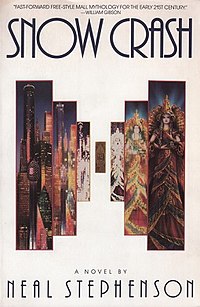
The same year, 1992, Neal Stephenson published a visionary novel called, Snowcrash. In retrospect, it merits the word, “prophetic,” for its sketch of life in the metaverse – a word Stephenson coined – and in the inconvenient world we call “reality.”

Consider:

In Snowcrash, Stepenson posits a world where nation states have transferred most of their power to corporations. Most people are corporate citizens and live in corporate enclaves, or less prestigious burbclaves.  The hero of Snowcrash, Hiro Protagonist, is a citizen of “Mr. Lee’s Greater Hong Kong.”  Military power belongs to private contractors, as do the roadways, which vie for driver/customers.  The post office is gone; private couriers deliver snail-mail.  The United States occupies a smallish territory centered in the Mohave Desert, and keeps it’s employees busy with make-work projects.  The former United States economy hinges on two industries – computer microcode and high speed pizza delivery, which has been revolutionized since the Mafia took control.

Though Hiro is a citizen of Hong Kong, as a pizza driver, he can’t afford to live in their enclaveclave.  Home is a self-storage unit under the flight path at LAX.  Like most of his hip and cyber-savvy generation, he spends most of his time online in the guise of his avatar, navigating virtual worlds.  But something is happening in the online world.  A strange new computer virus, when opened, generates a graphic pattern that scrambles the brains of the user.  They are dazed and speak in tongues.  With a young woman named YT, for Yours Truly, Hiro sets out to unravel the mystery.

The villain turns out to be a charismatic preacher.  In his attempt to secure both temporal and spiritual power, he has tapped into the ancient Sumerian glyphs that first scrambled human speech patterns in the event known as the Tower of Babel.

It’s been 20 years since I’ve read Snow Crash, so I’m writing this from memory.  I’m not necessarily recommending the whole novel.  The first jaw-dropping 100 pages, where Stephenson built his world, flew by and still leave me in awe.  I remember the rest of the book dragging in parts, but I still think of the story all the time.  Most futuristic fantasies prove as silly as the 1930’s movie shorts that show humans zipping along in their air cars between high rise buildings, happy and without any accidents.  This book is different.

In 1992 there were no virtual worlds.  Now there are, and you have to create an avatar to negotiate them.  These days, it isn’t so hard now to imagine a bright young man living in a self-storage shed.  But above all, Snow Crash comes to mind because in the wake of “citizens united,” it’s so easy to see corporate power growing while government power wanes.  With Super Pac money rolling the election year dice, does the government control corporations or do corporations control government?  Neal Stephenson saw this and other aspects of our world coming 20 years ago.

Snow Crash, is a visionary novel that all lovers of fantasy should know.

An Author’s Guide to Publishing in 2012 – A Guest Post by Amy Rogers, Part 2

This is the second part of a guest post outlining ways writers can understand and respond to the rapid changes in the world of publishing.  If you haven’t read Part 1, I suggest you start with that post, which immediately precedes this one.

_____________________________________________________________________

An Author’s Guide to Publishing in 2012 – Part Two, by Dr. Amy Rogers

Part 2: Indie Publishing

Take all of the above and add another, less glamorous tech advance: print-on-demand publishing.  What you get is a slew of new publishing options.  Traditional New York-based publishers (now consolidated into six major houses with many imprints) used to be the only game in town.  What was once derisively called vanity publishing has become “indie”, and indie publishing encompasses a wide range of approaches.

Self-publishing:

This is the buzzword on everyone’s lips, but what does it mean?   I find that many people use the term “self-published” to broadly describe any book in any format that does not have the imprimatur of a Big Six publisher.  This fails to account for the various degrees of self-publishing and also the new professional indie publishing options out there.

1.  A truly self-published book is written, edited, designed, formatted, and distributed all by the author.  The main advantages of this approach are total control and minimal financial expense (though the investment of time may be substantial).  Some writers create their own publishing company to do this.  However most self-pubbing authors hire out at least some the non-writing tasks.  In fact, the majority of “self-published” titles were published by a subsidy publisher chosen and paid for by the author.

2.  Subsidy publisher

A subsidy publisher is a company hired by the author to turn his text file into a paper or digital book.  In most cases, the subsidy publisher provides online distribution but NOT to bricks-and-mortar bookstores.

With subsidy publishing, the author pays out of pocket for all expenses.  The cost and services provided vary a lot, so it pays to shop around.  Unlike old “vanity” publishing, print on demand technology frees the author from having to pay in advance for a print run of books that might never sell.  This keeps the costs low relative to the old days.  In this model, the author is the publisher’s customer.

The next step closer to a traditional publishing arrangement is assisted self-publishing where the author does not pay the costs upfront but rather shares future royalties with the service provider.  This means the book has to be good enough that somebody is willing to take a modest financial risk in publishing it.  Several literary agencies are now offering this type of “consulting” service to their existing clients in exchange for a commission.

3.  Not self-pub: Small presses

A small press is any traditionally-structured publisher that is not owned by the Big Six.  University presses, regional presses, niche publishers and others fit in this category.  Such companies may only publish a few titles per year.  The key distinction that makes this “not self-pub” is the publisher, not the author, pays the costs of getting the book out there.  In this model, booksellers and readers are the publisher’s customers.  Unlike self-publishing, the author must provide a manuscript that is deemed commercially viable on at least a small scale.

4.  Digital-only full-service publishers

This category didn’t exist until a few years ago.  Digital-only publishers operate like small presses but release their titles only in e-book formats.  This keeps their costs lower and allows them to take on riskier projects—such as first novels—that may not sell enough copies to catch the attention of a Big Six imprint.  My own publisher, Diversion Books, is a leader in this category.

With Diversion, the author retains the right to self-publish in paper.  This creates an interesting situation: my science thriller Petroplague is currently on sale with two different covers and two different publishers.  One cover is for the professional e-book with Diversion; the other cover is on the paper books I produced at my own expense with the help of a subsidy publisher.

One size does not fit all in publishing these days.  Indie authors can choose to learn a variety of non-writing skills and publish their books themselves, or they can hire others to do it for them.  If the book is marketable and the author is willing to split royalties, a small press or a digital-only publisher may be an alternative to the Big 6.  For the first time in the history of the book, barriers to entry are low and every writer has the power to bypass the gatekeepers and put his or her words in the hands of readers.

—–

Amy Rogers is a Harvard-educated scientist, educator, and critic who writes science-themed thrillers. Her debut novel Petroplague is about oil-eating bacteria contaminating the fuel supply of Los Angeles and paralyzing the city.  She is a member of International Thrillers Writers Debut Class (2011-2012).  At her website ScienceThrillers.com [there’s a link on thefirstgates blogroll], Amy reviews books that combine real science with entertainment.  You can follow Amy on Twitter @ScienceThriller or on her Facebook fan page http://www.facebook.com/pages/Amy-Rogers/202428959777274

_____________________________________________________________________

Please stop by Amy’s blog, ScienceThrillers.com, to leave a comment if you enjoyed this series.  While you are there, take a look at the features, sign up to receive the newsletter, and enjoy the reviews of a number science-related thrillers, ranging from The Hound of the Baskervilles to Jurassic Park.  

An Author’s Guide to Publishing in 2012 – A Guest Post by Amy Rogers

Last September, I wrote an enthusiastic review of Petroplague by Amy Rogers http://wp.me/pYql4-1ep. With a PHD in microbiology, Dr. Rogers is uniquely qualified to bring her considerable writing skills to bear on a thriller in which an oil-eating bacteria ravages Los Angeles.  Airplanes fall from the sky.  Millions of cars stall on the streets and freeways.  No food deliveries.  No ambulance, police, or fire service as a greedy corporate criminal and deluded eco-terrorists strive to suppress a solution.

On two occasions, New York agents represented Amy Rogers’ work but were unable to sell it.  With a keen understanding of the turmoil in traditional publishing, Amy decided to take matters into her own hands.  After I posted my review, I invited her to write a summary of her experience for us.

Last week I received an email saying she’d finished a “5,000 word treatise” on current publishing options for writers.  This will form the basis for her presentation at the June meeting of the Sacramento California Writer’s Club branch.  She graciously sent a 1500 word, abridged version, for thefirstgates.  I am delighted to be able to share her account, for I think her observations and experiences can serve as as Ariadne’s thread as we work our way through the current publishing maze.

Because of the length, I am going post this article in two parts.  Meanwhile, I invite everyone to visit Amy’s blog, Science Thrillers.com (listed on my blogroll), and to follow her on Twitter at, @ScienceThriller.  Also, check out her Facebook fan page, where you’ll see that she has been invited to participate in the New Author’s Breakfast at the Left Coast Crime 2012 conference in Sacramento at the end of the month. http://www.facebook.com/pages/Amy-Rogers/202428959777274

And now, without further delay…

_____________________________________________________________________

An author’s guide to publishing in 2012 by Dr. Amy Rogers

Part 1: What’s going on with publishing today?

Book publishing is undergoing a revolution unlike anything seen since the invention of moveable type, an explosion of diversity in the paths leading to publication.  After centuries in a desert of limited choices, writers now have a rainforest of options to get their work in front of readers.

But the changes are so profound and happening so rapidly, many writers can’t keep up with the business.  We’re writers, so we write, but what then?  The simple formula—write book, sell rights to a print publisher, collect royalties—doesn’t apply to the majority of published books today.  Is this a bad thing?

The big changes in publishing are both challenge and opportunity.  Whether the changes are “good” or “bad” depends on where you stand.  In this series, I’ll first summarize some of the major trends in the book business that are affecting the way books get published and sold.  In the second, I’ll discuss how writers seeking “publication” of their work can navigate the path that’s right for them.

So why does the publishing business feel like a Kansas farmhouse in a tornado?  Simple: technology.  Digital disruption devastated the music industry; now it’s rolling over publishing.  The end results for various stakeholders (authors, publishers, readers, retailers) are far from certain.

1.  Ebooks

Top of the list of disruptive technologies: e-books.  Amazon’s Kindle e-reader is now in its third or fourth generation.  The critical $100 price point has been breached (a Kindle now costs as little as $79).  Barnes & Noble’s Nook e-reader and tremendous numbers of Apple’s iPad plus various smartphones (which can also be used as e-readers) give millions of Americans easy access to e-books.  (Not to mention ubiquitous laptop and desktop computers, which can be used to read e-books, though uncomfortably.)

How rapid is the rise of the e-book?  The Economist reports that in the first five months of 2011, “sales of consumer e-books in America overtook those from adult hardback books” and “amazon now sells more copies of e-books than paper books”. http://www.economist.com/node/21528611 Granted, Amazon’s experience does not represent the entire bookselling business, but it is significant.  In my own genre—thrillers—over half the books sold are now in digital formats.

2.  Distribution

Digital technology is changing the way books are distributed.  Obviously, e-books can be sold online—from anywhere in the world, to anywhere in the world, no neighborhood bookstore required.

But it’s not only e-book sales that are affected by digital tech.  The emergence of amazon as a global book retailer with no physical presence in communities has also changed how paper books are sold.  People are shopping for paper books over the Internet and getting them shipped.  Neighborhood and mall bookstores are struggling.  Browsing is nice, taking your book home with you on the spot is nice too.  But amazon’s price advantage is killing these stores.  The giant online retailer subsidizes much of its bookselling business, has smaller fixed costs, and still dodges sales tax in most states.

3.  Publicity

The best way to get a person to buy a book is word of mouth: a trusted source, whether a friend or a reviewer, mentioned the book.  Digital technology—the Internet and “social networking”—is truly revolutionizing word of “mouth”.  Successful book marketing is increasingly based in this virtual world.  Book bloggers, readers’ collectives like GoodReads and LibraryThing, Facebook, Twitter, book trailers on YouTube—this is what sells books.  Reviews remain critical, but the traditional venue—newspaper sections devoted to in-house book reviews—is vanishing.  Only a few papers still publish their own book reviews, and generally these reviews are few in number.  So authors and publishers must go online to get reviews and build “buzz” around a title.

_____________________________________________________________________

Section two of Dr. Amy Rogers, A Writer’s Guide to Publishing in 2012 will be featured in my next post.

Life: The Movie by Neal Gabler – A Book Review

In his final movie, Being There, 1979, Peter Sellers plays Chance, a gardener with a low IQ, who becomes an advisor to the president and business tycoons. In one iconic scene, Chance is accosted by a knife wielding youth in Washington, DC.  He pulls out his TV remote control and clicks it to change the channel.  He is puzzled when the assailant doesn’t vanish.

Peter Sellers as Chance in “Being There”

This might be the perfect illustration for Neal Gabler’s, Life, The Movie:  How Entertainment Conquered Reality, (2000).  Gabler quotes historian, Daniel Boorstin, who wrote in the early 60’s that, “We risk being the first people in history to have been able to make their illusions so vivid, so persuasive, so ‘realistic’ that they can live in them.”  Done deal, according to Gabler, who calls us, not just a “post-modern culture,” but a “post-reality culture.”

At times I had to keep my own assumptions in check:  subjects like reality and imagination open onto psychological and spiritual vistas beyond the scope of this or any other single book.  But when Gabler cited concrete examples, I found myself nodding my head on almost every page.

“You know how to brood because you have seen Rebel Without a Cause,” Gabler says, quoting cultural analyst, Louis Menand.  “What better model does the world offer?”

Gabler charts the ascendency of entertainment in America from the early 19th century, where the split between high and low culture was fueled by our democratic suspicion of all elites.  Calling someone “aristocratic” was a serious insult.  During the 1840 presidential campaign, when a man called Daniel Webster an aristocrat, he thundered back that he’d grown up in a log cabin, and anyone calling him an aristocrat was “a coward and a liar.”  ( Sound familiar? )

Nathaniel Hawthorn despaired of the fate of serious writers amid the flood of “trash” being published.  One publisher sold four million dime novels in five years, at a time when the US population was only 25 million.

In 1850, 1% of the population owned 50% of the nation’s wealth and held almost all public offices.  Upward mobility was a myth, since 98% of that wealth had been inherited.  While the one-percent held the power, then as now, culture wars raged, sometimes with a violence that we (thankfully) haven’t seen yet.  One night in New York, rival Shakespearean actors, one British and one American, were both scheduled to perform, the former in an uptown theater, the latter downtown.  Police ejected the rabble who had bought tickets solely to heckle the British actor.  A much larger crowd gathered across the street to throw rocks as the “aristocratic” crowd tried to leave.  The militia was called, a riot ensued, and before the night was over, 22 lay dead and more than a hundred wounded.

In the end, it was movies that won the day for popular culture.  The 1% stayed away from the early nickelodeons, which tended to be crowded and crass.  Later, with middle-class patronage, refined behavior became the norm, but the elite have never fared well in the movies, from the Marx Brothers  Night at the Opera, to the present, where a too-expensive suit is always the mark of a villain.

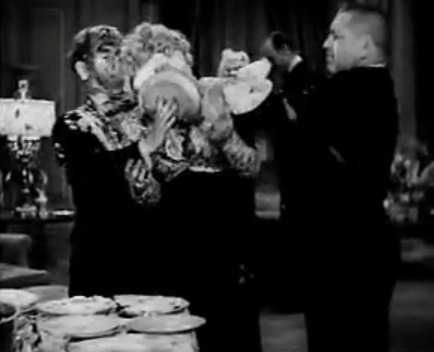
Three Stooges + high society + pies = disaster

As he charts the history of high vs. popular culture, Gabler makes a telling point.  It isn’t just about high brow and low brow – it’s about the ascendency of entertainment.  Being entertained is easy, and the corollary is that when the goal is entertainment, grabbing and holding audience attention is the supreme value, and “things that do not conform – for example, serious literature, serious political debate, serious ideas, serious anything – are more likely to be compromised or marginalized than ever before.”

Life: the Movie is a complex and disturbing book.  Gabler says in the introduction, it is diagnostic and not prescriptive.  To offer easy answers, he says, would be like the movie illusion where we meet the monster in act one and see it vanquished in act three.  Writing 12 years ago, Gabler said:

“One is almost compelled to admit that turning life into escapist entertainment is a perversely ingenious adaptation to the turbulence and tumult of modern existence.  Why worry about the seemingly intractable problems of society when you can simply declare ‘It’s morning in America,” as President Reagan did in his 1984 reelection campaign, and have yourself a long-running Frank Capra movie right down to the aw-shucks hero?”

I read this book after watching Neal Gabler speak on the fictions that lace the current election campaign on Moyers & Company, as I described in the preceding post. Because of it’s scope, I would recommend Life: the Movie only to those who want to delve into this issue in some depth.

But  I would recommend that everyone watch the ongoing conversation this year between Gabler and Moyers.  The confusions and illusions surrounding the political process are more convoluted than when the book was written, but Neal Gabler remains a reliable guide to pulling back the curtains and helping us draw closer to the truth.

Little Free Libraries

Todd Bol and Rick Brooks, with their Little Library

Todd Bol’s mother, a book lover, died a decade ago. Two years ago, to honor her memory, Bol built a miniature library, filled it with books, and set it in his front yard in Huron, Wis.  He and his friend, Rick Brooks, an outreach program manager at the University of Wisconsin, thought the idea could grow.  It has.  Bol and Brooks estimate there are 300 to 400 little libraries in 24 states and 8 countries.  Their website, http://www.littlefreelibrary.org/, has plans for people who want to build their own, places to purchase the small structures, and a map to track their locations.

“Take a book, leave a book,” is the operating principle.  Right now, a group of Wisconsin prison inmates is building libraries for new communities.  In New Orleans, Bol plans to make libraries out of debris left by Hurricane Katrina.  In El Paso, Texas, an elementary school where illiteracy was a problem now has two Little Libraries.  Lisa Lopez, the school librarian, says books are circulating “like crazy.”

“People tell us over and over, there’s something about the physical feel about the book in your hands,” Bol says. “It has meaning. There’s a spirit that can’t be found electronically.”

from an article in USA Today: http://www.usatoday.com/news/nation/story/2012-02-21/little-libraries-lawn-boxes-books/53260328/1

A Great Community Bookstore

Last week I wrote about Ann Patchett, a bestselling author who opened a bookstore after experiencing life in a city without one (http://wp.me/pYql4-1Kn).  A few days later, on a drive into the gold country, Mary and I were reminded of what a treasure a community bookstore can be.

The Book Seller has been a fixture in Grass Valley, CA since 1977.  For whatever reason, we hadn’t stopped by since the days when every small town had a bookshop.  In the days before anyone said, “brick and mortar,” because there was nothing else.

Kit Cole Hattem, The Book Seller owner

We didn’t set out with this or any other destination in mind, but stopped to look in the window and then walked in.  Several customers chatting with the salesclerk and carefully arranged displays in the front suggested the store was thriving.  With Ann Patchett’s words in my mind and Joni Mitchell’s too – “You don’t know what you’ve got till it’s gone” – I looked around to see what made this bookstore work.

Unique books for one thing, stacked from floor to ceiling.  I leafed through a few biographies I hadn’t seen before.  The selections had clearly been made by readers, not corporate marketing groups.

Lots of books of regional interest – fiction, history, natural history, and travel guides for the gold country and the Sierra foothills were well represented.

And ebook fans were not left out.  Notes on every shelf invited readers to order Google format books from the Book Seller’s website.  You can read these ebooks on pcs, macs, smartphones, tablets including the kindle fire, and all dedicated readers except the kindle.

Kit Hattem, owner of the Book Seller since 1985, said the store functions as a hub of a vibrant local writing community.  As if to emphasize her words, Steve Sanfield, a nationally known poet, author, and storyteller strolled in to chat with the sales clerk and browse for a few minutes.  Sanfield founded a popular summer event, the Sierra Storytelling Festival, 26 years ago.

To top off the great vibe in the store, conversation stopped when someone came in with a dog, for The Book Seller is pet friendly.  You can’t do that at Barnes&Noble…

I think you’ll enjoy The Book Seller’s website,  http://www.thebookseller.biz/.  If you read ebooks, think about ordering your next one from them.  And look around your own area.  What gems like this are waiting to be discovered and win your support?