The Unwinding: An Inner History of the New America, by George Packer

In the first sentence of The Unwinding, George Packer tells us what his title means:  “No one can say when the unwinding began – when the coil that held Americans together in its secure and sometimes stifling grip first gave way.”

Packer is a staff writer for The New Yorker, the author of an award winning book on American involvement in Iraq, two novels, and a play.  You could almost guess it would take someone with Packer’s chops to weave together the disparate threads of change that have irreversibly altered the country we thought we lived in.

It began in 1973, when the mid-east oil embargo coincided with models showing American had reached peak oil production.  And in 1977 when the steel mills in Youngstown, Ohio, that once stretched side-by-side for 25 miles, shut down.  When an idealistic young man named Jeff Connaughton, got an MBA and then decided to go to Wall Street, because by the early 80’s, getting a business degree and going to work for a company “that actually made things,” was viewed as failure.  When, according to Packer, concern over exported jobs prompted Wal-Mart to hang “Made in the U.S.A” signs over racks of clothing from Bangladesh.  When Connaughton became a Washington lobbyist and one of his colleagues told him, “Four-hundred thousand a year just doesn’t go as far as it used to.”

Poets see things before the rest of us, and Packer quotes Bruce Springsteen, who put it like this in 1984:  “Don’t you feel like you’re a rider on a downbound train?”

Now, almost 30 years later, when we all know we’re on a downbound train, Packer turns a light on some of the hydra-headed influences that led us collectively down this road.  He also shows us where positive change is likely to come from.  And where it is not.  It won’t come from the power elites, though it may come from disaffected refugees from those elites.

Jeff Connaughton, who made it into the outer circles of the inner circle, as a legal council for the Clinton White House, left Washington after being “radicalized by a stunning realization that our government has been taken over by a financial elite that runs the government for the plutocracy.”  Connaughton is now writing a book called The Payoff:  Why Wall Street Always Wins.

Packer also profiles Peter Thiel, a Silicon Valley entrepreneur who co-founded Paypal and helped bankroll Facebook as a startup.  Thiel put it like this:  “…the deep secret is there’s nobody at the steering wheel at all…People pretend to be in control, but the deep secret is there is no one.”  Thiel now looks for unusual entrepreneurial projects to fund.  Claiming that education is “the latest U.S. economic bubble,” he compares university administrators to sub-prime mortgage lenders.  In response, he began awarding Thiel Fellowships, two year grants of $100,000 each, to 20 people a year under the age of 20, willing to leave school to work on projects that “could make the world a better place.”

Packer doesn’t just profile movers and shakers in the post-unwinding world.  He details the story of Dean Price, son of generations of tobacco farmers, who overcomes multiple obstacles, including personal bankruptcy, to establish a working and profitable biodiesel refinery after learning about peak oil and taking the message to heart.

George Packer

author George Packer

In writing the book, Packer spent a lot of time with Tammy Thomas, an African-American woman who was 11 when the mills closed in Youngstown.  A few years later, she found herself an unwed mother of three, with a fierce determination, which she attributed to her grandmother, to get off welfare, even as jobs evaporated and gangs took over the neighborhoods.  She succeeded in doing so, and is now a community organizer and advocate, but her story makes clear that the odds were stacked against her.  She survived for 19 years in a car parts factory but is scornful of politicians who attach the label of “good jobs” to such work.  “Mitt Romney would be dead in week,” she said.

Packer interweaves the individual stories in a way that keeps you turning pages, like a novel with a large cast of characters that you care about.  Not all the stories have happy endings, and the suffering of individuals, cities, and regions is palpable.  By giving so many seemingly separate events the name, Unwinding, Packer helps clarify connections I had been sensing but unable to articulate.

“Alone on a landscape without solid structures, Americans have to improvise their own destinies, plot their own stories of success and salvation.”

A problem has to be named and described before we can begin to imagine solutions, and for this reason The Unwinding is a profoundly important book.
The North Wind’s Gift: a trickster tale from Italy

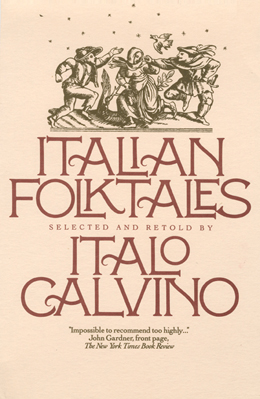
If you haven’t already done so, I suggest you read the preceding post, Notes on Trickster stories, which provides a background and context for this article.  Both posts were inspired by “The North Wind’s Gift,” a tale from Italo Calvino’s Italian Folktales, 1956.  The story came to my attention in Allan Chinen’s discussion of tricksters and appealed because of its relative simplicity and relevance to our own times.

Italian Folktales

Here’s a synopsis of the story:

Once there was a farmer named Geppone who toiled in his fields every day of the year but could barely feed his wife and three children.  The North Wind blew at harvest time and ruined his crops.  Finally Geppone had enough and set out to find the North Wind and demand justice.  He reached the North Wind’s castle.  “Every year you ruin my crops,” he said.  “Because of you, my family is starving to death.”

“What can I do?” the North Wind asked.

“I leave that up to you,” Geppone replied.

The North Wind’s heart went out to the little farmer.  He brought out a box.  “This is a magical box which will give you food when you open it, but tell no one else about the magic or you’ll lose it.”

Geppone thanked the Wind and set out for home.  On the way, he opened the box.  Instantly a table appeared, piled with food.  When he got home, Geppone opened the box again and treated his family to a feast.  He told his wife not to tell anyone, and especially to say nothing to the priest, who was their landlord and a greedy man.

The next day, the priest spoke to Geppone’s wife and wrung the story out of her.  He summoned Geppone and  demanded the box on pain of eviction, offering seeds in return, which proved to be worthless.  As bad off as he was before, the farmer returned to the North Wind’s castle to ask for another boon.

At first, the North Wind refused, saying, “You ignored my warning.  Why should I help you again?”  Geppone pleaded, and reminded the Wind that he was still the cause of the family’s ruin.

“Very well,” said the North Wind at last.  He gave Geppone a magnificent gold box, but said, “Open this only when you are starving.”

On his way home, Geppone stopped and opened the new box.  This time a ruffian with a club jumped out and began to beat the farmer, who struggled to close the lid.  When he did, the ruffian vanished.  Geppone limped home, sore and bruised.  When his wife and children clamored to try the golden box, Geppone left the room.  This time two ruffians jumped out and began to beat the family.  Geppone slipped back into the room, closed the box, and the assailants vanished.

“This is what you must do,” he said to his wife.  “Tell the priest I brought home an even finer box, but say nothing else.”

Geppone’s wife understood and did as her husband instructed.  When the priest called the farmer and demanded the golden box, Geppone feigned reluctance, but at last agreed to trade it for the original box.  The priest rubbed his hands.  The bishop was due to join him for Mass the next day; a feast would be just the thing to win the approval of his superior.

The next day, after Mass, the priest, the bishop, and their retinue gathered for supper.  When the priest opened the box, six ruffians jumped out and beat the clerics.  Geppone, who was waiting at the window, took his time in closing the box to save them.

No one objected when he carried this second box home.  The priest never bothered Geppone again.  The farmer was careful to guard the North Wind’s gifts, and his family lived in ease and comfort for the rest of their days.

You can read the story as it appears in Italian Folktales here:  The North Wind’s Gift

***

It’s clear at the start of the story that we’re in a post-heroic fairytale world.  Geppone is not out to slay a dragon, rescue a princess, or win a kingdom – he just wants to survive.

Allan Chinen speaks of the different life stages that different fairytales address.  While the majority center on young people venturing into the world,  “middle-tales” like this have older protagonists with different kinds of problems.  From a Jungian perspective, Chinen notes that tricksters usually don’t show up in our dreams when we’re 18 and planning to take the world by storm – they visit us when we’re 40, with a mortgage, a couple of kids, and a car that needs an engine overhaul.

Geppone works from dawn until dark but can barely make ends meet.  His wife doesn’t listen to him, and the landlord threatens eviction.  This setup makes his story seem contemporary – if we’re not in this situation ourselves, one of our neighbors probably is.

We get the feeling Geppone has been down on his luck and taking it on the chin for a while.  Something finally awakens within him and spurs him to action.  As a result, he meets the North Wind, a wild spirit who will become his guardian and mentor and teach him the wiles of the trickster.

The North Wind is invoked in the Song of Solomon, in Aesop, and in Greek and Norwegian folklore.  He shows up in George McDonald’s novel, On the Back of the North Wind, in the stories of Hans Christian Anderson, and in Pokemon.  The North Wind is also associated with thunder gods like Zeus and Odin.  It’s not surprising that he is a shadowy trickster in Italy, where invaders and winter both arrive from the north.

Almost every successful fairytale character wins the help of a guiding spirit, and the North Wind’s help is just what Geppone needs.  It prompts him first to stand up for himself and ask for what he needs and then to learn enough strategy to overcome his oppressive priest and landlord.  To Jungians, fairytale allies like helpful animals, fairy godmothers, and nature spirits represent parts of the unconscious mind that are older and wiser than ego, which gets us into trouble in the first place.

What this means in practical terms is a vast subject, beyond the scope of a few blog posts.  Jung would suggest to patients who were comfortable in a religious tradition to return to it for guidance.  Much of Jung’s work aimed at helping people estranged from existing traditions who still needed to tap inner sources of wisdom.

In the “Power of Myth,” Bill Moyers asked Joseph Campbell where ordinary (i.e., busy) people might look to experience the wisdom of myth.  Campbell suggested we take 30 minutes or an hour a day in a quiet place where we can read what inspires us and perhaps keep a journal.

Just like this story, the psyche is home to ruffians and riches, and the old stories are not to be taken literally.  James Hillman, a prominent Jungian thinker, always insisted that literalism is the greatest enemy of inner wisdom.  So how does trickster wisdom manifest  in our world right now?  I don’t think we have to look very far.

A world that’s increasingly dysfunctional serves as a magnet for trickster energy, for good as well as for ill.  A Facebook friend mentioned that he once loaned out a book on trickster mythology and never got it back.  That fits the myths of trickster gods like Hermes who are also patrons of thieves.  Hermes may be the supreme image of the trickster.  As fluid as the metal which bears his Roman name, Mercury, he was the messenger between gods and humans who also conducted souls to the afterlife.  Patron of travelers, herdsmen, poets, orators, athletes, and inventors, his herald’s staff, the caduceus, is the symbol of healing to this day.

I find myself watching for positive manifestations of trickster energy, which usually turn up under the radar of corporate and government organizations which carry a vested interest in the status quo.  When you look, quite a few individuals and groups are trying out new solutions.  I’ll post at least one example in the near future.

In the meantime I would love to hear where you find trickster energy in yourself and in those around you.

Notes on Trickster stories

Many of you will have heard the old Chinese curse, “May you live in interesting times.”  We do, beyond any question.  With a longstanding interest in folklore, I often find myself wondering which, if any, of the old tales can speak to us now and illumine our situation?  I always come back to the trickster stories.

Br’er Rabbit, an Americanized African trickster, from an 1881 book cover by Frederick S. Church. Public domain

Trickster tales are told around the world and may be among our earliest stories; in some traditions, tricksters create the world and bring fire to humans.  Sometimes benefactors and sometimes criminals, tricksters are contrarians, rule breakers, restless beings who disrupt and disturb, who keep creation moving, dealing out life and death in turn.

Groucho Marx, Loki, all of Shakespeare’s fools, and many animals, from Coyote, to Spider, to Br’er Rabbit are tricksters.  We named our first rescue dog Kit, short for Kitsune, which is Japanese for “Fox,” another famous trickster.  The reason should be obvious in this picture:

Kit

Kit

We have to lock the windows when driving with Kit because she knows how to hit the window button with her paw to roll it down so she can hang her head out, bark at other dogs, and catch the breeze. If Kit had thumbs, we’d be in serious trouble!

Establishments have little use for tricksters, and it’s easy to see why.  We may like them in the movies, but no one wants the Three Stooges to work on their plumbing. Schools are ruthless in their suppression of tricksters.  And yet, in times when the norms break down and the culture looses its rudder, trickster energy may be what we need.  Free of cultural norms and concern for what is polite or even legal, tricksters focus on what will work in the here and now.

After interviews with twin tower survivors, researchers discovered that people waited an average of ten minutes before deciding to exit the buildings.  “Do you think we should leave?”  “Will we have to use vacation time if we go?”  “What about the report I have to finish?”  Once they decided to exit, survivors spent several more precious minutes logging out of their systems and locking their desks and file cabinets.

Researchers concluded from this and other studies, that the human brain is often dangerously slow in reacting to radically different events or disasters.  These are the times when we need trickster energy.  Unbound by convention, the trickster jumps on a desk and yells, “The sky is falling – get the f**k out!”

Allan Chinen, M.D., a psychiatrist and professor of psychiatry, wrote about tricksters from the Jungian perspective.  In 2012, I discussed his Once Upon a Midlife, an analysis of folklore aimed at that stage of life.  In 1993, Chinen published Beyond the Hero:  Classic Stories of Men in Search of Soul.

beyond the hero

Chinen argues that despite popular concepts and movies like Man of Steel, The Hero is not the core masculine archetype – the Shaman/Trickster is an older, wiser, and more primal energy.

Like most Jungian’s I have read, Chinen regards tricksters as primarily masculine archetypes.  I’m not sure how opinion stands in currently folklore studies; much work has been done with women’s tales in the last 20 years.  It is Gretel, after all, who uses trickery to kill the witch and save her brother.  Only by wiles can Bluebeard be defeated or brothers saved from various enchantments.

I suspect the difference is that full-time tricksters like Coyote are usually male.  You see it in children at play too, and sadly, it is overwhelmingly boys who get dosed with ritalin when they’re not docile enough for the modern classroom.  As Jung and Hillman both observed, what a culture defines as pathology may say more about the culture than the people it labels as defective.

Guardians of the status quo are wary of tricksters and with good reason.  They are almost always subversive – the Stooges only throw pies in the homes of the 1%, and Charlie Chaplin was no friend of the captains of industry.

Charlie Chaplin in "Modern Times."  CC-by-SA-2.0

Charlie Chaplin in “Modern Times.” CC-by-SA-2.0

To personify self-preservation; to point out the shadow of a dominant culture; to keep the flame of hope and spirit alive; to demonstrate the power to wit to those who are disenfranchised.  Scholars now believe the Br’er Rabbit tales performed such functions for slaves as the Coyote stories did for Native Americans on the reservations.  In all likelihood, these are the gifts tricksters have given for untold millennia.

Next time I’ll look at a classic trickster story that Allan Chinen told, with an eye to it’s relevance for the 21st century.

Sleepless in Hollywood by Lynda Obst

Have you been to the movies lately?  Like what you see?  Wonder if it’s a trend?

Today’s edition of Marketplace clued me in on the answer to question three via an interview with Hollywood insider Lynda Obst, producer of The Fisher King and Sleepless in Seattle.  Obst realized something had changed when her son said, “Mom, trying to get movies made because they’re good is so 2003.”  The interview concerned her new book, Sleepless in Hollywood:  Tales from the New Abnormal in the Movie Business.  

sleepless in hollywood

Obst says the “old abnormal” was when she could get movies made because they were good.  DVD sales financed half of studio profits and allowed production of the “smaller” movies she loves, like romantic comedies.  Then domestic DVD sales tanked at the same time as foreign viewership rose, particularly in China and Russia, where there’s an endless demand for our blockbusters and special effects.  You can make “small movies” anywhere in the world, she says, but so far, you can only make blockbusters here.

Which may explain why I’ve been to so few movies this year – when the trailers assault my senses with digitized special effects, I tend to give them a miss, with the exception of movies like Star Trek, because…well, it’s Star Trek.

Sleepless in Hollywood is now in my book queue, in part because Obst’s final chapter is called, “Does the future have a future?” and I want to know her answer to the question.

And a final note on 2013 movies to date – they’ve finally pushed us into the 21st century, with a subscription to Netflix, so there is at least one happy outcome.

Inferno by Dan Brown: a book review

Inferno

I am one of the millions who couldn’t put The Da Vinci Code down when it was published in 2003.  Dan Brown’s breakout thriller went on to become the second best selling book of all time, trailing only The Bible.  Yet after reading his next offering, The Lost Symbol (2009), I swore off the author for good.  Information overload and a two dimensional, comic strip villain made it a disappointing read.

Time weakened my resolution, and happily so.  With Inferno, published this month, the author has found his stride again.  Weaknesses remain, but Dan Brown can tell an enthralling story.

The code that Robert Langdon must decipher this time comes from Dante’s Divine Comedy, and especially the first book of that trilogy, The Inferno.  It’s safe to say that everyone in the western world, Christian or not, has been influenced by The Divine Comedy, which gave us our graphic geographies of hell, purgatory, and paradise.  Artists then painted Dante’s vision, shaping the devils and angels that still lurk in imagination.

One of those paintings, Botticelli’s “La Mappa dell’Inferno” or “Map of Hell,” is a key to the mystery Langdon must decipher in his race to stop the release of an engineered plague designed to “cull the human herd” and prevent over population from destroying us all.

La Mappa dell'Inferno by Botticelli

La Mappa dell’Inferno by Botticelli

There aren’t many thrillers with stakes higher than this, and all the elements of it are real.  The threat of ever more people struggling for fixed or diminishing resources can hardly be exaggerated.  The threat of bio-terrorism is here.  Will genetic engineering open the gates of heaven or hell?  Into this nail-biting mix, drawn from the headlines, Brown adds a pretty and brilliant sidekick for Langdon, an equally brilliant mad scientist, and black-uniformed spooks in pursuit.  We have all the elements of an engrossing thriller, but Dan Brown has ways of subverting himself.

His most obvious flaw is excessive information dumping.  Inferno has two primary speeds, fast-forward chase scenes and slow motion data uploads.  When the pacing is off, both can become tiresome.

In one scene, Langdon searches for a clue in the 25th canto of Dante’s Paradiso.  He borrows an iPhone from a tourist to google the relevant passage, but then, although all the police in Florence and a surveillance drone are on his tail, the action stops for a treatise on different translations of Dante.  Robert Langdon, aka Brown, should take a page from Sherlock Holmes and not crowd his head or ours with facts that do not bear on the case at hand.

I also had a problem with several late-in-the-story surprises.  In any good thriller, things and people are not what they seem.  Sometimes it takes a magician’s sleight-of-hand and clever misdirection to pull off major twists with characters whose thoughts we have shared all along.  Several of Inferno’s revelations were clunky in a “What the…?” kind of way.  

Even with these flaws, I can recommend the book.  It had been a long time since I’ve found myself carried away by a work of fiction; as I read, I put everything I could on hold to keep turning the pages.

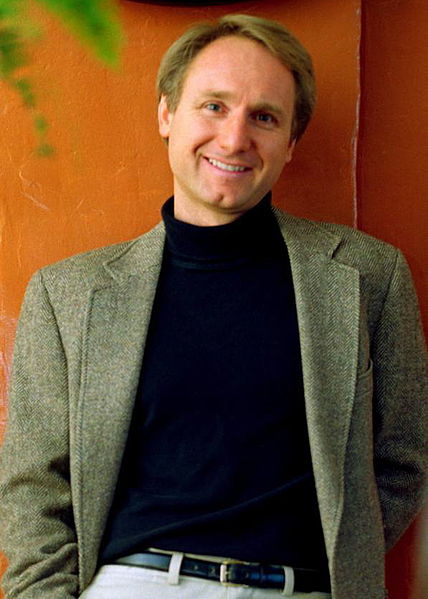
Dan Brown, 2007, by Phillip Scalia, CC-By-SA-3.0

Dan Brown, 2007, by Phillip Scalia, CC-By-SA-3.0

Reading Dan Brown convinces me yet again of the absolute primacy of story.  I had the same reaction after a pilgrimage to the home of Jack London, a writer I loved when I was young.  George Orwell, among others, described London’s writing and use of language as “poor,” yet more than 50 movies have been made from his novels and stories.  Not bad for a writer whose life was over at 40.

Fortunately for everyone who enjoys a gripping tale, Dan Brown, like London before him, has every reason to continue following his own star and forget the whining of critics like me.  If he does, he will likely continue to bring us supremely engrossing fiction.

The Worlds Revolve

As I scanned reviews of The Great Gatsby, I tuned in to one comment about the visionary quality of F. Scott Fitzgerald’s book:  he saw the end of the roaring 20’s in 1925, before almost anyone else.

Almost anyone else…

I’d argue that T.S. Eliot, in Prufrock and Other Observations (1917), saw where our 20th century mode of life was leading even before the party began.

Here is how the title poem, “The Love Song of J. Alfred Prufrock,” begins:

Let us go then, you and I,
When the evening is spread out against the sky
Like a patient etherised upon a table;
Let us go, through certain half-deserted streets,
The muttering retreats
Of restless nights in one-night cheap hotels
And sawdust restaurants with oyster-shells:
Streets that follow like a tedious argument
Of insidious intent
To lead you to an overwhelming question…
Oh, do not ask, “What is it?”
Let us go and make our visit.

And here is how Prufrock ends:

We have lingered in the chambers of the sea
By sea-girls wreathed with seaweek red and brown
Till human voices wake us, and we drown.

One of the best professors I ever had helped me engage Eliot with the visual imagination, which helped me see how radical he was compared to the literary establishment of the day.  A kind of tired, watered down romanticism was the norm before the war, so describing the sky as “a patient etherized upon the table” was shocking.  “Have you ever seen someone unconscious?” the professor asked.  “Or very sick or dead?  Eliot isn’t describing a postcard sunset.”

But perhaps my most unforgettable poetic image came from another piece in Eliot’s first book.  Regarded as a minor work, “Preludes” is even less cheery than Prufrock.  Here’s how the poem ends:

Wipe your hand across your mouth and laugh;
The worlds revolve like ancient women
Gathering fuel in vacant lots.

“Picture it,” the professor said, so I did.  I imagined an empty field on the outskirts of London, on a dark winter’s day.  Old women with scarves, patched sweaters and faded coats circle slowly, eyes on the ground, looking for sticks or slats from a discarded crate they can burn at home to stay warm.  Half a dozen figures or more in slow orbit.  They might as well be 100 miles apart, even though they are next to each other, doing the same thing.

Which worlds revolve like ancient women?  I’ve entertained many answers over the years, but one came up this week that helped clarify a sensation I’ve had very strongly since the November election.

The May 20, Time Magazine cover story featured our current crop of young people who are tagged as “Millennials.”

Time cover, May 30

I’ve read such generational articles since the days when they were written about me and my cohorts.  If you don’t take them too literally, they yield some interesting insights.  In this case, when author, Joel Stein, wrote “Millennials aren’t trying to take over the establishment; they’re growing up without one,” I literally jumped to my feet and ran out to brew some coffee.  I do that a lot when a light bulb goes on.

Millennials are growing up without an establishment.  Bulls-eye.  We’re all growing up without an establishment!

The worlds revolve like ancient women,
gathering fuel in vacant lots.

We’ve always had personal areas of concern, particular to our interests, our regions, and the groups that we align with, but have we ever been so lacking in the kind of national ethos and ideology that used to weld us together as one nation under one official God?

When journalists wrote about my generation, the lines were clear.  We had an ugly war which you were either for or against, yes or no, no ambiguity.  Now it’s all too inviting to forget that we’re still in a war no one believes in anymore, and maybe hasn’t for years.  In earlier days, we knew who was good and who was bad.  Now our enemies change on a regular basis.  Who is our biggest threat this month?  The worlds revolve and I can’t remember.

This week, if you live in Boston, you are concerned with the dead bomber’s burial.  In Washington, you follow the Benghazi hearings.  If you’re in congress or one of the 1%, you care about the deficit, though polls show that 92% of the rest of us do not.

If you live in Pennsylvania, you’ve got a new worry.  The legislature decided it’s probably unconstitutional to ban guns from public college campuses.  Think of armed drunken students on Friday night.  A well regulated militia, indeed.

My own new biggest concern springs from a report that our CO2 levels are higher than they have been in three million years.  I drive a hybrid car and use pumps instead of sprays, but clearly that’s not enough.  Some still say it’s a made up problem, and a few believe these are the end-times, so it’s a moot point.  What do I do if I’m not convinced?  Does anyone write to their senators anymore about anything?

No establishment means no one at the helm.  We’re on a ship without a rudder, or rather, many ships, going in circles like women gathering fuel in vacant lots.  The guy next to you at the stoplight is either talking on bluetooth or talking to himself.  You hope that if it’s the latter, he isn’t too angry and doesn’t have a gun.

House behind vacant lot, 2008, by Samuel A. Love, CC by-NC-ND 2.0

House behind vacant lot, 2008, by Samuel A. Love, CC by-NC-ND 2.0

These days some of those ancient women have concealed weapons and none have had background checks.  You spot a piece of wood at the same moment as another who narrows her eyes as if to say, “Are you feeling lucky today?  Well, are you?”

Yesterday’s paper featured an article on the current generation of survivalists, who now call themselves, “preppers,” a terrible name that sounds like a table condiment or the slacks and sweater look for high school students.  They are getting ready for the big collapse, which they say is just a matter of time.  They make a compelling point – ships without rudders run aground.  One local prepper who teaches his skills to others asks, “What would you do if you hadn’t had any water or food for three days?”

Strictly speaking, I think you die after three days without water, but it’s a good question.  I know what I hope I’d do in a crisis, though I don’t think anyone knows in advance for sure.  I recall stories of people helping each other during disasters and others doing just the opposite.  What’s scary is that I think you tend to help people you view as neighbors, and we all have fewer neighbors than ever before.

The survivalists are right about one thing – you have to plan the future you want and practice for it.  Isn’t that the real question, “the overwhelming question,” as Eliot put it? What do we want our lives to be like?  What kind of lives are worth surviving for?

What would happen if those ancient women teamed up to help each other gather fuel?  That’s so un-20th century, but now that we have no establishment, all bets are off.  That kind of future is so foreign to our current way of life that even with the best intentions and effort, many of us won’t see it in our lifetimes.  But that doesn’t really matter.

Outcomes are not as important as the questions.  What do we want our lives to be like?  How do we want to live?  Better to start asking now, lest the day come when human voices wake us and we drown.

Jorinda and Joringel, Part 2

Photo by Jon Sullivan, public domain

Photo by Jon Sullivan, public domain

This post continues my discussion of Jorinda and Joringel, a fairytale from the Brothers Grimm.  If you haven’t read Part 1, I suggest you do so.  What follows will make more sense.  Here is a summary of the story:

A young couple, betrothed to be married, stray too close to the castle of a witch in a dense forest.  The witch freezes the young man, Joringel, on the spot and turns the young woman, Jorinda, into a nightingale.  She cages Jorinda and carries her into the castle where she keeps thousands of other girl-songbirds.  

The witch then frees Joringel, who wanders to a strange town and works as a shepherd for a long time.  At last he dreams of a red flower enclosing a jewel which overcomes all enchantments.  After searching for nine days, he finds such a flower with a large drop of dew inside.  He uses the flower to free Jorinda and the other girls, and strip the witch of her magical powers.  Jorinda and Joringel marry and live happily for many years.

I have referred before to the writings of Marie-Louise Von Franz, Carl Jung’s closest associate, who wrote several books on folklore from a Jungian perspective.  In approaching this story, I reread parts of her Individuation in Fairy Tales (1977).

Individuation was  Jung’s central concept.  He used the term for the ultimate goal of inner-work, the lifelong struggle to realize the Self – not the ego-self but our unique totality, the union of all our tendencies, good, bad, and ugly.  This psychic wholeness can free us from the prison of neurosis.  

Jung and Von Franz listed numerous symbols for the Self:  the divine figures of all religions; the wise old man or wise old woman; the divine child, the helpful animal, mandalas, flowers, jewels, birds, golden balls, circular towers, and almost anything else that implies wholeness or completeness in itself. 

Rose windows in the cathedrals are well known western mandalas, symbols of unity in the cosmos, while our fairytale rose, which breaks all enchantments and hides a pearl, has a similar meaning for the lovers in this story.

English stained glass by William Wailes, ca 1865. Photo by TTaylor, 2006. Public Domain via Wikimedia Commons

Jorinda and Joringel, when they finally marry, embody another symbol of the Self in the Jungian view, the divine pair.  The mystery of the male-female union of opposites was often illustrated as a hermaphrodite in the alchemical texts that Jung studied, a western equivalent of the yin-yang symbol.

Fairytales don’t feature hermaphrodites, just normal weird being like giants and dragons, but I think we can look for this theme of “higher union” whenever a folktale ends with a wedding.  But before the happy ending, Jorinda and Joringel have to experience loss and getting stuck.

At the start of the story, they seem very young.  Young people don’t know the dark regions in the forest.  They play with golden balls, their original wholeness, but that is destined to go.  In folklore and in life, innocence makes a fall inevitable.

Everyone goes through stuck times. – the unsatisfactory job or relationship.  What once sustained us loses its flavor.  Marie-Louise Von Franz gave the example of one of her patients – a 43 year old unmarried man who lived at home and took care of his mother.  She had spells of illness whenever he talked of getting a place of his own.

Jorinda is caught in a different but similar trap.  Her transformation into a songbird is unique in my experience.  I haven’t come across this motif in any other tale.  A songbird is a pretty, entertaining, and unthreatening creature – perhaps what our culture wishes for young women and girls.  Yet to interpret the story like that amounts to projecting our modern sensibility onto earlier generations who shared this story around their hearths for hundreds of years – a risky proposition at best.

The witch is old.  Freezing people and caging them as songbirds can be seen as similar strategies for stopping time.  If we want to read this psychologically, we can imagine the witch as those places within that hate change, that cling to youth and beauty as if grasping will prevent them from slipping away.  It’s interesting that the healing flower contains a drop of dew, one of life’s more ephemeral things.

As happens when people are truly stuck, the solution doesn’t come from the characters’ ego selves – it comes from a transpersonal source, a “big dream” that leads Joringel to the magical flower.  And it doesn’t come immediately, but only after this one-time golden boy labors for a long time as a lowly shepherd.  Robert Bly has written in detail about the sobering quality of menial work in folklore.  Von Franz wrote about the value of work in helping the flighty, “eternal youth” in us get grounded.

The historical Saint Patrick was captured at 16 by Irish pirates and sold into slavery.  He worked for six years herding sheep.  He learned to pray in the wilderness and found his way to Christianity.  When the time was right, he heard a voice tell him his ship was ready, so he made his rather miraculous escape.  According to Jung and Von Franz, our inner center, the Self, does things like that.

To me, there is a beauty in these stories that equals scripture.  Faith, trust, kindness, belief in oneself and in the goodness of life, are implicit.  The heroes and heroines have to learn timing and instinct, when to trust and when to be wary, when to speak and when to be still.  They generally learn things the hard way (like us) after taking a fall – if their attention doesn’t falter in the forest, they wind up with a stepmother.  But those who listen to birds, to their own hearts, and to the voices in the wind, find a way to keep going and chose the right path.

jorinda

I don’t have any definitive answers about what the stories mean – the paths through the otherworld shift too fast for that.  I’m not sure that folklore meanings have that much meaning – I offer the ideas of Jung, Von Franz, and others as maps of where other explorers have gone.  In the end, I think it is living with these stories that matters most.  And then, as Joseph Campbell, another great explorer said, we enter the forest at the point that seems best us and watch for the birds or small creatures beside the road who can guide us.

The Secret of Getting Ahead?

Those who are old enough to have watched “Hee-Haw” will remember a song that Tennessee Ernie, Buck Owens, and the gang sang almost every week, “Gloom, Despair, and Agony on Me.”  One of the lines was, “If it weren’t for bad luck, I’d have no luck at all.”

These days, it sometimes seems like if it weren’t for bad news, we’d have no news at all, especially on the economic front.  I’ve been thinking about this a lot lately – not the economy per se, but the news, that is, the stories we tell about the economy.  I’ll have more to say about this later, but it’s increasingly clear that what we have beneath the headlines are dueling paradigms, different core assumptions of what is good and bad, what works and what doesn’t.

Here is a core assumption that never has gotten much air time:  altruism rather than self interest may be the greatest motivational force for people at work.  This is the thrust of the teaching and writing of Adam Grant, 31, the youngest tenured and highest ranked professor at the Wharton School of Business.  Sarah Dominus, a writer for the New York Times Magazine, profiled Grant in a March 27 article,  Is Giving the Secret to Getting Ahead?.

Grant first made a name for himself in the field of economics as a 22 year old grad student in organizational psychology, when he applied himself to boosting motivation and output at a university fund raising call center, a notoriously unpopular student employment option.

Realizing that the call center helped fund scholarships, Grant invited a scholarship recipient to address the callers to give them an idea of the value of their work.  Even Grant was amazed when the next month, revenues were up 171%.  In later studies, the jump was as high as 400%.  Since then, Grant designed other studies in other fields that gave parallel and equally quantifiable results.

Grant’s work has drawn criticism as well as praise, much of it centered on the potential for abuse of the findings.  Will corporations try to use them to keep workers happy while cutting their wages and benefits?  According to Sarah Dominus, Grant is skeptical of corporate motivation as well and says his effort is to understand the mechanism, not necessarily suggest implantation.

Two weeks ago, I attended a day long retreat with Norman Fischer, a long time teacher and former abbot at the San Francisco Zen Center.  The subject of his retreat was compassion.  “Self-cherishing never makes anyone happy,” he said.  “In the long run, concern for others is very practical.  It’s our only chance for living a satisfying life.”

I started thinking of the how and why of our bad news headlines when Fischer said he remains optimistic.  Despite the chaos and breakdowns of our traditional systems, he believes that interactions based on compassionate regard for each other are the future.  “Not in my lifetime and maybe not in yours, but I think it’s coming,” he said.

That’s why I was so pleased to discover Adam Grant’s work.  I don’t often think of economics as a likely field of compassionate action, but if, as the Buddha asserted, it’s an impulse at the core of our being, we should expect to find the evidence everywhere.  Adam Grant seems to have found it at the heart of “the dismal science.”  His first book for a wide audience, Give and Take, was published on April 9.