…the Sacramento Branch of the California Writer’s Club, founded October 31, 1925.
Here’s some info from the brochure at the celebration lunch last Saturday:
“Club history lore is that the founding of the California Writer’s Club emerged in part from picnics and companionship of Jack London and his writing friends up in the Oakland Hills, home of Joaquin Miller…”
Miller was a celebrated poet at the time.
“In 1909, those informal outdoor salons (‘a blanket’ and a basket of chow’) evolved into the CWC.”
The Sacramento Branch was the first of a number of branches founded throughout the state. CWC President, David George, presented us with a new charter, as the original one was long lost. Margie Yee Webb, our branch president, showed an archival print of the founding Sacramento members – the men in suits and tuxes, the women in dresses and evening gowns. In those early days, they met for dinner and discussion, then adjourned to someone’s house for more conversation and drinking.
The schedules, conventions, and mythologies of writer’s and poets have changed over the last 90 years; now we meet for breakfast or lunch, usually in jeans, and coffee is the libation of choice.
Jack London – who once worked as an oyster pirate and was jailed for a month for vagrancy – was the first creative artist, in any medium, to earn a million dollars from his work. One of my early blogging efforts, posted five years ago this month, was the account of a trip to Jack London State Park. I recommend a visit to all who enjoy his work.
The final presentation of the day was by literary agent, Laurie McLean, of the Fuse Literary Agency, who discussed why no writer needs an agent on the road to publication anymore. She also discussed those things an agent can do for us.
The gist of her talk was that we are only witnessing the start of the new forms of storytelling digital media will enable. She cited one example, popular in Japan, of serialized novels for cell phone apps that one can purchase 2,000 words at a time – a 21st century version of the way Conan-Doyle released Sherlock Holmes, a chapter at a time, in The Strand.
“What and who are you writing for?” Laurie asked. If we need the assurance that comes from acceptance by a traditional publisher, then we need to play the traditional game, but if our goal to get our story into the hands of readers, then new, more direct avenues are opening all the time.
Despite Jack London’s success as a writer, one of his greatest legacies may be the California Writers Club. It has nourished writers all over the state for the last 90 years, and hopefully will be here at the century’s end, encouraging those who have not been born yet, who will work in media that have not yet been invented.
“The medium is the message”, said Marshall McLuhan in Understanding Media, 1964. Fifty-one years later, I’m still not certain we understand media, but a light bulb went on for me Thursday night regarding McLuhan’s iconic phrase. While watching the Republican presidential debate, I had a minor epiphany; that television cannot help transforming politics into entertainment.
I am not suggesting that either party has a monopoly on show business. Yes, the Republicans are likely to be funnier this year, with their Jerry Springer moments, and The Donald, who’s public persona is a weird combination of Rodney Dangerfield and Don Rickles. I expect the Democrats to be far less interesting, more like infomercials on the home shopping channel.
There’s nothing new about politics as entertainment. If we believe television and movie depictions of pre-television and movie campaigns, there was plenty of bunting, and bluster, and brass bands in “the good old days.” But every now and then, wouldn’t it be refreshing to see something real happen on political TV?
The last time I saw reality break through was during the 2004 Democratic convention in Boston. The Democrats had barred one of my heroes, the late Senator Robert Byrd, from the podium. Byrd could not be trusted to stay on script. Massachusetts Senator Kennedy invited Byrd to speak at the Old North Church, where Paul Revere worshipped, and his address was broadcast on Democracy Now. Byrd held up his well-worn pocket copy of the US Constitution and warned us that it was under attack…
Politics, of course, is not the only thing that TV flattens out. I recall several surreal moments with TV news. One early evening in college days, when I was living in an off-campus house, my roomies and I were watching a shoot out on Mod Squad on an old black and white TV. I went to the kitchen to fix a sandwich, and when I returned, the shootout had grown more intense; the house where the bad guys were hiding was on fire. But it looked different. “Did somebody change the channel?” I asked.
“Nah, man,” said a house mate. “The news cut in. The cops are having a shootout with those guys who kidnapped Patty Hearst.” The visceral difference between watching a fictional versus a non-fiction firefight on TV was nonexistent without the dialog or voice over!
In a very real sense, that’s simply the nature of things according to both western depth psychology and Buddhist psychology. Every experience we have, noted James Hillman, begins as an event in the psyche. And Buddhist thinkers will tell you that our so-called realities are far more like the dreams we have at night than most of us dare to believe. Yet, as a practical matter, in order to make the right decisions, we have to be able to tell them apart, and that means turning a critical eye on the stuff we see on television.
I have recommended it before, but as we begin another presidential election mini-series, I can think of no better guidebook than Neal Gabler’s Life the Movie: How Entertainment Conquered Reality, 2000. In it, he says:
“the deliberate application of the techniques of theater to politics, religion, education, literature, commerce, warfare, crime, everything, has converted them into branches of show business, where the overriding objective is getting and satisfying an audience.”
Unless we choose to live with the wolves, we’re going to be part of that audience, but at least we can remember that wonderful Buddhist bumper sticker: “You don’t have to believe everything you think.”
Let’s try this again…last time I pulled a classic not-paying-attention trick – I hit “Publish” instead of “Save,” and then trashed the previous draft.
So as I was I was saying….
A movie trailer for a new version of Far From the Madding Crowd got me thinking of Thomas Hardy. This is the fourth movie based on Hardy’s fourth novel and the first one that brought him critical acclaim and commercial success. The 1967 film version, starring Julie Christie, Alan Bates, and Terrance Stamp, launched me on a long Thomas Hardy reading jag.
This version of Far From the Madding Crowd is the movie I most clearly remember from my teenage years. Not only did Hardy’s melancholia mesh with my teenage angst, but I’m sure I wasn’t the only teenage boy to fall in love with Julie Christie. Observe her gaping audience as she sings “Bushes and Briars:”
You can’t read Thomas Hardy without noting his stark vision of tragic fate in human affairs. The simplest act or coincidence can trigger chains of events that lead to disastrous outcomes. In Far From the Madding Crowd, an anonymous valentine, sent as a joke, leads to heartbreak, murder, and a hanging.
In Tess of the D’Urbervilles, also made into four movies, a snatch of conversation overheard at a crossroads by Tess’s drunken father leads to heartbreak, murder, and a hanging.
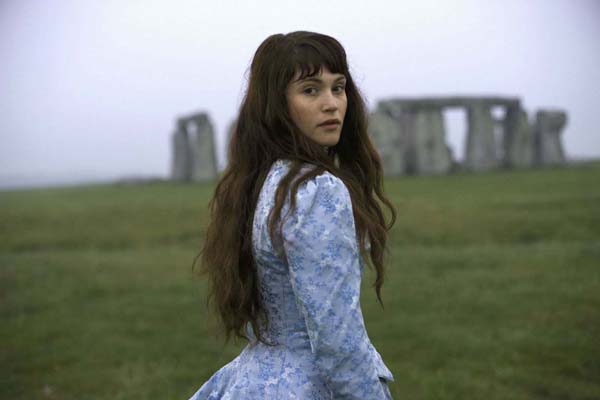
Gemma Arterton as the doomed Tess, 2008.
In Return of the Native, Hardy’s sixth novel, the beautiful Eustacia Vye, who longs for greater life than she can find on a remote heath, suffers the fate of a Greek tragic heroine. Her moves to escape her fate bring it upon her. Eustacia and her husband’s mother drown. In grief and despair, the husband becomes a preacher.
Catherine Zeta-Jones as Eustachian Vye in “Return of the Native,” 1994
With recurrent themes of the conflicting demands of culture versus nature for the individual, as well as liberal doses of illicit sexuality, Hardy’s 19th century works were popular with 20th century readers. Seeming to contrast with that is a tragic vision more purely classical than any other novelist I can think of.
And let’s face it, we Yanks love good British period dramas whenever we can get them, whether set in Camelot or on Egdon Heath. So you better believe I’ll be in line to see the new Far From the Madding Crowd when it’s released. It might even prompt me to take another foray into 19th century literature, something I thought I had long left behind. We never know where imagination will turn…
Ok, now that daylight time is here for us in the new world, and coming in a few weeks for the EU, it’s time for a pop quiz: who invented daylight savings time?
Yes, fellow Googlers, it was Benjamin Franklin who reasoned it would save candles in the colonies. It was not mandated in the US until we entered WWI, when the intent was to preserve resources.
According to Scientific American, the first study of the effectiveness of daylight savings time was conducted in the 70’s, during our first “oil crisis.” The same article notes that a study in Indiana in 2006, the year that state mandated daylight time in all rather than just some of its counties, showed an increase in energy usage.
Similar results were seen in California in 2007, when daylight time was lengthened by four weeks. California Energy Commission researchers found an energy savings of only 0.2% with a margin of error of 1.5%. Changes in air conditioning patterns as well as the pervasiveness of electronic controllers in homes and businesses are possible causes of the flat or negative results.
I, for one, enjoy the light in summer evenings. Farmers dislike daylight savings time, for it disrupts their schedules. Sports enthusiasts favor it. In the late ’90’s, for instance, representatives of the golf industry said daylight time earned them and extra $400 million in fees each year.
For it or against it, the odds of it’s changing are practically non-existent. Unless you live in Arizona, you’ve lived with it all your life. Besides, there are more pressing issues for Congress to fail to act on than this.
Daylight time is one of those things, like the Superbowl and plum blossoms, like St. Patrick’s day, and the start of baseball season, that signal the coming of another spring and summer. I’m not inclined to complain too much if that costs me an hour of sleep.
I’ve read about this, but it never happened to me before.
Late yesterday afternoon I was driving home from the bay area. I’d been up at 6:30 to attend a second day of Dharma teachings. The weather was fine, traffic was moving, I was listening to a decent audio book, but a wave of fatigue overtook me, and all I could think of was stopping for a stretch and caffeine at a Starbucks up the road.
I pulled up behind a small truck and half a dozen cars at the Benicia Bridge tollbooth. The truck seemed to take forever getting through, as if there was an argument about the toll. With some mixture of fatigue and (hopefully) the wisdom I had absorbed from the teachings, I waited patiently, and finally reached the window. I handed a five dollar bill to the cashier.
“No need, sir,” she said. “The lady ahead of you paid your toll.”
As I said, previously, this was something I had only read about before. I was suddenly wide awake, wondering how I could pass the gift on. Carry $10 next time I came to that bridge and pay for the stranger behind me, yes, but what about day to day actions? I don’t cross toll bridges often, and as I felt the effect of that small gesture ripple through me, all I could think of was how to pass it on.
“Don’t bother trying to save the world,” one of the lamas had said. “What right choice is in front of you now?”
What a powerful question, and how worthwhile it is to keep it in mind!
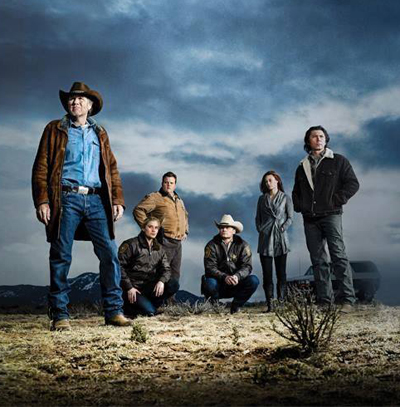
I’ve devoted only one of 645 posts to a television show, Longmire, because the series is exceptional. Walt Longmire, a rural Wyoming sherif, is haunted by his wife’s murder. Each week we see him try to keep peace with his own demons, with his daughter, his employees, and the neighboring Cheyenne reservation, while solving crimes and capturing desperadoes.
Though the show has a solid viewer base, A&E cancelled the series two weeks ago. TV Guide reports that Longmire viewers are too far over the hill. With an average age of 61, apparently we don’t by as much stuff as the sought-after 19-49 year old demographic.
“It was losing money for us,” said one A&E executive. “It’s a business.” No one thought the decision was based on quality…
All may not be lost. As one of the top 25 television shows of the summer, Warner Brothers is putting together a presentation to other cable networks to continue with a fourth season for Longmire. I hope they succeed so I don’t have to spend my “golden years” recalling the good old days when television was occasionally intelligent.
Last Friday, August 15, the theme of National Public Radio’s “TED Radio Hour” was “Simply Happy,” and carried the message that “finding happiness may be simpler than you think.” Narrator Guy Raz reviewed the ideas of five speakers whose TED presentations focused on happiness as something that can be cultivated.
Matt Killingsworth, a researcher at UC San Francisco, gathered real-time input from 35,000 people via a simple smart phone app one can register for at trackyourhappiness.org. Several times during the day, volunteers receive three questions on their phones:
1) How do you feel right now? (on a scale from very good to very bad).
2) What are you doing? (check one of 22 choices).
3) Are you thinking about what you are doing? (as opposed to “mind wandering”).
Killingsworth discovered that 47% of the time, people are thinking of something other than what they are doing (ranging from a high of 65% when taking a shower, to an interesting 10% whose minds wander while having sex). His finding, across all activities is that “people are substantially less happy when their minds are wandering.” This includes even unpopular tasks like commuting to work. He concludes that “mind wandering is a cause rather than a consequence of unhappiness.”
Though he doesn’t cite the growing interest in mindfulness meditation practice, it’s significant that recent articles in Scientific American have mentioned studies of this practice, including Is Mindfulness Good Medicine, which appeared on the Scientific American blog the day before NPR posted Killingsworth’s findings.
Carl Honore is a journalist and the author of In Praise of Slowness: Challenging the Cult of Speed (2005). He claims our world is “addicted to speed” and living “the fast life rather than the good life.” He says his wakeup moment came when he realized he was speed-reading bedtime stories to his young son, compulsively rushing through one of the richest times of his day.
Honore says we are “so marinated in the culture of speed that we almost fail to notice the toll it takes on every aspect of our lives – on our health, our work, our relationships and our community.” For one thing, speed and adrenaline can be exciting. For another there is a strong cultural bias that equates slowing down with being a slacker. One common meaning of “slow” is “not very bright.”
Honore says he still enjoys the fast pace of life as a journalist in London, but he is now “in touch with his inner tortoise,” and doesn’t unconsciously overload himself. “I feel like I’m living my life rather than actually just racing through it. So is it possible? That’s really the main question before us today. Is it possible to slow down? And I’m happy to be able to say to you that the answer is a resounding yes.”
Graham Hill was an early ’90’s internet millionaire by the age of 30. He sold the company he had built with friends, and then filled “the void” he felt inside with stuff: “I bought a 3,600 square foot home, Volvo sedan, tons of furniture, gizmos, technology, stereos, probably had one of the first MP3 players. You can’t believe how much stuff.”
Unlike most of his wealthy peers, Hill realized his stuff wasn’t making him happy so he got rid of most of it. He now lives in a custom designed, 420 square foot New York City apartment that is wonder of space efficiency:
Hill notes that Americans use three times as much space as we did 50 years ago, yet we have still spawned a $22 billion dollar, 2.2 billion square foot self-storage industry. Other consequences include, “Lots of credit card debt, huge environmental footprints, and perhaps not coincidentally, our happiness levels flatlined over the same 50 years. Well, I’m here to suggest there’s a better way – that less might actually equal more.”
Dan Gilbert, Harvard Psychologist and author of Stumbling on Happiness (2007), spoke in his talk of the many ways in which our happiness does not depend on circumstances or getting what we want. Humans are resilient enough, he says, to recover from serious trauma, though imagination generally tells us otherwise. Gilbert cited three cases, drawn from a single edition of the New York Times.
Jim Wright, Speaker of the House of Representatives before Newt Gingrich, resigned in disgrace after a scandal involving “a shady book deal.” He lost his position, reputation, and money, but now says, “I am so much better off physically, financially, mentally and almost every other way.”
Pete Best, The Beatles’ first drummer, was replaced by Ringo Starr just before the band became world famous. Still a drummer and studio musician, Best says, “I’m happier than I would’ve been with The Beatles.”
And most dramatic to me was Moreese Bickham, 78, released from prison because of DNA evidence after serving 37 years for a crime he did not commit. Upon release, Bickham said, “I don’t have one minute’s regret. It was a glorious experience.”
Baring “extraordinary” people like Gandhi or Nelson Mandela, we can hardly imagine prison as being worthwhile, let alone “glorious,” but Gilbert uses these and other examples to underline the power that “reframing” events has on our outlook. The stories we tell and the meaning we find in experience are critical. “It is wrong to say that we have no control over our happiness. It is wrong to say that we have complete control over our happiness. We have some input into how happy we will be…We can learn to see events in a constructive and positive way.”
Brother David Steindl-Rast, a Benedictine monk, has devoted himself to interfaith dialog and the interaction of religion and science. His TED topic was gratitude, as one might expect of a man whose home page is gratefullness.org. He says most people think we are grateful when we are happy, but the opposite is true: gratitude leads to happiness.
He outlines a simple way to cultivate gratitude, beginning with stopping our minds and our busyness to reflect that “You have no way of assuring that there will be another moment given to you. And yet, that’s the most valuable thing that can ever be given to us. We say opportunity knocks only once. Well, think again – every moment is a new gift, over and over again, and if you miss the opportunity of this moment, another moment is given to us, and another moment. We can avail ourselves of this opportunity or we can miss it. And if we avail ourselves of the opportunity, it is the key to happiness.”
Such a simple step, repeated, carries great weight, for Steindl-Rast reflects that grateful people are not fearful, and if we are not fearful, we will not be violent. “If you’re grateful, you act out of a sense of enough and not from a sense of scarcity, and you’re willing to share.If you’re grateful, you’re enjoying the differences between people and you’re respectful to everybody, and that changes this power pyramid on which we live. And it doesn’t make for equality, but it makes for equal respect, and that is the important thing. A grateful world is a world of joyful people, grateful people are joyful people. And that is what I hope for us.”
***
The question of attitudes and habits that lead to wellbeing has emerged as the key theme of theFirstGates this year. I’ve posted ideas from Carl Jung, the Dalai Lama, and Scott Adams, creator of Dilbert. Here are five more voices (and more to come) saying that happiness is not an accident, not given to a few select or fortunate people. It is a choice we can all make, a direction we can aim for at any given moment
Maleficent opens in a world of beauty, threatened by a greedy human king. The visual contrast between human actors and fantasy animation was great enough to take a few minutes for suspension of disbelief to kick in. After that, I was in for the ride, through an ambitiously re-crafted tale of the Disney arch villainess who gave kids of my generation nightmares in Sleeping Beauty (1959). As the poster implies, this movie belongs to Angelina Jolie, whose performance is gripping.
The Sleeping Beauty themes of love and betrayal remain but they manifest very differently in the two Disney versions of the story. Men betray and women love; implicit in Disney’s previous blockbuster, Frozen, the theme is explicit in Maleficent. For now at least, it’s Disney’s key to box office success.
Retelling fairytales with a modern twist is nothing new. Fantasy authors like Nancy Kress, Jane Yolen, Steven Brust, and Roger Zelazny, to say nothing of Neil Gaiman and George R.R. Martin have been doing this for decades. I’m currently reading a 1994 collection of short retold fairytales, Black Thorn, White Rose, edited by fantasy writers, Ellen Datlow and Terry Windling. There are two different versions of Sleeping Beauty. In both, it is the prince who needs to be rescued.
I take this as an inevitable pendulum swing from earlier Disney movies where princesses mostly sat around singing, “Someday my prince will come.” We have to remember that no Disney movie, then or now, is “real” folklore, nor is any work fantasy fiction. By “real” folklore, I mean stories shaped by the collective imagination of generations of members of a culture, region, or tribe. Strictly speaking, any talk of folktales now must be in the past tense. Nowadays the events that might spawn new fairytales, over a generation or two, become headlines or tweets, “details at 6:00,” to be forgotten in a day or an hour.
Among other things, the old fairytales were full of hints on wise living for those who knew how to listen. Here is one simple list of some of the lessons they taught:
Sorrow is real, and so is joy
Joy is freely available to all, just as sorrow comes freely to all, whether rich or poor, and without regard to changes in material fortune
The world is fraught with danger, including life-threatening danger, but by being clever (always), honest (as a rule, but with common-sense exceptions), courteous (especially to the elderly, no matter their apparent social station), and kind (to anyone who has obvious need), even a child can succeed where those who seem more qualified have failed.
Much as I love them, I don’t find that fantasy movies and novels teach lessons like these in a visceral or unforgettable manner, which leaves us sadly impoverished. Dragons have not gone away – any glance at the headlines makes that clear. What is gone is the wisdom to know how to deal with them.






 The First Gates