Part-time penury

Serfs

Between 1981 and 1984, I worked as a part time instructor at a community college in northern California.  Like most part-timers, I dreamed of the tenure track.  I was lucky.  At one point during a faculty meeting, I looked at all the other hopefuls, did the math, and realized I was on, if not a sinking ship, one that was dead in the water.  I started building a lifeboat and made my escape.

According to a recent NPR story, a million part-time, or adjunct professors, have not been so fortunate.  That’s 75% percent of U.S. college teachers who are stuck in part time positions; like workers at McDonalds, many rely on food stamps to get by.  Current pay for adjuncts is $2,000 – $3,000 a class with no benefits of any kind.  “Freeway fliers” is what we called ourselves when I was in the ranks, zipping between nearby schools to pick up any available classes.

One adjunct interviewed in a parallel story on the PBS Newshour teaches six English classes at three Ohio universities.  With a family to support, he couldn’t afford to stay home when he had pneumonia last fall.

At the time, I assumed the dismal prospects were my fault; I only had an M.A. and taught at a small town, two year school.  The articles make clear that although the trend began at two year schools in the 1970’s, it soon spread to all types of colleges and universities.

Peter Brown, professor emeritus of the State University of New York at New Paltz says the average salary of adjuncts there is $12,000 a year – less than the custodial staff.  “Between 1970 and 2008, the adjunct pay has gone down 49 percent,” says Brown.  “The salary of college presidents has gone up 35 percent.” 

In the 80’s we talked of organizing, and finally, three decades later, some colleges are granting part timers collective bargaining rights.  Twenty-two percent of adjuncts now belong to a union.  The death last fall of an 83 year old Duquesne University adjunct, who had taught for 20 years with good reviews, only to die impoverished, served as a wake-up call, as did a January congressional report that found adjuncts are treated like “cheap labor.”

In general, we get what we pay for, and as college students go ever deeper into debt, it’s worth asking what their education dollars are buying.  Well-to-do college administrations.  Top notch football teams.  A lot of professors too sick or stressed or busy commuting to hold decent office hours.  Ever fewer real-world prospects.  And…?

If we don’t want to end up singing “Glory Days” when we think of the long-gone time when American education was the best in the world, something will have to change.

Causes for happiness according to Carl Jung

Recently I thought of a chain of events in my life that I first considered unfortunate, though eventually they led to better results than I ever imagined. This got me thinking of “happiness,” and how wrong our ideas about it can be.

A few years ago I saw one of those lists of “10 factors for happiness” that both confirmed popular hunches (good health is factor #1) and contained surprises (children or no children makes no statistical difference in life satisfaction surveys).  Searching Google for “10 factors of happiness” led to 32 million hits.

I didn’t find the one I was after, but many of those I scanned were interesting.  None pretended to guarantee a sense of wellbeing – there are too many intangibles, such as personal outlook.  We’ve probably all known healthy, well to do, miserable people, as well as those who find satisfaction in overcoming adversity.

Public domain

Public domain

I am also attuned to Buddha’s warning, that any sense of wellbeing that depends on outside conditions is subject to change because those conditions are subject to change. I view these lists not as suggestions on where to look for the ultimate good, but as factors that can improve our odds of feeling satisfied much of the time.  The list I found most interesting gave five conditions for happiness according to Carl Jung.

  1. Good physical and mental health.
  2. Good personal and intimate relationships, such as those of marriage, the family, and friendships.
  3. The faculty for perceiving beauty in art and nature.
  4. Reasonable standards of living and satisfactory work.
  5. A philosophic or religious point of view capable of coping successfully with the vicissitudes of life.

I was especially interested to read “satisfactory work” in item #4, as “settling” for “satisfactory” work (rather than following my bliss) was the life choice I referred to at the start of this post. From what I’ve observed, following bliss is a slow, long term process, filled with trial and error, because most of us don’t know our bliss till we stumble over it in the dark – but that is a topic for another day.

In the Psychology Today article I’m quoting from, Jung observed that “No matter how ideal your situation may be, it does not necessarily guarantee happiness.” He also suggested that chasing happiness doesn’t work.  I agree in part. I think happiness is a by product of other actions rather than something we can grasp directly, but I know from personal experience that numerous actions and attitudes can improve or worsen my odds.  For instance, I find it helpful to limit TV news viewing to the PBS Newshour two or three times a week, and sometimes even that is too much. Dwelling on bad news we cannot change doesn’t appear on anyone’s happiness list.

Perhaps the best advice I received on happiness came from a high school English teacher, one the most important mentors I’ve had in this life. His was a one item list: “I think life is satisfying only when we’re committed to something greater than ourselves.” In the decades since then, I’ve found lots of elaborations, but nothing superior to that as a way to orient my inner compass.

What do you think?  What works for you or makes your glass half full and occasionally running over?

More notes from the Wasteland

Joseph Campbell considered the Wasteland and the quest for the Grail that heals it to be a core myth for our time.  During “The Power of Myth” series at the end of his life,  Campbell said the Wasteland results from a worldview that divides matter and spirit.  Referring to the Fisher King’s wound he said:

“the Christian separation of matter and spirit…has really castrated nature. And the European mind, the European life, has been, as it were, emasculated by this separation. The true spirituality, which would have come from the union of matter and spirit, has been killed.” (1)

Generations of western thinkers, culminating in Descartes, built upon the split Campbell cites to elaborate a mechanistic view of nature that made the world ripe for human exploitation.  Results of this world view are visible everywhere, both in the headlines and in the landscape around us.  This part of California, for instance, still bears the scars of hydraulic mining 150 years after the gold rush.
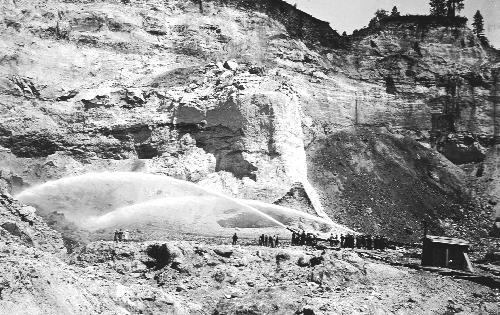
Hydraulic mining along the Yuba river.  Malakofdigginsstatepark.org

Hydraulic mining along the Yuba river. Malakofdigginsstatepark.org

Deliberate exploitation isn’t always the culprit.  We think of Native Americans as attuned with nature, but even they made mistakes.  From AD 900-1150, such a large concentration of Pueblo people lived in Chaco Canyon, NM that they cut an estimated million trees from the surrounding Colorado Plateau.  The resulting erosion, loss of game habitat, and flooding is thought to be one reason why they abandoned the site.  The surrounding landscape, once forest, has been desert ever since.

Pueblo Bonito ruins, Chaco Canyon.  Photo courtesy of Scott Haefner, scotthaefner.com

Pueblo Bonito ruins, Chaco Canyon. Photo courtesy of Scott Haefner, scotthaefner.com

Now that humans have the power to disrupt the environment on a global scale, the question of whether the harm is deliberate or inadvertent may be moot, but serious differences still lie at the heart of competing world views.  Campbell touched on this issue in Creative Mythology, the last book of The Masks of God, a four volume study of world mythology that he wrote between 1962 and 1968.  In this series, he ascribed four functions to myth (2)

  1. The Metaphysical Function: Awakening a sense of awe before the mystery of being
  2. The Cosmological Function: Explaining the shape of the universe
  3. The Sociological Function: Validate and support the existing social order
  4. The Pedagogical Function: Guide the individual through the stages of life

The Grail story resonates on all of these levels, but since I want to consider the Wasteland myth in light of our current environmental crisis, the third and fourth functions have the greatest relevance here.

Campbell points out that humans are born too soon, “absolutely helpless,” and unlike most other animals, learn how to survive from a social group.  Our earliest myths derive from the hunter/gatherer era, “hardly greater than large families, of which every adult member was in possession of the entire cultural heritage.”  

These earliest myths “served a fostering, educative function, bearing the unfinished nature product to full, harmonious unfoldment as an adult specifically adapted for survival in a certain specific environment, as a fully participating member of a specific social group; and apart from that group he would neither have come to maturity nor have been able to survive.”  There was room for diversity, but no one who threatened the group was tolerated.

The next strata of myth emerged when humans settled into agricultural communities, beginning around 7500 B.C..  Villages grew into towns and then into cities and “it was precisely at this point of space and time, in the Near East, and specifically Sumer, c. 3500-3000 B.C., that the evidence first appears among the ruins…first, of a disciplined social order imposed from above by force, and next, of deliberate expeditions of military conquest against neighbors…campaigns of systematic conquest and subjugation.”  The principle here, said Campbell, was “greed for more than one’s share.”

Imposed social orders are not inherently bad, says Campbell.  Despite romantic fantasies of the noble savage, few people really want to live in caves or give up such boons as advanced medicine, arts, spirituality, and transportation, to say nothing of indoor plumbing.  Like conventions in writing, music, or painting, cultural conventions may spark creativity when they are new and later stifle it as they atrophy.

“The Waste Land, let us say then, is any world in which…force and not love, indoctrination not education, authority not experience, prevail in the ordering of lives, and where the myths and rites enforced and received are consequently unrelated to the actual inward realizations, needs, and potentialities of those upon whom they are impressed.”

This was the situation when the European Grail myth emerged; the first written version was composed in the 12th century by Cretien de Troyes at the very time the inquisition began.  The Grail legend served as a counterpoint to the institutional church; the tale can be read as the map of a quest for personal realization, safely couched in a story of ladies and knights.  In the earliest versions, the Grail was not the cup of the last supper but a stone or a large stone dish, which like the philosopher’s stone of alchemy, granted the heart’s deepest desire.

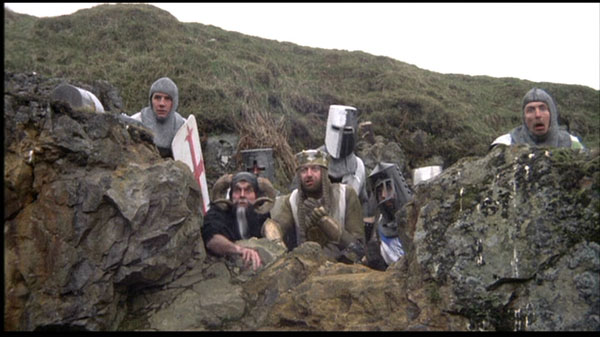
Even at our remove from the middle ages when the stories emerged, the Grail remains one of our living myths, at least if you pay attention to popular fiction and movies.  Think of The Da Vinci Code, Indiana Jones and the Last Crusade, and even Monty Python and the Holy Grail.
Pythons on the quest: at the lair of the Killer Bunny

Pythons on the quest: at the lair of the Killer Bunny

As much as the population of the middle ages, we are, in the words of 19th century poet, Matthew Arnold, “Wandering between two worlds, one dead, the other powerless to be born.”  The Grail continues to speak to such eras, especially one in which the Wasteland is not just the metaphor of an inner desert, but a world in which that desert is visible around us.

The Grail remains a shining image, never quite clear, but unforgettable, of the kind of life and world we seek among the confusion of possible futures.  At the end of “The Power of Myth” series, Bill Moyers asked Joseph Campbell what the myth of the future might be.

“You can’t predict a myth anymore than you can predict what you’re going to dream tonight,” Campbell replied (3).  “Dreams and myths come from the same place.”  Then he went on to say, “The only myth that’s going to be worth thinking about in the immediate future is going to be one that is talking about the entire planet.”

Earth from space

“You don’t see any divisions there of nations or states. This may be the symbol of the mythology to come. That’s going to be the country we are celebrating.” – Joseph Campbell, 1987″

Next:  Some people who are already question for the Grail.

Chimps in charge

chimp

The day after my post on how to find healthy veggies, Mary and I decided to grab some burgers for lunch.

As we sat down, I noticed “Heart of Stone,” from the Rolling Stones’s first album, playing in the background.  I was contemplating impermanence – how quickly the songs of youth wind up on the oldies station – when the song ended, and “Rudolph the Red Nosed Reindeer” came on.

I looked at Mary.  I muttered an expletive and said, “I thought we were done with all that!”

Our food came, and the music shifted to “Chain of Fools,” a good old Motown classic.  I sighed with relief.  Life was good.  January was good.  January means months and months without “holiday music.”

Or so I thought…

Until “Holly Jolly Christmas” began to play…

More than any other song, “Holly Jolly Christmas” reminds me of pre-transformation Scrooge and the wisdom of his comments concerning boiling certain people in their own Christmas puddings.

“Maybe they just want to hurry us out the door,” Mary said.

I slugged down the rest of my drink.  “It’s working,” I said.

The question I’m left with is, who put together that playlist?  I’m ruling out computer generation, since in my experience, the algorithms, (like iTunes’s “Genius” function) are too sophisticated to create such a mishmash.  I’m left with two theories:

  1. In an effort to save money, satellite radio stations now use institutionalized sociopaths to assemble their playlists.
  2. In an effort to save money, satellite radio stations now use chimps.

I kind of hope it’s the latter, although chimps-in-charge is not a trend that bodes well for things like TV schedules or mid-term election advertising, which will probably start up next week.

If you have any other ideas on who is to blame for Burl Ives in January, please let us know so we can free the poor chimpanzees from blame!

photo by Will Brenner, CC BY-ND 2.0

photo by Will Brenner, CC BY-ND 2.0

What’s coming to TheFirstGates in 2014?

Courtesy Emma Paperclip, Creative Commons

Courtesy Emma Paperclip, Creative Commons

Thanks to everyone who visited this year, old friends and new.  Here are a few year end musings on where this blog may be going in 2014.   These are not resolutions.  Remembering Yoda’s words to Luke, “Do or do not, there is no try,” I don’t make resolutions.  These are sort-of-predictions, aka guesses, based on a line from a Grateful Dead song, “I can tell your future / just look what’s in your hand.”

In the case of theFirstGates, it should probably read, “look at what books are piled up on the table beside you.”  Looking at the titles in the stack, I predict more of the same, only new and (hopefully) better.

I’m currently reading a book I got for Christmas, Grimm’s Complete Fairy Tales.  The key word is complete – I haven’t read all the tales before.  The other great feature is the Arthur Rackham illustrations.  No one has ever painted Faerie like Rackham, and it’s a place I never tire of visiting.

Another new title is Trickster Makes this World by Lewis Hyde.  Not only is Trickster an ongoing object of fascination, but he pervades blogging just like the rest of life.  I’m reminded of this every time I hit Publish while meaning to click on Save.

And perhaps most important for TheFirstGates, I’m rereading The Dream and the Underworld, one of James Hillman’s important early works.  Here he turns the tables on psychology’s habit of translating the night world of dreams into the language of daylight; serving the ego, in other words.

Dream and the Underworld

Instead of asking what a dream means, Hillman asks what it wants.  This shift is fundamental to all of Hillman’s thought – psychology, the science of the psyche, in service to soul and soul-in-the-world.

Of great interest to me as a blogger is Hillman’s effort to see through literal events to the fantasies, the mythical layers that underly the stories we tell ourselves and the ones we see on the evening news.  The reality in our fantasies and the fantasy in all our realities.

The coming year is unique in one respect: 2014 marks the centennial of the start of that worldwide disaster misnamed “The Great War.”  The first world war has haunted me for years with its end-of-an-age immensity and sadness.  There are millions of stories to tell, and I’ll try to post a few here, from the bumbling youths who sparked the conflict to a young lieutenant named Tolkien who was sent to Mordor in 1916, though the generals called it The Somme.

And finally, as always I will continue to be on the lookout for those stranger-than-fiction events that leave us shaking our heads, wanting to laugh or cry or both at the strangeness of it all.

I wish you all a joyous New Year, and I hope we will all continue to share the emerging wonders of this online experience!

Another great story rediscovered: Bamboo Charlie

Here is another inspiring tale that I bookmarked some time ago and then forgot.  Coincidentally, like the previous post, its subject is a uniquely creative folk artist.  I read about Bamboo Charlie in a memorial published in the L.A. Times in September, 2012.

Bamboo Charlie and his whimsical paradise

Bamboo Charlie and his whimsical paradise

Twenty years ago, a homeless Texan named Charles Ray Walker noticed a bamboo grove along a narrow stretch of land by the Los Angeles River in Boyle Heights.  The property owner told Charlie he could stay there if he kept the place clean.

On the strip of land, about 40′ x 200′, squeezed between a parking lot and a warehouse, Walker grew fruits and vegetables.  He carved stairs into the bare slopes and decorated them with hundreds of discarded toys and signs.  He built a shack under a tree, with a TV, bed,and sofa, and then he invited guests to visit: graffiti artists, children and their parents, musicians, police officers, and homeless friends.  He assembled a library out of salvaged books, including best sellers and one called The Semi-Complete Guide to Sort of Being a Gentleman.  Bamboo Charlie was featured on the front page of the L.A. Times in 2010.

"Bamboo Charlie"

During the 20 years he spent on the parcel, he collected cans for money, sometimes working late into the night. Duruing occasional trips back to Texas to visit his family, he operated a crane at a steel company. “I’m not going to ask another grown man for money. I never have, and I never will,” he said. “People expect that from a homeless man.”  

That pride may have contributed to an early death.  He suffered greatly from ulcers during his final years, but insisted he was fine when friends suggested he see a doctor. On Aug. 26, 2012, a young friend named Teyuca found him dead in his shack, of what the coroner determined was heart disease.  He was 61.

“I really think what he did was folk art, built out of scraps and things found, things that people gave him,” Teyuca said.  “He was a mad genius.  He had such a wild imagination.”

We were hopeful once, and young

Bob_Dylan_-_The_Times_They_are_a-Changin

I just came upon a high quality clip of an unbelievably young Bob Dylan at Newport in 1963, singing one of his best early songs.  Watching it, I’m reminded of a line from another early Dylan song, “We never much thought we could get very old.”  I guess no one ever does.

Change a few particulars and the song is as timely today as it was 50 years ago.  What’s missing is the collective hope/dream/prayer of those days that music could change the world.

Maybe it can, in the sense of planting seeds.  Maybe, but if so, those seeds take longer to germinate than anyone who is young can possibly imagine.

Enjoy a great clip of “North Country Blues.”  And maybe water the seed.

Robots ‘R Us, installment 2

The Steam Man of the Prairies, 1868.  Public Domain.

The Steam Man of the Prairies, 1868. Public Domain.

An obscure author, Edward S. Ellis, who published a dime novel called The Steam Man of the Prairies 145 years ago, may prove to have been a visionary according to two recent news articles.

The first, in the New York Times, reports that Google quietly acquired seven robotics companies over the last six months (Google Puts Money on Robots).  The scale of the investment is huge and appears to be aimed at automating manufacturing processes.  “The opportunity is massive,” chirped Andrew McAfee, an M.I.T. research scientist.  “There are still people who walk around in factories and pick things up in distribution centers and work in the back rooms of grocery stores.”

The second article I noticed bears an uncanny relation to the cover of  The Steam Man.  The California DMV has set rules for companies aiming to test automated cars (Driverless Cars Could be Cruising California Roads by Spring).  To put it in the terms of the M.I.T scientist, we may soon be able to robotize trucks and remove even more inefficient humans from the workforce.

The problem with this manufacturer’s wet dream should be obvious.  Robert Reich, former Secretary of Labor under Bill Clinton puts it simply: “the economy remains lousy for most people. It will likely remain that way: As technology and globalization take over the economy, the U.S. has no national strategy for creating more good jobs in America.” (The True Price of Great Holiday Deals).

Economic discussion, with few exceptions, focuses on how to get back to the good old days of (relatively) full employment and opportunity for those who work hard.  Politicians bicker over which levers to pull, but no one dares to ask the fundamental question: has the structure of the world economy changed too much to recapture that particular sort of past “good times?”

A few years ago, news got out of worker mistreatment at Foxconn, the huge Chinese assembly plant where much of our high-tech gear is assembled.  Foxconn agreed to reforms, and the CEO announced plans to deploy a million robots.  By December 2011, robotic arms had reduced the number of workers on certain assembly lines from “20 or 30 down to 5.”  As we argue over fair wages for fast food workers, it’s a good bet their employers are working on ways to automate the task of making a burger, which can’t be harder than plugging components into a motherboard.

The problem, of course, is that downsized workers will not be buying either Happy Meals or iPhones.

Last March, in a post called Robots ‘R Us (?), a first look at such issues, I quoted a blogger named Orkinpod who was already considering them in depth.  On Feb. 27 he said:  “When the future arrives (and I believe that it is very, very close), and machines can supply all the things that humans could possibly ever want, what is everybody going to do?”

One thing many may wind up doing is working on food production.  Last summer I wrote of a compelling PBS NewsHour series, “Food for 9 Billion” (1).  That’s the total number of hungry humans who will occupy the planet in 2050 as the amount of arable land continues to shrink.  One of several examples given of coming change was Singapore, where five million people live on an island with only 240 acres of undeveloped land.  A 50 year old Singapore engineer developed a revolutionary type of vertical greenhouse that prompted the Directer of the National Institute of Education to say, “I think, eventually, urban factories for vegetable production will take the place of electronic factories in Singapore.”

It’s a grand irony to reflect that industrialism, which began by channeling people out of agriculture, may have succeeded too well; its end game my involve shifting some of them back into food production again.  But what about everyone else?  What happens as robotics and marvels like 3D printers leave ever more people idle?  Insiders aren’t even asking the question, though science fiction writers have since the mid 20th century.

robot3

Unfortunately, in stories where humans go up against robots, the outcomes are usually not the ones we would like to see.