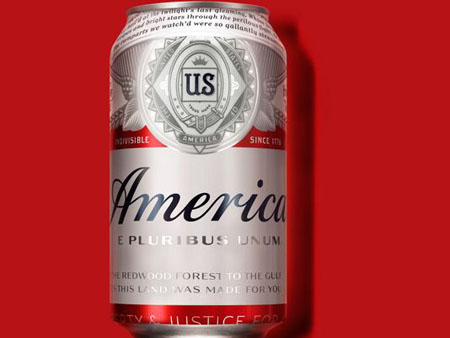
Land of the Free, Home of the Brave…

You mean Belgium, right?  That is, after all, the home of Anheuser-Busch InBev, parent company of Anheuser-Busch, maker of Budweiser, which shall henceforth be known as America beer. Until the election is over, that is.

America beer

And who among us, cannot wait for that day?

Ad Age, which announced the change noted that the motto, “King of Beers” will become, “E Pluribus Unum,” and the bottom of the can will feature this text: “From the Redwood Forest to the Gulf Stream Waters this land was made for you and me.”

Yep, let’s hoist one for good old Woody Guthrie. I’d love to hear the songs he’d be writing this year!

Hungry Ghosts

Section of Hungry Ghosts Scroll, Kyoto, late 12th c., Public Domain

Section of Hungry Ghosts Scroll, Kyoto, late 12th c., Public Domain

In traditional Buddhist cosmology, there are six major realms of existence. Only two of these, the human and animal realms, are visible. The other four, which include both heavens and hells, are not manifest to our physical senses. Unlike Christian heaven and hell, none of these are forever – the length of one’s sojourn depends on karma.

Many contemporary teachers, while not denying the metaphysical reality of these regions, focus on our inner “location” in the here and now. One who is filled with love and compassion dwells in heaven. The one seething with anger, red in the face, like a devil, at that moment experiences one of the hells.

Hungry ghosts have a region all to themselves; their dominant trait is insatiable craving. Hungry ghosts are depicted with huge bellies but tiny throats and mouths – desperate hunger and thirst that can never find relief.

Never enough, there is never, ever enough,” is the mindset of hungry ghosts, both in the imagined subtle realm and in this world. Addictions and insatiable cravings of all sorts make us hungry ghosts. The pre-repentant Ebenezer Scrooge, the archetypal miser, is the best known western hungry ghost. Now, the Panama Papers reveal how widespread is this disease, and how it drives the leaders and elites in nations throughout the world. Nor do we, at least in “the free world,” get to sit back and righteously condemn “those bad people.” Not in Buddhist thought, at least, where everything is interconnected.

The people of Iceland forced their Prime Minister out of office within 48 hours of the time the story broke. They did the same with the bankers in 2008. We, who have elected officials of both parties who tolerate bailouts and corporate shell games, are are not separate from the hungry ghosts who are fucking this world.

In his public discourse, Buddha never commented one way or another on metaphysical truths. There’s plenty to worry about here and now, he said. If greed locks us into the hell of the hungry ghosts, generosity, the mindset of Scrooge on Christmas morning, opens the gates of heaven.

Ratnasambhava, the primordial Buddha of "the wisdom of equality," manifests the virtue of generosity.

Ratnasambhava, the primordial Buddha of “the wisdom of equality,” manifests the virtue of generosity.

Perhaps there are no big or small acts of generosity. Our world, the people in it, and we ourselves, need nothing more urgently at this time.

Straight croissants

Even to me, this title seems to refer to the sexual preference of breakfast pastries, rather than its real subject, their shape. This is because “croissant” is French for “crescent,” and who ever heard of a straight crescent outside of higher mathematics?

straight croissant 2
Well, our cousins across the water are embroiled in a debate on this very subject.

Tesco, the largest supermarket chain in Britain, will no longer sell curved croissants. Tesco croissant buyer, Harry Jones, spoke of “the spreadability factor.” Curved croissants typically require three strokes to cover their surface with jam, the preferred topping of most Brits, while a straight croissant can be covered by a single sweeping stroke, thus cutting the risk of sticky fingers or table cloths. (1)

As a veteran of many sticky finger incidents involving restaurant marmalade containers, I can attest a Daily Telegraph editorial is wrong: it is not necessarily safer to eat toast!

Discussions of ease of use and symbolism fail to consider health implications. French law declares that straight croissants must be made with butter, while the curved varieties can use margarine.

In a world where so many familiar structures are in flux, curved croissants are now one less thing we can count on.

I guess there’s no help for it. Benjamin Turquier, last year’s champion Parisian butter croissant maker, said “I can understand the importance of symbolism and tradition, but straight croissants are more practical to make.”

Sigh…we’ll just have to learn to deal…

Trust no one!

Paranormal conspiracy theorists and science fictions fans from Area 54 to Roswell will recognize my title as the motto of FBI Special Agents Fox Mulder and Dana Scully, whose whimsical escapades have returned to television.

x-files-2016-premiere

On a less amusing note, it’s the American attitude toward virtually all institutions, according to journalist, Jeff Greenfield, whose essay,”In Nothing We Trust,” aired on the PBS Newshour on Friday, February 5.

Greenfield cites a recent Pew Research poll showing that Americans mistrust most institutions; only 19% of us trust the government to do “what is right most or all of the time.”

In 1964, with a strong economy, the passage of the Civil Rights bill, and an easing of the cold war, the number was 77%. Ten years later, after a decade of war in Viet Nam and a scandal that drove a president from office, the number was 36%, and it has never topped 50% again.

It isn’t just our government, according to Greenfield. We don’t trust churches. Labor Unions. Banks. Large corporations.  Medicine. Greenfield notes, in his TV news segment, that only 21% of us have “a lot of faith” in TV news.

In great measure, says Greenfield, there are good reasons to mistrust these institutions. Think of the movie, Spotlight. The government of Michigan and the City of Flint.  Yesterday’s congressional hearings on 5000% price hikes in the pharmaceutical industry.

In a similar editorial, I once heard a journalist say that the first act of colonial governments was an attempt to discredit all the institutions of the colonized people; “obviously your god, your army, your government are not as good as ours or we wouldn’t be here.” We may be, said the journalist, the first nation in the history of the world to have colonized itself!

Our pervasive mistrust, according to Jeff Greenfield, makes things especially difficult, in a political year, for those seeking to gain the public trust. It may, in fact, reward those who fan the flames of discontent.

But how, he asks, can a republic long survive when it’s motto is, “In nothing we trust?”

R.I.P. Professor Snape

Alan Rickman as Severus Snape. Creative Commons

Alan Rickman as Severus Snape. Creative Commons

We’ve lost another British luminary to cancer at the too-young age of 69.

Alan Rickman, whom Harry Potter fans remember as the tortured and acerbic Professor of Potions, is gone.  Tributes have poured into social media sites from those who knew and worked with him.

Daniel Radcliffe, who played Harry, wrote “As an actor he was one of the first of the adults on Potter to treat me like a peer rather than a child.”

J.K. Rowling offered a tribute, and Emma Watson, who played Hermione said,“I’m very sad to hear about Alan today. I feel so lucky to have worked and spent time with such a special man and actor. I’ll really miss our conversations. RIP Alan. We love you.”

That about says it all.

The 2015 Pinocchio Awards

pinocchio

The Washington Post released it’s annual Pinocchio Awards for the year’s biggest falsehoods. To no one’s surprise, the 2015 winners are all involved in politics. No one gets to feel smug; all parties and political persuasions were represented.

I’m sure lying politicians are as old as politics. What was disheartening this year was the blatancy of the lies. Fifty one years ago, Marshall McLuhan coined the phrase, “The medium is the message.” In 2015 we may have seen the ultimate corollary of that:  if you say it on TV with enough bravado, swagger, or apparent sincerity, some or many will believe you, regardless of facts. We, as a culture, prefer easy answers to truth.

Here are the winners:

Donald Trump for false and repeated assertion that he saw thousands of Muslims on TV celebrating the fall of the twin towers. Only in Trump’s fevered imagination did such an event play out.

Hillary Clinton for her defense of her husband’s signing of the anti-gay “Defense of Marriage Act,” with an assertion that it headed off an anti-gay marriage constitutional amendment. There may have been talk, but there was no momentum for such an amendment.

Donald Trump for his claims that immigrants commit more crimes than American citizens. While some on this list have cherry-picked their statistics, Donald apparently never looks at statistics at all.

Sen. Chris Murphy (D-Conn) for saying in June that there have been 128 school shootings since Sandy Hook. His stats came from an anti-gun violence advocacy group with a flawed methodology that included suicides and accidents in the numbers.

Donald Trump for his claim that Obama wants to admit 250,000 Syrian refuges to the US. The number is 10,000 Syrians, and the US maximum figure for all refugees is 180,000 over the next two years.

"Freedom of Speech," 1943. In Norman Rockwell's America, truth and respect for all viewpoints mattered

“Freedom of Speech,” 1943. In Norman Rockwell’s America, truth and respect for all viewpoints mattered

John Kerry for claiming he and Al Gore organized the 1988 Senate hearings on climate change. He was not even there.

Mike Huckabee for stating that “global freezing” was a serious concern 40 years ago.

Sen. Elizabeth Warren ( D-Mass ) for proposed regulations for car dealership loans based on “wildly” exaggerated statistics.

Rudolph Giuliani, former NY City Mayor, for saying Obama has never called America a great or exceptional country. Apparently Mr. Guiliani has never listened to an Obama speech.

President Obama for “dubious” claims about the Keystone pipeline.

Sen Rand Paul (R-Ky) for claiming an elderly man was in prison for “putting dirt on his land,” when in fact he was convicted of mail fraud, conspiracy, and environmental violations such as selling land with illegal sewage systems that were likely to fail.

Democratic legislators: On the house floor, staged a demonstration of solidarity with a black youth, shot by a white police officer in an incident that various investigations determined was legitimate self-defense.

Sex Trafficking Statistics:  “There are not 300,000 thousand children at risk in the US, nor  100,000 children in the sex trade, nor is human trafficking a 9.5 billion dollar business, nor do girls become victims at an average age of 13, nor has the government arrested hundreds of perpetrators.”  All of these were claims made by “politicians, advocacy groups, and government officials” in 2015.

I’d love to feel smug and wag my finger at the politicos, but I can’t.  To paraphrase the Master whose birth we celebrated yesterday, “Let he who lives without falsehood cast the first aspersion.”

Politicians behave like this because it works for them, it gets them elected and reelected. For that, We the People are responsible.  We can do better than this…

The Big Lie

“The great masses will more easily fall victim to a big lie than to a small one” – Adolf Hitler

I crossed the green mountain / I slept by the stream
Heaven blazing in my head / I dreamt a monstrous dream
Something came up / Out of the sea
Swept through the land of / The rich and the free” – Bob Dylan

In their wildest dreams, demagogues of the past never imagined how easy television and social media would make it to use lies as means of persuasion. We can all quote our favorite absurdities from the political arena, but no one relies on the power of falsehood more effectively than the current Republican front runner and former star of a type of television that large numbers of people mistake for “reality.” The efforts of so called “fact checkers” are doomed from the start; studies have repeatedly shown that rational argument is the least effective means of persuading anyone of anything.

The lie that prompted me to write this post hasn’t yet caught media attention, but it’s one we’re likely to hear quoted more frequently as the election circus continues.

It goes like this:  “China is stealing our jobs.” The reality is, “Corporations are offshoring them for profit.”

A decade ago, when I worked at the Intel campus in Folsom, I took a half hour walk every day on my lunch hour. When it was too hot or cold or rainy, I’d walk inside, through through seven interconnected buildings, up one flight of stairs, down another, and so on. One day I noticed that an entire floor in one of the four story buildings was empty. “What happened?” I asked a manager. “Those jobs have moved to Shanghai,” he said.

I’ve had relatives and friends in different industries compelled to train their Asian replacements in order to get a severance package. A decade later it’s still going on. Beware of any politician with “a plan to create jobs” or who blames illegals from Mexico for out-of-work software developers.

This is old news. I’ve already discussed it in 2013, in a review of The Unwinding by George Packer, an account of the dissolution of the bonds of mutual loyalty that once seemed an integral part of corporate life in America. I mention it now because one of the friends with whom I ate Thanksgiving dinner this year recently saw his job move to India after a buyout.

My hero in this is a 40 something software developer named Bob who outsourced his own job to Shanghai. Working through an outsourcing company, he paid his Chinese counterpart one-sixth of his salary, spent his days surfing the web, especially cat videos, and occasionally introduced errors into the near-perfect code he received, lest his employer, Verizon, get suspicious.

When the story broke, a Verizon spokesperson simply said “Bob no longer works here.”  Too bad – he’d be a great fit in upper management.

“You can take my soul, but not my lack of enthusiasm!” – Wally, in Dilbert.


Drinking in America: Our Secret History by Susan Cheever

Drinking in America

The Pilgrims who came to America on the Mayflower were headed toward Virginia, where they had a land grant from King James.  Instead, they landed illegally in Massachusetts because they were running out of beer.  So says historian, Susan Cheever in her just-released Drinking in America: Our Secret History.  Cheever, a sober alcoholic, documents the pendulum swings of our national love-hate relationship with alcohol as she explores an important but little-known aspect of our past.

Alchohol was a factor at critical turning points in American history.  It is likely that the shot heard round the world was fired by one of the seventy militiamen awakened by Paul Revere, who passed the time while waiting three hours for British troops at the Buckman Tavern on Lexington Green.

According to Cheever, for all the volumes written on the civil war, no one has documented the considerable effect of alcohol on this conflict.  General George McClellan wrote, in February, 1862, “No one evil so much obstructs this army…as the degrading vice of drunkenness.”  McClellan, who did not drink, was relieved of command for indecisiveness in battle – or sanity, as Cheever suggests, while “His colleagues who succeeded on the battlefield – Grant, Meager, and Hooker, for example – were drinkers whose performance was often affected by their whiskey intake.” 

Most who have studied the war know about Grant, but not as many realize that because of the riotous condition of his camps, some credited General Hooker for lending his name as an epithet for prostitute.  General Thomas Meager fell off his horse while drunk as he led his troops into action at Antietam.  He drowned in 1867, after drunkenly falling off a riverboat in Montana.

Grant managed to sober up before his election as president, while Richard Nixon is revealed as an angry blackout drinker whom National Security Advisor, Henry Kissinger, Defense Secretary Melvin Laird, and White House Chief of Staff H.R. Haldeman had to protect from his own drunken rages.  They “danced around the president’s homicidal, drunken orders to bomb the shit out of this or nuke the shit out of that – orders usually not even remembered the next morning.  ‘If the president had his way,’ Kissinger told his aides, ‘there would be a nuclear war each week.‘”

Cheever’s survey not only covers political and military history, for drinking plays a part in our folklore and arts as well. John Chapman, aka, Johnny Appleseed, did not tramp around the countryside planting apples for pies, but for cider, and five of the seven 20th century American writers who won the nobel prize – Sinclair Lewis, Eugene O’Neill, William Faulkner, Ernest Hemingway, and John Steinbeck – were alcoholics. That there is no inherent connection between writing and alchohol is shown by a similar list of 19th century literary greats who did not drink to excess: “Melville, Emerson, Thoreau, Hawthorne, Longfellow, the Alcotts, and…Whitman.”

This underscores the paradox of the poles in our cultural history:  “temperance and intemperance, drinking and abstinence, liquor and sobriety, addiction and recovery.  Our country has been, at times, the drunkest country in the world; our country has been, at times, one of the least drunk countries in the world.”

As she sums up the “objective” view of modern historical authors, Susan Cheever notes that the “broad, dispassionate view,” often misses the “moments that make up our lives.” One of those things often missed by American historians is the effect of drinking on our history and national character.

“What is history?: a way to sift through the past in an effort to comprehend the world we live in; a way to understand ourselves; a way to make meaning of our lives by finding meaning in the past. How can we do that without acknowledging something many of us do every day, the thing that we use to punctuate our lives in celebrations and in sadness; how can we do it without acknowledging that glass of wine or whiskey neat or dry martini that has been such a powerful and invisible part of our life as a nation?”