Paranoia stikes deep

My title comes from a phrase Stephen Stills used 46 years ago in the lyrics of, “For What it’s Worth,” a song The Buffalo Springfield released in January, 1967.

Paranoia strikes deep
Into your life it will creep
It starts when you’re always afraid
You step out of line, the man come and take you away

Those lyrics came to mind today around noon, when the dogs started barking. I found a UPS package on the doorstep, lightweight, about 10x8x8, from a local address I didn’t recognize.

“Expecting a package from a place called ‘Copperfield?'” I called to Mary, who was in the other room.

“No,” she yelled back. “Be careful opening it.”

“Honey, if it’s a bomb, being careful won’t help.”

“No,” she said. “I mean that poison.”

“OK,” I called. “I’ll start with the packing slip. That’s probably where they put the ricin.”

It turned out to be the can of black touch-up paint I’d ordered for our wood-burning stove. As you might have guessed, I wasn’t really scared of being blown up, but it was the first thing that came to mind. And why not? “They” consider my phone calls worth logging, and my internet hits, and my credit card use. Those of you with newer high-definition TV’s should realize there is a built-in feature that allows a 3d party to peer into your living room. That’s old news, as in posted at least a year ago, to a collective yawn.

There’s something happening here
What it is ain’t exactly clear

That’s the heart of our problem: what’s happening ain’t exactly or even a little clear, except maybe, “step out of line, the man come and take you away.”

One of the few people in Washington I admire, Sen. Bernie Sanders, Independent from Vermont, posted a survey on his website. Here are the four questions:

  1. Do you favor or oppose the National Security Agency’s program to monitor online communications in order to protect the nation from terrorist threats?
  2. Is it appropriate for the federal government to collect millions of phone records from American citizens, if doing so could potentially disrupt a terror plot?
  3. Do you think the president should or should not have the power to authorize the National Security Agency to monitor the electronic communications of American citizens without getting warrants?
  4. Do you favor or oppose changing the PATRIOT Act, which allows the government to collect the phone records of American citizens without a warrant?

I haven’t taken the survey yet, because I’m still “Unsure” on two of the questions. I find that upsetting, given that Sanders also posted the text of Amendment IV to the Constitution:

The right of the people to be secure in their persons, houses, papers, and effects, against unreasonable searches and seizures, shall not be violated, and no Warrants shall issue, but upon probable cause, supported by Oath or affirmation, and particularly describing the place to be searched, and the persons or things to be seized.

Decades ago, H.L. Mencken wrote, “The whole aim of practical politics is to keep the public alarmed (and hence clamorous to be led to safety) by menacing it with an endless series of hobgoblins, all of them imaginary.”

Right now, I think we are all numb. More precisely, I think this is what psychologists call “learned helplessness.” When a creature perceives that it’s powerless to prevent harmful events, it becomes listless and depressed. Or disgusted with politics. One of these days I expect that listlessness and disgust to erupt as outrage. When and if it does, I don’t think it’s going to be pretty or the stuff of songs – there is too much we have collectively stuffed, and for too long a time.

The Second Coming by W.B. Yeats

We have all heard and read more words this week than we want or need. The ones that keep coming back to me were written in 1919, in a poem called “The Second Coming,” a haunting vision written by William Butler Yeats in the wake of the first world war.

W.B. Yeats by John Singer Sargent. Public Domain W.B. Yeats by John Singer Sargent. Public Domain

The Second Coming

Turning and turning in the widening gyre
The falcon cannot hear the falconer;
Things fall apart; the centre cannot hold;
Mere anarchy is loosed upon the world,
The blood-dimmed tide is loosed, and everywhere
The ceremony of innocence is drowned;
The best lack all conviction, while the worst
Are full of passionate intensity.

Surely some revelation is at hand;
Surely the Second Coming is at hand.
The Second Coming! Hardly are those words out
When a vast image out of Spiritus Mundi
Troubles my sight: somewhere in sands of the desert
A shape with lion body and the head of a man,
A gaze blank and pitiless as the sun,
Is moving its slow thighs, while all about it
Reel shadows of the indignant desert birds.
The darkness drops again; but now I know
That twenty centuries of stony sleep
Were vexed to nightmare by a rocking cradle,
And what rough beast, its hour come round at last,
Slouches towards Bethlehem to be born?

***

Yeats was a member of The Golden Dawn, an early 20th century occult organization centered in Britain that sought to recover lost elements of the western mystery traditions.  Their once-secret teachings are now posted online, where we can see that the group practiced the kind of visualizations that could give rise to spontaneous “images out of Spiritus Mundi,” the World Spirit, one of the Golden Dawn’s concepts.

Elsewhere we can read that the poet worked out his own concept of world cycles or “gyres” as he put it here.  We find theories of world cycles from many cultures in many times.  The Greeks said there once was a Golden Age, but now it is Iron.  We’ve all heard of the Age of Aquarius, though unfortunately astrologers now tell us it won’t begin for a few hundred years.  Eastern cultures envision vast cycles that rise and fall and rise again eternally.

In all of these visions, this is the Iron Age, the Kali Yuga, a time of degeneration, where the ceremony of innocence is drowned.  Different traditions differ on where it goes from here.

In one account, offered by Paramahansa Yogananda, the crucifixion marked the nadir of this particular world age.  Things are getting better; right now we are experiencing inertia, a last gasp of the dark ages.  Even in this hopeful account, nothing is fixed or pre-determined.  It’s up to us.  How we live our lives, what we think, and what we do, matter more than we know.  More than we can imagine.

In truth, we already know this, just as we know that despair is not an option.  It seems to me the only choice we have is to live moment by moment as if we are the people we want to be, living in the world we want to live in.  There may not be anything more important.  Isn’t it true that the sum of our collective thoughts and actions is going to shape our world and the one future generations are going to inherit?

The North Pond Hermit

He was just arrested on Tuesday, but already they’re writing ballads about the North Pond Hermit:

Nobody seen his face in twenty-seven years,
Since that day in ’86 when he up and disappeared.

The story has travelled around the world, and unless you are living in the woods, you’ve heard the rudiments of Christopher Knight’s story:

At the age of 19, he disappeared and set up a camp in the woods near Rome, Maine, where he lived for 27 years by stealing sleeping bags, food, propane, and books from nearby vacation cabins and a summer camp.  He spent the long winters wrapped in multiple sleeping bags and never made a campfire for fear of being discovered.  He spent his time reading and meditating.  His only conversation in 27 years was a greeting exchanged with a hiker he met on the trail in the ’90’s.

Christopher Knight

Christopher Knight

When he was arrested, Knight was neatly groomed and clean shaven.  He’s up on current affairs thanks to a transistor radio he used to listen to rock music, news, and Rush Limbaugh.  That’s about all we know, since Knight politely refuses to talk to journalists or explain himself to anyone.  This guy is going to pass on his 15 minutes of fame, his shot at a spot on Letterman, and the chance for a best selling ghost-written bio!

He walked away into the pines to live out in the woods
He turned his back on everything and he was gone for good.

I think the story resonates so deeply because part of us too, wants to walk away from all that crap.  “Lives of quiet desperation” in the words of Thoreau, who lived for two years in relative solitude at Walden Pond, but never made or intended to make a break as complete as that of Christopher Knight.

Into an unimaginable mystery like this, each of us will project our own biases.  For me, Knight’s practice of meditation aligns him with spiritual seekers who have sought out caves of one sort of another for millennia, but they never threw off all human connections.

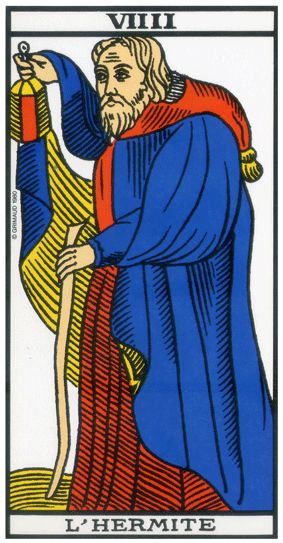
The Hermit, from the Tarot

The Hermit, from the Tarot de Marseille

Christians have maintained a hermit tradition from the desert fathers through Thomas Merton, but none of them relinquished all human company.  Milarepa, a famous Tibetan yogi, lived in a cave for years eating boiled nettles, which gave his skin a greenish cast, yet once he attained awakening, he returned to teach what he’d learned to others.

Did Christopher Knight intend to return someday, to tell us what he’d discovered about the mushrooms and eagles who were his only companions?  We don’t know and won’t unless he decides to tell us.  In a way, I hope he doesn’t.  Whatever his story may be, it will be trivialized and forgotten a week after the tabloids get ahold of it.  I don’t want Christopher Knight’s tale to be forgotten.

Some of his old friends have said he was “intelligent, quiet, and nerdy” in high school – just like millions of us, in other words.  What could make an intelligent man who is one of us, simply decide to walk away, to opt out?  I hope we will wonder about that for a long, long time.

The North Pond Hermit, livin’ in the woods,
The North Pond Hermit, they’d catch him if they could.

You can listen to The North Pond Hermit Song here.

*** UPDATE after posting the original article ***

Troy Bennet and his dog, Hook, who brought you this great ballad, have posted a link to an MP3 version we can download for an optional contribution via Paypal.  Bennet says it isn’t his very best song, but it’s the one he’s written about a hermit this week.

Robots ‘R Us (?)

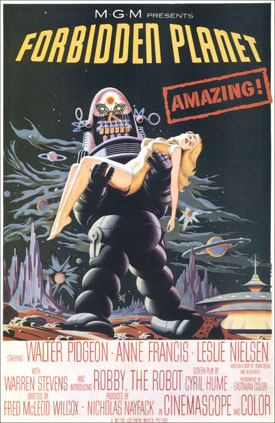
forbiddenplanet

In the field of robotics, as in so many other areas of life, science fiction writers saw the future decades before the rest of us; they warned that androids were coming and the relationship would not always be easy.

Recently, I’ve seen adds on the cable channels by legal firms inviting the “thousands of victims” of botched robot surgery to join class actions suits (go to badrobotsurgery.com).  Ironically, the same Google search that brought up the lawsuit page also showed adds for robotic prostate surgery, which is not the time you want your robots going rogue!

Practicing medicine without proper training isn’t all the dastardly droids have been up to.  In an article called, When the future comes, what are we going to do with it?, blogger Orkinpod looks at how robots eliminate manufacturing jobs.

As an Apple geek, I was dismayed last year to hear stories of mistreated workers at Foxconn, the mammoth Taiwanese contractor that assembles iPads and iPhones.  Apple hired independent auditors to investigate, and Foxconn agreed to clean up its act, but that was not their only decision.  According to links in Orkinpod’s post, Foxconn is stepping up plans, announced in 2011, to deploy a million robots across their assembly lines.  They are much less inconvenient than humans.

If the sheer size of this transition is hard to grasp, the trend itself isn’t news.  Industry experts have already warned us not to get too excited about Apple’s move to bring mac production back to the states.  The process is now so automated that the number of new jobs will be far less than hoped for.

All this prompts Orkinpod to pose a question I haven’t heard anyone ask before:  “When the future arrives (and I believe that it is very, very close), and machines can supply all the things that humans could possibly ever want, what is everybody going to do?”  

That’s a question I’ve been thinking about since I read his post, and it generates many other questions centering on the value of work.  Even excluding the jobs that are dangerous or abusive, no work situation is perfect.  Everyone wants more respect or money or benefits than they currently get, but if we’ve learned anything over the last few years, it’s that being out of work is usually worse than being badly employed or under employed.  Aside from the money, work lies close to the core of self-esteem and meaning in our lives.  Even if we are working on the great American novel at night, as an artist I admire once said, “You’ve got to do something during the day.”

Even where there are safety nets, ever larger numbers of people displaced by technology is an issue I don’t think any nation has started to address.  In December, I discussed a report by the National Intelligence Council called Global Trends 2030:  Alternative Worlds. The report’s most definite conclusion was that the next 18 years will usher in more rapid change than anyone living has ever seen.  Summing up the findings, NIC Chairman, Christopher Kojm said:

“We are at a critical juncture in human history, which could lead to widely contrasting futures. It is our contention that the future is not set in stone, but is malleable, the result of an interplay among megatrends, game-changers and, above all, human agency. Our effort is to encourage decision makers—whether in government or outside—to think and plan for the long term so that negative futures do not occur and positive ones have a better chance of unfolding.”

I recommend Orkinpod’s post, which asks important questions “for the long term, so that negative futures do not occur and positive ones have a better chance of unfolding.”


Economic imaginings

The key aim of this blog, as stated on my “About” page, is to look at “the reality in our fantasies and the fantasy in our realities.”  The phrase was inspired by James Hillman, who used the word “fantasy” to suggest how imagination and the unconscious always elaborate “literal” facts.

These days, nothing seems more literal than “the economy.”  Its worldwide meltdown has caused and continues to cause untold suffering.  The suffering itself is not imaginary – losing a job or a house is all too real.  The fantasy, as Hillman used the term, is found in the fears that keep us up at night.  It’s lodged in the sharply differing stories we hear of what caused the crisis, who is to blame, how bad it is, and what we should do to fix it.

I want to share the best account I’ve ever heard of our impasse.  It’s a story of cause and  effect that reaches back two centuries.  It’s an account by Dr. Richard Wolff, Professor Emeritus of Economics at the University of Massachusetts, who was a guest on Moyers & Company on Feb. 22.

Dr. Richard Wolff on Moyers & Company

Dr. Richard Wolff on Moyers & Company

In an earlier lecture, ca 2008, Capitalism hits the fan, Wolff presented an historical framework to allow us to understand “how big, how serious, how profound” our current crisis is.

For 150 years, from 1820 to 1970, wages increased across every decade in America.  Wolff believes this is unique in the history of the world.

America was blessed with unimaginable riches – minerals, timber, water, and millions of acres of farmland (after the native populations were killed or contained).  Immigrants poured in from all over the world to work in factories and build railroads, convinced that their sacrifice could provide a better future for their children.  For a century and a half, they were right.  This gave rise to the myth of American Exceptionalism, the conviction that we as a nation are unique and this is our birthright.

Collectively, we began to measure our worth and success by this standard, but it failed in the mid 1970’s.  Inflation adjusted wages peaked around 1973.  There are four reasons according to Wolff.

  1. Beginning in the ’70’s, computer technology began to eliminate millions of jobs.
  2. The practice of exporting jobs and entire industries began.
  3. Huge numbers of women entered the workforce.
  4. Successive waves of immigration came to America’s shores.

The combination of many more applicants for fewer jobs held wages in check and has continued to do so.  Americans tried to compensate by sending more people out of each home to work and by working longer hours.  By 2000 we were working 20% more hours than we had in 1970 (why else invent fast food, Wolff asks).  When that didn’t work well enough, we went on a borrowing binge to prop up our “standard of living,” often in the form of credit card debt, at 18% interest.

Forty years later, according to Wolff, we have a working class that’s exhausted, with collapsing personal lives and the anxiety of “a population whose average level of debt exceeds its annual income.”  

With a workforce unable to carry more debt or work any harder, “We have reached the limits of this kind of capitalism,” Wolff says.  “That’s why our current crisis is not temporary.  It’s not a blip.” 

Photo by Ann Douglas, 2010.  CC by-NC-SA 2.0

Photo by Ann Douglas, 2010. CC by-NC-SA 2.0

The same period of stagnant wages saw an unprecedented bonanza for business.  Flat wages plus technology driven leaps in productivity delivered all time record profits.  Along with multi-million dollar compensation for upper management, more and more corporations got into the business of credit, and this, says Richard Wolff, is the key to understanding our economy over the last 30 years.  General Motors, for instance, made more money from interest in loaning people money to buy cars than it did making cars.

Banks and corporations began to loan workers the money they no longer paid them, and this is the system, says Wolff, that is now imploding.

Our leaders don’t know how to fix it.  Traditional economic measures, from stimulus to bailouts to regulation to austerity have been tried before.  They were tried by two administrations during the ’30’s without much success – it took a world war to end the depression.  These tactics have also been tried in Japan since 1989 with disappointing results.

What are the possible solutions?  Wolff does not propose any concrete answers but simply offers one alternative model, based on the cooperative structures pioneered by some Silicon Valley startups.  He claims such a structure offers a better hope of leading toward renewal than any other suggestions of which he’s aware.

“If we don’t take basic steps of this sort, to deal with a crisis that has built over this length of time; if we keep tinkering at the edges with our financial system, because we need to call this a financial crisis, rather than a crisis of capitalism, which is what it is, we will all be very sorry.” – Richard Wolf.

***

Work is a critical elements of our lives, one of the key factors of wellbeing or its lack.  As such, it is rife with fantasy and arouses huge passions.  Our current political climate of rancor makes that clear.  None of our other issues cause such concern.  What happens when the solutions offered by both political parties fall short?

Photo by windsordi, East Detroit, 2012.  CC By-NC 2.0

Photo by windsordi, East Detroit, 2012. CC By-NC 2.0

In last week’s interview with Bill Moyers, Wolff suggested that the nation as a whole is like the proverbial deer caught in the headlights. He went on to say, “if my psychiatrist wife is right, as she usually is, what happens after that period of stasis, of shock, is a boiling over of anger, as you kind of confront what has happened. And that you were deceived and betrayed in your expectations, your hopes. And then the question is, where does that go?”

Best case, he says, we begin to ask questions about the system as a whole: “I think there’s a wonderful tradition here in the United States of people feeling that they have a right, even if they don’t exercise it a lot, to intervene, to control. There is that democratic impulse. And I put a lot of stock in the hope that if this is explained, if the conditions are presented, that the American people can and will find ways to push for the kinds of changes that can get us out of this dilemma. Even if the political leaders who’ve inherited this situation seem stymied and unable to do so.”

If he’s right, this is the place for fantasy, the place for imagination to plumb the sea of possibilities to bring up something that works in a new world in a new century.

Pandora’s box, repression, and gun violence

From my perspective, the big news this week was the start of senate hearings on gun violence, which evoked a wide range of passions across the spectrum of public opinion.  More poignant than any testimony in Washington was the death of Hadiya Pendleton, a 15 year old honor student who performed at President Obama’s inauguration on the 21st.  The day before the speechifying began, Hadiya was shot and killed in public park in a “nice” section of Chicago, about a mile from the president’s house.  Police think it was a case of mistaken identity.

I thought of Hadiya Pendleton as I was out walking the dogs in a “nice” local park.  I remembered a lecture one of my psych professors gave 20 years ago.  We were studying defense mechanisms, and of these, repression gets a lot of bad press.  Nobody wants to be repressed or live in a repressive society.

My professor expressed an alternate view in his lecture:  repression kept a lid on many antisocial behaviors.  He quoted James Hillman who said, “What used to be the darkest dreams of Freud’s neurotic patients are now played out on our streets.”

The human psyche has not changed in 100 years, but our world has altered dramatically.  Men no longer need to wear boiled shirts, and women are free to bare their ankles.  We’ve learned to embrace the individual conscience and the search for an “authentic me,” but we don’t know what to do if someone’s “authentic me” turns out to be a sociopath.

We’ve found out the hard way that you  can’t just unrepress the good stuff.  When we let our angels out of the box, the demons get a pass too.  Which brings to mind the story of Pandora.

In order to punish humans for Prometheus’ theft of fire, Zeus sent Pandora to earth with a sealed jar (later mistranslated as “box”) and instructions not to open it.  We all know what happens in folklore with orders like that.

Pandora by John Waterhouse, 1896

By the time Pandora got the lid back on, all the evils of the world had been released.  Only hope remained in the jar.  Pandora’s dilemma is ours.

When it comes to our violent behaviors, inhibition was not such a bad thing.  Now that it’s out of the box, the question becomes, what do we do with our hope?

Thich Nhat Hanh on climate change

On monday, in his inaugural speech, President Obama said that ignoring climate change amounts to betrayal of our children and future generations.

Also on monday, Justin Gillis, a New York Times writer, published the findings of geologists whose study of the location of fossil deposits adds some real numbers to the threat of rising oceans.  With a rise of “only a couple of degrees Fahrenheit, enough polar ice melts, over time, to raise the global sea level by about 25 to 30 feet.  But in the coming century, the Earth is expected to warm…perhaps 4 to 5 degrees, because of human emissions of greenhouse gasses.” http://tinyurl.com/bz4qkry

And again, on Monday, Thich Nhat Hanh, the Vietnamese Zen master who Martin Luther King nominated for a Nobel Peace Prize, was quoted in an article in The Guardian speaking of climate as the great crisis facing civilization over the next century.

“The 86-year-old Vietnamese monk, who has hundreds of thousands of followers around the world, believes the reason most people are not responding to the threat of global warming, despite overwhelming scientific evidence, is that they are unable to save themselves from their own personal suffering, never mind worry about the plight of Mother Earth.”  http://tinyurl.com/atdu2dz.

Thich Nhat Hanh

Thich Nhat Hanh

Hanh, who is known by the nickname, Thay, has been a proponent of “engaged Buddhism” since the 60’s, when he came to this country to speak out against the Vietnam war.  Now he refuses to sidestep the seriousness of our environmental crisis.  Noting that people with vested interest in the status quo are unlikely to change, he says we need the kind of grassroots movement Gandhi organized, but insists it will only work if “activists first deal with their own anger and fears, rather than projecting them onto those they see at fault.”

Thich Nhat Hanh has written more than 100 books, the most popular being The Miracle of Mindfulness.

His writing often seems deceptively simple, but it’s a hard won simplicity, forged in daily meditation over the seventy years since his ordination. His concepts are born of realization rather than doctrine “By recognising the inter-connectedness of all life, we can move beyond the idea that we are separate selves and expand our compassion and love in such a way that we take action to protect the Earth.”

What are the alternatives?  This is an important article and an important issue to face, since the potential cost of ignoring it continues to rise.

Remembering Stan-the-Man

I was away all day, and when I got home this evening, I learned that baseball great, Stan Musial, died today at the age of 92.  Every time I think of him, I remember one of those glorious days of my childhood.

In the early summer of 1963, some of the dads took some of the kids to Candlestick Park to watch the San Francisco Giants play the Saint Louis Cardinals.  I had seen some of the greats of the day hit home runs – players like Willie Mays and Willie McCovey, but I’ve never before or after seen a homer like the one Musial hit out of the park  – literally – that day.

He was a left hander with a funny looking stance, with his knees together, almost touching, but the ball he hit that day cleared the right-field bleachers, sailed way above them, out to the parking lot beyond.  People were shaking their heads like they couldn’t believe what they’d seen.  Though the Cards were the home team’s opponents that day, everyone rose to their feet to clap as Stan rounded the bases.

He retired at the end of the year with numerous major league records and was inducted into the Hall of Fame in 1969 on the first ballot.

Stan Musial at the 2009 All-Star game

So what’s the big deal after all these years?   Just childhood nostalgia?  To some extent, maybe, but there is something more.  In one respect he reminds me of my father – both were born in 1920 and both served in the navy in WWII.  But more than that, it’s a “greatest generation” thing.  The day I saw Musial hit his home run, back in the era of my innocence, was also something like a time of national innocence.

It’s not that I think ball players were the saints that starry-eyed kids thought they were, but a player like Stan-the-man had no need of steroids.  It’s nice to pause and reflect on someone who personifies what we can become if we follow “the better angels of our nature.”

Here is the full story:http://usat.ly/VdXpmE