A Popular Writer Opens a Bookstore

“I have no interest in retail; I have no interest in opening a bookstore,” said Ann Patchett, whose Parnassus bookstore opened Wednesday in Nashville.  “I also have no interest in living in a city without a bookstore,” she continued.

Author Ann Patchett welcomes customers to Parnassus Books

Nashville, once called “the Athens of the South,” lost it’s last independent bookstore and its Borders, in what one local writer called, “a civic tragedy.”  Cultural leaders held meetings in the public library, and hatched such ideas as a co-op bookstore, with individual investments of $1000 to startup.  Nothing came of those suggestions.  Then Patchett, the best selling author of Bel Canto and Truth and Beauty, began to think of opening a store.

In April, she met with Karen Hayes, who had worked with a large book wholesaler and as a sales rep for Random House.  The two  became partners and co-owners.  Patchett, whose most recent book, State of Wonder, reached number 3 on the New York Times bestseller list, put up an initial investment of $300,00.  When she went on a 15 city book tour last summer, she was bursting with questions for the owners of all the stores she visited:  How many square feet?  How many employees?  What makes this store work?

“Put the children’s section in the back of the store,” (so if they bolt, they can be stopped before they hit the street).  “If you hang signs from the ceiling, people will buy what’s advertised on them.”  “Make your store comforting and inclusive, smart but not snobby.”  These were bits of advice she gained from others in the trenches.  Like other independent bookstores, Parnassus will use Google to offer ebooks to customers.  (“Novelist Fights the Tide by Opening a Bookstore,” by Julie Bosman, The New York Times, Nov. 16, 2011, p. A1).

Stocking the children's section

In an NPR interview, Ann Patchett said she felt nervous, “like the first day of school,” but added, “I actually think this is going to go really, really well.”  http://www.npr.org/2011/11/16/142413792/ann-patchett-opens-parnassus-books-in-nashville

Patchett says Parnassus is her “gift to the city.”  Compared to the bookstores Nashville lost, Ms Patchett’s store, at 2500′, is tiny, but she says, “This is the way bookstores used to be. This is the bookstore of my childhood, and I feel fantastic being back here.”

I think maybe all of us can remember the magic of childhood bookstores and wish Ann Patchett, Karen Hayes, and the city of Nashville great success with their latest enterprise.

Another Thread in the Social Fabric Unravels

My wife and I both come from (different) upstate New York factory towns.  My family moved to San Jose when I was nine.  Mary moved to California after high school, while her brothers stayed in Rochester and went to work for Kodak.  In the early ’70’s, that was a reasonable path to choose.  Kodak was a solid Dow Jones company and historically, one of the first to offer generous benefits to workers.

Over the last three decades, Mary and I have gone back for fun, for weddings, and funerals.  Rochester isn’t the same city.  Weeds grow in the parking lot of many silent factories.  Birds fly out of smokestacks once touted as the tallest in the country.

Kodak is a textbook example of a successful company blindsided by a “disruptive technology.”  But textbooks are the last thing on the minds of many of Kodak’s 38,000 retirees.  Late to the digital party, there is now talk of Kodak going bankrupt, and unfortunately, Kodak retiree health care is tied to the company’s fortunes.  http://www.npr.org/2011/10/12/141257737/the-picture-isnt-pretty-for-some-kodak-retirees

There are way too many stories like this in the news.  This one caught my attention because I know the town a little bit, and know people who are affected, people who played by the rules and now find themselves getting screwed.  A week from now, their story will be forgotten.

***

I found myself thinking again of the Occupy Wall Street protestors and some reactions from our “leaders” to their attempt to give people like the Kodak workers a voice.

According to Paul Krugman of the New York Times, Eric Cantor has called the protestors a “mob” and denounced them for “pitting Americans against Americans.”  Mitt Romney accused them of “waging class warfare.”  Herman Cain calls them “anti-American.”  Senator Rand Paul fears the protestors will start taking iPads from the rich, and according to the talking heads on CNBC, they are “aligned with Lenin.”  http://www.sacbee.com/2011/10/11/3973680/plutocrats-fearing-scrutiny-demonize.html

***

Hard times bring out the best in some people and the worst in others.  These days I find myself paraphrasing the Serenity Prayer – asking for “the wisdom to know the difference.”

Occupied

I sat up and took notice the other night when a local news announcer complained that the “Occupy Sacramento” protestors “could not even say what they want.” In other words, they won’t play by the rules – you know, the unwritten rule that says when a TV station sends a van to cover your event, you need to have your sound-byte ready. How else can they work it into a one minute segment and move on? How else can you be neatly pigeonholed?

Actually, there is at least one articulate answer to the question of what the protestors want, supplied by Naomi Klein, a Canadian author and activist, at the “Occupy Wall Street” rally in New York. http://www.thenation.com/article/163844/occupy-wall-street-most-important-thing-world-now. This link comes courtesy of Genevieve’s blog, Look Who’s Blogging Now, which you can find on my blogroll. I suggest you check it out if you are interested in this latest eruption of frustration with the status quo, since Genevieve is off to check out the “Occupy Minnesota” protests, and will likely have more to say.

Occupy Wall Street protestors

Perhaps one reason I took special notice of the protests that night, was because I’d been reading of another famous entity that didn’t seem to be playing by the rules; I mean the universe we live in. If – and this is a big if – a large group of European physicists are right, and neutrinos really move faster than light, then some of our core assumptions about the nature of matter are wrong. Here’s a good article by Jason Palmer, science and Technology reporter for the BBC news: http://scienceblogs.com/startswithabang/2011/09/this_extraordinary_claim_requi.php

So this neutrino walks into a bar a moment after he’s ordered a beer…

Suddenly we’re faced with conclusions like these:

  • Twentieth century politics no longer works.
  • Twentieth century economics no longer works.
  • Twentieth century physics may need to be revised at its core.
  • As I have often discussed here, twentieth century publishing models are spluttering, and I’m sure you can think of other specialty areas where the past no longer functions as a reliable guide to the present.

Something similar happened a hundred years ago. In 1905, Freud published The Interpretation of Dreams, and Einstein published his special theory of relativity. Nineteenth century notions of human nature and the world no longer fit. The start of World War I nine years later marked the greatest failure of business-as-usual in the history of the world (up until then).

So what happens now?

Einstein said, “The mind that creates a problem is not the mind that can solve it.” In other words, we have people who are sick of the status quo, but for the moment, avoid easy answers. Analogies to the Tea Party are obvious enough that even this week’s Saturday Night Live picked up the thread. As I recall, the media was frustrated with the Tea Party in the beginning for the same reasons – no central spokesperson, no succinct Powerpoint agenda. Once they sent people to Washington, the Tea Party got buttonholed pretty fast as a one-issue-movement. “Balance the budget without raising taxes and life will be good again.” Does anyone, even a member of congress, really believe that?

Here’s an observation by a local man:

“The enemy of my enemy is my friend? Despite reasonable differences, tea partyers and “occupiers” have far more in common with each other than with the politicos they elected to represent them. Conversely, Republicans and Democrats have more in common with each other than they do with the people who voted for them.” Bruce Maiman, “Wall Street Protestors, meet the tea partners,” editorial in The Sacramento Bee, Oct. 7, 2011, p. 13

The news media, even NPR, refused to acknowledge the occupiers for more than a week, but they didn’t go away. I hope they stay out in the open long enough for people and especially politicians to really get a glimpse of the underlying disappointment, fear, and outrage that animates so many who can no longer be soothed by simplistic answers.

What do they want? For now, “None of the above,” is a valid answer!

R.I.P Steve Jobs

Logging into my mac just now, I was very saddened to see, on the Apple home page, that today we lost a true American original.

“Your time is limited, so don’t waste it living someone else’s life.  Don’t let the noise of others’ opinions drown out your own inner voice.” – Steve Jobs

Please take a look at Jobs’s 2005 commencement address, delivered at Stanford University, a source of ongoing inspiration for me:  http://www.forbes.com/sites/davidewalt/2011/10/05/steve-jobs-2005-stanford-commencement-address/

Remembering that I’ll be dead soon is the most important tool I’ve ever encountered to help me make the big choices in life. Because almost everything — all external expectations, all pride, all fear of embarrassment or failure – these things just fall away in the face of death, leaving only what is truly important. Remembering that you are going to die is the best way I know to avoid the trap of thinking you have something to lose. You are already naked. There is no reason not to follow your heart – Steve Jobs

Celebrate Banned Books Week

Banned Books Week, Sept. 24 – Oct. 1 is our only national celebration of the freedom to read.  The event was founded by the American Library Association in 1982, in the face of a surge in “challenges” to books in libraries, bookstores, and schools.  The ALA reports more than 11,000 challenges since then, and estimates that 70% are never reported.  At least 348 books were challenged in 2010.  http://www.bannedbooksweek.org/.  In whatever ways we find suitable, this is a wonderful occasion to celebrate books that somebody, somewhere, did not want us to read.

Huckleberry Finn was banned by the Concord Public Library in 1885 as “trash suitable only for the slums.”

In addition to “sexually offensive” passages in Anne Frank’s diary, some readers complained that the book was “a real downer.”

The Arabian Nights, was banned both by Arab governments and the US, under the Comstock law of 1873.  (Hint – get hold of an unexpurgated edition of Burton’s translation).

Brave New World by Aldous Huxley.  It “centers on negative activity.”

When I found Catcher in the Rye at sixteen, I was no longer alone.  More than one generation had this experience.  The most widely banned American book between 1966 and 1975, people complained it had “an excess of vulgar language, sexual scenes, and things concerning moral issues.”

Fahrenheit 451 by Ray Bradbury.

The Grapes of Wrath by John Steinbeck.

Gulliver’s Travels by Jonathan Swift.

I Know Why the Caged Bird Sings by Maya Angelou. Parents in Kansas objected to “vulgar language, sexual explicitness, and violent imagery,” in this autobiography.  The author mentions being raped as a girl.

A Light in the Attic supposedly,”glorified Satan, suicide and cannibalism, and also encouraged children to be disobedient.”

Of Mice and Men A second winner for Steinbeck.

The Scarlett Letter by Nathaniel Hawthorne.

Song of Solomon by Toni Morrison, a Nobel Laureate.

Uncle Tom’s Cabin by Harriet Beecher Stowe.

A Wrinkle in Time by Madeline L’Engle. This award winning favorite was on the ALA most challenged list from 1990-2000 for, “offensive language and religiously objectionable content (for references to crystal balls, demons and witches).”

Lord of the Flies by William Golding.

The Sun Also Rises by Ernest Hemingway.

Catch-22 by Joseph Heller.

As I Lay Dying by William Faulkner.

Lady Chatterly’s Lover by D.H. Lawrence.

Madame Bovary by Gustave Flaubert.

Ulysses by James Joyce. The US Post office burned 500 copies in 1922.

This book has frequently been banned for the abuse James suffers. “Others have claimed that the book promotes alcohol and drug use, that it contains inappropriate language, and that it encourages disobedience to parents.”

***

I find it easy to roll my eyes and assume that the bad old days of suppressing Mark Twain are behind us.

Unlike the good people in the American Library Association, I’m not on the front lines, seeing the constant attempts to limit what we can read and think.  Banned Books Week is a perfect time to reflect on our freedoms and pass the word of this celebration to others.  And read or reread a book that someone, somewhere, tried to keep out of our hands!

An Interlude with Mutant Chickens

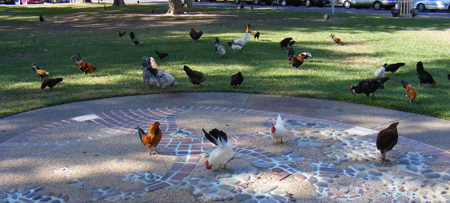
The other day, I took a break from literary activities to meet a friend in Fair Oaks Village for coffee.  Once upon a time, Fair Oaks was a farming community, separated by miles of fields and orchards from Sacramento.  Those days are gone, but there’s still something inviting about the town.  It’s slower than the boulevards and mini-malls that surround it, but not yet gentrified.  That may have something to do with the chickens, but I will get to that.

Fair Oaks Coffee Shop and Deli

So my friend were I are sitting at a table outside, having coffee and waxing eloquent on matters of great import, when I spotted a mutant chicken pecking at the pretzel I’d dropped on the sidewalk.  If you really pay attention, even normal chickens are sort of scary; you can understand the theory that they descend from dinosaurs.  Watch them run around, and you think of mini-velociraptors.  Yet chickens are the official Fair Oaks bird.  Herds of them run loose in town, and they are even featured on the town sign.

Once, when our dog, Holly, was younger, she jerked her leash out of my hand and took off after a chicken. By the time I caught her, thinking I was about to burst a lung, an irate citizen informed me that chickens are protected.  I believe I said something along the lines of, “Come on, Holly, we’ll hunt for dinner elsewhere.”

Fair Oaks is famous for chickens, and I have it on good authority that people throughout the region come here to dump their excess fowl.  What you have is a group of birds that interbreed, and every now and then you see a really demented one, who could play in a monster movie.  Such was the one who pecked at my feet the other day.  It had some kind of growth, like the extra head on the alien in Men In Black II.  I was so busy thinking of tetanus shots and keeping my feet out of its way, that I forgot the camera phone in my pocket and didn’t document the monster.   Today I went back with a real camera, and naturally all the chickens looked normal – or as normal as chickens can look.

Here’s the Fair Oaks chicken ideal:

Mural on the Fair Oaks, open air theater

And here’s the reality – chickens invading the public men’s room:

Employees must wash their hands before returning to work

The ideal – an idyllic shot in the town square

Don’t be fooled! Think of Alfred Hitchcock.

The real – high noon in roosterville.

Go ahead – make my day.

And finally, here is the biggest Ideal Chicken of all – at the 2010, Fair Oaks Chicken Festival:

Has everyone had a chance to go, “Awwww?”  If you can make it, this year’s Chicken Festival will be held on September 17.  Feel free to bring the munchkins, but be ready to change the subject if they ask, “What’s for lunch?”  Last year, the featured item was barbecued chicken.  (I’m serious).

Have fun if you go.  I would never dream of saying anything on my blog about eating Big Bird, but I will be home that day eating tofu.  Probably with the shades drawn too, in case the mutant chicken knows where I live.

The Ghost Star

Twenty-one million years ago, in the Pinwheel Galaxy – a close neighbor in cosmic terms – a white dwarf star exploded.  This week, as the moon sets early, we will have the rare chance to see this one-time sun’s final blaze of glory from our own back yards, with just a small telescope or a pair of binoculars.  Scientists are calling this a once in a generation event; type 1a supernovas like this are usually much farther away.

How do you find it?  Locate the last two stars on the Big Dipper’s tail, and imagine an equilateral triangle pointing north:

According to a Washington Post article, because type 1a supernovas are equal in intensity, astronomers use them to refine calculations of distance.  In the 1990’s, Robert Kirshner of Harvard:  “led a team that leveraged this property to make one of the biggest discoveries of the past century: The universe is flying apart, rapidly accelerating.

To explain this, cosmologists were forced into an uncomfortable conclusion. Either gravity does not work the way it is supposed to, or a mysterious force is pushing galaxies apart at a quickening pace. They called this unknown force “dark energy” and still have little idea what it is, even though they are able to calculate that it constitutes an astounding 73 percent of all mass and energy in the universe.”  http://www.washingtonpost.com/national/health-science/brightest-supernova-in-decades-serves-up-cosmic-clues-for-astronomers/2011/08/31/gIQA88CqwJ_story.html

Telescopes large and small, both on earth and in space (the Hubell) will be trained on this event, in the hopes that it may even clarify the nature of dark energy.  Though I don’t have a telescope, my father’s old film camera has a telephoto lens, and I’m hoping that on a tripod, we may be able to see the pinwheel galaxy.

I find this of interest from more than a scientific (or aging Trekkie) perspective.  The world’s religions tell us that things are not what they seem.  Most of the time we can only approach such truths through inference, faith, or meditation.  For the next few days we will have the chance to turn our physical eyes on something dramatic that has not existed physically for millions of years.

Something to think about…

An Important Book You Can Only Buy on Amazon

News on ebooks seems to come in clusters, and it happened again today.  While having lunch at Fresh Choice, one of those build-your-own-salad type places, I was reading and enjoying a Donovan Creed novel by John Locke who I wrote about yesterday.

I’ve said many times that I think the burgeoning option of ebook publishing is important for readers and writers.  But there is important and there’s important.   Here’s something weightier than simply a good read.

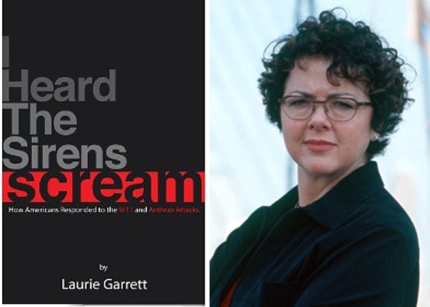
After my lunch, I got in the car and turned on NPR to listen to, “Science Friday.”  Laurie Garrett was being interviewed about her book on 9/11 entitled, I heard the Sirens Scream.

Ms Garrett is senior fellow for global health at the Council on Foreign Relations.  She’s the only journalist to win “the big three” prizes in her field, the Peabody, the Polk, and the Pulitzer, but you cannot get her book in a bookstore – it is only available on Amazon.

With all the impending chest thumping and flag waving on the occasion of the 10th anniversary of 9/11, I would suggest everyone listen to or read the transcript of this interview:  http://www.npr.org/2011/08/26/139972661/a-look-back-at-9-11-in-i-heard-the-sirens-scream

Garrett is furious that New York:  “became the reason to beat the drumbeats of war, that the attacks on our city were used by people who don’t live here to decide that we needed to invade Iraq, that the attacks on our city have been used by any number of politicians, misused, abused, with rewritten narrative, you know, the great lies told to justify all sorts of political things, everything from decreasing our civil liberties to building up a massive bioterrorism apparatus in this country, distorting our whole public health mission.

And I think the other thing is that as we approach the 10th anniversary, I should warn your listeners you’re going to be deluged with pathos.”

She contrasts this with the attempts of by Congress to deny funding to surviving Twin Towers rescue workers.  Garrett herself, who spent time near ground zero, was coughing up blood on her pillow at night, and talks of the way reports were massaged to remove the word, “asbestos.”

She summarizes worldwide response to 9/11 as unity or “singularity,” in outrage at the horror of the attacks, but goes on to say:  “You go out 120 days, that singularity has turned into the exact opposite: a moment of complete fracturing, of compete degeneration of the unity that was on one day…I think many of the ways that we responded, whether we’re talking about the public health response, the political response, the law enforcement, whatever aspect you look at, many of ways we responded set the seeds for this terrible, almost civil-war-type atmosphere that we live in in this country with such partisan dispute that the word compromise is considered evil, and the word governance is on nobody’s lips.”

You can see more of Laurie Garrett’s work on this and other topics at her blog: http://www.lauriegarrett.com