Notes from 2017 – The war on what???

Intruder Alert! St. Nicholas, by Thomas Nast

Intruder Alert! St. Nicholas, by Thomas Nast

Piety and commercialism, two unlovely attributes, are rampant at this time of year, so it’s time for my annual Christmas history post. If you search on “Christmas” here, you’ll find some interesting info on things like the Ghostly Christmas tree ship (Christmas Tree Facts and Legends), my grinchly rant on “Holiday music,” and most poignantly, the Christmas Truce, when to the chagrin of the generals, peace broke out on the western front on Dec. 25, 1914.

One thing you won’t find are notes on a “war on Christmas,” since there isn’t one. No one out here in the world cares whether you say “Merry Christmas,” or “Happy Holidays.” But if you look back in history, you’ll find a number of instances of Christians waging war on Christmas. Consider that:

–Early Christians did not celebrate Christmas. Origen of Alexandria, a third century theologian, wrote that “only sinners like Herod and Pharaoh celebrate their birthdays.”

–Christians didn’t celebrate Christmas until the ninth century reign of Charlemagne.

–During the middle ages, the Feast of Epiphany was more important than Christmas, which didn’t really emerge as a feast until 1377, when Richard II held a months long blowout with his nobles. Twenty-eight oxen and 300 sheep were slaughtered for the event, which according to chroniclers, featured “drunkenness, promiscuity, and gambling.” Early Christmas carols were sung, but they were bawdy.

–In 1645, Oliver Cromwell banned Christmas in England, and the Mayflower pilgrims outlawed it in Boston from 1658-1681.

–The New York City Police Department was formed after a Christmas riot in 1828. We read on History.com that “The early 19th century was a period of class conflict and turmoil. During this time, unemployment was high and gang rioting by the disenchanted classes often occurred during the Christmas season.”

–The “one percent” of the day responded with a campaign to transform a holiday long known for outlandish behavior into a commercial, family centered time, drafting the work of Thomas Nast, Charles Dickens, Washington Irving and others for the task.

–Victorian sensibilities focused on family and children, and it was only then, in 1870 that Christmas become a legal holiday in America. We’ve been led to believe we celebrate this day as it has been done for centuries, but that simply isn’t so (Humbug Revisited: A Brief History of Christmas).

I have no complaints about Christmas as a spiritual holiday, and it’s a great time to remember family and friends, but I do my best to ignore the cultural trappings. I boycott stores that force employees to work on Thanksgiving. I celebrate “Buy Nothing Day,” instead of Black Friday.

I will end with an observation I once heard an Art History professor share on the iconography of Santa Claus.

Glance at the Thomas Nast illustration at the start of this post. If you saw this guy in your living room, you’d either unlock your gun safe or call 911. He’s looking for your liquor cabinet and fridge, as he carries a sack of loot boosted from the neighbors!

Now look at the “Jolly Old Elf” in this modern representation below – white hair and beard but a child’s nose! This is an infantilized Santa Claus! It may help to get parents of very young children out to Toys R Us, but I don’t think it does much good for the maturity level of the culture…

Happy Solstice everyone!

Santa with puppies, kittens, and the facial features of a child.

Santa with puppies, kittens, and the facial features of a child.

Notes from 2017, part 1

Petroglyphs, Saguaro National Park, Arizona

Petroglyphs, Saguaro National Park, Arizona

This morning, at 2:44 am local time, the still point of the turning world became even more still. Like the gap between the end of an outbreath and the next inbreath, the earth paused.  From the depth of our longest night, her axis tilted back toward summer.

Darkness is metaphorical as well as physical. By many measures, our nation is in its darkest hour since the civil war. The inspiration for what will become a series of posts through the coming year was an article by Summer Brennan, called Notes From the Resistance: A Column on Language and Power. Ms Brennan begins by saying:

“In George Orwell’s 1984, the first act of rebellion undertaken by Winston, the protagonist, is to acquire a blank book and begin to write down his thoughts and memories.”

As Big Brother watches, Winston begins to reclaim words and celebrate truth. Big Brother is not yet as pervasive here, although security experts warn I should put a piece of tape over the camera on my laptop – just in case. In my estimation, I’m hiding in plain sight, betting that no one much cares about pics of an unshaven man in his 60’s, sitting in his bathrobe before dawn, swilling coffee and searching for words.

Although if Ken Bones could go viral…

But I digress. A minority of those Americans who voted chose a petty tyrant and reality TV star to become the most powerful man on earth. Lies are his currency. I will not repeat the lies here, but rather, use these posts to document my reality, and as much as I can sense it, the national reality, over the coming year.

Rather adding my saliva to the spitting contest between supporters and detractors, I will use this space, through the coming year, to ask the Dr. Phil question: “How’s this working for you?”

Here we will celebrate truth and truth-tellers.

Here I begin by celebrating Pope Francis, who so follows so beautifully in the footsteps of the apostle of peace for whom he is named. Yesterday, he declared that evolution and the Big Bang theory are correct. That God is not a magician who pulled the universe out of a hat 5000 years ago. That science can be a mode of truly appreciating the handiwork of the Creator.

Happy Solstice to all!

Back / Bart to the Future

Anyone who spends much time watching The Simpsons will likely agree that for 600 shows and counting, they’ve had the best writing in the history of television. Did you know that the show’s writers are sometimes prophetic? Sixteen years ago, in an episode called “Bart to the Future,” they showed us Donald Trump as president.

This shot from the episode shows Mr. Trump with a poster reading, “America you can be my ex-wife.” Think about that for a moment…

From "Bart to the Future" episode of the Simpsons, first aired March 19. 2000

From “Bart to the Future” episode of the Simpsons, first aired March 19. 2000

Homer is beginning to see what even those who voted for him will soon learn – that we’ve been screwed by a con man and pathological liar, who cares no more for us than he cared for the students at Trump University.

Voters had every reason to be angry with the status quo. When John Stumpf, the disgraced CEO of Wells Fargo, resigned with no jail time and $133 million, every working man or woman who is slipping further behind can see how those who play by the rules get shafted, and it is mainstream politicians of both parties who put the rules in place.

Donald Trump feigned concern for these workers just long enough to get elected. Union leaders aren’t stupid; five weeks before the inauguration, Richard L. Trumka, president of the AFL-CIO, said Trump’s cabinet appointments prove his campaign promises were hollow. Many other well meaning people who voted for the hope that Mr. Tump offered will learn soon enough they were conned. There won’t be much of a honeymoon.

Meanwhile, there is no room for compromise with evil and stupidity; it’s time for the majority of Americans who voted against our sociopathic president-elect to take a page from the Republican notebook, and prepare to defy and obstruct the incoming administration in every way we can.

When Barack Obama was elected, and the Republican party in seeming disarray, Mitch McConnell, senate minority leader, announced his party’s goal – to obstruct and insure that Obama was a one term president. It’s time for Democrats to adopt his playbook. The Tea Party taught us it doesn’t take that many people to stall a government.

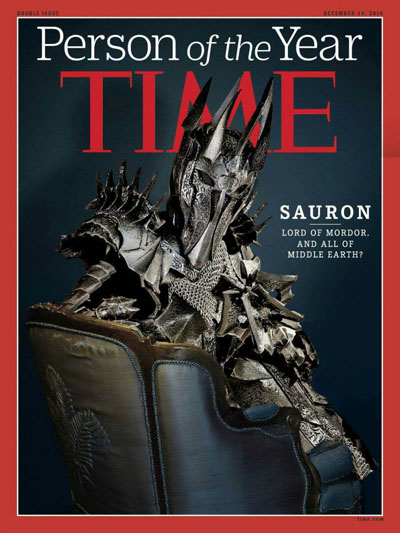
sauron_blog

A good place to start is with this detailed outline, prepared by former congressional staffers, on how to influence members of congress: An Anti-Trump Guide.  The premise is simple – those who work closely with representatives report that they care about just one thing – reelection. The more personal our interaction, the better. None of them much care about social media or blogs. Personal emails are good, print letters are better, and best of all are direct questions at the public events and townhalls they host.

“Where do you stand on privatizing Social Security? Oh, so you really want to deliver seniors’ lifeblood to the tender mercies of the too-big-to-fail firms that gave us the great recession?”

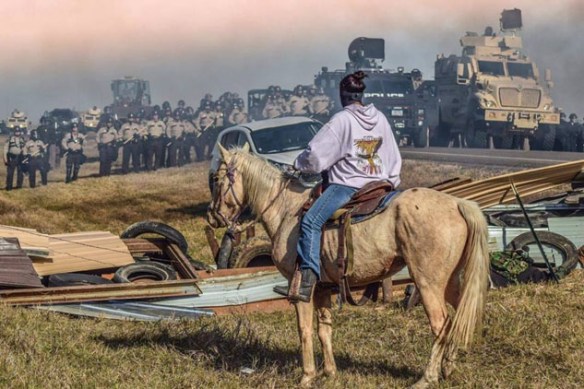
Those who stood firm at Standing Rock remind us of the lessons of Gandhi and Martin Luther King – the power of non-violent resistance. The tech engineers and CEO’s who refuse to work on a Muslim registry are also exemplars, as is Jerry Brown, Governor of California, who vows that we’ll launch “Our own damn satellite,” if Mr. Trump succeeds in defunding NASA climate monitoring. We can honor the administration of the EPA, which refused to submit a list of their people who attend climate conference, and Leonardo DiCaprio, who has made himself a spokesman, not only for the science of climate change, but for the economic opportunities clean energy holds.

There’s a lot of damage that Mr. Trump’s ship of fools can do in the near term, but a battle is on for the soul of the nation. Few things are more important than insuring that the incoming government is thwarted at every turn, and voted out of office, in the disgrace it deserves, as soon as possible.

Prayers for Standing Rock

prayer-for-standing-rock

At 10:00am Central time, on Sunday, December 4, there will be a world-wide half hour of prayer and meditation “with the water, the earth, and the global community of supporters” of the Standing Rock Sioux nation, of those whose lives depend on the Missouri River, and all who understand the importance to all beings, of clean drinking water and reverence for sacred space.

You can register to participate at praywithstandingrock.com, donate to the water protectors, and sign a petition to President Obama, requesting that he end the violence against unarmed, peaceful protestors, who understand that water is more important than oil.

Here is an interview with Wendy Egyoku Nakao, abbot of the Los Angeles Zen Center, on why she, her and her organization, and more than 500 clergy of all denominations support the Sioux nation:

“I think we are heading for more confrontation in the days ahead. The First Nation peoples are taking a ceremonial and prayerful stand for healing from historical trauma and declaring their right to live on this earth. The DAPL folks have continued their actions, with the support of the Morton County law enforcement, regardless of injunctions, and are poised to go under the Missouri River. The mainstream media all but ignores what is happening. The current POTUS has been weak on the issue; the future POTUS is invested in Energy Transfer Partners. I encourage everyone to Stand with Standing Rock and protect the Water. Water is Life.”

I want to apologize to someone, but I don’t know who

“I cross the Green Mountain
I sit by the stream
Heaven blazing in my head
I dreamed a monstrous dream
Something came up
Out of the sea
Swept through the land of
The rich and the free” – Bob Dylan

Timely quotes from Reinhold Niebuhr

Reinhold Niebuhr,By Source, Fair use, Link

Reinhold Niebuhr,By Source, Fair use, Link

Reinhold Niebuhr (1892-1971) was an American theologian, ethicist, commentator on politics, and professor at Union Theological Seminary for 30 years. Among his most acclaimed books are, Moral Man and Immoral Society, and The Nature and Destiny of Man, which Modern Library named as one of the 20 best nonfiction books of the 20th century.

Neibuhr’s  best known work, however, is the Serenity Prayer: “God, grant me the serenity to accept the things I cannot change, the courage to change the things I can, and the wisdom to know the difference.”

In the wake of this year’s election cycle, his musings on history and politics have a special poignancy and relevance:

“The tendency to claim God as an ally for our partisan value and ends is the source of all religious fanaticism.”

“Frantic orthodoxy is never rooted in faith but in doubt. It is when we are unsure that we are doubly sure. ”

“Religion, declares the modern man, is consciousness of our highest social values. Nothing could be further from the truth. True religion is a profound uneasiness about our highest social values.”

“Religion is so frequently a source of confusion in political life, and so frequently dangerous to democracy, precisely because it introduces absolutes into the realm of relative values.”

Neibuhr’s most haunting observation to me is this, which implies that not a single one of the countless empires that have risen and fallen before ours made much of their greatness until it was gone:

“One of the most pathetic aspects of human history is that every civilization expresses itself most pretentiously, compounds its partial and universal values most convincingly, and claims immortality for its finite existence at the very moment when the decay which leads to death has already begun.”

Harbor Scene with Roman Ruins, Leonardo Coccorante (1680-1750), public domain

Harbor Scene with Roman Ruins, Leonardo Coccorante (1680-1750), public domain

My Fulfillment Package

retro-1310353_640

The voice on a recent robo-call, in the masculine-but-chirpy tone of a game show host, said, “Hi, this is Tod, here to tell you your fulfillment package is ready! Having just come from the meditation room, I wondered what kind of fulfillment Tod was selling. “Stay on the line for details on how to get your medical alert package.” I hung up.

We all know Big Data is watching our every keystroke, and that “secure information” is an oxymoron, but although “they” may have accurately placed me in the medical alert demographic, they don’t understand my idea of fulfillment.  Or do they?

Every “positive psychology” poll I’ve ever seen on the key factors of happiness lists “good health” as most important, so perhaps Tod wasn’t that far off.  Or so you might think, unless you’d seen the third annual Chapman University Survey of American Fears, which lists the flip-side of happiness, things that get in the way of fulfillment. The top fear, listed by 60.5% of the 1511 Americans surveyed was, “Corruption of government officials.”

Understandable, especially this year, but it also tells me that the survey is skewed toward a young demographic. Trust me, when you get old enough to care for a parent with Alzheimer’s, the things you fear change dramatically. Plus, I’m cynical enough to believe that “corrupt government official” is usually redundant – like speaking of “wealthy millionaires.” (There are 383 of those in Congress, by the way).

Here are the results of the survey:

  • Corruption of government officials (same top fear as 2015) — 60.6%
  • Terrorist attacks — 41%
  • Not having enough money for the future — 39.9%
  • Being a victim of terror — 38.5%
  • Government restrictions on firearms and ammunition — 38.5%
  • People I love dying — 38.1%
  • Economic or financial collapse — 37.5%
  • Identity theft — 37.1%
  • People I love becoming seriously ill — 35.9%
  • The Affordable Health Care Act/”Obamacare” — 35.5%

Interesting to note that by a small percentage, more of us fear losing our guns than losing our loved ones.  Nope, not my fulfillment package.

However, fear of clowns didn’t make the top ten, so perhaps we can let Stephen King off the hook….

Changes

2x2 Matrix: possible futures, by Gaurau Mishra. CC-BY-2.0

2×2 Matrix: possible futures, by Gaurau Mishra. CC-BY-2.0

Almost four years ago, I posted Change is the Only Constant, a discussion of the December, 2012 report of the National Intelligence Council, a consortium of the 16 major U.S. intelligence agencies. Since 1997, they have issued comprehensive reports on future trends after each presidential election and posted the reports online. We can expect the next installment this winter.

The 2012 edition, which predicts alternate futures for the year 2030, outlines some things that are certain, like aging populations in the developed world; some which are possible, and some “black swans” – potential surprises for good or ill. Here are two key predictions.

  • The rate of change in all areas of life will continue to accelerate and will be faster than anything anyone living has seen.
  • World population will grow from 7.1 billion (in 2012) to 8.3 billion in 2030. Demand for food will increase 35% and for water by 40%.

Keep this in mind as we look at a some current events.  I should preface these comments by saying I’ve long had a rule of thumb: never trust a politician who says, “I have a plan to create jobs.” Both presidential candidates have said those exact words this year.

The fantasy is that by pulling the right levers – cutting or raising taxes, threatening or cajoling China, building a wall at our southern border, and so on, we can restore whatever American golden age our imagination conjures. Maybe the 50’s, when we were the only industrial nation not ravaged by WWII. Maybe the 90’s dot com boom, when even your Starbucks barista had stock tips to share.

We all know that’s not going to happen. The truth is even harder to face than any elected or would-be elected American official has yet been willing to share.

On May 16, the BBC reported that China’s Foxconn, the largest electronics manufacturer in the world, where Apple and Samsung smart phones are made, replaced 60,000 workers with robots.  Chinese manufacturers are investing heavily in robotics. So much for bringing jobs back from China.

For an article in the August 1 issue of Time, (“What to do about jobs that are never coming back”), Rana Foroohar spoke to Andy Stern, a former head of the Service Employees International Union:  “Stern tells a persuasive story about a rapidly emerging economic order in which automation and ever smarter artificial intelligence will make even cheap foreign labor obsolete and give rise to a society that will be highly productive–except at creating new jobs. Today’s persistently stagnant wages and rageful political populism are early signs of the trouble this could generate.”

In a Common Dreams article published last week,  You Can’t Handle the Truth,  Richard Heinberg, steps back for a much longer view of our situation and says:

“We have overshot human population levels that are supportable long-term. Yet we have come to rely on continual expansion of population and consumption in order to generate economic growth—which we see as the solution to all problems. Our medicine is our poison.

“And most recently, as a way of keeping the party roaring, we have run up history’s biggest debt bubble—and we doubled down on it in response to the 2008 global financial crisis.

“All past civilizations have gone through similar patterns of over-growth and decline. But ours is the first global, fossil-fueled civilization, and its collapse will therefore correspondingly be more devastating (the bigger the boom, the bigger the bust).

“All of this constitutes a fairly simple and obvious truth. But evidently our leaders believe that most people simply can’t handle this truth. Either that or our leaders are, themselves, clueless. (I’m not sure which is worse.)”

“…any intention to “Make America Great Again”—if that means restoring a global empire that always gets its way, and whose economy is always growing, offering glittery gadgets for all—is utterly futile, but at least it acknowledges what so many sense in their gut: America isn’t what it used to be, and things are unraveling fast. Troublingly, when empires rot the result is sometimes a huge increase in violence—war and revolution.” (emphasis added)

The last major decline of empires, he notes, resulted in World War I. The US and the rest of the world are, in Heinberg’s words, “sleepwalking into history’s greatest shitstorm.”

“…Regardless how we address the challenges of climate change, resource depletion, overpopulation, debt deflation, species extinctions, ocean death, and on and on, we’re in for one hell of a century. It’s simply too late for a soft landing.

“I’d certainly prefer that we head into the grinder holding hands and singing “kumbaya” rather than with knives at each other’s throats. But better still would be avoiding the worst of the worst. Doing so would require our leaders to publicly acknowledge that a prolonged shrinkage of the economy is a done deal. From that initial recognition might follow a train of possible goals and strategies, including planned population decline, economic localization, the formation of cooperatives to replace corporations, and the abandonment of consumerism. Global efforts at resource conservation and climate mitigation could avert pointless wars.

“But none of that was discussed at the conventions. No, America won’t be “Great” again, in the way Republicans are being encouraged to envision greatness. And no, we can’t have a future in which everyone is guaranteed a life that, in material respects, echoes TV situation comedies of the 1960s, regardless of race, religion, or sexual orientation…”

Heinberg’s conclusions aren’t easy to digest, and are tempting to deny. Keeping attention on even a few of the significant points in the articles referenced here leads to disturbing conclusions.

If 16 US Intelligence agencies are anywhere near correct in their numbers, in 14 years, 8.3 billion people will be competing for 40% less water and 35% less food (in this case, living up to their name, the intelligence agencies don’t waste anyone’s time denying the effects of climate change).

Can we imagine “global efforts at resource conservation” in which nations co-operate, and at least try to send relief where it’s needed?  Like after tsunamis or the earthquake in Nepal? Or are we headed toward a survivalist wet dream?  Futures aren’t set in stone, said the NIA. It all depends on how we behave (sinking feeling in the gut…).

I can see it both ways. Speaking of our current election, someone recently said to me, “I haven’t felt this bad about things since 9/11. Maybe it’s even worse.”  Maybe so. In the immediate aftermath of 9/11, we were a nation and a world largely united in awareness of our fragile humanity and revulsion at senseless suffering.

It strikes me that communities often pull together in the face of disaster when our leaders and governments won’t. That is Heinberg’s conclusion as well. Given our lack of competent leadership at the top, how can we build “local community resilience?”

I wish I knew. But since Iceland has more sense than to open it’s doors to American refugees, I’ll have time to think it over!  Meanwhile this quote from the Dalai Lama comes to mind:

“We can live without rituals. And we can live without religion. But we cannot live without kindness to each other.”

Changes are certain but futures aren’t set in stone…