
Hungry Ghosts

Section of Hungry Ghosts Scroll, Kyoto, late 12th c., Public Domain

Section of Hungry Ghosts Scroll, Kyoto, late 12th c., Public Domain

In traditional Buddhist cosmology, there are six major realms of existence. Only two of these, the human and animal realms, are visible. The other four, which include both heavens and hells, are not manifest to our physical senses. Unlike Christian heaven and hell, none of these are forever – the length of one’s sojourn depends on karma.

Many contemporary teachers, while not denying the metaphysical reality of these regions, focus on our inner “location” in the here and now. One who is filled with love and compassion dwells in heaven. The one seething with anger, red in the face, like a devil, at that moment experiences one of the hells.

Hungry ghosts have a region all to themselves; their dominant trait is insatiable craving. Hungry ghosts are depicted with huge bellies but tiny throats and mouths – desperate hunger and thirst that can never find relief.

Never enough, there is never, ever enough,” is the mindset of hungry ghosts, both in the imagined subtle realm and in this world. Addictions and insatiable cravings of all sorts make us hungry ghosts. The pre-repentant Ebenezer Scrooge, the archetypal miser, is the best known western hungry ghost. Now, the Panama Papers reveal how widespread is this disease, and how it drives the leaders and elites in nations throughout the world. Nor do we, at least in “the free world,” get to sit back and righteously condemn “those bad people.” Not in Buddhist thought, at least, where everything is interconnected.

The people of Iceland forced their Prime Minister out of office within 48 hours of the time the story broke. They did the same with the bankers in 2008. We, who have elected officials of both parties who tolerate bailouts and corporate shell games, are are not separate from the hungry ghosts who are fucking this world.

In his public discourse, Buddha never commented one way or another on metaphysical truths. There’s plenty to worry about here and now, he said. If greed locks us into the hell of the hungry ghosts, generosity, the mindset of Scrooge on Christmas morning, opens the gates of heaven.

Ratnasambhava, the primordial Buddha of "the wisdom of equality," manifests the virtue of generosity.

Ratnasambhava, the primordial Buddha of “the wisdom of equality,” manifests the virtue of generosity.

Perhaps there are no big or small acts of generosity. Our world, the people in it, and we ourselves, need nothing more urgently at this time.

Straight croissants

Even to me, this title seems to refer to the sexual preference of breakfast pastries, rather than its real subject, their shape. This is because “croissant” is French for “crescent,” and who ever heard of a straight crescent outside of higher mathematics?

straight croissant 2
Well, our cousins across the water are embroiled in a debate on this very subject.

Tesco, the largest supermarket chain in Britain, will no longer sell curved croissants. Tesco croissant buyer, Harry Jones, spoke of “the spreadability factor.” Curved croissants typically require three strokes to cover their surface with jam, the preferred topping of most Brits, while a straight croissant can be covered by a single sweeping stroke, thus cutting the risk of sticky fingers or table cloths. (1)

As a veteran of many sticky finger incidents involving restaurant marmalade containers, I can attest a Daily Telegraph editorial is wrong: it is not necessarily safer to eat toast!

Discussions of ease of use and symbolism fail to consider health implications. French law declares that straight croissants must be made with butter, while the curved varieties can use margarine.

In a world where so many familiar structures are in flux, curved croissants are now one less thing we can count on.

I guess there’s no help for it. Benjamin Turquier, last year’s champion Parisian butter croissant maker, said “I can understand the importance of symbolism and tradition, but straight croissants are more practical to make.”

Sigh…we’ll just have to learn to deal…

Trust no one!

Paranormal conspiracy theorists and science fictions fans from Area 54 to Roswell will recognize my title as the motto of FBI Special Agents Fox Mulder and Dana Scully, whose whimsical escapades have returned to television.

x-files-2016-premiere

On a less amusing note, it’s the American attitude toward virtually all institutions, according to journalist, Jeff Greenfield, whose essay,”In Nothing We Trust,” aired on the PBS Newshour on Friday, February 5.

Greenfield cites a recent Pew Research poll showing that Americans mistrust most institutions; only 19% of us trust the government to do “what is right most or all of the time.”

In 1964, with a strong economy, the passage of the Civil Rights bill, and an easing of the cold war, the number was 77%. Ten years later, after a decade of war in Viet Nam and a scandal that drove a president from office, the number was 36%, and it has never topped 50% again.

It isn’t just our government, according to Greenfield. We don’t trust churches. Labor Unions. Banks. Large corporations.  Medicine. Greenfield notes, in his TV news segment, that only 21% of us have “a lot of faith” in TV news.

In great measure, says Greenfield, there are good reasons to mistrust these institutions. Think of the movie, Spotlight. The government of Michigan and the City of Flint.  Yesterday’s congressional hearings on 5000% price hikes in the pharmaceutical industry.

In a similar editorial, I once heard a journalist say that the first act of colonial governments was an attempt to discredit all the institutions of the colonized people; “obviously your god, your army, your government are not as good as ours or we wouldn’t be here.” We may be, said the journalist, the first nation in the history of the world to have colonized itself!

Our pervasive mistrust, according to Jeff Greenfield, makes things especially difficult, in a political year, for those seeking to gain the public trust. It may, in fact, reward those who fan the flames of discontent.

But how, he asks, can a republic long survive when it’s motto is, “In nothing we trust?”

R.I.P. Professor Snape

Alan Rickman as Severus Snape. Creative Commons

Alan Rickman as Severus Snape. Creative Commons

We’ve lost another British luminary to cancer at the too-young age of 69.

Alan Rickman, whom Harry Potter fans remember as the tortured and acerbic Professor of Potions, is gone.  Tributes have poured into social media sites from those who knew and worked with him.

Daniel Radcliffe, who played Harry, wrote “As an actor he was one of the first of the adults on Potter to treat me like a peer rather than a child.”

J.K. Rowling offered a tribute, and Emma Watson, who played Hermione said,“I’m very sad to hear about Alan today. I feel so lucky to have worked and spent time with such a special man and actor. I’ll really miss our conversations. RIP Alan. We love you.”

That about says it all.

The 2015 Pinocchio Awards

pinocchio

The Washington Post released it’s annual Pinocchio Awards for the year’s biggest falsehoods. To no one’s surprise, the 2015 winners are all involved in politics. No one gets to feel smug; all parties and political persuasions were represented.

I’m sure lying politicians are as old as politics. What was disheartening this year was the blatancy of the lies. Fifty one years ago, Marshall McLuhan coined the phrase, “The medium is the message.” In 2015 we may have seen the ultimate corollary of that:  if you say it on TV with enough bravado, swagger, or apparent sincerity, some or many will believe you, regardless of facts. We, as a culture, prefer easy answers to truth.

Here are the winners:

Donald Trump for false and repeated assertion that he saw thousands of Muslims on TV celebrating the fall of the twin towers. Only in Trump’s fevered imagination did such an event play out.

Hillary Clinton for her defense of her husband’s signing of the anti-gay “Defense of Marriage Act,” with an assertion that it headed off an anti-gay marriage constitutional amendment. There may have been talk, but there was no momentum for such an amendment.

Donald Trump for his claims that immigrants commit more crimes than American citizens. While some on this list have cherry-picked their statistics, Donald apparently never looks at statistics at all.

Sen. Chris Murphy (D-Conn) for saying in June that there have been 128 school shootings since Sandy Hook. His stats came from an anti-gun violence advocacy group with a flawed methodology that included suicides and accidents in the numbers.

Donald Trump for his claim that Obama wants to admit 250,000 Syrian refuges to the US. The number is 10,000 Syrians, and the US maximum figure for all refugees is 180,000 over the next two years.

"Freedom of Speech," 1943. In Norman Rockwell's America, truth and respect for all viewpoints mattered

“Freedom of Speech,” 1943. In Norman Rockwell’s America, truth and respect for all viewpoints mattered

John Kerry for claiming he and Al Gore organized the 1988 Senate hearings on climate change. He was not even there.

Mike Huckabee for stating that “global freezing” was a serious concern 40 years ago.

Sen. Elizabeth Warren ( D-Mass ) for proposed regulations for car dealership loans based on “wildly” exaggerated statistics.

Rudolph Giuliani, former NY City Mayor, for saying Obama has never called America a great or exceptional country. Apparently Mr. Guiliani has never listened to an Obama speech.

President Obama for “dubious” claims about the Keystone pipeline.

Sen Rand Paul (R-Ky) for claiming an elderly man was in prison for “putting dirt on his land,” when in fact he was convicted of mail fraud, conspiracy, and environmental violations such as selling land with illegal sewage systems that were likely to fail.

Democratic legislators: On the house floor, staged a demonstration of solidarity with a black youth, shot by a white police officer in an incident that various investigations determined was legitimate self-defense.

Sex Trafficking Statistics:  “There are not 300,000 thousand children at risk in the US, nor  100,000 children in the sex trade, nor is human trafficking a 9.5 billion dollar business, nor do girls become victims at an average age of 13, nor has the government arrested hundreds of perpetrators.”  All of these were claims made by “politicians, advocacy groups, and government officials” in 2015.

I’d love to feel smug and wag my finger at the politicos, but I can’t.  To paraphrase the Master whose birth we celebrated yesterday, “Let he who lives without falsehood cast the first aspersion.”

Politicians behave like this because it works for them, it gets them elected and reelected. For that, We the People are responsible.  We can do better than this…

The medium is…

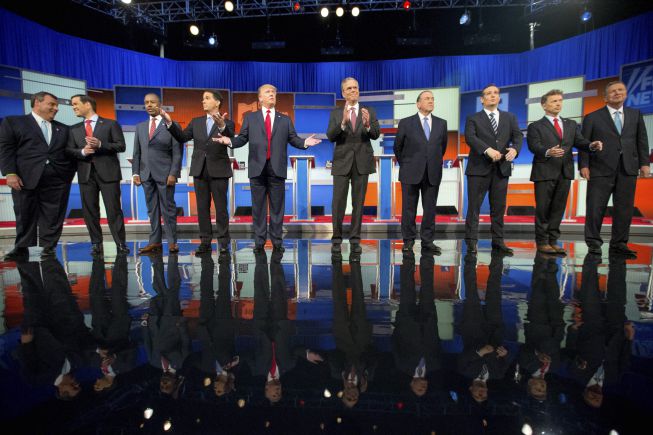
Republican debate

“The medium is the message”, said Marshall McLuhan in Understanding Media, 1964. Fifty-one years later, I’m still not certain we understand media, but a light bulb went on for me Thursday night regarding McLuhan’s iconic phrase. While watching the Republican presidential debate, I had a minor epiphany; that television cannot help transforming politics into entertainment.  

I am not suggesting that either party has a monopoly on show business.  Yes, the Republicans are likely to be funnier this year, with their Jerry Springer moments, and The Donald, who’s public persona is a weird combination of Rodney Dangerfield and Don Rickles.  I expect the Democrats to be far less interesting, more like infomercials on the home shopping channel.

There’s nothing new about politics as entertainment. If we believe television and movie depictions of pre-television and movie campaigns, there was plenty of bunting, and bluster, and brass bands in “the good old days.” But every now and then, wouldn’t it be refreshing to see something real happen on political TV?

The last time I saw reality break through was during the 2004 Democratic convention in Boston.  The Democrats had barred one of my heroes, the late Senator Robert Byrd, from the podium. Byrd could not be trusted to stay on script. Massachusetts Senator Kennedy invited Byrd to speak at the Old North Church, where Paul Revere worshipped, and his address was broadcast on Democracy Now. Byrd held up his well-worn pocket copy of the US Constitution and warned us that it was under attack…

Politics, of course, is not the only thing that TV flattens out. I recall several surreal moments with TV news. One early evening in college days, when I was living in an off-campus house, my roomies and I were watching a shoot out on Mod Squad on an old black and white TV. I went to the kitchen to fix a sandwich, and when I returned, the shootout had grown more intense; the house where the bad guys were hiding was on fire. But it looked different.  “Did somebody change the channel?” I asked.

“Nah, man,” said a house mate. “The news cut in. The cops are having a shootout with those guys who kidnapped Patty Hearst.” The visceral difference between watching a fictional versus a non-fiction firefight on TV was nonexistent without the dialog or voice over!

In a very real sense, that’s simply the nature of things according to both western depth psychology and Buddhist psychology. Every experience we have, noted James Hillman, begins as an event in the psyche. And Buddhist thinkers will tell you that our so-called realities are far more like the dreams we have at night than most of us dare to believe. Yet, as a practical matter, in order to make the right decisions, we have to be able to tell them apart, and that means turning a critical eye on the stuff we see on television.

I have recommended it before, but as we begin another presidential election mini-series, I can think of no better guidebook than Neal Gabler’s Life the Movie: How Entertainment Conquered Reality, 2000.  In it, he says:

“the deliberate application of the techniques of theater to politics, religion, education, literature, commerce, warfare, crime, everything, has converted them into branches of show business, where the overriding objective is getting and satisfying an audience.”

Unless we choose to live with the wolves, we’re going to be part of that audience, but at least we can remember that wonderful Buddhist bumper sticker:  “You don’t have to believe everything you think.”

Does daylight savings time save energy?

Public Domain

Public Domain

Ok, now that daylight time is here for us in the new world, and coming in a few weeks for the EU, it’s time for a pop quiz: who invented daylight savings time?

Yes, fellow Googlers, it was Benjamin Franklin who reasoned it would save candles in the colonies. It was not mandated in the US until we entered WWI, when the intent was to preserve resources.

According to Scientific American, the first study of the effectiveness of daylight savings time was conducted in the 70’s, during our first “oil crisis.” The same article notes that a study in Indiana in 2006, the year that state mandated daylight time in all rather than just some of its counties, showed an increase in energy usage.

Similar results were seen in California in 2007, when daylight time was lengthened by four weeks. California Energy Commission researchers found an energy savings of only 0.2% with a margin of error of 1.5%. Changes in air conditioning patterns as well as the pervasiveness of electronic controllers in homes and businesses are possible causes of the flat or negative results.

I, for one, enjoy the light in summer evenings. Farmers dislike daylight savings time, for it disrupts their schedules. Sports enthusiasts favor it. In the late ’90’s, for instance, representatives of the golf industry said daylight time earned them and extra $400 million in fees each year.

For it or against it, the odds of it’s changing are practically non-existent. Unless you live in Arizona, you’ve lived with it all your life. Besides, there are more pressing issues for Congress to fail to act on than this.

Daylight time is one of those things, like the Superbowl and plum blossoms, like St. Patrick’s day, and the start of baseball season, that signal the coming of another spring and summer. I’m not inclined to complain too much if that costs me an hour of sleep.

Alternate views of the evil empire

Here is another take on the Amazon / Hachette controversy by Barry Eisler, a former CIA operative and best-selling author of thrillers. Eisler made headlines in 2011 when he turned his back on traditional publishing (which he calls “legacy publishing”) to publish his work independently on Amazon.

In this June 4 article in The Guardian, Eisler ticks off these pluses for Amazon: it “singlehandedly created a market for digital books, [is] now the greatest source of the legacy publishing industry’s profitability (though of course legacy publishers are sharing little of that newfound wealth with their authors)…built the world’s first viable mass-market self-publishing platform, a platform that has enabled thousands of new authors to make a living from their writing for the first time in their lives. And [it] pays self-published authors something like five times as much in digital royalties as legacy publishers do.”

Eisler makes some interesting arguments while waving a red flag (Amazon-hating authors are the literary “one-percent”). I recommend the article to anyone interested in this current publishing brouhaha. My biggest takeaway was Eisler’s simple observation, in an otherwise complex debate, that individual attitudes are probably based more on personal interest than selfless concern for the future of literature. To blame Jeff Bezos for the loss of bookstores, he says, is like buggy makers blaming Henry Ford for the development of internal combustion. Though some of his analogies may be questionable, they point toward two facts that are not: (1) new technologies never go back into the box, and (2) their ramifications are never known at the outset.

I was halfway through the paragraphs above when the postman brought the June 16 issue of Time, with an essay on the back page by Joel Stein, Hachette author of Man Made: A Stupid Quest for Masculinity.

Stein ventured, “with trepidation,” to Amazon “to see what barbarism it had committed on my book’s page – changing my author photo go one of my high school mullet shots, perhaps, or allowing yet more people to start their one-star reviews with ‘No, I haven’t read this book.'”

When he found nothing amiss, Stein sadly reflected that Amazon, with its cutting edge algorithms, had to know how much it would hurt his ego and confidence to be left out of the feud. “I have no idea who will publish my next book,” he says, “though I do know they’ll be sorry they did.”

Diversity and variety are central to the richness of life. I’m old enough to remember and miss various mom and pop stores of all kinds, not just bookstores. A local nursery used to employ master gardeners, who could look at a sick leaf and tell you exactly what to do. Through no fault of their own, the people who work in the Lowe’s garden section can only tell you, “Fertilizers are down aisle one.” As a kid, I learned to make flying airplanes out of balsa wood and tissue paper at a local hobby shop; it was a far more interesting place than any Toys ‘R Us.

Right now, perhaps all we can do in the publishing battle is watch and wait, and opt for diversity and richness in whatever way we can.