The Unwinding: An Inner History of the New America, by George Packer

In the first sentence of The Unwinding, George Packer tells us what his title means:  “No one can say when the unwinding began – when the coil that held Americans together in its secure and sometimes stifling grip first gave way.”

Packer is a staff writer for The New Yorker, the author of an award winning book on American involvement in Iraq, two novels, and a play.  You could almost guess it would take someone with Packer’s chops to weave together the disparate threads of change that have irreversibly altered the country we thought we lived in.

It began in 1973, when the mid-east oil embargo coincided with models showing American had reached peak oil production.  And in 1977 when the steel mills in Youngstown, Ohio, that once stretched side-by-side for 25 miles, shut down.  When an idealistic young man named Jeff Connaughton, got an MBA and then decided to go to Wall Street, because by the early 80’s, getting a business degree and going to work for a company “that actually made things,” was viewed as failure.  When, according to Packer, concern over exported jobs prompted Wal-Mart to hang “Made in the U.S.A” signs over racks of clothing from Bangladesh.  When Connaughton became a Washington lobbyist and one of his colleagues told him, “Four-hundred thousand a year just doesn’t go as far as it used to.”

Poets see things before the rest of us, and Packer quotes Bruce Springsteen, who put it like this in 1984:  “Don’t you feel like you’re a rider on a downbound train?”

Now, almost 30 years later, when we all know we’re on a downbound train, Packer turns a light on some of the hydra-headed influences that led us collectively down this road.  He also shows us where positive change is likely to come from.  And where it is not.  It won’t come from the power elites, though it may come from disaffected refugees from those elites.

Jeff Connaughton, who made it into the outer circles of the inner circle, as a legal council for the Clinton White House, left Washington after being “radicalized by a stunning realization that our government has been taken over by a financial elite that runs the government for the plutocracy.”  Connaughton is now writing a book called The Payoff:  Why Wall Street Always Wins.

Packer also profiles Peter Thiel, a Silicon Valley entrepreneur who co-founded Paypal and helped bankroll Facebook as a startup.  Thiel put it like this:  “…the deep secret is there’s nobody at the steering wheel at all…People pretend to be in control, but the deep secret is there is no one.”  Thiel now looks for unusual entrepreneurial projects to fund.  Claiming that education is “the latest U.S. economic bubble,” he compares university administrators to sub-prime mortgage lenders.  In response, he began awarding Thiel Fellowships, two year grants of $100,000 each, to 20 people a year under the age of 20, willing to leave school to work on projects that “could make the world a better place.”

Packer doesn’t just profile movers and shakers in the post-unwinding world.  He details the story of Dean Price, son of generations of tobacco farmers, who overcomes multiple obstacles, including personal bankruptcy, to establish a working and profitable biodiesel refinery after learning about peak oil and taking the message to heart.

George Packer

author George Packer

In writing the book, Packer spent a lot of time with Tammy Thomas, an African-American woman who was 11 when the mills closed in Youngstown.  A few years later, she found herself an unwed mother of three, with a fierce determination, which she attributed to her grandmother, to get off welfare, even as jobs evaporated and gangs took over the neighborhoods.  She succeeded in doing so, and is now a community organizer and advocate, but her story makes clear that the odds were stacked against her.  She survived for 19 years in a car parts factory but is scornful of politicians who attach the label of “good jobs” to such work.  “Mitt Romney would be dead in week,” she said.

Packer interweaves the individual stories in a way that keeps you turning pages, like a novel with a large cast of characters that you care about.  Not all the stories have happy endings, and the suffering of individuals, cities, and regions is palpable.  By giving so many seemingly separate events the name, Unwinding, Packer helps clarify connections I had been sensing but unable to articulate.

“Alone on a landscape without solid structures, Americans have to improvise their own destinies, plot their own stories of success and salvation.”

A problem has to be named and described before we can begin to imagine solutions, and for this reason The Unwinding is a profoundly important book.

The Secret of Getting Ahead?

Those who are old enough to have watched “Hee-Haw” will remember a song that Tennessee Ernie, Buck Owens, and the gang sang almost every week, “Gloom, Despair, and Agony on Me.”  One of the lines was, “If it weren’t for bad luck, I’d have no luck at all.”

These days, it sometimes seems like if it weren’t for bad news, we’d have no news at all, especially on the economic front.  I’ve been thinking about this a lot lately – not the economy per se, but the news, that is, the stories we tell about the economy.  I’ll have more to say about this later, but it’s increasingly clear that what we have beneath the headlines are dueling paradigms, different core assumptions of what is good and bad, what works and what doesn’t.

Here is a core assumption that never has gotten much air time:  altruism rather than self interest may be the greatest motivational force for people at work.  This is the thrust of the teaching and writing of Adam Grant, 31, the youngest tenured and highest ranked professor at the Wharton School of Business.  Sarah Dominus, a writer for the New York Times Magazine, profiled Grant in a March 27 article,  Is Giving the Secret to Getting Ahead?.

Grant first made a name for himself in the field of economics as a 22 year old grad student in organizational psychology, when he applied himself to boosting motivation and output at a university fund raising call center, a notoriously unpopular student employment option.

Realizing that the call center helped fund scholarships, Grant invited a scholarship recipient to address the callers to give them an idea of the value of their work.  Even Grant was amazed when the next month, revenues were up 171%.  In later studies, the jump was as high as 400%.  Since then, Grant designed other studies in other fields that gave parallel and equally quantifiable results.

Grant’s work has drawn criticism as well as praise, much of it centered on the potential for abuse of the findings.  Will corporations try to use them to keep workers happy while cutting their wages and benefits?  According to Sarah Dominus, Grant is skeptical of corporate motivation as well and says his effort is to understand the mechanism, not necessarily suggest implantation.

Two weeks ago, I attended a day long retreat with Norman Fischer, a long time teacher and former abbot at the San Francisco Zen Center.  The subject of his retreat was compassion.  “Self-cherishing never makes anyone happy,” he said.  “In the long run, concern for others is very practical.  It’s our only chance for living a satisfying life.”

I started thinking of the how and why of our bad news headlines when Fischer said he remains optimistic.  Despite the chaos and breakdowns of our traditional systems, he believes that interactions based on compassionate regard for each other are the future.  “Not in my lifetime and maybe not in yours, but I think it’s coming,” he said.

That’s why I was so pleased to discover Adam Grant’s work.  I don’t often think of economics as a likely field of compassionate action, but if, as the Buddha asserted, it’s an impulse at the core of our being, we should expect to find the evidence everywhere.  Adam Grant seems to have found it at the heart of “the dismal science.”  His first book for a wide audience, Give and Take, was published on April 9.

Robots ‘R Us (?)

forbiddenplanet

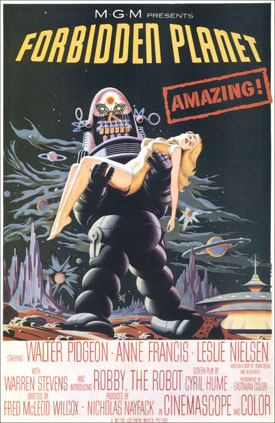
In the field of robotics, as in so many other areas of life, science fiction writers saw the future decades before the rest of us; they warned that androids were coming and the relationship would not always be easy.

Recently, I’ve seen adds on the cable channels by legal firms inviting the “thousands of victims” of botched robot surgery to join class actions suits (go to badrobotsurgery.com).  Ironically, the same Google search that brought up the lawsuit page also showed adds for robotic prostate surgery, which is not the time you want your robots going rogue!

Practicing medicine without proper training isn’t all the dastardly droids have been up to.  In an article called, When the future comes, what are we going to do with it?, blogger Orkinpod looks at how robots eliminate manufacturing jobs.

As an Apple geek, I was dismayed last year to hear stories of mistreated workers at Foxconn, the mammoth Taiwanese contractor that assembles iPads and iPhones.  Apple hired independent auditors to investigate, and Foxconn agreed to clean up its act, but that was not their only decision.  According to links in Orkinpod’s post, Foxconn is stepping up plans, announced in 2011, to deploy a million robots across their assembly lines.  They are much less inconvenient than humans.

If the sheer size of this transition is hard to grasp, the trend itself isn’t news.  Industry experts have already warned us not to get too excited about Apple’s move to bring mac production back to the states.  The process is now so automated that the number of new jobs will be far less than hoped for.

All this prompts Orkinpod to pose a question I haven’t heard anyone ask before:  “When the future arrives (and I believe that it is very, very close), and machines can supply all the things that humans could possibly ever want, what is everybody going to do?”  

That’s a question I’ve been thinking about since I read his post, and it generates many other questions centering on the value of work.  Even excluding the jobs that are dangerous or abusive, no work situation is perfect.  Everyone wants more respect or money or benefits than they currently get, but if we’ve learned anything over the last few years, it’s that being out of work is usually worse than being badly employed or under employed.  Aside from the money, work lies close to the core of self-esteem and meaning in our lives.  Even if we are working on the great American novel at night, as an artist I admire once said, “You’ve got to do something during the day.”

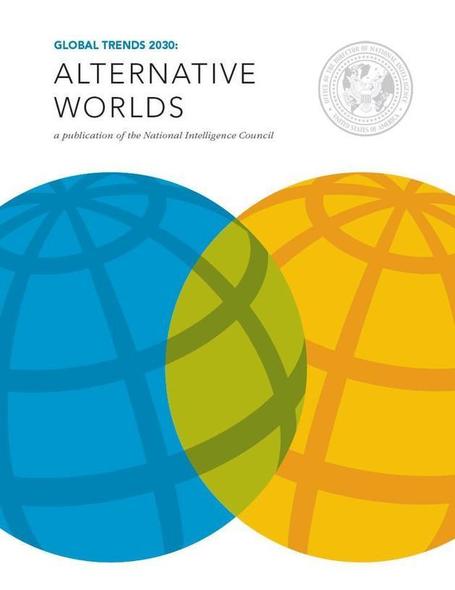
Even where there are safety nets, ever larger numbers of people displaced by technology is an issue I don’t think any nation has started to address.  In December, I discussed a report by the National Intelligence Council called Global Trends 2030:  Alternative Worlds. The report’s most definite conclusion was that the next 18 years will usher in more rapid change than anyone living has ever seen.  Summing up the findings, NIC Chairman, Christopher Kojm said:

“We are at a critical juncture in human history, which could lead to widely contrasting futures. It is our contention that the future is not set in stone, but is malleable, the result of an interplay among megatrends, game-changers and, above all, human agency. Our effort is to encourage decision makers—whether in government or outside—to think and plan for the long term so that negative futures do not occur and positive ones have a better chance of unfolding.”

I recommend Orkinpod’s post, which asks important questions “for the long term, so that negative futures do not occur and positive ones have a better chance of unfolding.”


Economic imaginings

The key aim of this blog, as stated on my “About” page, is to look at “the reality in our fantasies and the fantasy in our realities.”  The phrase was inspired by James Hillman, who used the word “fantasy” to suggest how imagination and the unconscious always elaborate “literal” facts.

These days, nothing seems more literal than “the economy.”  Its worldwide meltdown has caused and continues to cause untold suffering.  The suffering itself is not imaginary – losing a job or a house is all too real.  The fantasy, as Hillman used the term, is found in the fears that keep us up at night.  It’s lodged in the sharply differing stories we hear of what caused the crisis, who is to blame, how bad it is, and what we should do to fix it.

I want to share the best account I’ve ever heard of our impasse.  It’s a story of cause and  effect that reaches back two centuries.  It’s an account by Dr. Richard Wolff, Professor Emeritus of Economics at the University of Massachusetts, who was a guest on Moyers & Company on Feb. 22.

Dr. Richard Wolff on Moyers & Company

Dr. Richard Wolff on Moyers & Company

In an earlier lecture, ca 2008, Capitalism hits the fan, Wolff presented an historical framework to allow us to understand “how big, how serious, how profound” our current crisis is.

For 150 years, from 1820 to 1970, wages increased across every decade in America.  Wolff believes this is unique in the history of the world.

America was blessed with unimaginable riches – minerals, timber, water, and millions of acres of farmland (after the native populations were killed or contained).  Immigrants poured in from all over the world to work in factories and build railroads, convinced that their sacrifice could provide a better future for their children.  For a century and a half, they were right.  This gave rise to the myth of American Exceptionalism, the conviction that we as a nation are unique and this is our birthright.

Collectively, we began to measure our worth and success by this standard, but it failed in the mid 1970’s.  Inflation adjusted wages peaked around 1973.  There are four reasons according to Wolff.

  1. Beginning in the ’70’s, computer technology began to eliminate millions of jobs.
  2. The practice of exporting jobs and entire industries began.
  3. Huge numbers of women entered the workforce.
  4. Successive waves of immigration came to America’s shores.

The combination of many more applicants for fewer jobs held wages in check and has continued to do so.  Americans tried to compensate by sending more people out of each home to work and by working longer hours.  By 2000 we were working 20% more hours than we had in 1970 (why else invent fast food, Wolff asks).  When that didn’t work well enough, we went on a borrowing binge to prop up our “standard of living,” often in the form of credit card debt, at 18% interest.

Forty years later, according to Wolff, we have a working class that’s exhausted, with collapsing personal lives and the anxiety of “a population whose average level of debt exceeds its annual income.”  

With a workforce unable to carry more debt or work any harder, “We have reached the limits of this kind of capitalism,” Wolff says.  “That’s why our current crisis is not temporary.  It’s not a blip.” 

Photo by Ann Douglas, 2010.  CC by-NC-SA 2.0

Photo by Ann Douglas, 2010. CC by-NC-SA 2.0

The same period of stagnant wages saw an unprecedented bonanza for business.  Flat wages plus technology driven leaps in productivity delivered all time record profits.  Along with multi-million dollar compensation for upper management, more and more corporations got into the business of credit, and this, says Richard Wolff, is the key to understanding our economy over the last 30 years.  General Motors, for instance, made more money from interest in loaning people money to buy cars than it did making cars.

Banks and corporations began to loan workers the money they no longer paid them, and this is the system, says Wolff, that is now imploding.

Our leaders don’t know how to fix it.  Traditional economic measures, from stimulus to bailouts to regulation to austerity have been tried before.  They were tried by two administrations during the ’30’s without much success – it took a world war to end the depression.  These tactics have also been tried in Japan since 1989 with disappointing results.

What are the possible solutions?  Wolff does not propose any concrete answers but simply offers one alternative model, based on the cooperative structures pioneered by some Silicon Valley startups.  He claims such a structure offers a better hope of leading toward renewal than any other suggestions of which he’s aware.

“If we don’t take basic steps of this sort, to deal with a crisis that has built over this length of time; if we keep tinkering at the edges with our financial system, because we need to call this a financial crisis, rather than a crisis of capitalism, which is what it is, we will all be very sorry.” – Richard Wolf.

***

Work is a critical elements of our lives, one of the key factors of wellbeing or its lack.  As such, it is rife with fantasy and arouses huge passions.  Our current political climate of rancor makes that clear.  None of our other issues cause such concern.  What happens when the solutions offered by both political parties fall short?

Photo by windsordi, East Detroit, 2012.  CC By-NC 2.0

Photo by windsordi, East Detroit, 2012. CC By-NC 2.0

In last week’s interview with Bill Moyers, Wolff suggested that the nation as a whole is like the proverbial deer caught in the headlights. He went on to say, “if my psychiatrist wife is right, as she usually is, what happens after that period of stasis, of shock, is a boiling over of anger, as you kind of confront what has happened. And that you were deceived and betrayed in your expectations, your hopes. And then the question is, where does that go?”

Best case, he says, we begin to ask questions about the system as a whole: “I think there’s a wonderful tradition here in the United States of people feeling that they have a right, even if they don’t exercise it a lot, to intervene, to control. There is that democratic impulse. And I put a lot of stock in the hope that if this is explained, if the conditions are presented, that the American people can and will find ways to push for the kinds of changes that can get us out of this dilemma. Even if the political leaders who’ve inherited this situation seem stymied and unable to do so.”

If he’s right, this is the place for fantasy, the place for imagination to plumb the sea of possibilities to bring up something that works in a new world in a new century.

Change is the only constant

That’s what they say in the tech industry.  That’s what Buddha said 2600 years ago.  And that’s what the National Intelligence Council says in a 140 page report, “Global Trends 2030: Alternative Worlds.”

Click for the text of the whole report

Since 1997, the NIC, formed of all 16 US intelligence agencies, has issued five Global Trends reports, one after each presidential election.  For this one they engaged think tanks, government, and business leaders in 14 nations and concluded that the world will be radically different in 18 years.  The pace of change will be faster than at any period in modern history.

NIC Chairman, Christopher Kojm, says:
“We are at a critical juncture in human history, which could lead to widely contrasting futures. It is our contention that the future is not set in stone, but is malleable, the result of an interplay among megatrends, game-changers and, above all, human agency. Our effort is to encourage decision makers—whether in government or outside—to think and plan for the long term so that negative futures do not occur and positive ones have a better chance of unfolding.”

Here is a link to a summary of the report. ww.bloomberg.com/news/2012-12-10/u-s-intelligence-agencies-see-a-different-world-in-2030.html

The NIC defines “megatrends” as scenarios likely to happen under all circumstances.  “Game-changers” are “critical variables whose trajectories are far less certain.”  Additional possibilities are listed as “black swans,” discrete events that would cause large scale changes, either for good (a democratized China or a reformed Iran) or ill (global pandemic, WMD attack).

The report identifies four megatrends, changes regarded as inevitable over the next two decades:

  • Diffusion of power:  The US will lose it’s international dominance, but no other nation will take its place.  “Power will shift to networks and coalitions in a multi-polar world.”  Though the report didn’t say it, as a student of World War I history, I have to observe that the last time the world was structured this way, things did not turn out very well.  The report identifies one best case scenario as a new era of US/Chinese cooperation.
  • Individual Empowerment: A rising middle class in emerging nations, increased access to education, widespread use of technology, and health care advances can improve the lot of large numbers of people. The report notes that technology is two edged sword: it can benefit and disrupt.  Advances sometimes create and at other times eliminate jobs.  Technology fosters communication but also  leaves infrastructure vulnerable to cyber-attack.
  • Demographic Change: World population will grow from 7.1 to 8.3 billion, and 60% world will live in cities (it’s 50% now).  This will strain resources and increase pollution. Aging populations may slow economic growth in developed nations. Immigration will increase.
  • Food, Water, and Energy Shortages: In 18 years, the world will need 35% more food and 40% more water.  Our intelligence agencies don’t waste time pretending climate change isn’t real.  They note that conditions like widespread drought have grown more severe in just the 18 months they’ve been working on the report.

National Geographic issue on extreme weather, published one month before Superstorm Sandy

Rather than summarize more of the report, I invite readers to check it out for themselves.  Let’s step back and reflect on what this means.

My dogs do not like change.  They find comfort in their routines, and if I am honest, so do I.  This month a 72 year old hardware store, where you could find anything, closed it’s doors.  So did a 76 year old nursery, where master gardeners could always diagnose the ugly brown spots on your roses.  That’s enough to put me in a funk, imagining our big box future, and yet this is nothing compared to what Global Trends 2030 suggests is coming – change at a faster rate than anyone living has seen.

Change that rapid generates fear.  Looking at the last decade, we see resistance to change spawning violence.  Religious fundamentalists are more vocal in nearly all denominations.  Reactionary politicians grasps at some idealized past that is gone if it ever existed.  The urge to get what is mine at all costs further disrupt economic life and generates even more fear.  People bemoan the loss of civility.

Do we have any guides for living through times like these?

As I asked myself the question, I remembered Joseph Campbell’s assertion that world mythology holds wisdom for all the turns that life can take.  And Marie Louise Von Franz, Jung’s closest colleague, said that fairy tales offer the “purest and simplest” expression of “the basic patterns of the human psyche.”  Do stories created by people who traveled by foot and ox cart really have something to teach us in the 21st century?

I believe they do.  Next time we will consider what the old stories may say about living through difficult times.

I’m not a real active Facebook user, but even I have recently scratched my head at posts on my newsfeed from entities I’ve never liked or friended. Maggie has the answer – “sponsored stories,” a newly implemented FB practice that allows pages to pay-for-“reach.” And here we naively thought all posts were created equal – HA! Show ’em da money! – Morgan

Maggie O'Toole's avatarMaggie (Not Margaret)

Or, Sponsored Stories are Bad News for Facebook Users

Recently, my Facebook reach has been rather down.  What, I’m I suddenly not as interesting?  Are my pictures not as good?  My posts not as funny?  Although Facebook doesn’t provide individual users with stats about their posts’ engagement and reach, I can tell you what my graph would look like – like a plane crashing from 30,000 feet.

For a while, I was thinking that this was a personal problem – that I’d been so fussed on school and work that I’d let my social media presence slip.  I didn’t even want to think about my Klout score.  Then friends started mentioning that they were experiencing lower engagement, as well.  I started seeing, “Hello, can anyone see this?” posts.  Then I noticed that the same problem was happening on the pages that I admin.

View original post 539 more words

The Limits of Power: The End of American Exceptionalism by Andrew Bacevich – A book review

Anyone paying attention knows that our nation has lost its way, but that’s where clarity ends.  How and when did we go wrong?  Sometimes I wish I could read the histories that will be written a hundred years from now, after time has lent perspective to the chaos of current events.  Thanks to Andrew Bacevich, we don’t have to wait for at least one piercing analysis.

Bacevich, a Viet Nam veteran, retired as a colonel after 23 years in the army.  He holds a PhD in American Diplomatic History from Princeton and taught at West Point and Johns Hopkins before joining the faculty at Boston University in 1998.  In March, 2007, he described the US doctrine of “preventative warfare” as “immoral, illicit, and imprudent.”  Two months later, his son died in Iraq.

Andrew Bacevich

In The Limits of Power, published in 2008, Bacevich steps back to examine our history from WWII to the present, to look at the root cause of the folly that has made constant warfare, with its huge cost in lives and resources, our norm.  Foreign policy and domestic policy are wedded together, he says.  Despite political rhetoric, our seeming state of perpetual warfare is not simply the result of international villains like Slobodan Milošević, Saddam Hussein, or even Osama Bin Laden.  To blame them, he says, is like “blaming Herbert Hoover for the Great Depression or…attributing McCarthyism entirely to the antics of Senator Joseph McCarthy.”  Foreign policy has become “an expression of domestic dysfunction.”  Bacevich pulls no punches, and pinpoints the nature of this dysfunction in the title of his first chapter, “The Crisis of Profligacy.”

“For the majority of contemporary Americans, the essence of life, liberty, and the pursuit of happiness centers on a relentless personal quest to acquire, to consume, to indulge, and to shed whatever constraints might interfere with those endeavors.”

Bacevich says the critical, though seldom acknowledged, turning point was bookmarked by two presidential speeches.  The first was President Jimmy Carter’s so-called “malaise” speech, though he never used the word.

The seventies was a decade of severe economic shocks that saw the first oil crisis, a stock market meltdown, and our transition from a producer to a consumer economy.  On July 15, 1979, Carter said the real crisis was not what OPEC was doing to oil prices, but our way of life, which makes us depend on foreign oil.

“In a nation that was proud of hard work, strong families, close-knit communities and our faith in God…too many of us now tend to worship self-indulgence and consumption.  Human identity is no longer defined by what one does, but by what one owns.  But we’ve…learned that piling up material goods cannot fill the emptiness of lives which have no confidence or purpose.”

To continue down that road, Carter said, was “a certain route to failure.”  He urged a renewal of national purpose, characterized by national restraint and an effort to find and develop alternative energy sources.  The main effect of his speech was to provide ammunition to his political opponents.  Republican presidential candidate, Ronald Reagan, in his “morning in America” speech told us there were no restraints.  The energy crisis was the government’s fault.  The solution was to reduce federal spending and cut taxes.

In an effort to salvage his re-election prospects, Carter adopted a pugnacious tone, articulating the “Carter Doctrine” in January, 1980.  He said the nation would “use any means necessary, including military force,” to prevent any other power from dominating the Persian Gulf.”  Sadly, this endorsement of American imperialism rather than his earlier call to fiscal and moral balance is what guides our politicians to this day.  It isn’t hard to see why.  In the 1980 presidential election, Carter won just four states, while Reagan carried 48.  No one in Washinton missed the message:  the way to get elected is to pander to our illusions, to suggest that our credit is infinite and the bills will never come due.

In 1983, President Reagan proposed his “Star Wars” missile defense shield, implying that our national security and way of life were wedded to military superiority.  “Defense is not a budget item,” he said.  George Bush didn’t think so, nor do this year’s presidential candidates.  The President criticizes the Ryan budget for draconian cuts to key domestic services, but says nothing about its huge uptick in military spending – perhaps because for Democrats too, “defense is not a budget item.”

Bacevich articulates solutions akin to Carter’s – an end to the fool’s errand of trying to reshape the world in our image and an effort to set our own house in order.  He cautions that expecting those in power to adopt such a course of action is like expecting the CEO of a major car company to lobby for public transportation – there’s too much power and money vested in the status quo. Among other suggestions, he says:

“No doubt undertaking a serious…national effort to begin the transition to a post-fossil fuel economy promises to be a costly proposition.  Yet…spending trillions to forcibly democratize the Islamic world will achieve little, while investing trillions in energy research might actually produce something useful.” 

Technical innovation has been an American strongpoint, from the Mahattan Project to the space race, to the digital revolution.  In contrast, our efforts to reshape other cultures has been rather dismal.

If a change of course is possible, Bacevich does not think it likely.  Throughout his book, he quotes Reinhold Niebuhr, a pastor, theologian, and author who wrote between 1930 and 1960.  He gives us this quote by Niebuhr:

“One of the most pathetic aspects of human history is that every civilization expresses itself most pretentiously, compounds its partial and universal values most convincingly, and claims immortality for its finite existence at the very moment when the decay which leads to death has already begun.”

The Limits of Power is a disturbing book to read, but one I can recommend to everyone who prefers hard truth to subterfuge and lies.  For a more recent look at Andrew Bacevich and his ideas, I recommend this interview, conducted in March, on “Moyers and Friends:” http://billmoyers.com/episode/moving-beyond-war/

As they say in 12 step programs, admitting there is a problem is the first step toward a solution.

Bill Moyers on “The Cowardly Lions of Free Speech”

Here is Bill Moyers’ response to the recent Supreme Court decision not to revisit Citizen’s United.  Check out the full clip, which only runs 6 1/2 minutes.

Three things don’t go together: Money. Secrecy. Democracy. And that’s the nub of the matter. This is all a sham for invalidating democracy in the name of democracy. It’s the trick authoritarians always use to hide their real intention — in this case absolute power over our public life and institutions: the privatization of everything. The Supreme Court is pointing the way. Instead of mitigating the worst excesses of both the state and the private sector, the Court has taken sides. Saying to the massed wealth of the one percent: America is yours for the taking, for the buying.
http://billmoyers.com/

There really is nothing to add to something so shameful and tragic.