Of Greensleeves and Christmas Carol Karma

Regular readers will recall that at the start of the  season, I posted a wee diatribe on how much I hate what passes for Christmas music in most of the stores. http://wp.me/pYql4-1tv

Here’s where karma part comes in:  Mary is organizing a Christmas dinner for a large number of people at a local church.  I already volunteered to help with food prep, but the other day she gave me a further assignment.   “I need you to make a three hour playlist of Christmas music, and it has to be respectful.”

That actually is not a problem.  I love Christmas music – if I didn’t, the stuff in the stores wouldn’t bother me.  As I started to rummage through what I have on iTunes, I got caught up in listening to various versions of “Greensleeves,” and wondering – even though I love the song – what it has to do with Christmas.  Tracking its origins was not unlike researching a folktale.  I also found that everyone from Homer Simpson to John Coltrane has covered it, so I invite you to have a listen as I share a bit of what I learned about this haunting song.  Let’s begin with Homer (relax – his clip is only 14 seconds long).

Greensleeves is a traditional English folksong, of the sort known as a “romanesca.”  A broadside ballad of this name was registered at the London Stationer’s Company in Sept., 1580, as “A New Northern Dittye of the Lady Greene Sleeves”.  A broadside was a ballad or poem, printed on one side of a cheap sheet of paper and common between the 15th and 19th centuries.  Here is a traditional version, sung by Méav Ní Mhaolchatha’s on the Celtic Woman tour:

There’s a persistant rumor that Henry VIII wrote the song while courting Anne Boleyn, since at first she apparently “cast [him] off discourteously,” but music experts dismiss the legend.  Greensleeves is an Elizabethan song, composed in an Italianate style that did not reach England until after Henry’s death.

Another common interpretation is that the song refers to a promiscuous woman or a prostitute.  At the time, the color green had sexual connotations.  One translator of Chaucer notes that in the Canterbury Tales, green “was the colour of lightness in love.”  I tend to agree with this interpretation based on what I know of pre-Christian nature religion in the British isles, and the Pan-like “Green Man,” whose face still peeks out at worshipers in many British churches and cathedrals:

Green Man at Dore Abbey, Herefordshire

A reference to Greensleeves in The Merry Wives of Windsor, 1602, suggests both the popularity of the song, and coming from Falstaff, a bawdy interpretation.  The popularity of the song has continued unbroken to the present day.  Here my favorite modern interpretation, by Jethro Tull:

In 1865, William Chatterton Dix wrote “What Child is This,” to the tune of Greensleeves, which made both songs popular during the Christmas season.  Here is the version I’m going to use for the Christmas dinner project.  Josh Groban knows how to stir the soul, and that is something we really need this year.  Elizabethan renditions of Greensleeves have historical interest but tend to be slow and even lugubrious.  Much as I love ballads of trials and woe, this year we need all the hope we can get and the kind of music that can awaken it.

***

I wish each and every one of you a joyous holiday in whatever way you celebrate it.  I’m going to take a blogging break for a week or so, to walk, to read, to meditate, to catch some of the great year end movies, and in general, to simply kick back for R&R.  I will be back right around the new year.

Peace to all of you!
Great Info on Charles Dickens From a Reader

I enjoy all the comments I receive, and sometimes they lead me down the trail to another post. One like that came in this morning, when blogger, Nixy43 (aka, Helen Nix) left a note on my recent post, Humbug Revisited:  http://wp.me/pYql4-1sF.

Ms Nix, a Londoner, is compiling a detailed list of 1000 interesting things to do in London for less than a tenner.  Any idiot can enjoy London on a large bankroll, she says, but it’s not so easy for the frugal tourist or people who live there.  She sent me a link to her marvelous post, “Thing 86:  Enjoy a literary evening at Foyles and bond with Dickens at Christmas.”  http://wp.me/p1I6Mp-5m

There is much information about Dicken’s, about changing attitudes to Christmas when he wrote A Christmas Carol, and links to much information about this classic.  London is gearing up for an all out celebration of Dicken’s in 2012, the 200th anniversary of his birth, so if there is any chance you will visit next year, this post is a must.

Stop by, enjoy the story, and thank Helen for posting it!

Charles Dickens

Music (?) of the Season

Caution: entering Grinch zone.

Silence makes a lot of people uncomfortable, so in stores, you often hear music intended to be soft and inoffensive.  Most of the time, it’s pretty innocuous.  Now and then the muzak version of “Light My Fire” will force me to confront the passage of time, but that isn’t really a bad thing.

So why do stores at this time of year feel compelled to play the musical equivalent of leaf blowers on a Saturday morning?  I’m talking about all the denatured “Christmas” songs, the fluff ones, the ones designed not to offend, which wind up offending everybody because they are so insipid.  Do you like hearing, “Jingle Bell Rock?”  Or “Rocking around the Christmas Tree?”  If so, post a comment.  I probably won’t believe you and will assume you’re pulling my chain, but comment anyway.  Pa rum pum pum pum.

Today I ventured out to several stores, and I’ll share some of my findings.  My current working hypothesis is that stupid music confuses our brains and makes us less rational shoppers.  Let’s see how the data holds up.

First stop was JC Penny’s.  I like Penny’s, and they also shot up in my esteem for opting out of the Black Friday midnight madness.  I was hunting for a specific gift.  When I didn’t find it, I thought about browsing, but just then, “Holly Jolly Christmas,” came over the sound system.  I hurried for the exit.

Next I went to a Best Buy.  I went to look at DVD players and noticed there was no music at all – I could actually hear myself think!   In the end, I wasn’t sure which model to get, so I decided to think it over and come back later.  As I was leaving the store, after that moment of clarity, I began to wonder if that is not the point of obnoxious holiday music – to befuddle our minds and rob us of clarity?  What happens to your brain when you hear “Little St. Nick?”  All I can think is, “Make it stop,”  and I’m ready to throw down a credit card if that will do the trick!

Next stop was OSH, for a string of tree lights. No Christmas songs, for which they get kudos, but their music was equally strange – the worst of old time rock, with songs like, “Sugar Shack,” and “These Boots are Made for Walking?” I did as the lyric suggested and walked right out of there.  The strange thing is, I go to OSH throughout the year for minor hardware needs, and they never play music like that.  What possessed them to do it now?

That question launched my backup theory of holiday music – mass possession of store managers by evil entities.  Perhaps I should save that one for another occasion…

By then it was time for lunch, so I stopped at Fresh Choice, one of those make-your-own-salad restaurants.  I like eating there, but never again at this time of year!  The music was one part Dean Martin – Christmas songs you could tap dance to – and one part “The Little Drummer Boy,” which played twice while I was there.  Twice!!!  I am not making this up!

After I bolted my food and hurried out of the restaurant, I remembered the New Age adage that we attract to ourselves what we dwell upon. I did my best to clear my mind before my final stop of the day, at Beverly’s, a crafts store.

However you want to explain it, something worked.  Not only did I find exactly the gift I was looking for, but the music was nice instrumental Christmas songs.  I caught the sound of a harpsichord as I stood in the check out line, and I made a point of telling the clerk how much I enjoyed their civilized music.

So here are a few more Grinchly survival tips for the season, not necessarily in order of importance:

1)  Humor is everything.  Actually, this is number one in importance.

2)  If someone is doing something right, let them know.

3)  Earbuds are not a bad idea.  You may look silly if you’re not a teen, but I’m going to carry them next time.

I’ll be back with more tips as the season drags on, but meanwhile,  Be careful out there!

Humbug Revisited: A Brief History of Christmas

It’s coming on Christmas
They’re cutting down trees
They’re putting up reindeer
And singing songs of joy and peace
Oh I wish I had a river I could skate away on
– Joni Mitchell

I can’t get the name of Walter Vance out of my mind.  He was the 61 year old pharmacist, with a history of heart problems, who collapsed in a West Virginia Target store shortly after midnight on Black Friday.  Witnesses told MSNBC that many shoppers ignored Vance and walked around or even stepped over him as he lay on the floor.

When NPR held a call-in show to ask about listeners’s Black Friday shopping experience, one caller reported that a woman had grabbed an item out of her cart, saying, “It isn’t yours until you’ve paid for it.”  The incident mirrors a scene in a commercial that ran incessantly in the days leading up to the event.

Sales receipts were no guarantee of safety either – just ask the shooting victims in several parking lot robberies.

Exhausted after an all-night shift, one Target employee drove her car into a canal.

All of these reports emerged after the infamous pepper spray story that had the media wagging its head – the very same media that helped whip crowds into a feeding frenzy during the previous days

None of this is new.  Christmas has always been the church’s most problematic holiday.  The Hallmark version we know today was in part, carefully crafted by early 19th century merchants, in a manner not different in essence, from the effort to persuade millions of seemingly sensible people to spend Thanksgiving night in big-box stores.

Santa Claus by Thomas Nast, 1865. Would you want this guy roaming around your home late at night?

The Bible does not give a date for the birth of Jesus.  Apparently, birthdays were not a big issue back then.  Origen of Alexandria, a 3d century theologian, wrote that “only sinners like Herod and Pharaoh celebrate their birthdays.”  December 25 was not fixed as the date of Christmas until the 4th century, and the nativity was largely ignored until the 9th century reign of Charlemagne.

Through the early middle ages, Christmas was overshadowed by Epiphany, which commemorates the visit of the Magi.  It was not until the high middle ages that Christmas emerged as a popular feast day.  “Feast” is an understatement.  In 1377, Richard II’s guests consumed 28 oxen and 300 sheep.  Caroling became popular then, though chroniclers complained of lewd lyrics.  The same writers blamed pagan holidays like Saturnalia and Yule for the “drunkenness, promiscuity, and gambling,” of the celebrations.

In 1645, in an effort to rid England of decadence, Oliver Cromwell and his Puritans banished Christmas in England.  The Pilgrims on the Mayflower were even stricter.  From 1659-1681, Christmas was outlawed in Boston.  English customs were shunned after the revolution, and Christmas did not become an official American holiday until 1870.

We can read on history.com that, “The early 19th century was a period of class conflict and turmoil. During this time, unemployment was high and gang rioting by the disenchanted classes often occurred during the Christmas season.”  The New York City police force was organized in 1828 in response to a Christmas Riot.  History.com continues:   “This catalyzed certain members of the upper classes to begin to change the way Christmas was celebrated in America.”  

In the absence of television, one thing 19th century chambers of commerce used to push their version of Christmas was Washington Irving’s, The Sketchbook of Geoffrey Crayon, a series of stories of life in an English manor house.  “The sketches feature a squire who invited the peasants into his home for the holiday. In contrast to the problems faced in American society, the two groups mingled effortlessly.”  Historians now claim the book does not describe any actual customs, but ones that Irving wished for and thus invented.  

Even more important to the evolution of Christmas was Charles Dickens’s, A Christmas Carol, with its strong message that celebrating this holiday can make you a better person.  Dickens’s book meshed with the Victorian emphasis on family , as well as a new appreciation of children.

Referring to the 19th century upswing of Christmas popularity, history.com says: “Although most families quickly bought into the idea that they were celebrating Christmas how it had been done for centuries, Americans had really re-invented a holiday to fill the cultural needs of a growing nation.”

The optimism of “a growing nation” that we see in historical prints and Christmas cards seems as quaint these days as the cards themselves.  For a sense of the collective mindset this year, I look at this photo of students at the Charles W. Howard Santa School in Midland, MI.  This year the Santas are learning to gently lower children’s holiday expectations.

Photo by Fabrizio Constantini, New York Times

I wonder what Santa said to the boy who showed up with a multi-page spreadsheet, cross referencing all the toys he wanted to different stores and prices. (What was he doing on Santa’s lap to begin with)?

***

Even a little research reveals that there is no “right” way to celebrate Christmas.  This holiday has been re-invented numerous times.  If individuals and families opt out of what no longer works and try to create saner traditions, no one will ever miss them.  I’ll go ahead and lead off with a clip from my favorite Christmas movie of all time, in the scene that inspired this post, and leads me to wonder if the pre-repentant Scrooge isn’t due for re-evaluation.

Meanwhile, Be Careful Out There, and in case you were wondering, I’m off to see the new Muppet Movie today.  I’ll soon be back with a report.

Be Careful Out There: Shopping Rage

The title of this post is taken from the sergeant who read the daily assignments on the ground-breaking, 80’s cop show, “Hill Street Blues.”  Every day he would warn his people, “Be careful out there!”

Sadly, the same caution may be needed this year by holiday shoppers, after an incident in southern California that police are calling, “competitive shopping rage.”  At 10:20 pm on Thanksgiving night, shoppers were lining up in the Porter Valley Walmart to purchase discounted Xboxes, when a woman began pepper spraying them “to gain a shopping advantage.”

Ten people were treated for pepper spray, and ten others for bumps and bruises suffered in the confusion.  The assailant got away, and it isn’t clear if she scored an Xbox.  The store is going through register receipts to see if she left a credit card trail.  The woman could face felony battery charges if apprehended.  We all should be thankful she didn’t bring a gun.

I really want to condemn something or someone for this insanity, but that would be false.  A better question would be, how am I complicit in the greed that has come to surround the birthday of the Prince of Peace?  And to reference my previous post on Andrew Weil, how happy is this kind of grasping likely to make someone on Christmas morning?

In Flanders Field the Poppies Blow

At 11:00am, on the 11th day of the 11th month of 1918, the insanity of the First World War came to an end. Though the United States holiday was renamed to Veterans Day after World War II, it is still known as Armistice Day in France and Belgium. It is known as the Day of Peace in Flanders Field, where many of the dead from the western front are buried and one of the most famous poems of this war or any war was written.

Poppies near the Connaught British cemetery on the western front

Poppies are an annual, summer-blooming wildflower whose seeds are carried on the wind.  They can lie dormant for a long time but will bloom if the earth is disturbed – as it was, of course, during the years of trench warfare.  In many parts of the line, in the summers of 1915, 1916, 1917, and 1918, the little poppies shone as the only symbol of life amid the devastation of no-mans land.

In May, 1915, Major John McCrae, a Canadian military doctor and artillery commander, noticed the poppies growing in the disturbed ground between the graves that surrounded his artillery position near Ypres.  When the chaplain was called away, McCrae was asked to conduct the burial service for a friend.  We think he began his famous poem that evening.

In Flanders fields the poppies blow
Between the crosses, row on row,
That mark our place; and in the sky
The larks, still bravely singing, fly
Scarce heard amid the guns below.

We are the Dead. Short days ago
We lived, felt dawn, saw sunset glow,
Loved and were loved, and now we lie
In Flanders fields.

Take up our quarrel with the foe:
To you from failing hands we throw
The torch; be yours to hold it high.
If ye break faith with us who die
We shall not sleep, though poppies grow
In Flanders fields.

***

***

Even more than McCrae’s poem, Armistice Day / Veterans’ Day brings to mind a song by the Scottish musician, Andy Stewart.  His song, “Young Jimmy in Flanders,” commemorates his uncle James who served as a piper during the war, and miraculously survived.  More than any other picture or poem or story, this ballad evokes for me the terrible sadness and anger at this conflict where boys playing bagpipes led troops against machine guns and poison gas:

He played his pipes to battle,
and the laddies died like cattle,
and the brandy was drunk in Whitehall,
a million miles away.

This song is recorded on Stewart’s fine album, “Fire in the Glen,” 1991.

http://www.youtube.com/watch?v=y-IhN7IVQdk

An Interlude with Mutant Chickens

The other day, I took a break from literary activities to meet a friend in Fair Oaks Village for coffee.  Once upon a time, Fair Oaks was a farming community, separated by miles of fields and orchards from Sacramento.  Those days are gone, but there’s still something inviting about the town.  It’s slower than the boulevards and mini-malls that surround it, but not yet gentrified.  That may have something to do with the chickens, but I will get to that.

Fair Oaks Coffee Shop and Deli

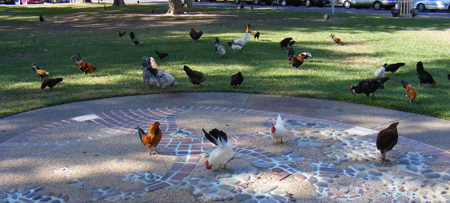
So my friend were I are sitting at a table outside, having coffee and waxing eloquent on matters of great import, when I spotted a mutant chicken pecking at the pretzel I’d dropped on the sidewalk.  If you really pay attention, even normal chickens are sort of scary; you can understand the theory that they descend from dinosaurs.  Watch them run around, and you think of mini-velociraptors.  Yet chickens are the official Fair Oaks bird.  Herds of them run loose in town, and they are even featured on the town sign.

Once, when our dog, Holly, was younger, she jerked her leash out of my hand and took off after a chicken. By the time I caught her, thinking I was about to burst a lung, an irate citizen informed me that chickens are protected.  I believe I said something along the lines of, “Come on, Holly, we’ll hunt for dinner elsewhere.”

Fair Oaks is famous for chickens, and I have it on good authority that people throughout the region come here to dump their excess fowl.  What you have is a group of birds that interbreed, and every now and then you see a really demented one, who could play in a monster movie.  Such was the one who pecked at my feet the other day.  It had some kind of growth, like the extra head on the alien in Men In Black II.  I was so busy thinking of tetanus shots and keeping my feet out of its way, that I forgot the camera phone in my pocket and didn’t document the monster.   Today I went back with a real camera, and naturally all the chickens looked normal – or as normal as chickens can look.

Here’s the Fair Oaks chicken ideal:

Mural on the Fair Oaks, open air theater

And here’s the reality – chickens invading the public men’s room:

Employees must wash their hands before returning to work

The ideal – an idyllic shot in the town square

Don’t be fooled! Think of Alfred Hitchcock.

The real – high noon in roosterville.

Go ahead – make my day.

And finally, here is the biggest Ideal Chicken of all – at the 2010, Fair Oaks Chicken Festival:

Has everyone had a chance to go, “Awwww?”  If you can make it, this year’s Chicken Festival will be held on September 17.  Feel free to bring the munchkins, but be ready to change the subject if they ask, “What’s for lunch?”  Last year, the featured item was barbecued chicken.  (I’m serious).

Have fun if you go.  I would never dream of saying anything on my blog about eating Big Bird, but I will be home that day eating tofu.  Probably with the shades drawn too, in case the mutant chicken knows where I live.

The Freedom Index

Actually, there is no Freedom Index, except in my possibly fevered imagination.  The idea came from reading the WordPress Daily Post, “What Does Freedom Mean?”  That’s a good question to think about.  It is very hard to answer, which makes it interesting.

All of the obvious answers lead you in circles.  Millions of people in these troubled times long for the freedom that work brings, but that reminds me of all the five dollar bills I tossed into lottery pools at work.  I’m guessing that nearly all working stiffs sometimes dream of winning the lottery and achieving that sort of freedom – even though lots of studies show that a year later, most winners are no higher on the Happiness Index (which really exists).

News reports are always full of threats to our freedom, often couched in words of blame for someone else.  Still, on a hypothetical Public Freedom Index, things could be a lot worse.    We can watch fireworks if we choose – or not, since we don’t have mandated public celebrations.  The explosions tonight will be for fun; we live free of the threat of real bombs.  We can can blog and tweet to our heart’s content, and Google on a staggering array of topics.

Personal Freedom is always a little more dicey.  We are still guaranteed “the pursuit of happiness,” but you have to wonder how most people would answer the Dr. Phil question:  “How’s that working for you?”

The Dalai Lama says all of us desire happiness and an end to suffering, but we really don’t know how to go about it.  Many of our choices lead to the opposite result.  Perhaps the freedom to ask – really ask – where our real happiness lies, is one of the greatest freedoms of all.  That and Freedom of Information which allows us to follow the trail where ever it leads.

Here is Buddhist blessing/prayer, known as The Four Immeasurables:

May all beings have happiness and the causes of happiness.
May all beings be free from suffering and the causes of suffering.
May all beings know the supreme happiness that is beyond suffering.
May all beings rest in equanimity, free from attachment and free from aversion.

Happy Fourth of July!