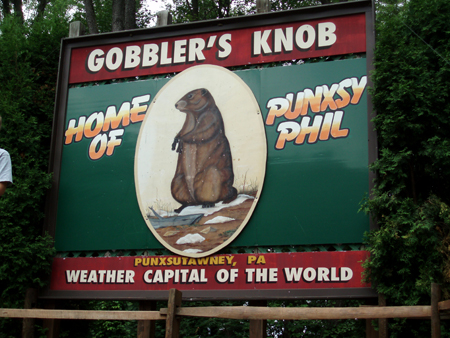
Phil sees his shadow!

Photo by Eddie~S, CC BY 2.0

Photo by Eddie~S, CC BY 2.0

In the key news event of the day, I’m sad to report that it was sunny in Punxsutawney, PA, spooking the groundhog and plunging us into another 6 weeks of winter.

This has not been a winter anyone wants to linger.  A mini-ice age threatens the east, while 11 western states are morphing into Death Valley.  And to add insult to injury, here in northern California, where legions of disgruntled football fans are settling in to watch those other teams play – all the while muttering that at least spring training starts soon – spring may be on hold!

So as the blues settle in like the overcast on this chilly, cloudy, but rainless day, only three suggestions come to mind:  (1)  book a flight to Hawaii, (2) drink some more caffeine, (3) watch a funny movie.

It just so happens that I have an idea for number 3:

"Don't drive angry!"

“Don’t drive angry!”

PostScript: For readers outside our borders, who may not get all my topical references, here is a brief glossary:

  1. February 2 is “Groundhog Day.”  When the groundhog emerges (most famously, Punxsutawney Phil, in Pennsylvania), if he sees his shadow, it will spook him and he’ll return to his burrow for another 6 weeks of winter.
  2. Here in the western US, where we have no groundhogs, it’s sometimes called Prairie Dog Day, but that hasn’t gained much traction in the media yet.
  3. Local sports fans are disgruntled because our beloved 49’ers were knocked out of the playoffs by the devil-spawned Seattle Seahawks.  No real rancor, although we hates them forever, my precious.

Let me know if I can be of any further assistance explaining my rant.

Final notes on the Grail and the Wasteland

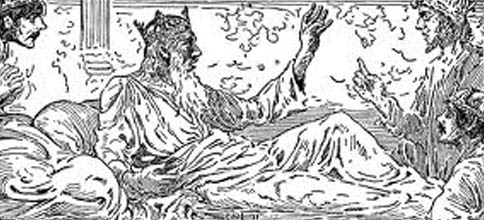
An ailing king lives at the heart of the Wasteland. We often find this figure in fairy tales, such as “The Water of Life,” where efforts to heal him launch the story.  Jungians interpret the king as the “dominant ruling attitude” of a culture or individual, which grows atrophied unless it is periodically renewed.

water of life king

In seeking a simple description of our own collective attitude, I thought of an often misquoted phrase spoken by President Calvin Coolidge in 1925: “The chief business of the American people is business.”  This attitude swept the world in the years since then and sheds much light on our current Wasteland with an ecosystem in crisis.  Sadly, few people know what else Coolidge said in that speech:  

“Of course, the accumulation of wealth cannot be justified as the chief end of existence…So long as wealth is made the means and not the end, we need not greatly fear it…But it calls for additional effort to avoid even the appearance of the evil of selfishness. In every worthy profession, of course, there will always be a minority who will appeal to the baser instinct. There always have been, probably always will be, some who will feel that their own temporary interest may be furthered by betraying the interest of others.” (1)

***

In the earliest versions of the legend, the king is healed when the hero asks this question:  “Who does the Grail serve?”  In these tellings, the Grail is a stone or a large platter that nourishes each person according to their heart’s desire.  This suggests a cornucopia, a potential earthly and spiritual abundance.  There have always been cycles of growth and cycles of famine, cultural florescence and decay.  In the legend, that question, “Who does the Grail serve?” appears to lie near the heart of these cycles.  Somehow we intuit that what Campbell termed “Greed for more  than one’s share” on a large scale is a formula for disaster.

***

In my two previous posts, I mentioned hearing many accounts of people seeking new ways of doing most everything.  I’ve collected so many stories it took several days figure out how to present them.  Simplicity won out in the end; here is one brief account, with more to follow in the future.

I’ve listened to Jill Stein on several occasions, most recently on BillMoyers.com in November, 2013.  Stein, a Harvard Medical School graduate, “became so outraged by how politics adversely affected her patients” that she ran as the Green Party candidate for president in 2012.

Naturally, she was not allowed to participate in the presidential “debates,” which don’t really deserve the name, but in 2012 she and Green vice-presidential candidate, Cheri Honkala, were arrested for simply trying to enter the debate hall.  “We were arrested, taken to a secret detention facility, and handcuffed to metal chairs for eight or nine hours until the debate was long over.”  
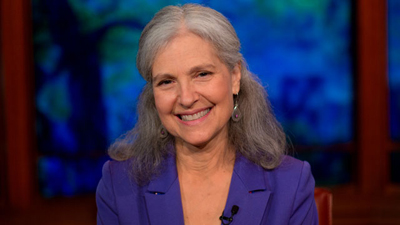
Jill Stein, 2012 Green Party candidate for president

Jill Stein, 2012 Green Party candidate for president

You’d expect her to be discouraged after this blatant violation of civil liberties, as well as a host of other abuses she cited during the interview, but she was not, saying instead that,

“America is ready to move. And when we start moving together…all we have to do is realize how numerous, strong and inspired we are. And then we are unstoppable. You know, in the words of Alice Walker, the biggest way people give up power is by not knowing we have it to start with. It’s by flicking that switch and rejecting the disempowerment that’s beaten into us every waking moment by every media source that surrounds us.”

I encourage everyone to watch the interview or read the transcript.  There much that was frightening but even more that was hopeful in this discussion of our current situation.  As time goes on, I’ll feature other optimistic stories I have collected, featuring “ordinary” people searching for those Grails that can transform and renew the world and the lives we are living.
In memory of Pete Seeger

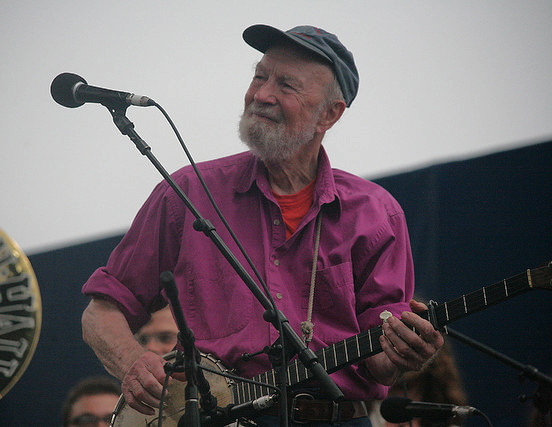
Pete Seeger, 1919-2014.  Photo by wfuv, Creative Commons

Pete Seeger 1919-2014. Photo by wfuv, Creative Commons

“The key to the future of the world is finding the optimistic stories and letting them be known.” – Pete Seeger, 1994

I was fortunate enough to hear Pete when he dropped by to play several informal concerts at the high school I attended during my sophomore and junior years.  Not even really “concerts” – they were too informal and intimate for that.  He sat on a folding chair with his banjo and sang, talked, joked and got us to sing along.  It should be clear to those who read this blog that I am not the sing along type, but it was different with Pete Seeger.

He had a presence, an authenticity, a naturalness that won us over.  He was instantly “one of us,” and this in an era when we said, and really believed, “Never trust anyone over 30.”  We had seen betrayal.  We knew what it looked like and felt like.  But Pete was one of us.  “We’re all in this together,” he seemed to say, “as brothers and sisters.”  You wanted to sing along, be part of a moment like that.

Just “small events” that I’ve never forgotten.  The memory jumped to mind when I heard that Pete has moved on from this world.  Our good fortune is that he gave us so many anthems to remind us that we are still in this together.

Cool water

“Cool Water,” a classic western song, was written in 1936 by Bob Nolan (1908-1980), a Canadian transplant to Arizona, who fell in love with the desert.  Nolan, an actor, poet, singer, and songwriter also wrote “Tumblin’ Tumbleweeds,” and is credited with the creation of “western music” as a distinct genre.

Bob Nolan in "The Lights of Old Santa Fe," 1944

Bob Nolan in “The Lights of Old Santa Fe,” 1944

“Cool Water” tells of a man and his mule, lost in the desert and beset with mirages.  The song has been widely covered by artists as diverse as Hank Williams, Marty Robbins, Joni Mitchell, Burl Ives, Johnny Cash, The Muppets, and Fleetwood Mac.

All day I’ve faced a barren waste
Without the taste of water, cool water
Old Dan and I with throats burnt dry
And souls that cry for water, cool, clear, water.

The song came to mind for obvious reasons last week:  Gov. Brown to declare California drought emergency.  Nobody here needs the newspaper to tell us we’re in trouble.  A glance at the brown lawns in January, and the American River, running lower than I’ve ever seen it at this time of year will do that.

My thoughts have been filled with many songs, stories, and images of water that I will be sharing here.  I was planning on writing a longer post today, but I never got past this clip of Marty Robbins’ version of “Cool Water.”

I first heard the song on my absolute favorite album as a kid, Robbins’ Gunfighter Ballads and Trail Songs.  Even though he’s kidding around with his friends (I think it’s a clip from “Hee Haw”), if you listen, it sounds like a prayer.  I think I’ll leave it at that for today.

Pope Francis on Economic Justice

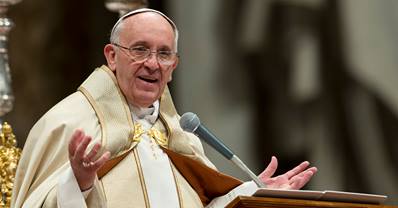
Pope Francis

“How can it be that it is not a news item when an elderly homeless person dies of exposure, but it is news when the stock market loses 2 points?” – Pope Francis (1)

On Tuesday, Pope Francis delivered a sharp rebuke of unfettered capitalism as “idolatry of money” that will lead to “a new tyranny.” (2)  His language was specifically directed at those in the United States who continue to defend “trickle-down economics,” which he said “has never been confirmed by the facts, [and] expresses a crude and naive trust in the goodness of those wielding economic power.”

“Meanwhile,” he said, “the excluded are still waiting.”

President Obama said he was “hugely impressed with the pope’s pronouncements.”  Nevertheless, on Wednesday, the US announced it will close its Vatican embassy as a “cost saving measure.” (3)  The seven embassy staffers will be retained, just moved beyond the borders of Vatican City, which is the world’s smallest sovereign nation.

Republican senators, many of whom still advocate the trickle-down policies the pope condemned, were quick to denounce the administration’s move as “a slap in the face to Catholic Americans around the country.”

Though I’m not a Catholic, I find myself deeply grateful on this day of thanks, for the current Vicar of Christ.  When politicians of all persuasions spend most of their time defending an increasingly dysfunctional status quo, it is refreshing and marvelous to find a world leader willing to speak the truth.


Trust and belated reflections on November 22

I was going to pass on adding my $0.02 to the discussions of the Kennedy assassination.  I have nothing to add concerning the event itself.  I am writing this post because of a comment I cannot get out of my mind:

“Like a tornado, the Kennedy conspiracy theories have spun off whirlwinds of doubt about other national traumas and controversies…The legacy of that shocking instant is a troubling habit of the modern American mind: suspicion is a reflex now, trust a figment.” – David Von Drehle in Time Magazine, Nov. 25, 2013

You can’t argue with Drehle’s conclusion, that suspicion of government is a reflex,  but when and how did it come about? I truly don’t remember it starting in Dallas.  People at the time expressed shock and grief, and everyone shook their head and said the killing of Lee Harvey Oswald was “pretty suspicious,” but no one I knew, and not a single history teacher I ever had, obsessed about the conspiracy like we do now.

I wonder if that’s a key – like we do now.  I wonder if the weight given this month to assassination conspiracy theories isn’t history revised in light of our current mistrust of government, a mistrust that came about from a long string of incidents rather than a single one.

There was the Gulf of Tonkin the following year, used to justify escalating the war in Vietnam, which Robert McNamara, then Secretary of Defense, later admitted never happened.  There was the 1970 National Guard shooting of 13 students in Kent, Ohio, when fear and loathing of government rose to heights I’ve never seen before or since.  There was Watergate, the non-existent Iraq WMD’s, and now let’s all say hi to the NSA, both I who am writing and you who are reading this post.

Trust is the foundation of any honest relationship, slow to evolve and quickly broken by deceit.  In interpersonal relationships, once it’s gone it is pretty much gone for good – “fool me once…” as they say.

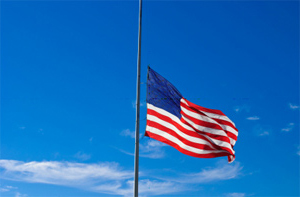
The flags flying at half-staff yesterday brought to mind a childhood grief, but we have moved on from the loss of one man.  What lingers and haunts is the memory of how that man could invite a public trust – “Ask not what your country can do for you…” – and seem worthy of it.  That level of hope and public trust is gone, and I don’t see it coming back.

More than a man, that is what I found myself mourning yesterday.

HalfStaffFlagNotification

When governments work as they should

An inspirational article in Sunday’s Sacramento Bee reminds us of what can be done when governments are composed of adults who are willing to work together toward a common goal.

An agreement between the California State Parks Department and local Indian tribal governments allowed an important ceremonial structure, closed for five years because of fire damage, to be reopened for an annual all-tribes gathering for dance and ritual this past weekend.

In question was the roundhouse at Indian Grinding Rock State Park, or Chaw’se in the Miwok language.

Chaw'se Roundhouse, photo by Mary Mussell.  When this photo was taken, Jan. 2011, the structure was closed

Chaw’se Roundhouse, photo by Mary Mussell. When this photo was taken, Jan. 2011, the structure was closed

The state said the cedar roof on the roundhouse, which is 60′ wide, had to be replaced, but the tribes could not agree on how to approach the task without disturbing ancestral spirits. Finally, Adam Dalton, chairman of the Jackson Rancheria Miwoks, offered to bring in a native construction crew, to work in cooperation with a state appointed structural engineer, while dismantling the damaged parts of the roundhouse with proper ceremonies.

Local tribes gathered each fall for thousands of years in the Grinding Rocks area to harvest the abundant acorns.  The park takes its name from the 1185 mortar holes left in the soft limestone slabs, where native women ground the acorns.  Some of the petroglyphs, carved between the mortar holes, are 2,000-3,000 years old.

Grinding Rock Mortar Holes

Grinding Rock Mortar Holes

The park, some 50 miles southeast of Sacramento, near Jackson, is one of my favorite destinations in the foothills, especially at this time of year or in the spring.  If you’re ever in the area, it’s well worth a visit.  Detailed information and history can be found on the park’s website.

Now, in addition to natural beauty and historical interest, the grounds at Chaw’se stand for the way governments are supposed to work.

The Rim Fire, day 22

rim fire

Smoke from the Rim Fire, photographed from the Glacier Point road some 30 miles south.  The photograph fails to convey the sense of scale of the smoke plume, even at this distance.

On day 22, the blaze is 80% contained.  It has burned 394 square miles of timber, watershed, and wildlife habitat.  More than 3,600 firefighters are on the lines, and efforts to contain this 3d largest fire in California history have cost $89 million to date.

A team of 50 scientists is moving into the burn area to assess erosion and mudslide dangers once the rainy season comes.  Of particular concern are the Tuolumne River and Hetch Hetchy Reservoir which provides drinking water to 2.8 million people in the greater San Francisco area.

The fire began when a hunter’s illegal campfire burned out of control.