The Importance of Stories and Listening

This wonderful article was sent to me by a friend and a marvelous storyteller, Robert Bela Wilhelm.

The article, “The Art of Listening,” by Henning Mankell, was published in the Dec. 10 New York Times.  Mankell is a Swedish author of many books, including the Wallendar novels.  He also spent 25 years in Africa, an experience central to what he writes here.

Henning Mankell

His comments on listening are striking:  “In Africa listening is a guiding principle. It’s a principle that’s been lost in the constant chatter of the Western world.”

Of great interest too is his observation that western story structure is simply one possibility among many.  Mankell writes:  “instead of linear narrative, there is unrestrained and exuberant storytelling that skips back and forth in time and blends together past and present. Someone who may have died long ago can intervene without any fuss in a conversation between two people who are very much alive.”

Check this out.  The article is brief and I’m sure you will enjoy it.  http://tinyurl.com/7gqfchj

Structure in Folktales, continued

Red Riding Hood, by Gustave Dore

In my last post, I said I was going to review some folktales to see if any conventions of the “three act structure,” used in contemporary fiction and cinema, apply.  Lest I be accused of hubris, I did not say I was going to be systematic about this.  My qualifications are simply a lifetime of love for this stuff.  Here are a few random observations.

The first thing I noticed – and I should have expected this – was the apples and oranges nature of my comparison between long fiction and short, between modern novels and screenplays and the kinds of tales you find in Grimm and other folklore collections.

Some longer epics do mesh with the three act structure.  In Homer’s Iliad, plot point #1 is Paris taking Helen to Troy, and plot point #2 is the Trojans wheeling the horse into the city – this is how the 2004 movie, Troy, is structured too.  It seems the three act structure only really fits longer fiction.  This leads to the question of whether the concepts apply to short fiction at all and to folktales in particular.

Every one of the folktales I reviewed has what Syd Fields called, an “inciting incident,” an event or situation that sets the action in motion.  The king is sick, the princess is missing, a dragon is loose on the land.  Often this is right where the tale begins, without any other preamble.

In terms of the major plot points, most of the folktales I looked at only have one.  Some have two and a few do not have any.  Are there any plot points, in the sense of a major crossroad, in the tale of Red Riding Hood?  Not really.  The unfortunate girl obeys her mother – “Take this basket to grandmother” – and events roll on to their unfortunate conclusion.

Cinderella has a single plot point.  The fairy godmother asks, “Do you want to go to the ball?”  When Cinderella says yes, her happy fate unrolls like destiny.

Cinderella by Edmund Dulac

Another common folktale set up has just one decision point:  three brothers or three sisters set off on quest.  Each of them meets an “insignificant” or repellant creature as they set out.  The older siblings are arrogant and come to an unfortunate end.  The younger sibling behaves with respect, and the creature’s advice and boons are key to fulfilling the quest and often finding love and riches as well.

A Grimm’s fairytale, “The Water of Life,” is a good example.  The king is sick and only the water of life will heal him.  Two brothers set out, but disparage an “ugly little dwarf” who offers advice.  They wind up stuck – literally – in a mountain pass.  The youngest brother, who is open to help, receives it in abundance, both for the immediate quest and in overcoming the treachery of his brothers later on.  Although the action is rather complex, the only real decision the brothers face is whether or not to befriend the little man at the side of the road.  That choice determines their fate.

Beauty and the Beast by Warwick Goble

Some stories with two plot points echo the three act structure.  An example is, “The Pedlar of Swaffham,” which I discussed here a year ago:  http://wp.me/pYql4-85.  A poor pedlar in the English village of Swaffham dreams he will find gold if he travels to London Bridge.  Unlike most people who do not act on their dreams, he decides to go (plot point #1).  He spends three days waiting fruitlessly.  His decision to stick it out, to believe in his dream, is the second key plot point and is rewarded when a shopkeeper asks what he’s doing.  When the pedlar tells him, the shopkeeper says dreams are a lot of foolishness:  “Why just last night I dreamed of a bag of gold under the peddlar’s oak in the village of Swaffham, wherever that is, but you don’t see me running all over the countryside, do you?” 

A story like this seems so modern in it’s emphasis on trusting oneself and following dreams, it may be surprising to know that Rumi recorded the first version 900 years ago.  In other variations, the poor man travels to Baghdad, Jerusalem, or Krakow.  Still, in conforming (sort of) to the three act structure, “The Pedlar of Swaffham” is the exception and not the rule.

*** 

Every story has a beginning, middle, and end.  How long the sections are and how we move between them is the province of structure.  If you’ve ever heard a good storyteller, you’ve seen them adjust the pacing to match the mood of the audience.  You’ve seen gesture, expression, and silence used to enhance the tale in ways a written transcription can never capture.

It’s easier to gain an intuitive sense of how to tell a story aloud than to write one, and easier to structure a short story than a novel or screenplay.  Some people may gain a sense of how to structure a novel by reading them, but for the rest of us, constructions like the three act structure form a useful skeleton to build a story.  It isn’t the secret of what makes a novel or movie compelling, but I find it a useful bridge to that destination.

In a similar way, structure alone does not explain the magic in my favorite folktales.  For that I will have to slow down and consider each one more closely.  And there is a topic for more than one future post!

Puss In Boots by Gustave Dore

The Ballad of Jesse James

It’s easy to see why I was drawn to the Ballad of Jesse James as a kid; the song paints Jesse as an American Robin Hood:

Jesse James was a lad, he killed many a man,
He robbed the Glendale train.
He stole from the rich and he gave to the poor,
He’d a hand, and a heart, and a brain.

Jesse James

Not surprisingly, singers who have covered this ballad include Woodie Guthrie, Pete Seeger, and Bruce Springsteen.  The song also has those elements of mystery I believe are central to stories that take up permanent residence in imagination:

Oh, Jesse had a wife who mourned for his life,
Three children they were brave,
But that dirty little coward, that shot Mr. Howard,
Has laid Jesse James in his grave.

The notes in the book of ballads I found as a kid explained that “Howard” was the alias Jesse James used when he married, settled down, and tried to leave his life of crime behind.  The dirty little coward was Robert Ford a friend of Jesse, who shot him as he straightened a picture on the wall of his home.  Something in us recoils at that and wants to know how Ford could do it.  We know in our bones why Dante assigned traitors to the lowest circle of Hell.  I am not the only one who wonders, for the story has been dramatized several times, most recently in 2007, when Brad Pitt played Jesse in The Assassination of Jesse James by the Coward Robert Ford.

With Jesse James we get to witness a legend in formation, for unlike the Child ballads, this story is just over a hundred years old.  We can see how imagination shapes facts the way the ocean smooths pebbles, and something in us prefers the legend – we want to know who the heroes and villains are and we want them larger than life.  If you are like me, you’ll be disappointed to learn that no historical record shows the James gang ever using its loot to benefit anyone but themselves.

Jesse James, (1847-1882), and his older brother Frank, came of age during an especially bloody phase of the Civil War – the guerilla conflicts that raged across the border state of Missouri.  The James brothers rode with William Quantrill, one of the most notorious guerillas; we would call him a terrorist now.  Sixteen year old Jesse joined Quantrill in 1864, and supposedly took part in the Centralia massacre, where the band killed 22 unarmed Union troops then scalped and dismembered them.

After the war, Missouri freed its slaves, but forbade ex-Confederate soldiers from voting, serving on juries or even preaching from pulpits; it was a fertile ground for outlaws.  The James brothers joined with Cole, John, Jim, and Bob Younger, and went on decade long spree of robberies that spread from Iowa to Texas, and from Kansas to West Virginia.  John Newman Edwards, an editor of the Kansas City Times, published Jesse’s letters and presented him as a symbol of Confederate resistance to Reconstruction.  The James-Younger gang was adept at publicity, often hamming it up before crowds during escapes from stagecoach and bank robberies.  Because they took safes and strongboxes and did not rob passengers, Edwards’s editorials painted Jesse as Robin Hood.

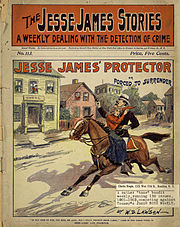
Jesse James dime novel cover

The Pinkerton Detective Agency was hired in 1874 to stop the James-Younger gang, and after numerous setbacks, Allan Pinkerton took on the case as a personal vendetta.  In 1875 he staged a raid on the James homestead and threw an incendiary device into the home.  It exploded, killing Jesse’s half-brother, and blowing off one of his mother’s arms.  This, more than any editorial, won public sympathy for Jesse James.  A bill granting the James and Younger brothers complete amnesty was narrowly defeated in the Missouri legislature.

Jesse married his cousin Zee in 1874, and two of their children survived to adulthood.  The downfall of the gang came in 1876, when they raided the First National Bank in Northfield, Minnesota.  All of the Younger brothers were killed or captured.  Only Frank and Jesse escaped.

Jesse tried to live quietly with his wife after that, in a home near St. Joseph, but he invited Charley Ford, a former gang member, to move in with the family for protection, and Charley brought in his younger brother Bob.  Both Ford brothers had been in contact with the governor of Missouri about his reward for Jesse, dead or alive.    One day, in 1882, as the three men were getting ready to leave for a robbery, as Jesse stopped to clean dust from a picture on the wall, Bob Ford shot him twice in the back of the head.

***

Memory, both individual and collective, is always mixed with imagination, increasingly so with the passage of time.  And if ours is not an era that treats the reputation of heroes well, at least we grasp human complexity.  Could Jesse James have been a loving father and a cold blooded killer and sympathetic to the poor?  Of course.  What was he really like?  We are never going to know, and besides, if there was a simple answer, I would not still be researching the legend and listening to the song.  Here is Pete Seeger’s version:

http://www.youtube.com/watch?v=DDo1sd9hZ5E

On Fairy-Stories by J.R.R Tolkien

Once in a while, I worry that I have said everything I have to say, that I have nothing left to blog about.  The mood hit yesterday, after I hit the “Publish” button, and it lasted a good 20 minutes.

Then I remembered that for the last three years or so, my battered and yellowing copy of The Tolkien Reader has been stashed in the software cabinet, along with CD’s for Office, Photo-Shop, and Quicken.  I have no idea why I put it there, but that’s where it stayed because I knew where it is was and it seemed as good a place as any.

When I say yellowing, I mean the pages of this book are really yellow:  it must be at least twenty-five years since I opened it, but I remembered Tolkien’s essay, “On Fairy-Stories” and had a look.

It was downright eerie to see how certain passages I had underlined decades ago are relevant to my present writing interests and concerns.  For instance, those who followed this blog in February will remember a three-part series I wrote on shape-shifters.  “The trouble with the real folk of Faerie is that they do not always look like what they are,” says Tolkien.

Tolkien asks what a fairy story really is and notes that it is not just a story about fairies.  It is also not a story for children, a connection he dismisses as a cultural quirk.  Fairy stories are, he says, “stories about…Faerie, the realm or state in which fairies have their being.”

Faerie lies beyond this world, in an intermediate realm, between the extremes of heaven and hell.  Tolkien quotes the ballad of “Thomas the Rhymer (Child #37) where the Fairy Queen shows Thomas three paths.  They will take the third, which winds into the unknown hills:

O see ye not yon narrow road,
So thick beset wi’ thorns and briers?
That is the Path of Righteousness,
Though after it but few inquires.

‘And see ye not yon braid, braid road,
That lies across the lily leven?
That is the Path of Wickedness,
Though some call it the Road to Heaven.

‘And see ye not yon bonny road
That winds about the fernie brae?
That is the Road to fair Elfland,
Where thou and I this night maun gae.

Analogies jump to mind:  the imaginal realm of Archetypal Psychology, the place of soul, between the physical world and the formless world of transcendent spirit.  The astral world of Hindu cosmology, described in detail in Paramahansa Yogananda’s Autobiography of a Yogi, which is far more subtle than physical reality, and far more dense than the realm of spirit.  I am not just being scholarly here, but trying to point to a key fact:  Faerie is analogous to the place of dreams and nightmares, of angels and demons, in old and new traditions around the world.  I could cite a lot more examples.

According to Tolkien, some our most primal desires lie in our fascination with tales of Faerie:  the desire for “the realization, independent of the conceiving mind, of imagined wonder.”  Another is “the desire of men to hold communion with other living things.”  And finally, we look to “the land of the ever young” in our longing to escape death.  And though we can’t pull that off in physical reality, Tolkien says that “fully realized” or “complete” fairy tales end with “imaginative satisfaction” of some of our deep desires.  They give us “a fleeting glimpse of Joy, Joy beyond the walls of the world, poignant as grief.”

I’d recommend this essay, written in 1939, especially to writers of fantasy literature, but to writers in general, for Tolkien has much to say about another primal desire, the desire to be a creator of worlds – “sub-creator” is the phrase he uses.

***

And finally I will end with some unexpected good news for Tolkien fans.  Today’s Sacramento Bee reported that filming of The Hobbit has started after numerous delays.  This will be a two year, two film project, directed by Peter Jackson, staring Martin Freeman as Bilbo, and also featuring Elijah Wood, Ian McKellan, Cate Blanchett, and Orlando Bloom.   Release of film number one is expected in late 2012.  Something else to look forward to for those who love to explore the world that Tolkien created.

Shapeshifting in Faerie: The Ballad of Tam Lin

One fall day, when I was a college sophomore, I was boiling water for coffee in my off-campus apartment, getting ready to leave for a 9:00am class.  A clock radio on the counter was tuned to the local progressive rock station, but I wasn’t really listening, until a driving tempo opened a song with a strong, urgent, woman’s voice singing what was clearly a piece of folklore:

I forbid you maidens all,
that wear gold in your hair,
to travel to Carterhaugh,
for young Tam Lin is there.

I turned up the volume…

Them that go to Carterhaugh,
but they leave him a pledge,
either their mantles of green,
or else their maidenhead.

I was hooked by then, all my attention on this music.

Janet tied her kirtle green,
a bit above her knee,
and she’s gone to Carterhaugh,
as fast as go can she.

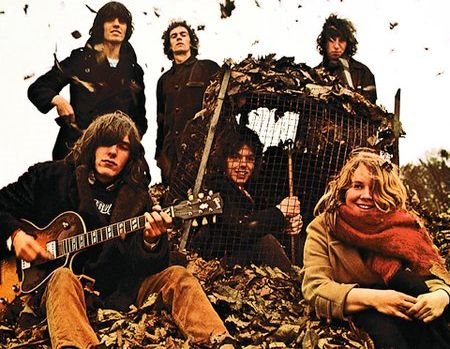
The group was Fairport Convention, the vocalist, an amazing singer named Sandy Denny who died in a tragic accident a few years later.  The song was, Tam Lin.
Fairport Convention

At the end of the day, I came home with the album, Liege and Lief tucked under my arm, and a backpack full of books like Folklore in the English and Scottish Ballads. You could say the passion that music ignited is with me to the present day:  it launched me into fantasy literature, shaped twenty years of storytelling, and this particular ballad is an important source for the fictional world I am building now for a heroine who wrestles with her fairy/mortal ancestry.

The ballad

Tam Lin comes from the Scottish border country and was first transcribed in 1549.  Francis James Child published 14 variants in his collection of English and Scottish ballads.  A mortal woman falls in love and conceives a child by a man who had been a mortal knight, until he was captured and somehow enchanted by the fairy queen.  In the Fairport lyrics:

Tell to me, Tam Lin, she said,
why came you here to dwell,
The queen of fairies caught me,
when from my horse I fell.

At the end of seven years,
she pays a tithe to hell,
I so fair and full of flesh,
am feared it be myself.

To disenchant her lover, Janet must hide at midnight on Halloween, at Miles Crossing, pull Tam from his horse, and hold on for dear life as the queen transforms him into a series of hideous and frightening shapes (I said this involved shapeshifting).  The queen turns Tam Lin into a snake, a newt, a bear, a lion, red-hot iron, and finally burning lead, at which point Janet does as instructed and throws him into a well, from which he emerges in his human form.  The queen is furious, and says if she had known of Janet’s loyalty, she’d have plucked out her eyes.  The real fairies of folklore are not nice people and are known to blind mortals who can see them.

Carterhaugh in 2005. You can still visit Tam Lin's well

Such renowned fantasy authors as Susan Cooper, Pamela Dean, Diana Wynn Jones, and Patricia McKillip have written novels based on Tam Lin’s story.  In 1970, Roddy McDowall directed a movie version staring Ava Gardner.  Countless individuals and groups have covered the ballad and there is at least one website devoted to nothing but exploration and creative elaboration of this song.  (see all these links here:  http://en.wikipedia.org/wiki/Tam_Lin)

What about the Shapeshifting?

Though Tam Lin is local to Scotland, the motif of disenchanting someone by holding on through countless frightening transformations is common to folklore throughout Europe.  This tale of shapeshifting is really quite different from Barth’s Menelaiad, discussed in the previous post.

There is a youthful, hopeful quality in this story of a heroic young woman who knows what she wants with such a fierce determination that nothing can thwart her, not even all the illusions and false paths that waylay most people’s dreams.

There is a quality of angst in Barth’s story question:  how can we ever sort out what is true from what is illusion?  I recall that after his campus visit, several sophomores proclaimed the death of literature as we know it.  Janet and Tam have no time for that – if this be illusion, play on, they would say (to badly misquote the bard).

Tam Lin explores the illusions of young lovers, while the Menelaiad does the same for a middle-aged and war-weary king.

Our final story of shapeshifting comes from India, and is several millenia old.  It sits somehwhere between the optimism and pessimism of the first two tales.  Yes, it affirms, life is a series of dreams, where dreams of joy transform into nightmares and back again endlessly – but imagine the joy of waking up.  That awakening, according to this tale, is nearer than we think.

Meanwhile here – as timeless as any fairy artifact – is Fairport Convention’s version of the Ballad of Tam Lin:

http://www.youtube.com/watch?v=jy3ihk205ew

Happy Imbolc, St. Brigid’s Day, Candlemas, Groundhog Day.

Our Celtic ancestors marked the changing seasons not by solstice and equinox days, which divide the year into quarters, but with the “cross-quarter days” which fall between the astronomical events.  Seasons figured in this way more closely match our experience in the northern temperate zones.  Winter begins at Samhaim (Halloween) and ends on Imbolc, the first day of spring, February 2.  Imbolc or Oimelc are Gaelic words that refer to the lactation of ewes.  Through most of the British Isles, February was bitterly cold, yet it was also the time when lambs were born and shoots of green grass appeared, events that were heralds of new life and a new year.   http://www.chalicecentre.net/imbolc.htm

This time of year was celebrated in the British isles for at least 3,000 years, the age of several megalithic stone circles in Ireland oriented toward the positions of the sun on Samhain and Imbolc http://en.wikipedia.org/wiki/Imbolc.  The people who raised the standing stones were as remote from the Celts as the Celts are from us:  we can only speculate on their motives and the meaning the day had for them.  And even though the word, Imbolc was used in the middle ages in Ireland and Scotland, who and what the Celts celebrated isn’t certain.  The earliest written records of Celtic cosmology come from Julius Ceasar’s commentary on the Gallic War, 51-52 BCE, in which Celtic beliefs are filtered through the Roman perspective.

Even so – even if our stock of “Celtic lore” dates from the 19th century on, when a revival of interest began (think of pre-Raphealite painting and William Morris’ craft movement), that does not mean it is not “authentic.”  When Yeats tramped around Ireland at the turn of the century gathering fairy lore, some of his informants lived such remote lives that they only spoke Gaelic.  How far back can such an oral tradition go?  Pretty far according to most folklorists.

At Imbolc, the maiden goddess, Brigid or Bride supplants the Cailleach, the hag of winter.  Brigid is the goddess of healing, poetry, and smithcraft.  And fire and divination and wisdom and childbirth.  As patron of healing she presides over numerous sacred wells in Ireland and in Britain (where they were renamed for Minerva by the Romans).  To this day, people extinguish old fires and light new ones for the coming year in her honor.

Brigid the goddess was supplanted by Brigid the saint in the Christain era, where she was revered as, “the Mary of the Gaels.”  Numerous miracle stories surround her life.  When just an infant, neighbors saw a fire burning at her house that rose to the heavens.  http://www.brighid.org.uk/saint.html.   Though a beautiful woman, Brigid renounced marriage to found dual monastic communities at Cill Dara, now Kildaire, in Ireland.  The nuns tended a sacred flame that burned continuously until the reformation, except for a brief 13th century inteval where a bishop had it extinguished for being too pagan.

Brigid and children, Kildaire, Ireland, copyright, brigid.org.uk

February 2 has long been celebrated by Christians as Candlemas.  The early church was not the least bit shy about superimposing new festivals over earlier pagan rites.  This day celebrates the Presentation of Jesus at the temple and the purification of the Virgin Mary.  The association of the day with candles comes from the passage where Simeon, an aged seer, recognizes Jesus and proclaims him as “a light for revelation.”  (Luke 2:21).  One website that explores correspondences between Christian and pagan festivals notes that the association of fire or light with this date is widespread through Europe.  In ancient Armenia, Feb. 2 was sacred to Mihr, the god of fire.  http://www.schooloftheseasons.com/candlemas.html

Of course no discussion of February 2 would be complete without a reference to Groundhog day, although locally, the staff at the Folsom City Zoo Sanctuary points out that groundhogs are not native to the American west.  Here we celebrate Prairie Dog Day.

"Don't drive angry!"

There is also an old Celtic tale involving the Cailleach that explains the importance of weather on Feb. 2.

Legend has it that if she intends to make the winter last a good while longer, she will make sure the weather on Imbolc is bright and sunny, so she can gather plenty of firewood. Therefore, people are generally relieved if Imbolc is a day of foul weather, as it means the Cailleach is asleep and winter is almost over. (see the Wikipedia link above.)

***

I don’t keep sheep, but the signs of spring are everywhere. It’s light out at 5:00pm. The sap from the liquid amber tree takes a nightly dump on my car and I swear every year at this time to dig out our car-cover. The buds on the apple tree are a bit late but I expect them any day now. Strangely, pruning the apple tree is one of those rituals of super-bowl sunday I always enjoy.  The super-bowl itself is like the closing rite of winter – after this I won’t want to spend an entire sunday afternoon indoors. In two weeks the almond and walnut trees will be covered with blooms that look like snow when they fall.  Our brown hills will turn emerald green for a month or so.

May everyone have a happy Imbolc and bask in the promise of the return of light and warmth to the earth.

The King is Dead; Long Live the King!

The Oak King and the Holly King

As predicted by Las Vegas odds-makers, the Oak King scored a narrow victory today over his twin brother, the Holly King. The Winter Queen is reportedly in mourning, though she is expected to emerge – as she has since time began – in her guise as the Spring Maiden, on or about February 2, (aka, Imbolc, Candlemas, St. Brighid’s Day) to take her place beside the new reigning monarch. At least that is the story the old Britons told to explain how the darkest day of the year hides the seed of summer, and why the Winter King is likely to win the scheduled rematch on June 21.

Winter Solstice: the default explanation

Though I cannot prove it, I’ve always believed this tale of eternally battling twins must have gone into the making of the black-on-the-left vs. black-on-the-right episode of Star Trek.

Is this a real legend – one the Celts and Saxons actually told?   Robert Graves said as much in The White Goddess, suggesting that Balin and Balan, as well as Gawain and the Green Knight represent the eternally dueling pair in Arthurian legend.  Sir James Frazer’s earlier Golden Bough had a similar section entitled “The Battle of Summer and Winter,” although he told the story with only one eternally dying and reborn Divine King.

The Oak and Holly kings battle at a 2005 Winter Solstice ritual. Photo by Anderida Gorsedds.

Whatever you may think of the story, now that the solstice has arrived, may you stay warm and dry, and bask in the confidence that summer is coming around again.

Genre Soup

Genre bending and blending has gone mainstream. (Vampire-romance-coming of age tales anyone?).  It’s really not anything new (Think of The Odyssey:  paranormal-action adventure-romance), but lately it it seems to be the golden road to standing apart from the crowd, and to blockbuster sales, action figures, and movie deals – except when it doesn’t work.

I once heard a literary agent explain that one reason the first Harry Potter book was rejected 23 times was because J.K. Rowling mixed the conventions of middle-grade and young adult fiction, which was a no-no at the time.

So if you feel the urge to cross the boundaries, whaddya do?

First, realize you are in good company.  In his introduction to Stories, Neil Gaiman says: I realized that I was not alone in finding myself increasingly frustrated with the boundaries of genre:  the idea that categories which existed only go guide people around bookshops now seemed to be dictating the kind of stories that were being written.

Literary agent, Joanna Stampfel-Volpe discusses the question with advice and cooking metaphors: http://www.writersdigest.com/article/dos-and-donts-of-combining-genres.  She boils it down to some common sense guidelines.

1) Write the stories you’re dying to tell.
2) Don’t try to please everyone.
3) Know your story and intended audience well enough to identify your “base genre.”

I’d add one more, based on something I saw the first time I told a story from a stage. Almost twenty years ago, our local storytelling guild was preparing a show for “Tellabration,” a day in November set aside by storytellers around the world to bring this most ancient art form to as many people as possible. http://www.tellabration.org/

It was the first Tellabration for a young woman and me. The old timers had coached us thoroughly. My inner-ham emerged and mine went pretty well. Then it was my fellow newbie’s turn. She was telling a spooky Eskimo story called, “The Skeleton Woman,” but when she got to the first chilling moment, everyone started to laugh! The hero of the tale, a young fisherman, was out in his kayak and managed to hook a skeleton which rose to the surface and pursued him as he paddled like hell, and that image struck the audience as funny.

With no indication of how nervous she was (she’d confided to the group before we started), the woman turned on a dime, and played the story for laughs, making it up as she went along. She finished with a well-deserved round of thunderous applause.

Horror and comedy genres are not “natural” companions but ever since I saw that switch,  my fourth rule for genre – and maybe my first rule for everything else would have to be:

4) Flexibility and a sense of humor are highly recommended!